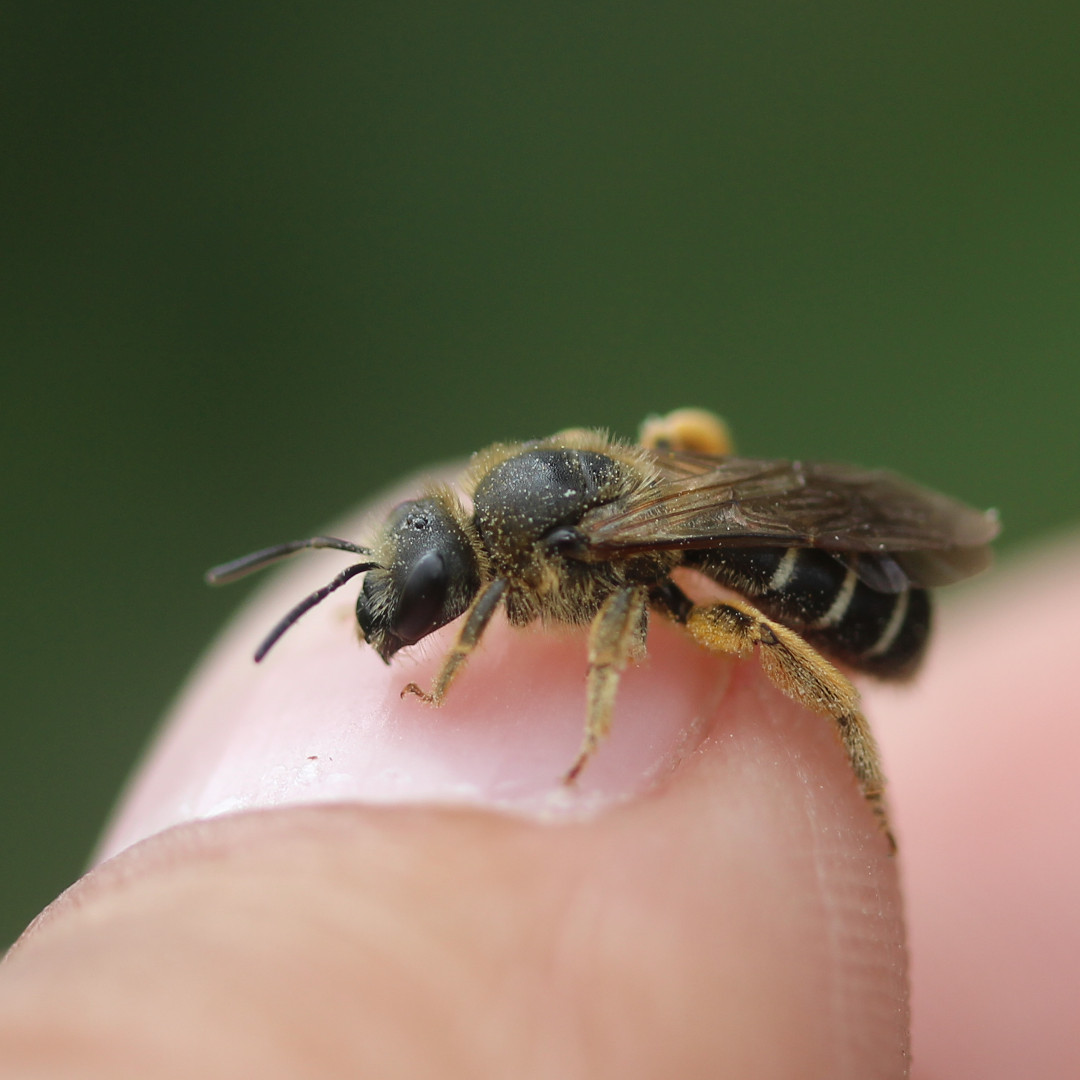
While western honey bees (Apis mellifera) are considered key pollinators of certain North American food crops, they are not native to North America. British Columbia has over 400 species of native bees, which provide key roles in pollinating wild and cultivated plants in the province. Many of these plants include nutrient dense wild and cultivated fruits, seeds and vegetables we humans depend on. These other lesser-known and lesser-studied bees, such as bumble bees, mason bees and leafcutter bees are often more efficient pollinators than imported honey bees.
However, their nesting requirements are not as conveniently portable as those of the western honey bee. As a naturalist and educator who is passionate about helping people create habitat for native bees, I try to convince gardeners to embrace a natural aesthetic that is welcoming to nesting native bees, both in the ground and in decaying plants.
The issues facing native BC bees are related to resource extraction and the life cycles of native bee species. As we take or use resources from bee habitat, we have to be sensitive to how each land (and water) use industry affects bees: forestry, ranching, mining, housing, farming, and even recreation and tourism. We need to study how each industry affects the habitat needs of bees for successfully reproducing year after year. Bees need resources to thrive and reproduce: pollen for feeding developing larvae, nectar for feeding adult bees, plants and soil for nesting sites and nesting materials. You could call it their own form of resource extraction, but the benefits they give back to the environment: pollination of food for other insects, humans and animals are integral to life itself. We need to move beyond a human-centred view of resource management to include the whole biodiversity of flora and fauna in BC. My particular focus in this complex collection of considerations has been for the needs of the native bees during their entire life cycle.
Ground-Nesting Bees
Seventy percent of native bee species in BC nest in the ground, which works against them in areas of crop production where the soil is tilled on a regular basis to grow annual crops. I n urban and industrial environments, the soil is covered by cement, pavement and turf grass, making it difficult for mining and digger bees to find bare soil they need for nesting. We often think of providing pollen and nectar for bees by planting appropriate trees, shrubs and perennials, but we also need to leave a diverse collection of bare soil sites for different species of bees to dig into and make their nests. Some bees prefer flat soil, others like angled soil or even sheer cliff faces. Some species nest in sand, while others prefer hard-packed soil with some clay content. Some bees, such as the orange-legged furrow bee (Halictus rubicundus) have adapted to nesting in urban sites such as school and church yards. Other, such as the sand nesting Pacific dune-digger bees (Habropoda miserabilis) thrive in wild spaces that have not been altered by human habitation.

Cavity-Nesting Bees
The remaining thirty percent of lesser-known species are cavity nesting bees. They can generally be divided into two groups: bumble bees and plant tunnel nesting bees. Most bumble bee species prefer to nest in abandoned rodent burrows in the ground or in a wood pile. Occasionally some bumble beeswill nest in cavities in hollow trees or a bird house. The plant tunnel nesting bees use stems and beetle holes in tree trunks and stumps. The stems and tunnels they use are slightly larger than their bodies. The cavities are just large enough to crawl into, deposit pollen, lay an egg and then create a cell wall that protects the developing larva. Often decaying stems and trees are considered ‘unsightly by gardeners, who will clean up and dispose of them, leaving very few options for these plant-nesting bees.
Food Sources for Native Bees
Bees need sustenance growing near their nest sites, the closer the better. Female bees gather pollen from plants near the nest to create provisions for their larvae. Some of the newest research on native bee species shows that the bacteria in the pollen is beneficial to the gut biome of the developing bees. They have sensitive little digestive systems! Just like humans, they require a healthy diet free from toxins like herbicides and pesticides. Sadly, many of the land use industries in BC are hooked on chemical treatments that harm and kill bees, both imported honey bees and native bees.

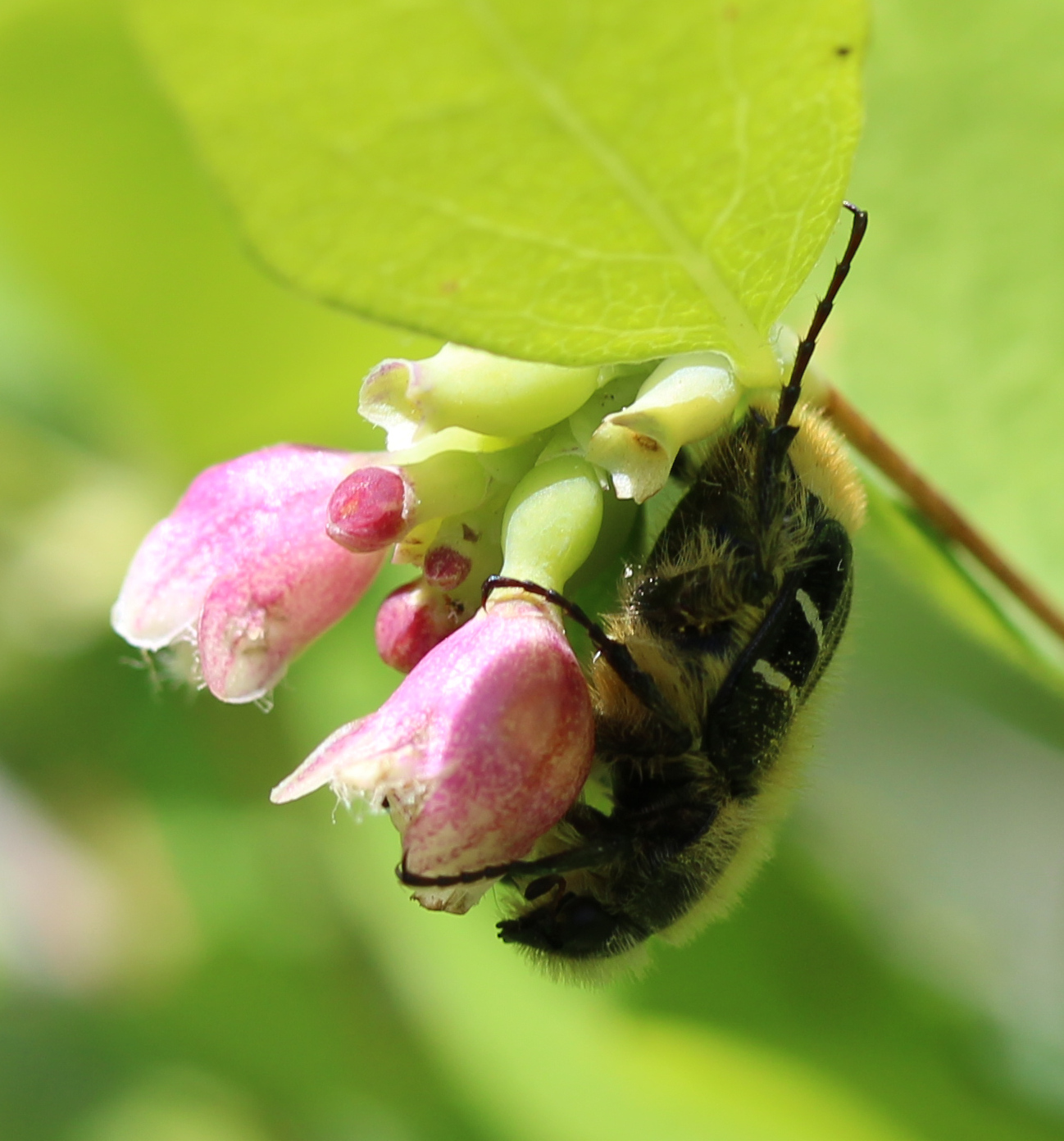
some native bees are specialists that require pollen from one family, genus, or even one species of plant. Lose the plants, you lose the bee. Lose the bee, you lose the plants. This summer, during the Native BC Bee Course, I was excited to photograph the bees that specialize on snowberry bushes in the south Okanagan. They are known as the all-blue shortface bees (Dufourea holocynaea). They depend on a good stand of snowberry shrubs to collect the pollen that they take down into the nests they build in the ground right next to the plants. The cuckoo bee (Neotrypetes) parasitizes these snowberry specialists, so they also depend on these snowberry plants.

Impact of The Forestry Industry
The forestry industry needs to consider the life cycles of wild native bees. Forest edges in particular, with their diversity of spring blooming berry shrubs such as salal, salmon berry, snowberry and thimbleberry are a haven for native BC bees. This forest edge habitat is particularly important to BC’s bumble bees, which are the most vulnerable native bees because they need a continuous supply of nectar and pollen from early spring to the first frost. The blossoms that feed bees form the berries that feed bears and birds and are also traditional food plants for many Indigenous communities. According to Stop the Spray BC, approximately 37,000 acres of forests are sprayed in BC every year. The plants they are targeting are those trees and shrubs that grow around the trees that are harvested for lumber. Some forestry companies spray these trees and shrubs with glyphosphates. The effect of these herbicides has been studied on honey bees and found to have lethal and sub lethal effects. There is growing evidence these herbicides are harmful to humans and other insects and animals.

The solution to these issues is to focus on the needs of bees and consider them on par or greater than the extraction needs of humans. Every bit of pollinator habitat you can create and/or protect is a positive step towards building a better infrastructure for the protection of BC’s native bees. Even a few native plants in pots on your balcony, such as evergreen huckleberry, wild strawberries and purple coneflower can be a haven for the bees in your neighbourhood. Taking the time to capture photographs on the bees you see and posting them on iNaturalist helps scientists study and protect native bees. (All photos of bees taken in BC are added to our NBSBC BC Bee Tracker Project.)
Becoming a better naturalist and learning about the life cycles of native bees will help you become a better gardener, farmer, and conservationist. If you are interested in learning more about BC native bees and what positive steps you can take to help them thrive, consider joining the Native Bee Society of BC.
Lori Weidenhammer, aka Madame Beespeaker, is a Vancouver performance-based interdisciplinary artist and educator. She is a settler originally from Cactus Lake Saskatchewan. It is in this place, bordered by wheat fields and wild prairie, that she first became enchanted with bees. She is the author of the book Victory Gardens for Bees: A DIY Guide for Saving the Bees. For the past several years she has been appearing as the persona Madame Beespeaker, practising the tradition of “telling the bees”. As a food security volunteer, artist and activist Lori works with students of all ages on eating locally and gardening for pollinators. She uses many art forms in her teaching and art practise including garden designing, drawing, painting, collage, printmaking, cyanotypes, sculpture, photography, textiles, singing, culinary arts and installation. Using all the skills in her artist’s tool kit, Lori Weidenhammer works to be positive force giving people of all ages new ways to connect to the beauty and wonder of BC’s native bees.

 The Meaning of Water