
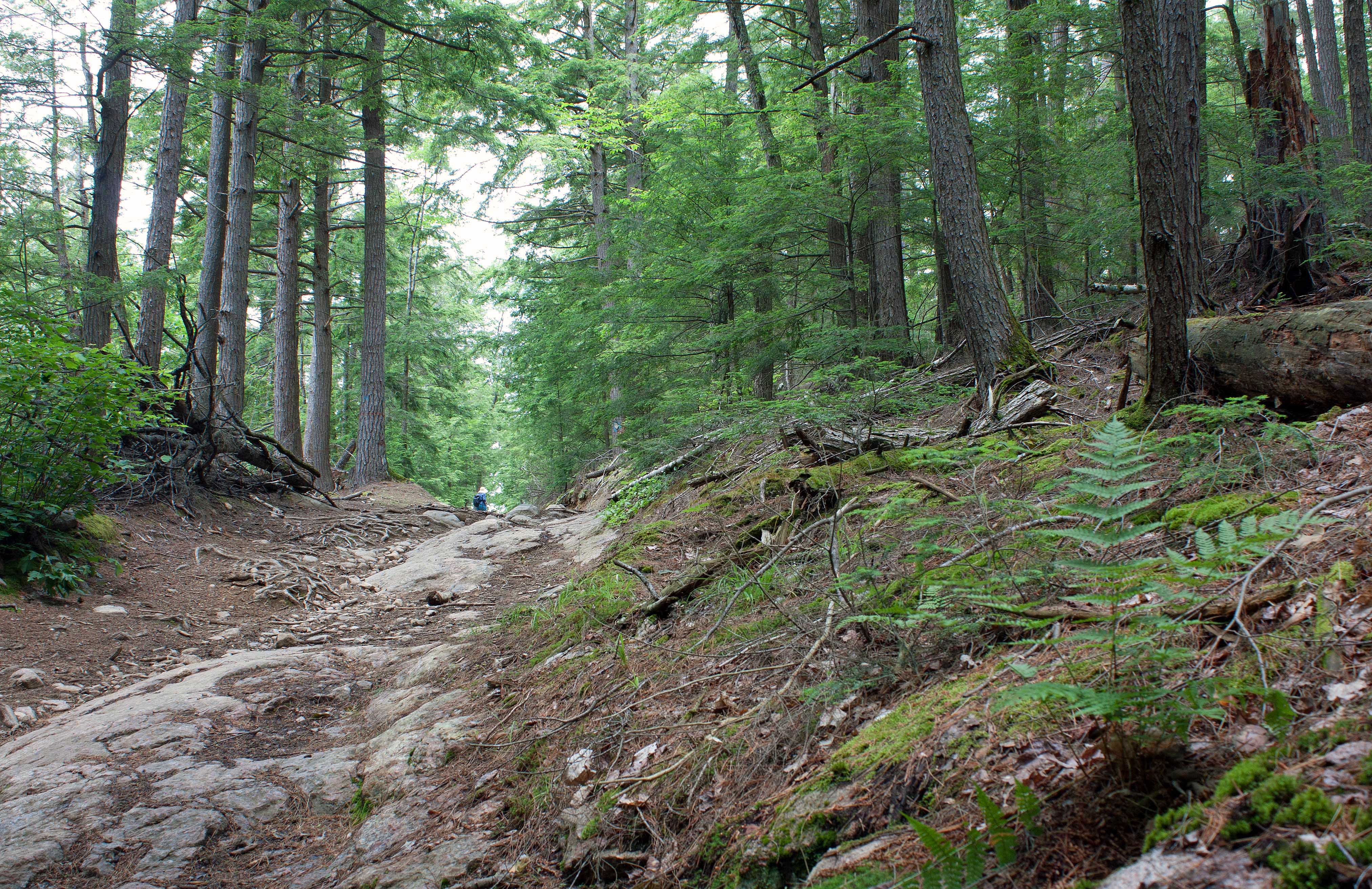
I reach the trailhead off Highway 507 sometime before lunch. The trail starts wide and fairly even in elevation. It begins as a gravel road and eventually continues as a rough and narrow dirt road with exposed slabs of limestone. Soon after I start up the hill, I enter a dense forest of over 20-metre (70 ft) tall hemlocks. Hemlock trees over 40 cm wide (DBH) tower above me, splendid sentinels of a mixed forest that includes a diverse mix of conifer and deciduous trees. Red and white pine, some spruce and fir, white and yellow birch, basswood, poplar, hop hornbeam, red and sugar maple, and oak, both white and red.
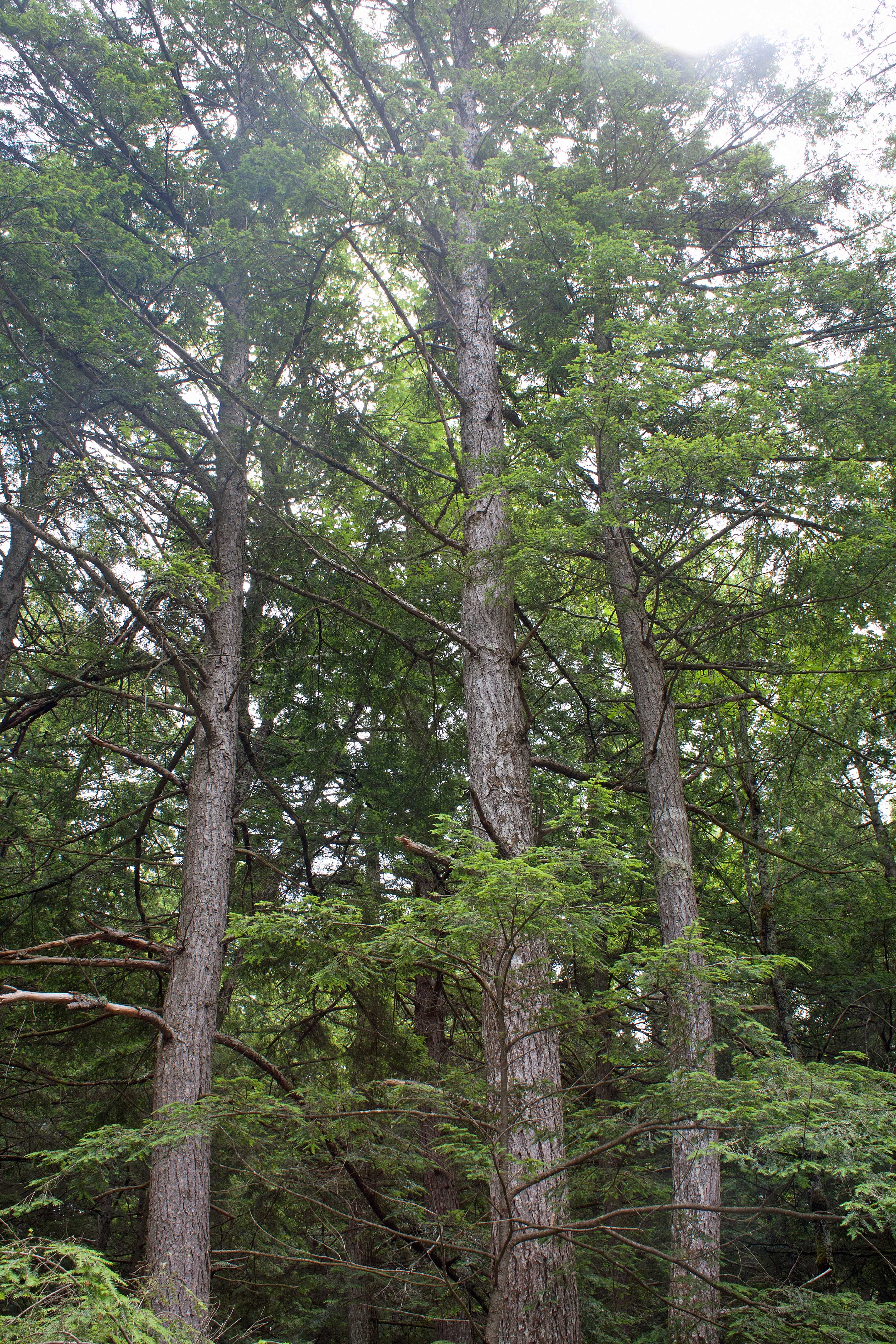
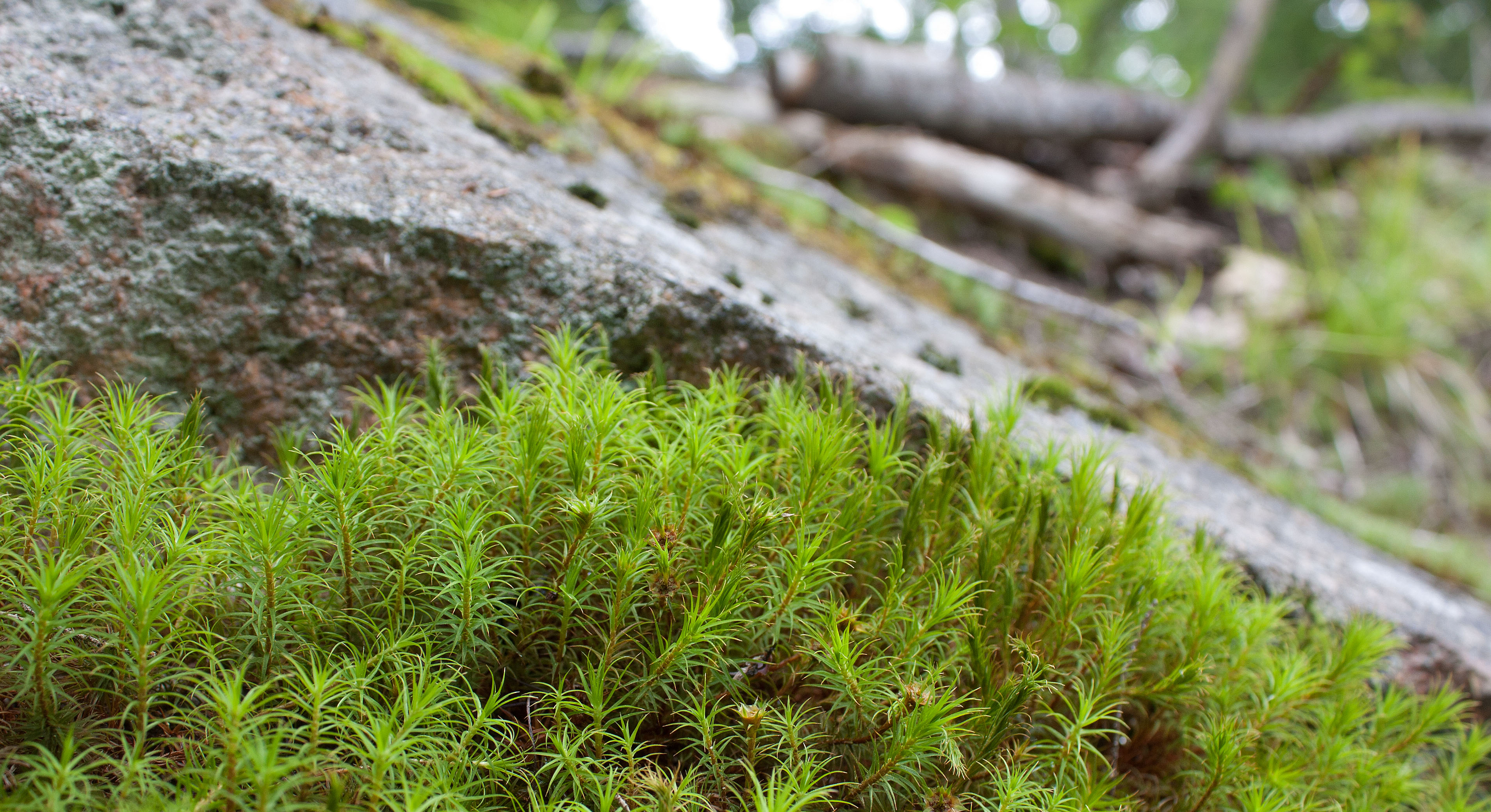
I’m in Catchacoma Forest and I’m standing on the Canadian Shield, where Precambrian Archean bedrock emerges through thin upland loam. Pink granite and grey limestone form outcrops, cliffs and huge boulders, covered in a bright green soft carpet of mosses and ferns. This is one of the last significant and largest known old-growth eastern hemlock forests in Canada; and because of its rarity, this forest is designated an endangered ecosystem.

During a photo shoot, I scare up a family of young red squirrels. I count five squirrels that scurry up the nearby hemlock then scold me in loud chitters, curious and angry at the same time.
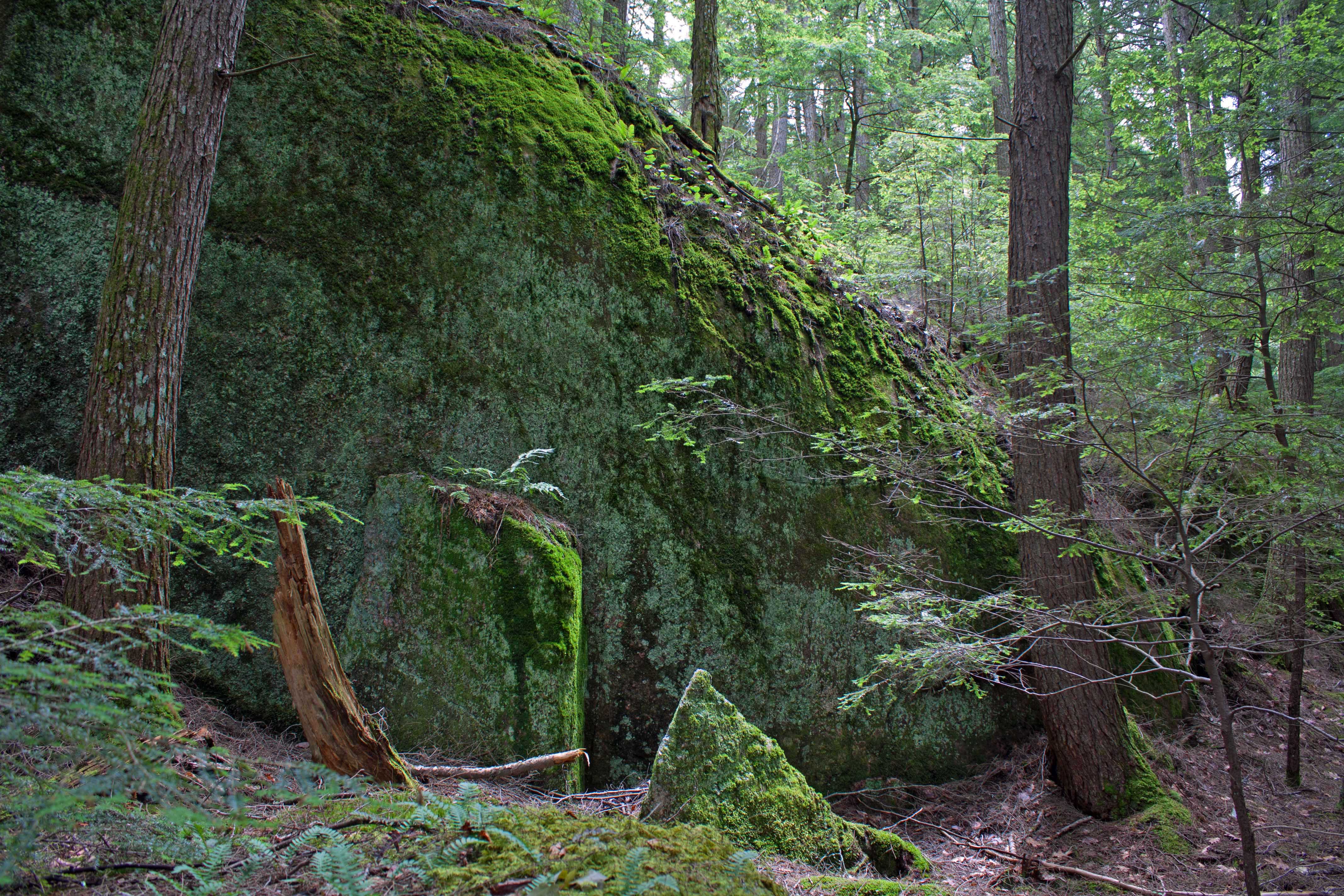
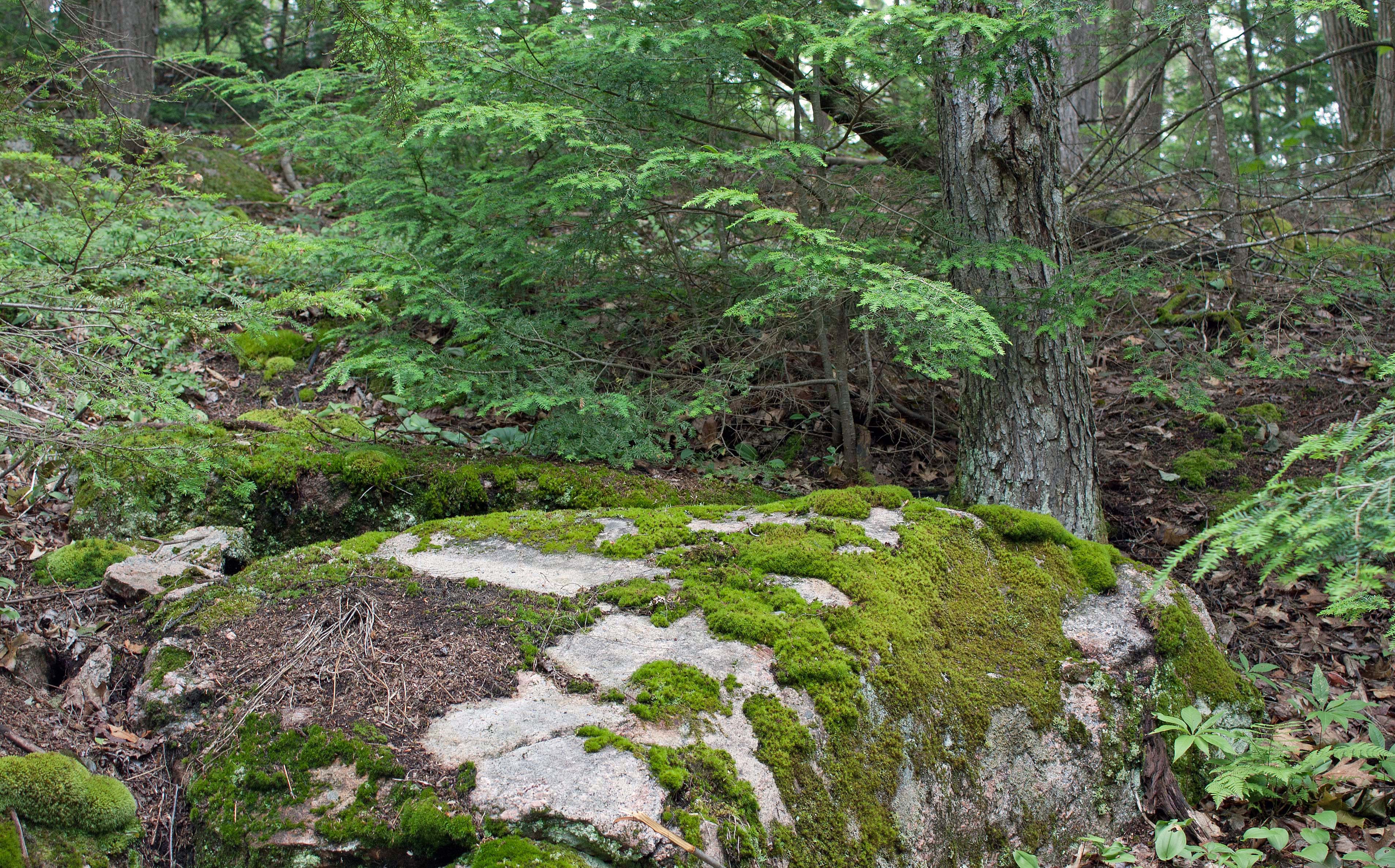
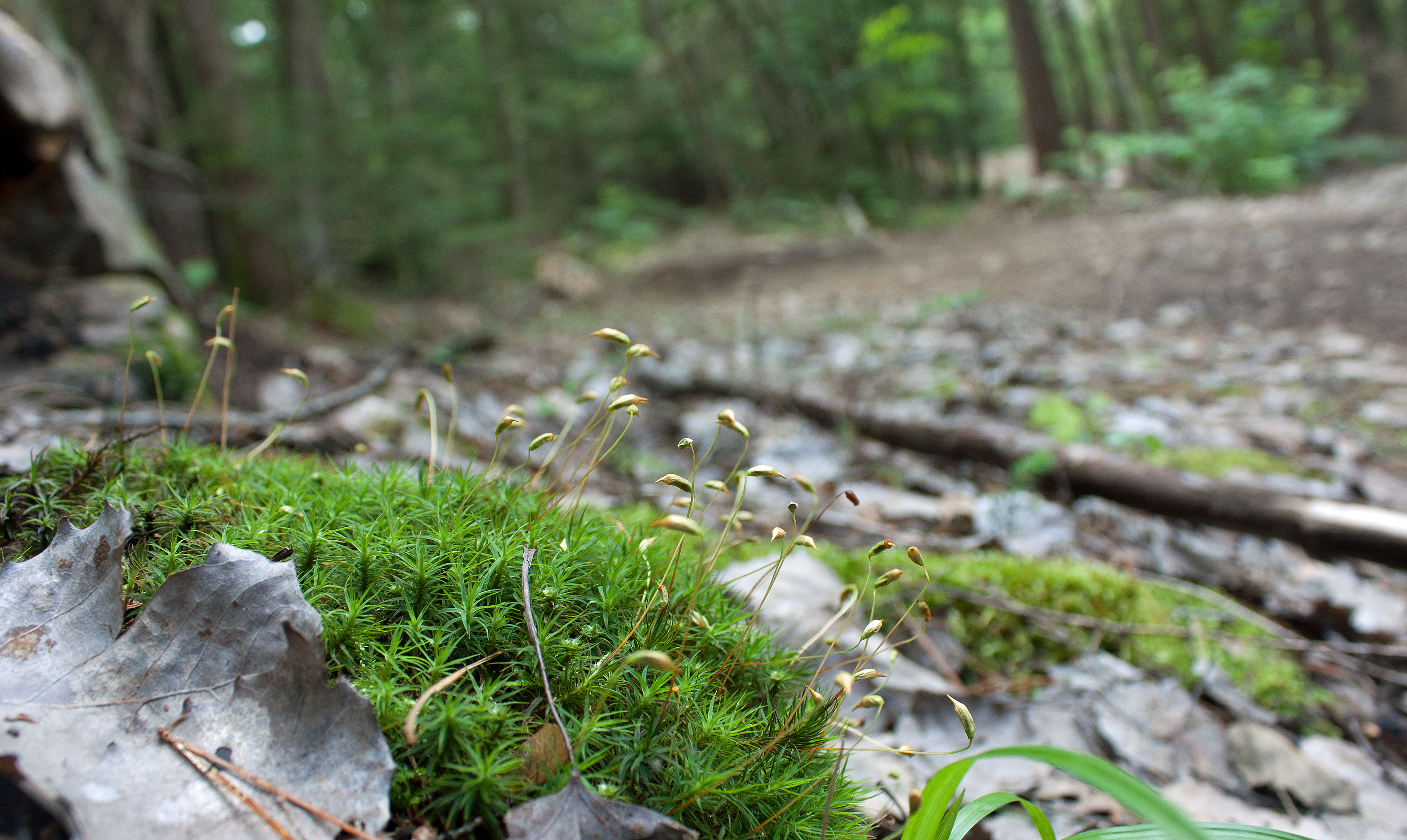
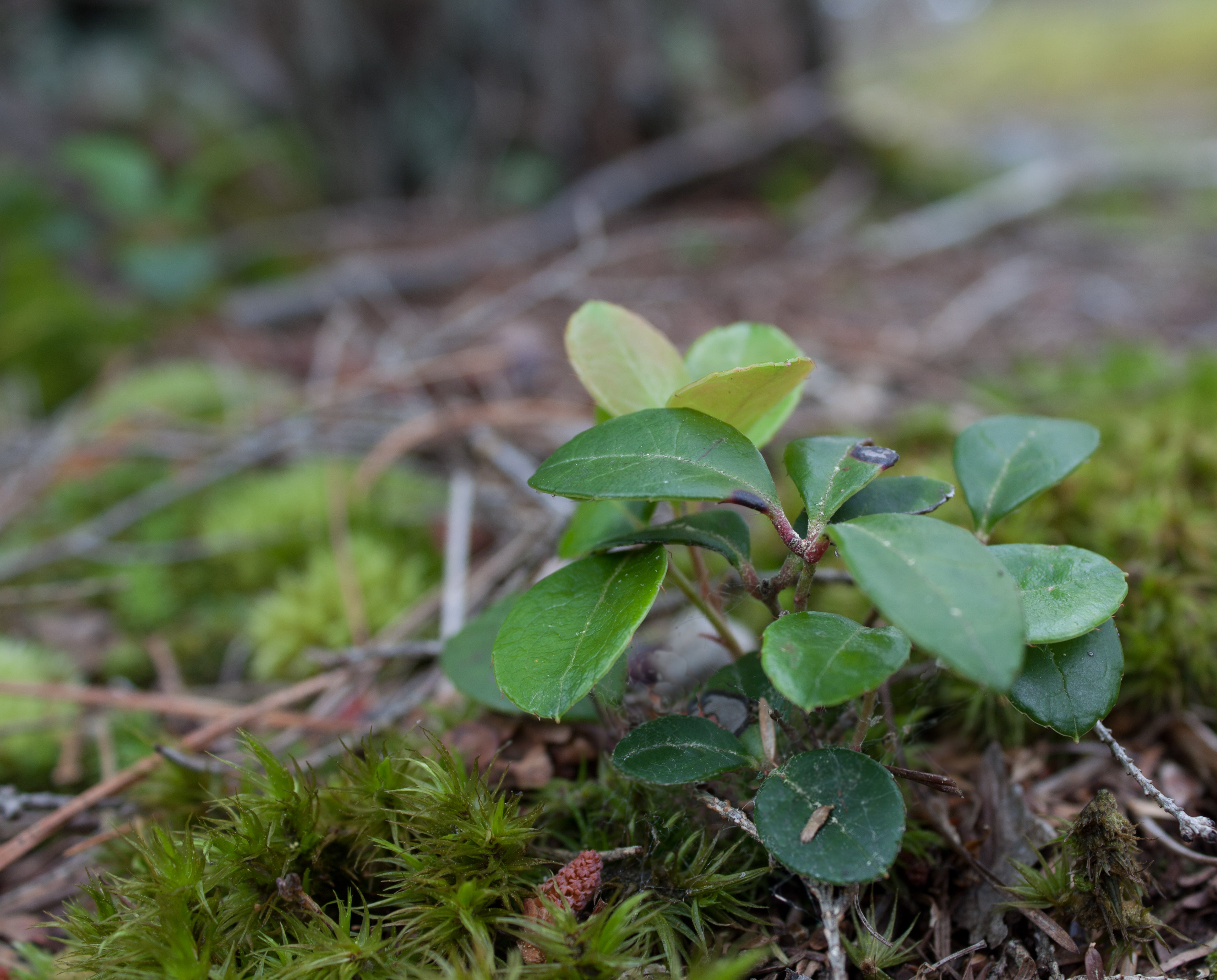
I stray off the rock-strewn dirt road up a slope to take a picture of moss-covered granite and limestone boulders. Sweetferns (Comptonia peregrina) poke up their backs like stray hairs on a green carpet. My feet sink into the spongy forest floor and I watch my steps not to turn my ankle. The soft ground is covered in litter, mosses, lichens and fungi. Wood ferns thrust up toward the light. A diverse underbrush of forbes and shrubs include wild Sarsaparilla (Aralia nudicaulis), bunchberry (Cornus canadensis), Enchanter’s Nightshade (Circaea lutetiana), low sweet blueberry (Vaccinium angustifolium), and young hemlock saplings. I find another old friend, the wintergreen (Gaultheria procumbens), forming a thick ground-cover with the ground moss by the trail. Somewhere on a mounded outcrop, I stop and quietly eat my lunch to the lyrical sounds of the forest.

The Forest’s Poet
As I reach a rocky outcrop and small clearing in the dense forest, a hermit thrush offers its tender ode to the forest. A pure song that opens from a singular note into successive waves of pure light.
I stop in my tracks and listen to this outpouring of heaven’s light from this tiny creature. The hermit thrush (Catharus guttatus) is a reclusive indistinctive brown bird; yet its song—an echoing fluting trill—celebrates the forest like no other sound. It is a prayer to beauty, stirring one’s heart into celebration. The hermit thrush song is Nature’s hymm to the beauty of all life. It is the forest’s poet.

Soon after, the red-listed wood thrush (Hylocichla muselina) adds its notes into a resonating chorus. I’m entranced; they are both singing nearby at the same time and I feel like I am in a giant cathedral. Like a heavenly duet, these two birds produce a mellifluous symphony uniquely beautiful and heart-stirring.
Their song is their gift to the world and I feel blessed in hearing them.
Through their song, these thrushes (and I include the robin here, for it is also a thrush with a beautiful fluting song) also fulfill the herald archetype of catalyst; they enhance whatever stirs you at the moment. If you are sad, they might stir you to tears. If you are feeling joy, they will stir you into ecstasy. If you are neutral—of little mind and emotion—their song will stir you to feel deeply alive.

Value of The Catchacoma Hemlock Forest
The Eastern Hemlock (Tsuga canadensis) is a very long-lived evergreen tree that is common in many of Ontario’s old-growth forests. It’s lifespan reaches well over 300 years and can achieve 900+ years. Hemlock often grows on steep ravine slopes, on lakeshores and along creek-sides where it casts very deep shade, cooling streams so that cold-water fish such as brook trout can thrive. The eastern hemlock is considered a keystone species, providing numerous ecosystem services that include erosion control, temperature control, and air and water filtration. In addition to providing critical shade for cooling of waters, the hemlock provides crucial food, shelter (and nesting sites), and habitat for over 96 species of birds, including songbirds, woodpeckers, and birds of prey. Some species were found to significantly decline with the disappearance of the hemlock. These include the black-throated green warbler, Blackburnian warbler, oven bird, blue-headed vireo, Acadian flycatcher, yellow-bellied sapsucker, pileated woodpecker, northern goshawk, red-shouldered hawk, long-eared owl, and saw-whet owl—and, of course, the hermit and wood thrush.

The hermit thrush and wood thrush rely on hemlock forests; they like open areas in coniferous and mixed forests, such as trails, pond edges and meadows. Both thrushes occupy the understory of forests and forage on small insects in the leaf litter of the forest floor. They may also eat a small amphibian or reptile and berries. Both hermit and wood thrush are sensitive to habitat fragmentation and require undisturbed forest. The hermit thrush uses the eastern hemlock for nesting and feeding, building their nests on the ground beneath young hemlocks and thrives in the abundance of insects and invertebrates in hemlock stands. The wood thrush nests in the lower branches of a sapling or shrub. Ideal habitat for the wood thrush includes trees over 50 feet tall, a moderate understory of saplings and shrubs, an open floor with moist soil and decaying leaf litter, and water nearby.

According to The Wilderness Committee, the 662-hectare old-growth eastern hemlock mixed forest may be the largest known of its kind in all of Canada with dominant trees 150-350 years old. P. Quinby with Ancient Forest Exploration & Research reports that 226 species are found in the area, including several species-at-risk such as the Algonquin wolf, cerulean warbler, eastern wood pee-wee, rusty blackbird, wood thrush, Blanding’s turtle, hog-nosed snake, five-lined skink, monarch butterfly, and the lichen Coenogonium pineti.
Proposed Logging of the Catchacoma Forest

The Bancroft Minden Forest Company holds logging rights in the area and plans to log several large blocks of the old growth. They counter that the area is not untouched old-growth, given that portions of the forest were already logged in 1988. They went on to suggest that they would be removing less robust trees and leaving healthy hemlocks, a practice that still creates disturbance that will affect the wildlife. Ian Dunn, president and CEO of the Ontario Forest Industries Association, contended in an email to The Narwhal that since human activity is already contributing to invasive species and increased wildfires, forests need the active management that comes with logging. “Forests depend on ecological succession and disturbance (natural or human) to maintain ecological integrity, reinforcing the need for more active management, not less,” he said to The Narwhal.
As an ecologist, I find this rhetoric misleading and hubristic, particularly for what it leaves out; given its source–the CEO of a logging association with an obvious mandate–this ‘appeasing’ language fails to hide a profit-agenda. When Dunn mentions the role of humans in ecological succession & disturbance and in the same breath, “the need for more active management, not less,” he is hubristically elevating human intelligence and knowledge over Nature’s wisdom and complexity. Our track record managing forests has not been stellar, particularly given the agendas of forest companies (to create timber for market) and the governments who support them. Clearcut logging right to a water course or with unacceptable riparian buffer is one example; mismanaging sediments and causing erosion from roads and other practices is another.
Forest engineers in the 1950s coined the term “decadent forest” to proclaim the natural state of a mature climax forest as diseased, undesirable and needing to be converted to young ‘thrifty’ plantations. Foresters used the term to vindicate logging practices that maximized timber productivity and did not consider ecosystem services provided by old-growth. Such a view is not only fraught with ecological error; it ignores (and disrespects) systems knowledge, ecological integrity and holistic forest health. This 1950s term and the mindset underlying it was still being taught and used by foresters in the 1980s and 1990s–I ran across it during my limnological consulting work in British Columbia from the 1990s through 2010. The words have changed and forest companies have adopted some appeasing rhetoric, but the practices seem to remain the same, with significant government-sanctioned gaps in biodiversity protection and looming species extinctions as a result.
I have too often seen the results of a management style driven by the simplicity of profit over the complexity of ecosystem health. The bottom line is that there is no good way to log old-growth forest. Not for the forest, anyway.

What We Can Do
The Wilderness Committee is working with local community members and ecologists to pursue protection status for this rare ecosystem and its high conservation values including habitat for several species at risk. Write today to decision-makers to support protection for Catchacoma Forest.
To find out more about ways to get involved or to get more information on what the Wilderness Committee is doing, email the SFSC through: Katie@wildernesscommittee.org. Find the latest AFER reports at: https://www.peterborougholdgrowth.ca/research-reports. The draft Forest Management Plan and how to submit comments can be found here: https://bit.ly/3tcdLxP.

References:
Conlin, B., C. Dewar and P. Quinby. 2020. Species-at-risk in the Catchacoma Old-growth Forest Region, Peterborough County, Ontario. Research ReportIn-preparation, Ancient Forest Exploration & Research, Powassan & Peterborough, Ontario.
Dewar, C. 2019. Catchacoma Old-Growth Eastern Hemlock Forest based on 1987-20013 FRI data [Map]. Ancient Forest Exploration & Research. Powassan & Peterborough, Ontario.
Hosie, R.C. 1990. Native Trees of Canada, Eighth Edition. Fitzhenry & Whiteside Ltd. & Canadian Forest Service. Markham, Ontario.
Little, E. L. and A. A. Knopf. 1980. Eastern Hemlock. The Audubon Society Field Guide to North American Trees: Eastern Region. Chanticleer Press, New York, New York.
Ministry of Natural Resources and Forestry (MNRF). 2018. Bancroft Minden Forest: Maps: Operations: Operations 1098 00. (accessed January 6, 2020).
Nature Conservancy of Canada (NCC) and TD Bank Group. 2017. Putting a Value on the Ecosystem Services Provided by Forests in Canada: Case Studies on Natural Capital and Conservation. Nature Conservancy of Canada, Toronto, Ontario.
Quinby, P. 2019a. “An Inventory of Documented Old-growth Eastern Hemlock Forests in Canada.” Forest Landscape Baselines No. 35, Ancient Forest Exploration & Research, Powassan & Peterborough, Ontario.
Quinby, P. 2019b. “Rare, Threatened and Endangered Forest Ecosystems in Ontario’s Temperate Forest Region.” Forest Landscape Baselines No. 34, Ancient Forest Exploration & Research, Powassan & Peterborough, Ontario.
Quinby, P. 2020a. “The Catchacoma Ancient Forest Landscape: An Initial Inventory of Species and Habitats.” Ancient Forest Exploration & Research. Research Report No. 39. 14pp.
Quinby, P. 2020b. “Mapping Old-Growth Forests in Northern Peterborough County, Ontario.” Ancient Forest Exploration & Research. Research Report No. 40. Powassan, Ontario. 26pp.
Stantec (Stantec Consulting Ltd.). 2008. “Kawartha Highlands Signature Site Park Access Road Study: Final Environmental Study Report.” Prepared for Ontario Parks, Ministry of Natural Resources, Peterborough, Ontario.

Nina Munteanu is a Canadian ecologist / limnologist and novelist. She is co-editor of Europa SF and currently teaches writing courses at George Brown College and the University of Toronto. Visit www.ninamunteanu.ca for the latest on her books. Nina’s bilingual “La natura dell’acqua / The Way of Water” was published by Mincione Edizioni in Rome. Her non-fiction book “Water Is…” by Pixl Press(Vancouver) was selected by Margaret Atwood in the New York Times ‘Year in Reading’ and was chosen as the 2017 Summer Read by Water Canada. Her novel “A Diary in the Age of Water” was released by Inanna Publications (Toronto) in June 2020.
 The Meaning of Water
One thought on “The Poet of Catchacoma Forest”