
When I first came to the Kawartha Region, I explored the local forests near Peterborough and beyond, looking for the giant trees of old-growth: white cedars, maple, hemlocks, pines and tall beeches. But I found myself just as enthralled by the little things in the forest: the seeds, the mosses, the lichen and the fungi. I soon purchased some extra gear—tripod, macro lens, rain pants and knee pads—for taking pictures up close and personal.

One of my favourite fungi are puffballs. Since I was a child, poking them to release billowing clouds of yellow-brown spores, I’ve been fascinated by them. On a recent autumn hike with a naturalist friend, as we walked a trail on a hill in the Little Rouge Park forest, we encountered ahead of us what looked like a large yellow cloud suddenly billowing down the hill and toward us. My friend backed away but I moved closer (curious as a cat!). I remember thinking, even as I advanced toward this mysterious cloud, that it reminded me of a killer fog in a few of the science fiction shows I’d seen. The cloud quickly dispersed, following its trajectory downhill, and when we came upon its path, we noticed on the path a piece of a very large and dark brown spongy puffball, still ‘smoking’. I had to smile. This giant old puffball must have suddenly dislodged uphill and rolled down, crashing through the forest and breaking up as it went, rolling across our trail and onward, releasing copious spores along the way. Doing exactly what the puffball was meant to do. The spore cloud was considerable but so was the size of the puffball; I’d recently read that these giant puffballs can release seven trillion spores at a go. Our luck in witnessing the event was impeccable, I thought, because within moments there was no sign of the event and that large powdery dark brown mass on the path could be mistaken for many other things.
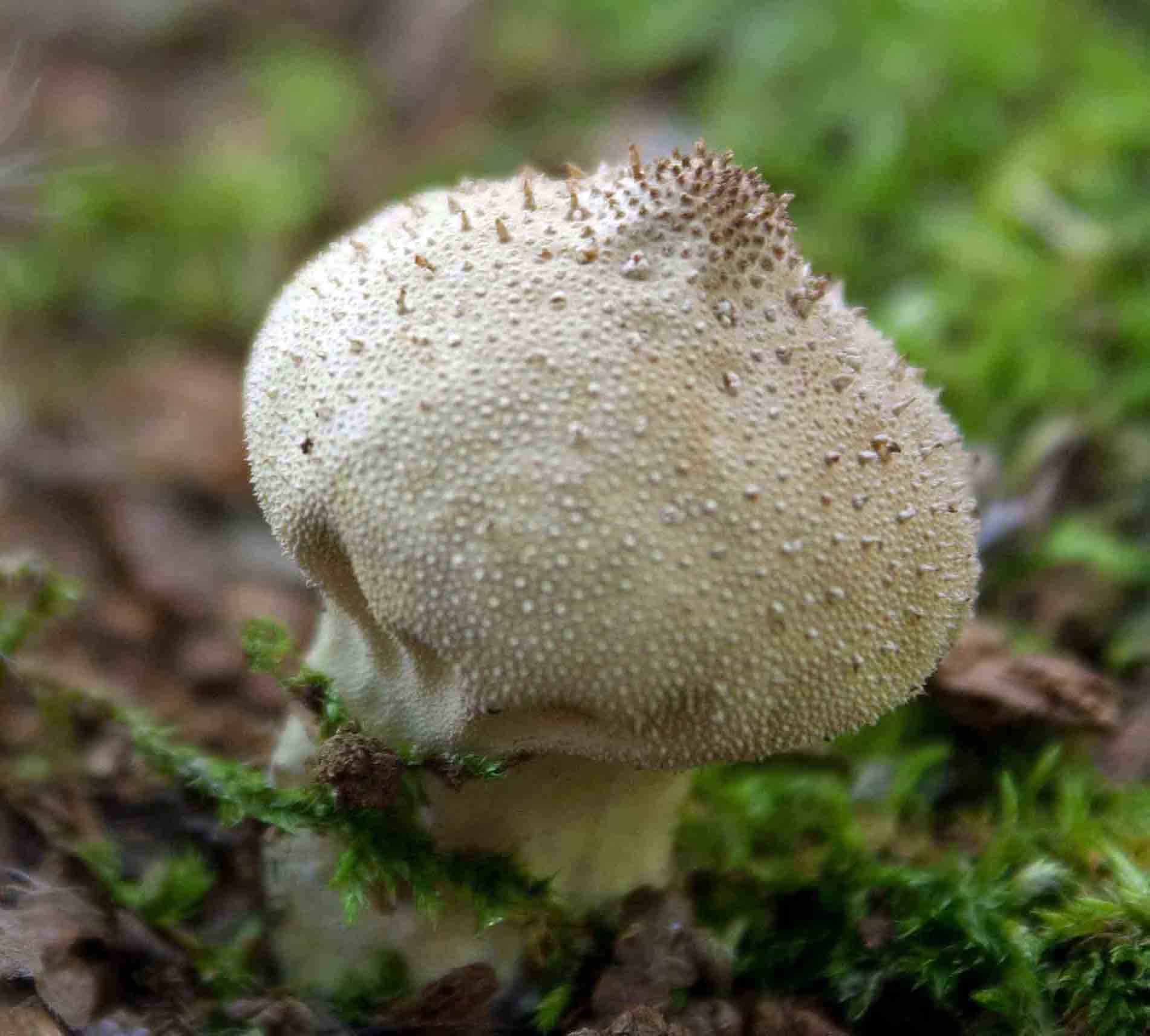
Puffballs have a ball-shaped fruiting body (when mature) that opens through an aperture or cracks open to release a cloud of dust-like spores like the one I’d encountered in Little Rouge Park. They don’t have a cap with spore-bearing gills like other mushrooms. Instead, the spores are made inside a spheroidal body called a gasterothecium and often develop a small neck or stalk below that may attach to the ground via a root mass (rhyzomorph).

When young and before the spores begin to form, the flesh of a puffball is white and firm. They are often edible at this stage. As the spores develop and mature, they form a mass called a gleba that often is dark. When mature, the puffball’ exterior skin (peridium) turns brittle and papery. It either develops an aperture (called an ostiole) through which spores jettison from the pressure of a single raindrop, or it literally splits open (like that giant puffball I experienced in Little Rouge) to release its dust-like spores into the dispersing wind. Puffballs belong to the division Basidiomycota and common genera include Calvatia, Calbovista and Lycoperdon.
Below I describe four types of puffballs that I’ve encountered, studied, and in one case tasted.
.
Lycoperdon pyriforme

Also called the Stump Puffball (because it tends to fruit in densely-packed groups on decaying tree stumps and fallen and rotting logs), Lycoperdon pyriforme is common in the world and one of the most gregarious of all fungi. It swarms over dead stumps of deciduous and coniferous trees in woodlands, particularly where thinning has taken place or storms have brought down trees (as in the Trent Nature Sanctuary after the May 2023 Derecho). Michael Kuo of MushroomExpert.com shares that this saprobic mushroom is one of only a few puffballs that grow on wood, making it easy to identify. However, both iNaturalist and Wild Mushroom Hunting note that the Common Puffball Lycoperdon perlatum can also be found growing on decayed wood and wood chips, where I found it in Trent Nature Sanctuary (see top photo). As a further diagnostic, Lycoperdon pyriforme is also only finely spiny with short pyramidal warts (vs both Lycoperdon perlatum and Calvatia excipuliformis with larger warts, see above and below) and forms a pear-shaped overall appearance.
When young, Lycoperdon pyriforme are pale and covered in short pyramidal warts. The skin eventually darkens to tan then a darker brown, particularly at the apex, which eventually opens to release its olive-green to brown spores.

Lycoperdon literally means ‘wolf’s flatulence,’ given its totally unpleasant gas-like odour when cut. First-Nature asks the obvious question of “who got close enough to a wolf and stayed there long enough to become an expert on such matters.” The word pyriforme comes from Latin and means pear-shaped, which well-describes the general shape of this puffball.
I found this common puffball mostly in the forests of the Trent Nature Sanctuary in the fall. The first time I saw them, they’d crowded over an old birch log near the canal. On another occasion, I saw them colonizing up a dead cedar tree and several cedar stumps and logs. I also saw an old colony covering an old beech log in the Mark S. Burnham old-growth forest.

Note to self: Totally Wild UK shares that “the spores have been known to trigger a disease called lycoperdonosis when they are inhaled so care should be taken especially with mature samples.” ACK! No more playing with spores!
Calvatia excipuliformis

Also called the Pestle Puffball, Calvatia excipuliformis is common in mixed forests, often singly or in very small groups. I found it most often in a pair. This is how I found it in the Trent Nature Sanctuary swamp cedar forest, colonizing the litter-rich ground under the shade of cedar, ash, maple, birch and hemlock trees. The underside of Calvatia is attached to the ground by a root-like assemblage of hyphae called a rhizomorph. I remember noting this when I tried to lift an old spent puffball–wrinkled, papery and deflated–and found that it was still stuck to the ground.
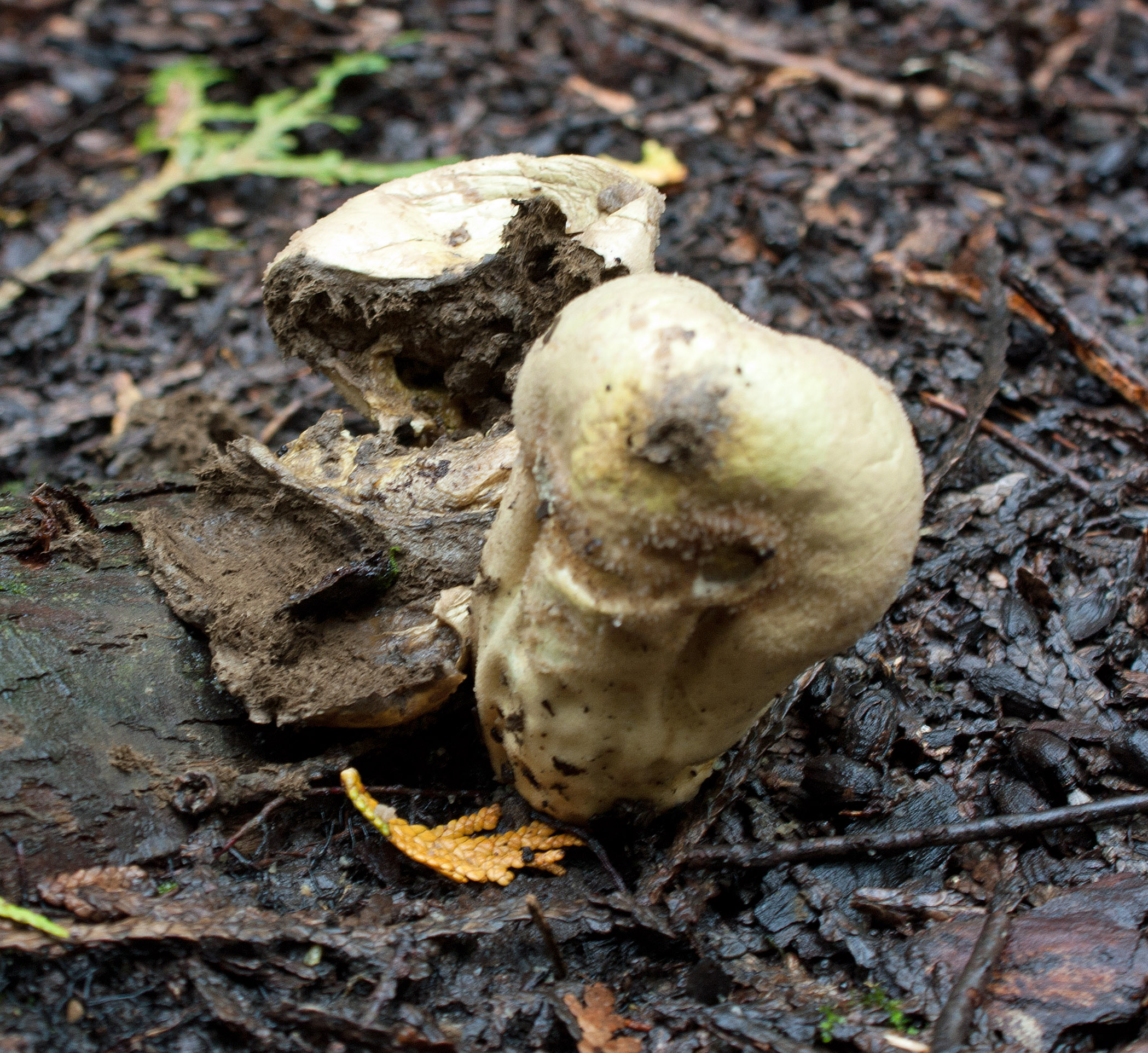
The upper globe-like section of the puffball is white at first, covered in soft pointed warts, then turns ochre as it ages and the warts fall off, leaving a paper-like smooth surface in which the spores develop. In late fall, the skin of the puffball stem wrinkles once the head has ruptured and released the spores. These dark blue-reddish deflated ‘paper bags’ littered the ground in the winter.
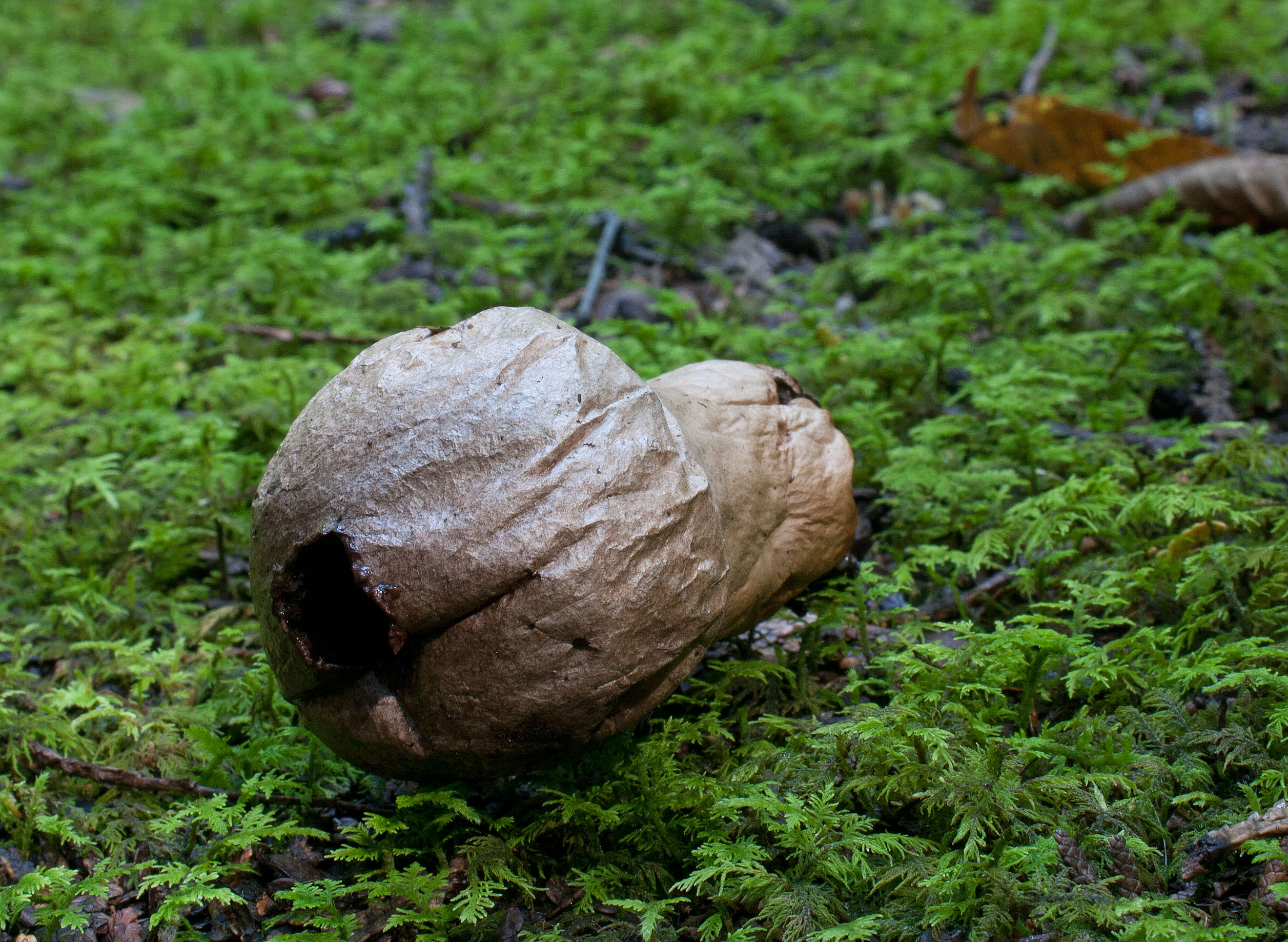

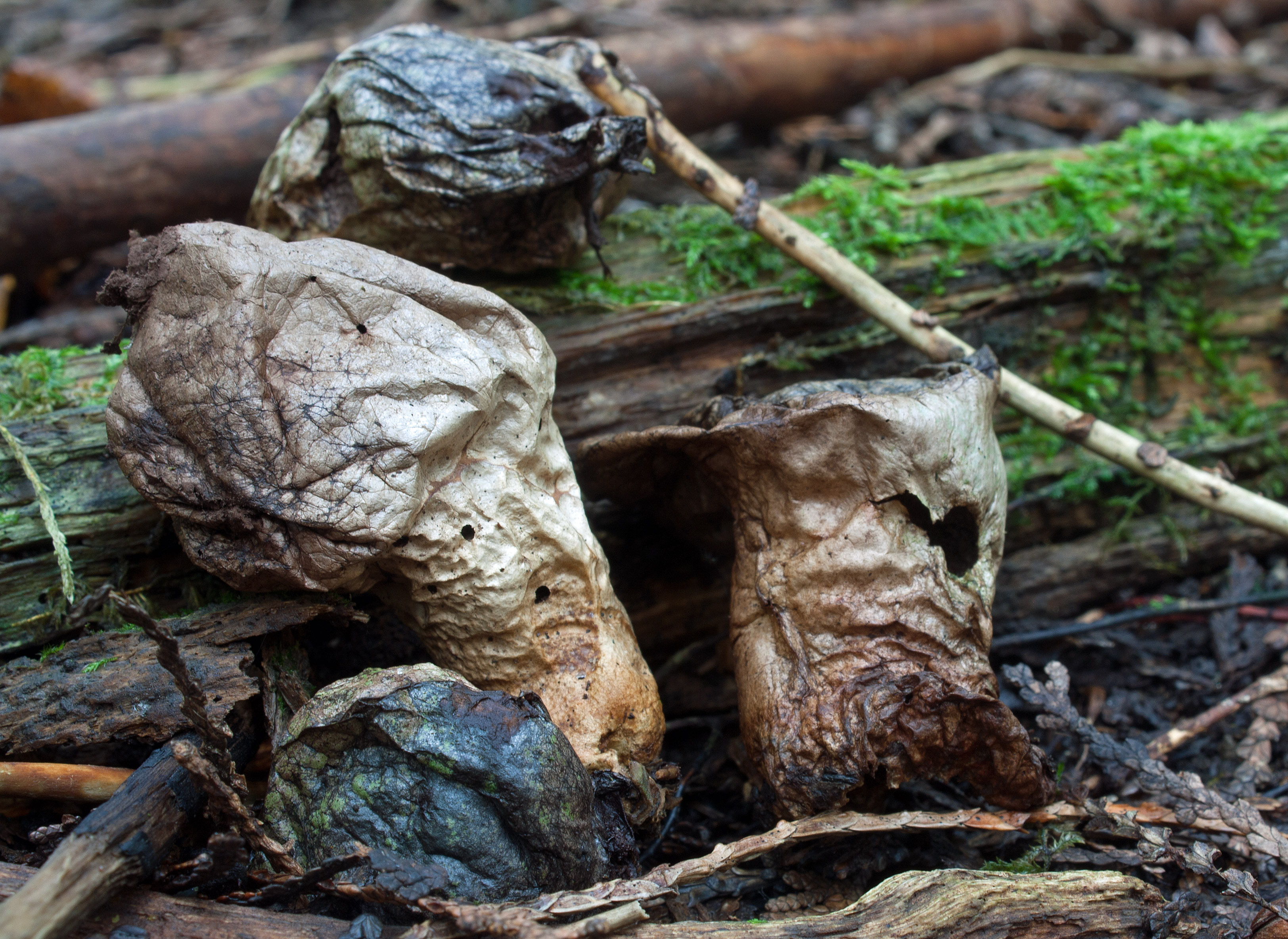
On one fall outing, I found a good-sized Calvatia excipuliforme that had not only ruptured at its upper pore, but had split in half where the globe (the gasterothecium) started. The split puffball showed a papery outer skin or peridium and the different insides of the puffball: the globe or gasterothecium, being totally dark brown inside with its powdery spore mass; and the neck or stalk below, still showing a reticulate fleshy sub-gleba interior. I also noticed, after picking up the two halves, that the lower neck or stalk, which is normally attached to the ground by its rhizomorph, also demonstrated a very low centre of gravity; whenever I pushed it over onto its side, it bounced up, righting itself to ‘stand up.’

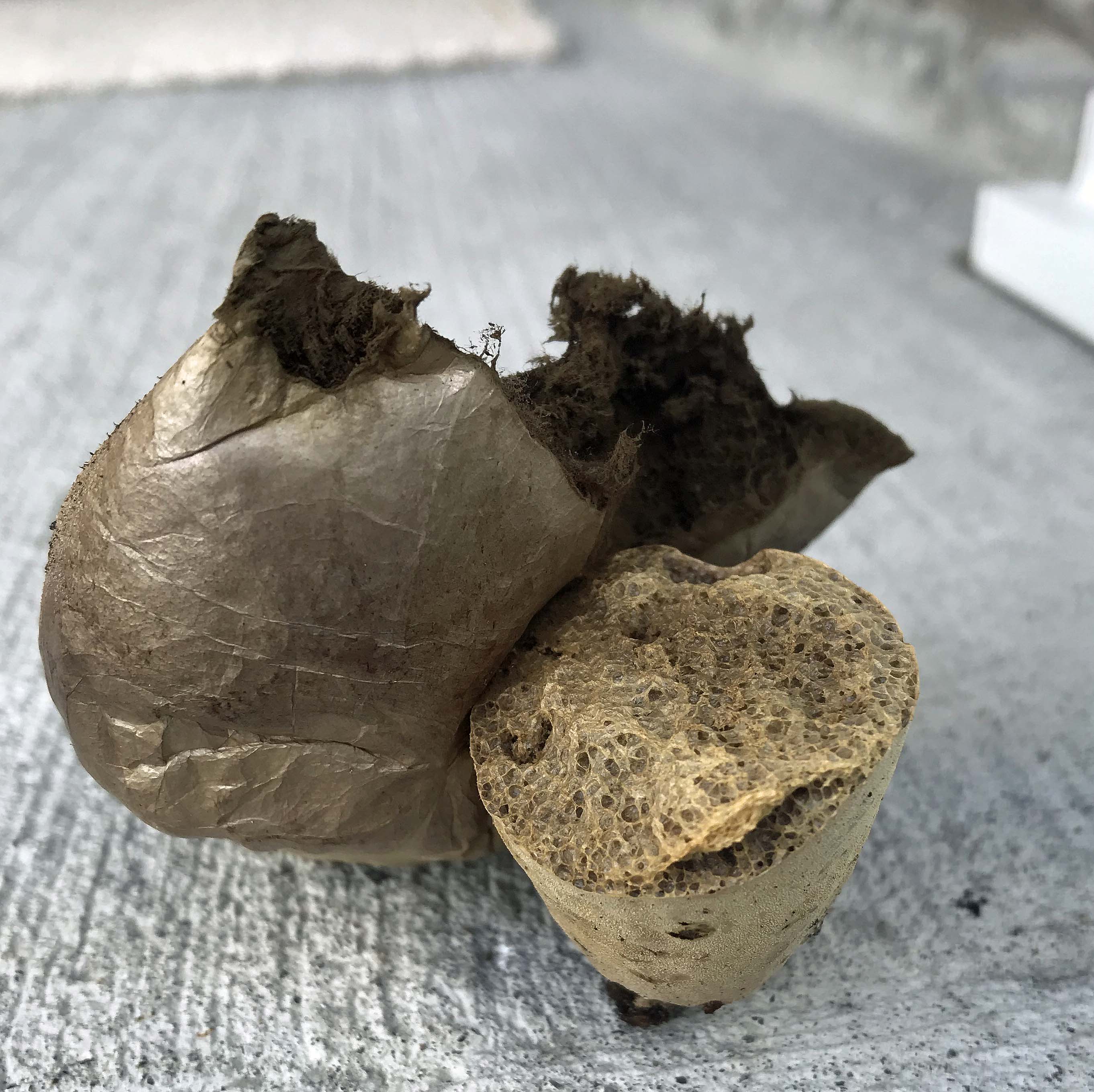
According to First-Nature, “the epithet excipuliforme comes from the Latin words excipulum, which means a vessel (a chalice, for example), and forma, which means ‘in the shape of’.”
.
Calvatia gigantea
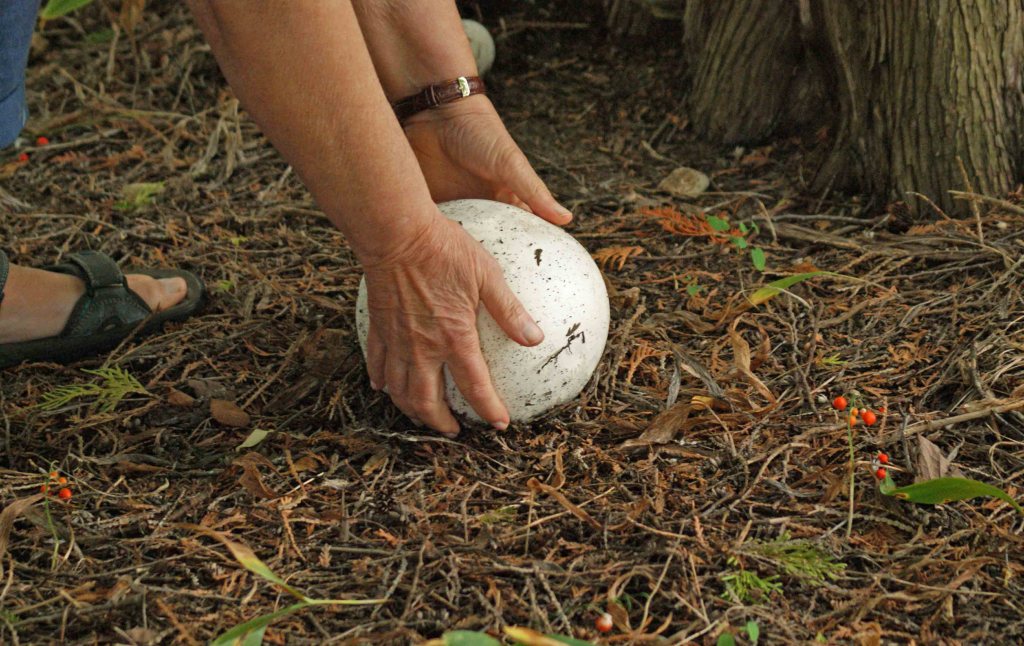
During a walk one day a small cedar grove in Peterborough, I chanced upon a large white globe resting in the duff by a cedar tree. It looked like a soccer ball. My naturalist friend recognized it right away as the Giant Puffball (Calvatia gigantea) and convinced me to partake in a tasty meal of it. I hesitated as we gazed down at the giant, nestled by the base of the tree. But I had confidence in my friend and in no time, I’d easily pried the giant from its ‘nest’ on the cedar forest floor. It was about eight to ten inches across and surprisingly light but solid. Aside from a bit of dirt at the bottom, it was a gorgeous and startling white colour. Feeling inordinately guilty and excited, I put the puffball into a bag and we brought our prize to my friend’s place to prepare.

I made a wonderful mushroom soup with the flesh of the puffball. Frankly, I have not had many mushroom soups (in restaurants and houses) that beat this one. Creamy, smooth, with a mild yet distinctively-voiced flavour, this mushroom soup and recipe is deliciously balanced. The added ingredients serve as chorus to the subtle yet assertive mushroom aria. Check this link for the recipe.
The giant puffball is commonly found in late summer or early fall on wet humus-type soils and its fruiting body can be as large as 120 cm (4 feet) in diameter and contain seven trillion spores. In the 1960’s scientists isolated from the giant puffball the substance calvacin, which was shown to inhibit sarcoma in lab mice. Calvacin is now cited as one of the first substances with antitumor activity isolated from a mushroom.
.
Geastrum triplex

In the swamp forest, I literally stumbled upon a colony of Geastrum triplex—also called Collared Earthstars—in an “alleyway” between two rotting and moss-covered cedar log piles, in a grove of yellow birch and cedar. I had just crawled over one decaying cedar log pile to photograph the mosses when I came eye-to head with one. Then another. And then many others.

Geo means earth and astrum means star. The species name triplex, which means ‘having three layers,’ refers to the way the ‘star’ arms of the outer layer crack when they peel back, making it look like the spore-sac is sitting on a dish. Spores escape from the apical pointed hole (peristome) as breezes blow across it. Much larger puffs are released when raindrops hit and compress the spore-sac—or an interfering finger depresses the sac. What escapes is a powdery gleba (which distributes the tiny spores). The sides of the peristome ‘beak’ are fibrous and appear slightly ragged.

According to the Missouri Department of Conservation, Earthstars spend most of the year as a network of fungal cells (mycelia) that penetrate the soil and digest decaying organic material. When they are ready to reproduce, the mycelium develops the “earthstar” above ground.
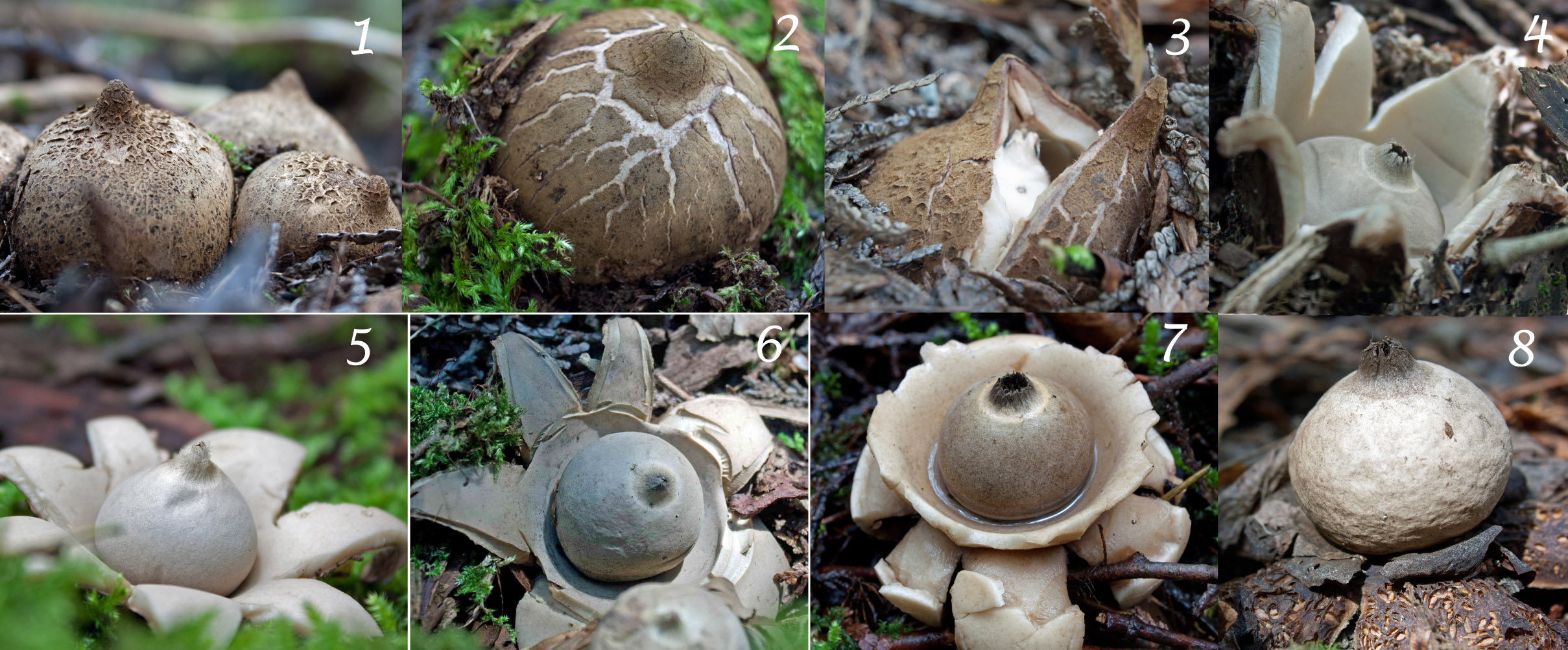
I saw every stage of Earthstar over the course of my visits: the early stage looks like a tear-drop shaped cocoa-dusted truffle, pushing itself out of the duff. The outer layer (exoperidium) cracks open and splits into several arms that spread out and down, lifting the spherical spore sac. The outer layer further splits around the perimeter of the spore sac to form a ‘collar’ around the base of the spore sac. These outer layers will later dry up into ochre-coloured patterned “rays” around the paper-like smooth spore sac (peridinium). The open pore (peristome) at the top of the peridinium is a small pointed beak that resembles a blue-grey fuzzy puckering mouth. When I poked one mature spore sac with an open pore, the ‘mouth’ released a blue-brown cloud of spores. Earthstars are used medicinally by indigenous peoples. The Blackfoot call them ka-ka-toos, meaning “fallen stars,” which—according to legend—are an indication of supernatural events.

.
References:
Barron, George. 2014. “Mushrooms of Ontario and Eastern Canada.” Partners Publishing, Edmonton. 336pp.
Ellis JB, Ellis MB. 1990. “Fungi without Gills (Hymenomycetes and Gasteromycetes): an Identification Handbook. ”Chapman and Hall. London. ISBN 0-412-36970-2.
Fascinated by Fungi, 2nd Edition, Pat O’Reilly 2016, reprinted by Coch-y-bonddu Books in 2022.
Millman, Lawrence. 2019. “Fungipedia” Princeton University Press. 177pp.
First Nature. “Geastrum triplexJungh.—Collared Earthstar” Online: https://www.first-nature.com/fungi/geastrum-triplex.php
Kirk, Paul M., Paul F. Cannon, David W. Minter and J. A. Stalpers. 2008. “Dictionary of the Fungi.” CABI, 2008
Kuo M. 2008. “Geastrum triplex“. MushroomExpert.Com.
Pegler, D.N., Laessoe, T. & Spooner, B.M (1995). British Puffballs, Earthstars and Stinkhorns. Royal Botanic Gardens, Kew.
Project Noah. 2020. “Collared Earthstar”
Roody WC. 2003. “Mushrooms of West Virginia and the Central Appalachians.” University Press of Kentucky, Lexington, KY. p. 443. ISBN 0-8131-9039-8.
Torpoco V, Garbarino JA (1998). “Studies on Chilean fungi. I. Metabolites from Geastrum triplex Jungh”. Boletin de la Sociedad Chilena de Quimica. 43 (2): 227–29.
Woodland Trust. “Collared Earthstar.” Online: https://www.woodlandtrust.org.uk/trees-woods-and-wildlife/fungi-and-lichens/collared-earthstar/

Nina Munteanu is a Canadian ecologist / limnologist and novelist. She is co-editor of Europa SF and currently teaches writing courses at George Brown College and the University of Toronto. Visit www.ninamunteanu.ca for the latest on her books. Nina’s bilingual “La natura dell’acqua / The Way of Water” was published by Mincione Edizioni in Rome. Her non-fiction book “Water Is…” by Pixl Press(Vancouver) was selected by Margaret Atwood in the New York Times‘Year in Reading’ and was chosen as the 2017 Summer Read by Water Canada. Her novel “A Diary in the Age of Water” was released by Inanna Publications (Toronto) in June 2020.
 The Meaning of Water