.
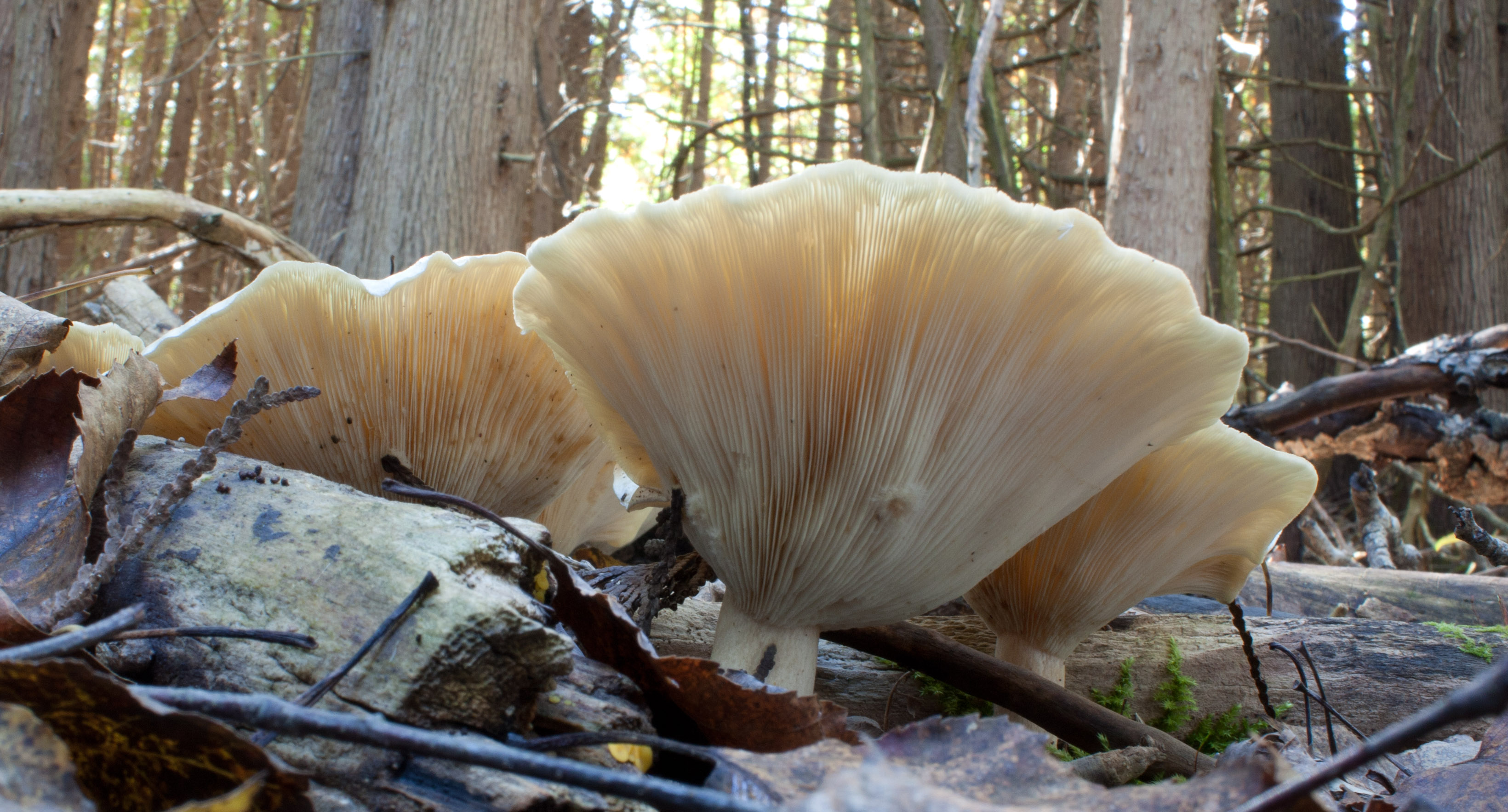
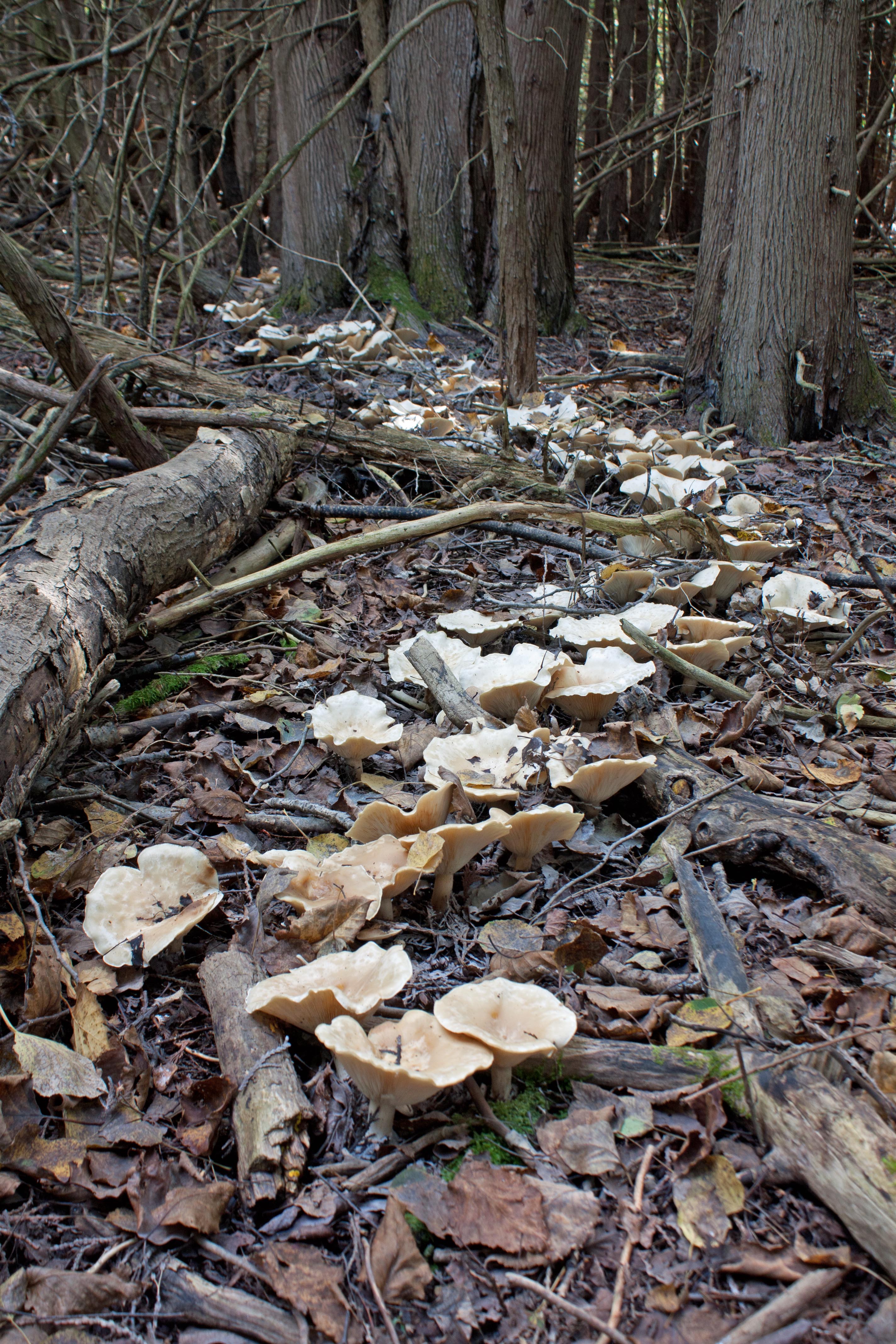
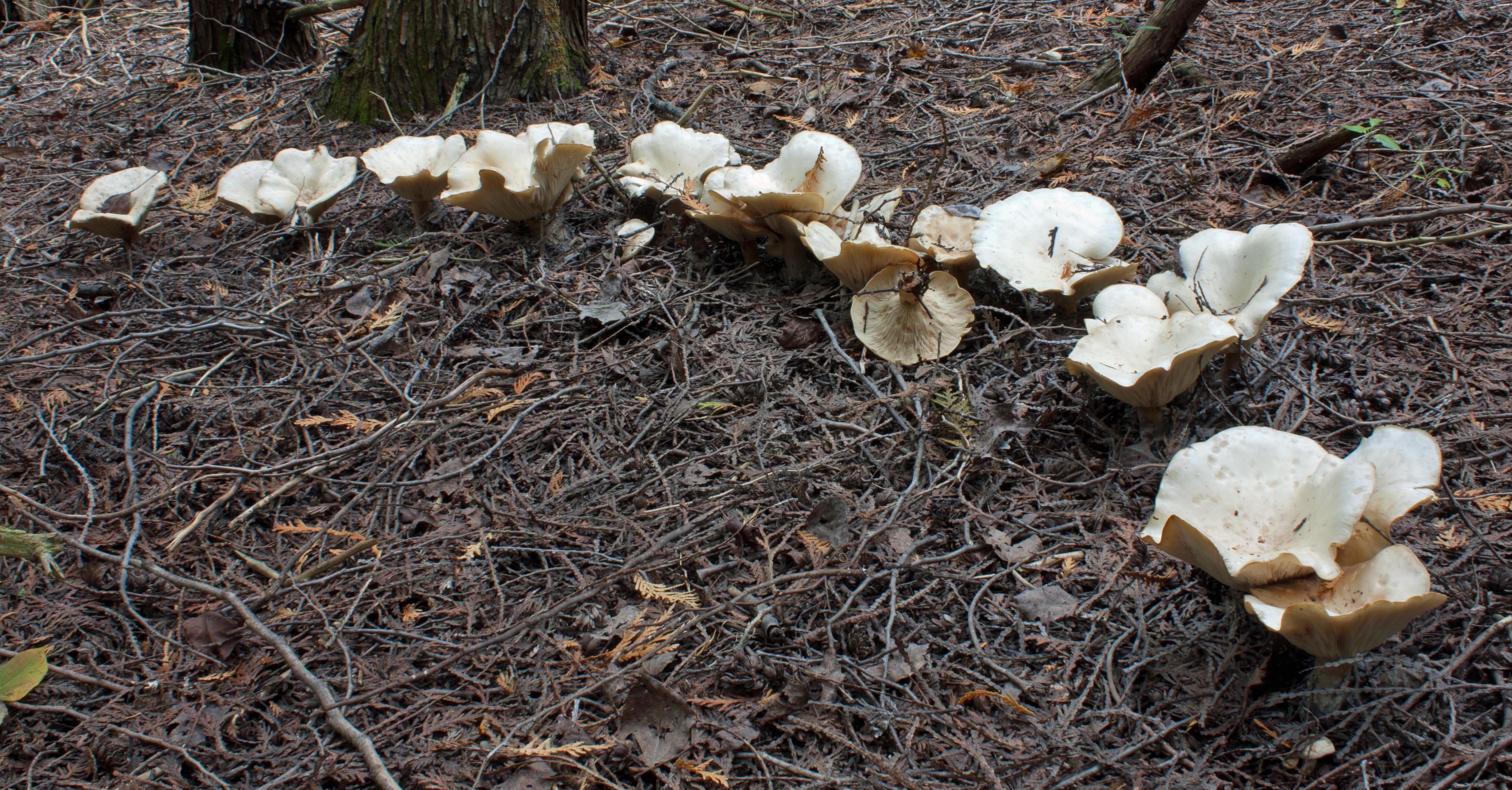
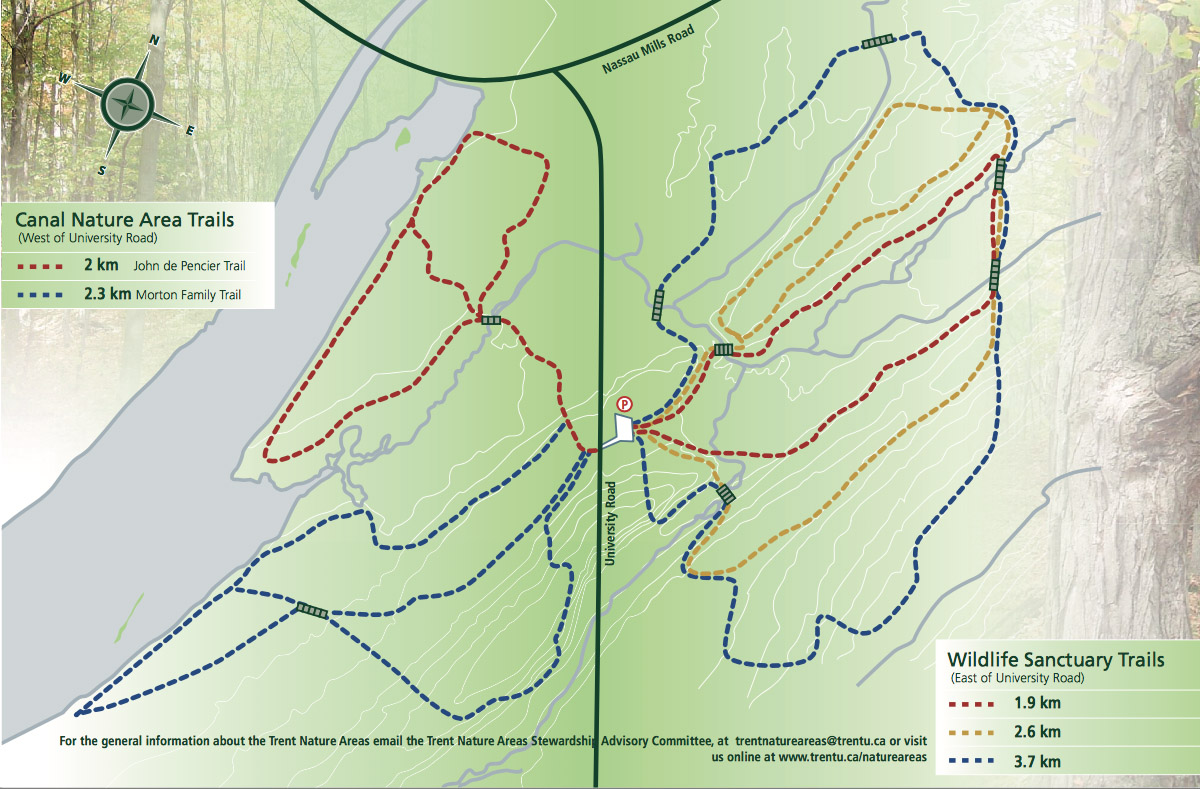
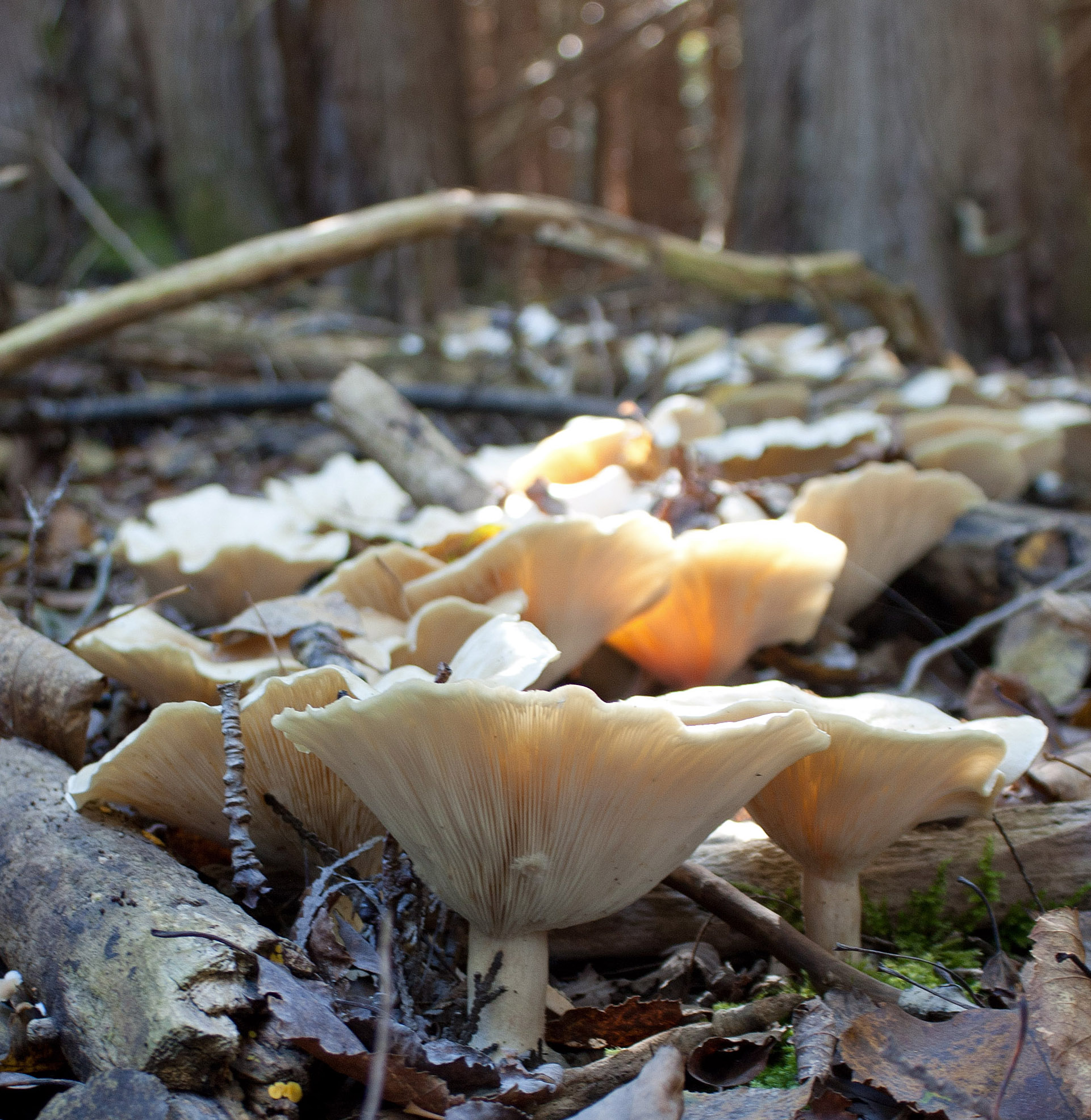
It was early October on a warm gentle day when I chose to walk a different path in the Trent Nature Sanctuary forest. And there, in the cedar-birch-poplar forest, I discovered beautiful fanned-shaped saprotrophic mushrooms arranged like street trees on a boulevard and stitching an enchanting network of crisscrossing lines of creamy ‘flowers’ on the forest floor. I noticed that they were arranged in close to what looked like a fairy circle in the thick duff amid dead logs and branches of several fallen poplar and birch trees; no doubt obtaining their nourishment from the decaying wood.
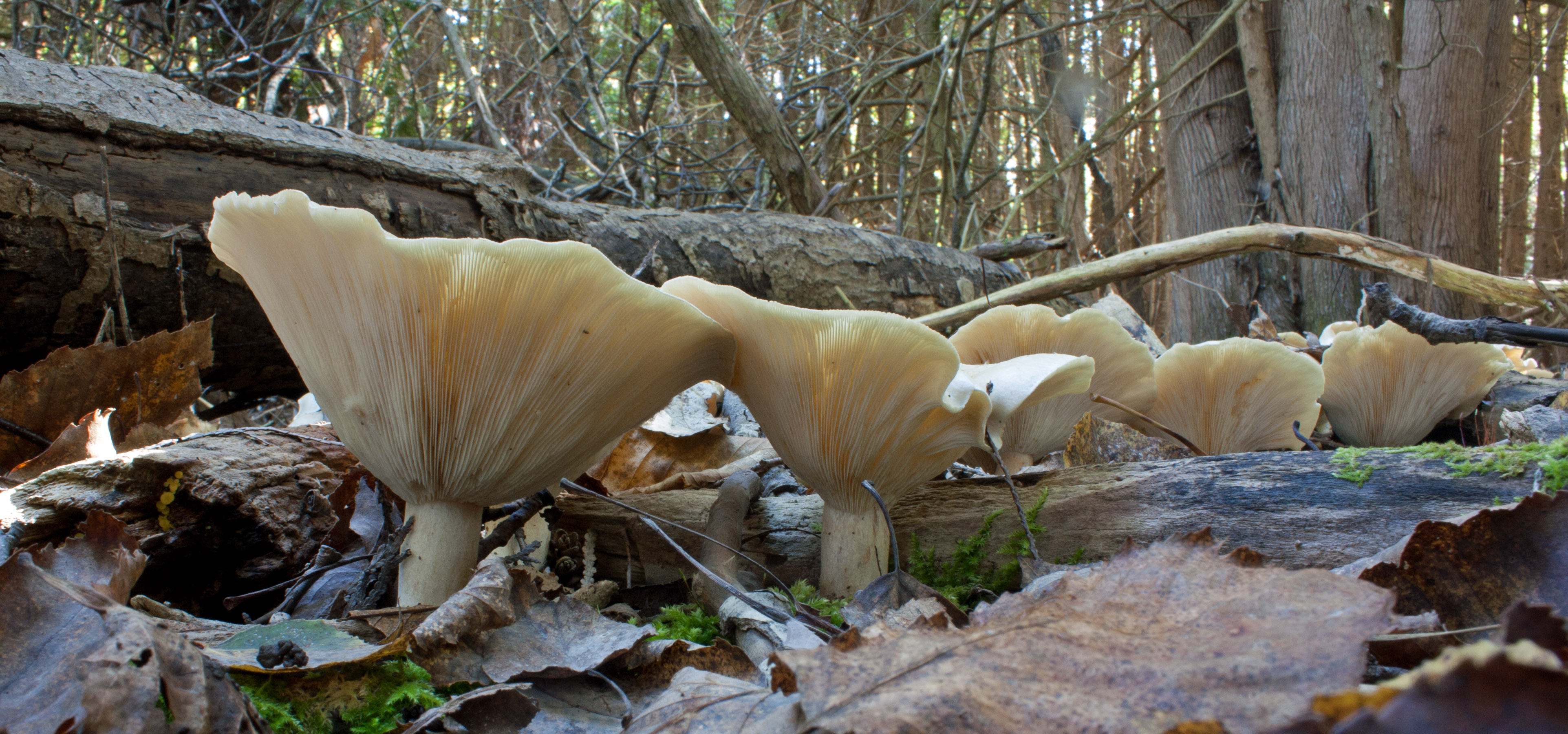
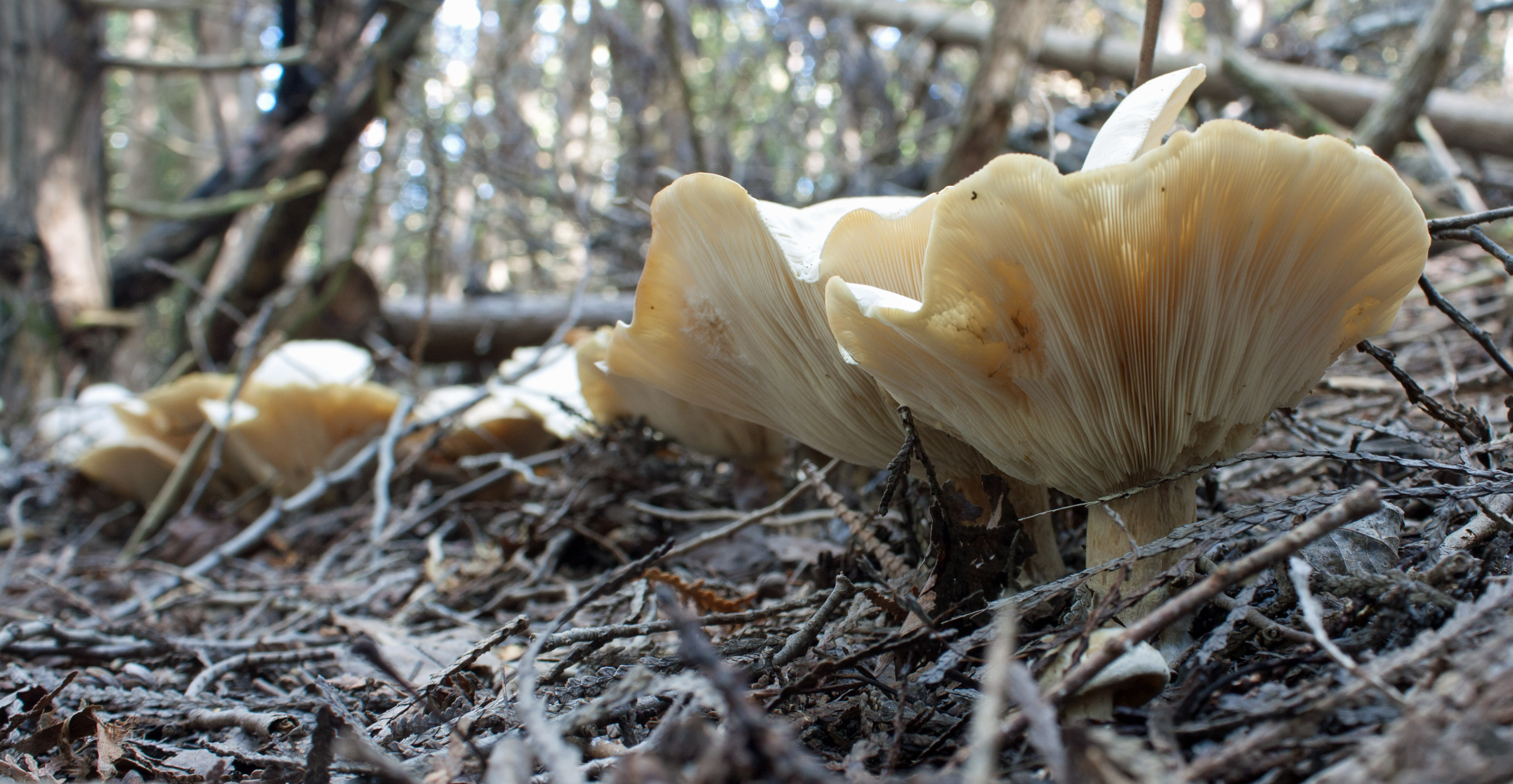
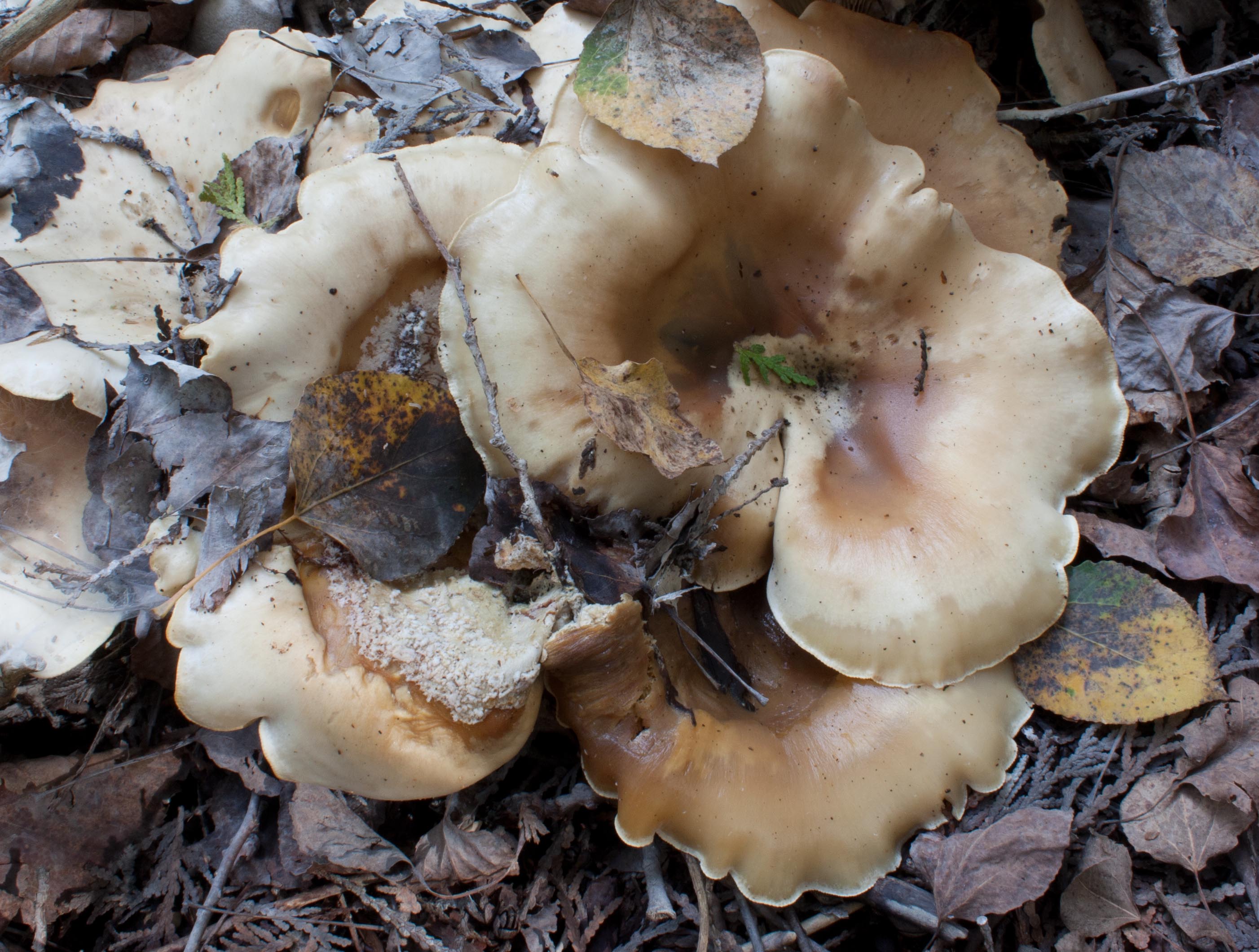
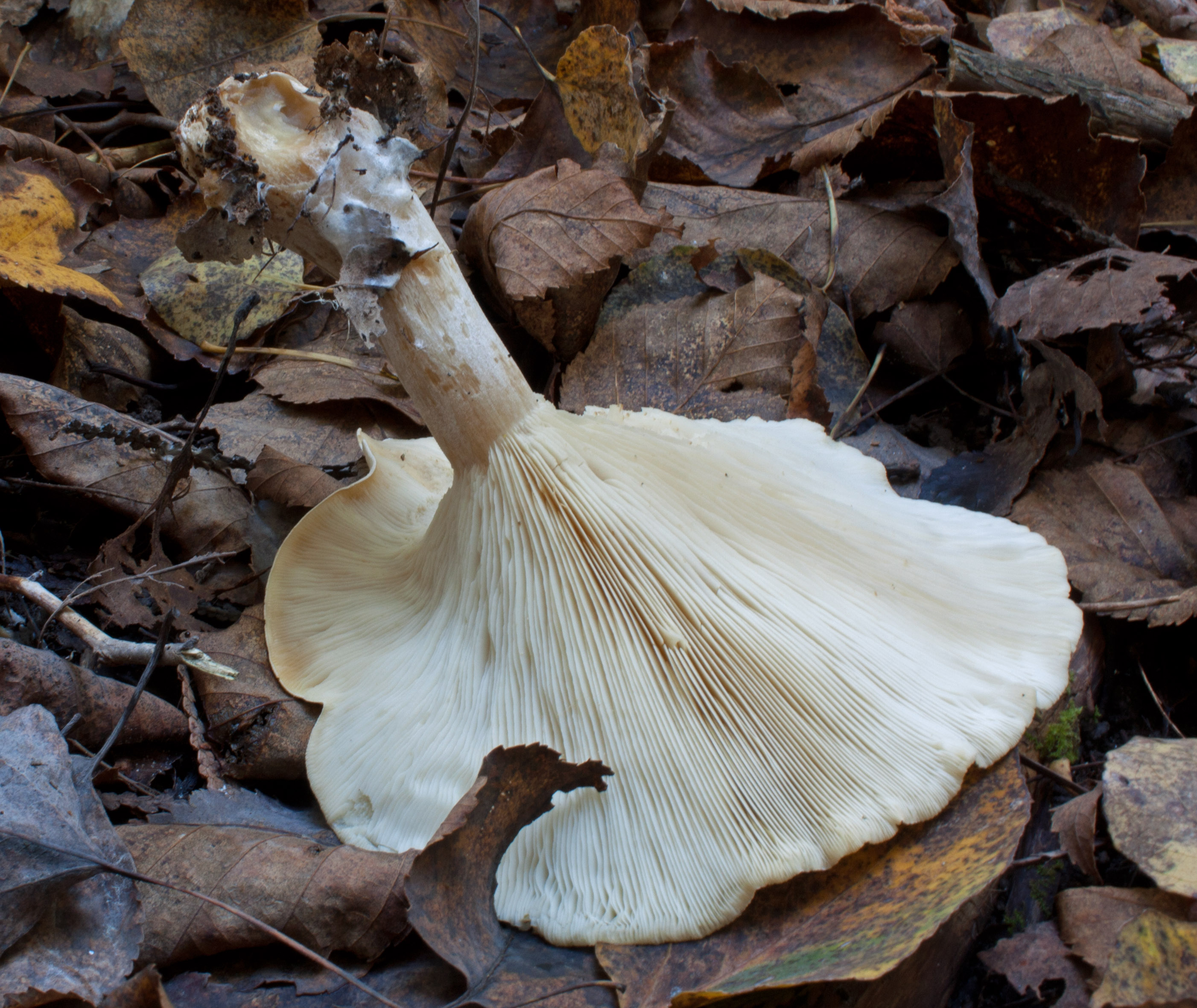
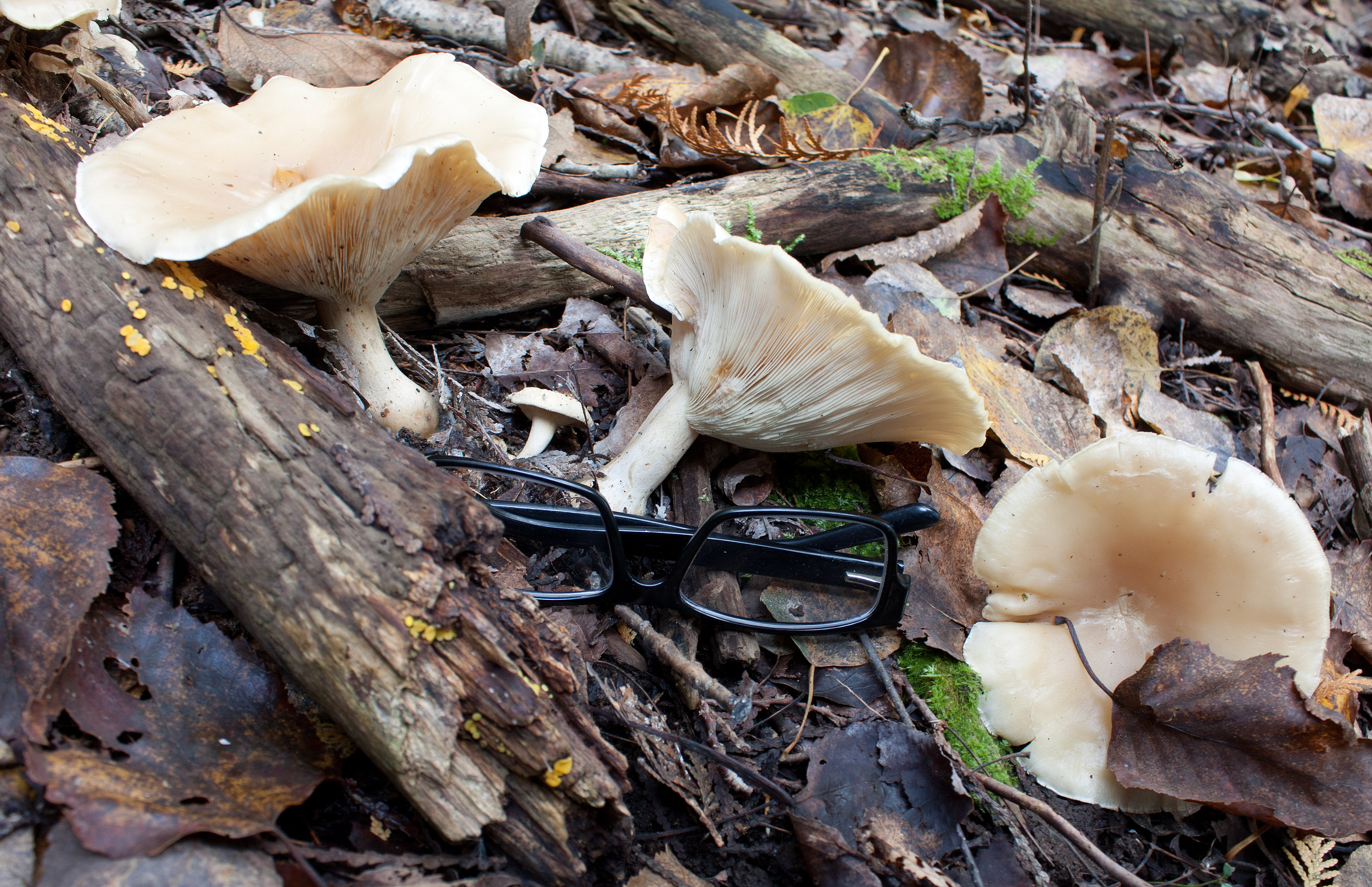
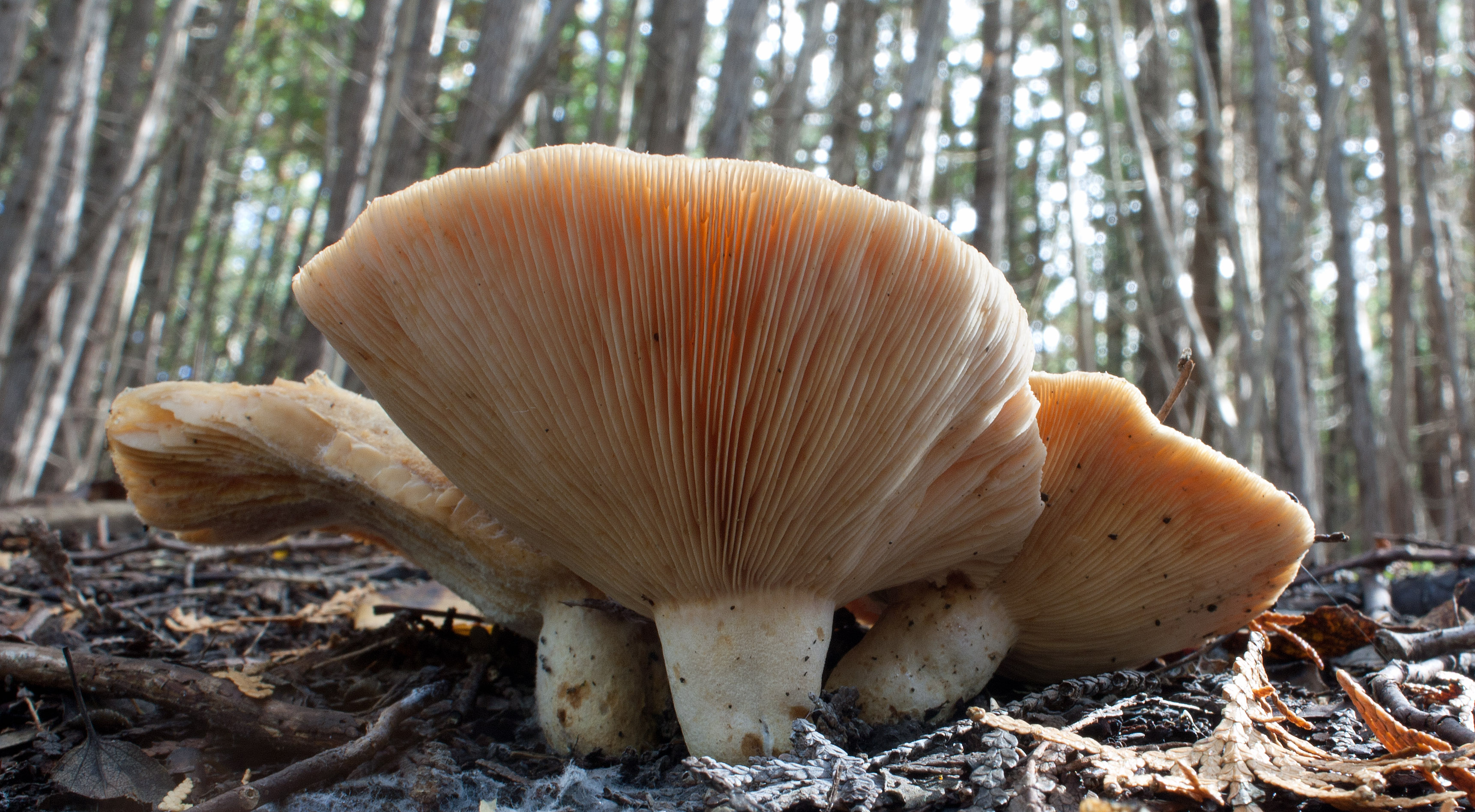
Ranging from four to seven inches across, their mushroom caps were mostly cream-coloured, and depressed in the middle. Some were browning on the edges and centre. These were all fairly mature, I thought, with smooth and rather wavy margins and whitish gills that descended down to (decurrent on) a short thick stubby stem.
.
NOT an Oyster Mushroom…
When I returned home, I initially identified this as the common oyster mushroom Pleurotus ostreatus, also called the Pearl Oyster. But further research revealed another more likely species based on its preference for the dead and rotting wood of poplar: the Aspen Oyster, Pleurotus populinis. This mushroom is a recent addition to the oyster family, separated out from P. ostreatus in 1993, given that it so closely resembles P. ostreatus. The Aspen Oyster mushroom appears anytime from spring through fall and grows mainly on living, dead or dying aspens and cottonwoods. They tend to grow in dense shelf-like clusters on dead or dying poplars. It seemed a good fit.
.
BUT… Jenny at Mushroom Appreciation describes both P. populinis and P. ostreatus as “mild and mushroomy, sometimes with a light licorice scent.” I detected no light licorice scent; while my specimen smelled ‘mushroomy’, it also gave off a rather pleasing sweet fruity-floral, almost vanilla, fragrance. I also thought it odd that all the mushrooms I found were thrusting out of the ground beside—not on—the fallen trees. Their gills also did not clearly run down the entire stem as they do in true oyster mushrooms. So, I abandoned the oyster and continued my search…
.
NOT a Milk Cap Mushroom…
My search came across the milk cap mushroom, commonly found in woodlands in Ontario. Their description of morphology and micro-habitat more closely matched the specimens I found. In keeping with their mycorrhizal associations, they were not restricted to trees, living on the ground under broadleaf deciduous trees (such as birch or beech trees) and sometimes conifers. Milk cap fruiting bodies become large, often with creamy-white caps more than 10 cm in diameter, depressed in the middle, and with shortly decurrent gills on the underside that end on an often stubby stem. Their scent depends on the species and varies from fruity to a distinctive coconut scent.
BUT, when I broke open a mushroom and rubbed my fingers against the fleshy gills, no milk came forth. All milk cap mushrooms, I’m told, exude milk; it’s why they go under that name. So, I kept looking…
.
Definitely a Short-Stemmed Russula (Russula brevipes)
.
After consulting Mushrooms of Toronto, I came upon my answer and found the ‘look-alike’ to the milk cap: Russula brevipes (short-stemmed russula), which is common throughout North America. The species name brevipes means ‘short foot’.
The City of Toronto notes that both milkcaps and russula have large white somewhat funnel-shaped caps, often depressed in the centre, and short white stalks. The authors suggest that, “Since Lactarius mushrooms have latex and Russulas do not, you should be able to tell these two mushroom species apart by breaking the flesh and looking to see if it exudes a milky white fluid.” I did and mine didn’t. The fragrance of my specimen was also in keeping with the varied description for the russula: from faintly fragrant to faintly foul. Alpental describes their smell as “sweet or flowery like cherries or geraniums, fishy, or putrid like rotting food.” My specimens gave off a distinct mushroom scent with a complex and pleasing sweet fragrance of flower and fruit with a hint of vanilla or cherry.

.
According to iNaturalist, the fruiting bodies of short-stemmed russula often develop under masses of leaves or conifer needles in a mycorrhizal association with trees from several genera (including fir, spruce, and hemlock). I found them thrusting up in a line or ring through a thick duff of cedar, poplar and birch leaves amid rotting logs and branches. UBC describes the habitat of Russula brevipes as “all kinds of forests, both with oaks and conifers, often only visible as a raised piece of forest floor.” According to Wang et al. andother scientists, Russula is an ectomycorrhizal fungus (EMF) that generally forms a mutualistic symbiotic partnership with various host plants, particularly conifers such as fir, spruce, pine and cedar, but also oak and alder. This ectomycorrhizal symbiont is often found partly hidden under forest litter, which is how I found many. Those ‘rings’ or ‘rows’ were likely a result of a specific symbiotic connection to specific tree roots below ground.
.
Russula brevipes is an Ectomycorrhizal Fungus
Ectomycorrhizal fungi help the plants obtain minerals and water as well as enhance plants’ resistances against pathogen infections and environmental stresses. Ectomycorrhizal symbiosis is a ubiquitous phenomenon, playing an important role in accelerating nutrient and mineral cycling and in maintaining ecosystem stability.
.
Unlike other mycorrhizal relationships (e.g. arbuscular and ericoid mycorrhiza) ectomycorrhizal fungi don’t penetrate their host’s cell walls; instead, they form an entirely intercellular interface known as the Hartig net, which consists of highly branched hyphae that form a latticework between epidermal and cortical root cells.
Ectomycorrhizas form a dense hyphal sheath, known as the mantle, that surrounds the root surface and hyphae can extend up to several centimeters into the surrounding soil. The hyphal network helps its host plant take up nutrients, including water and minerals, often helping the plant to survive adverse conditions. In exchange, the fungal symbiont receives carbohydrates. Ectomycorrhizas can occur in deep tree roots, up to four meters deep. This is why Russula is often not even seen at the surface.
.
Eating Russula brevipes & the Lobster Mushroom
.
According to UBC, Russula brevipes is edible, though they also warn that it may taste “down right awful.”
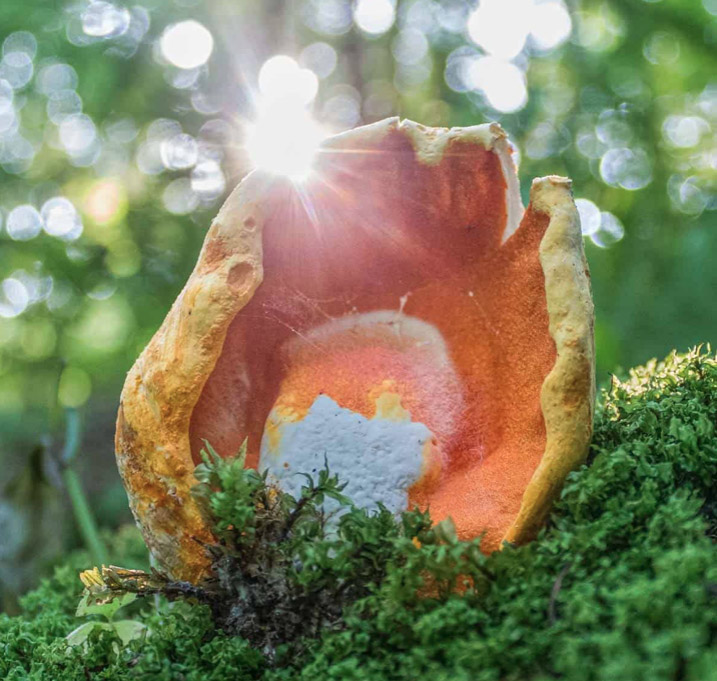
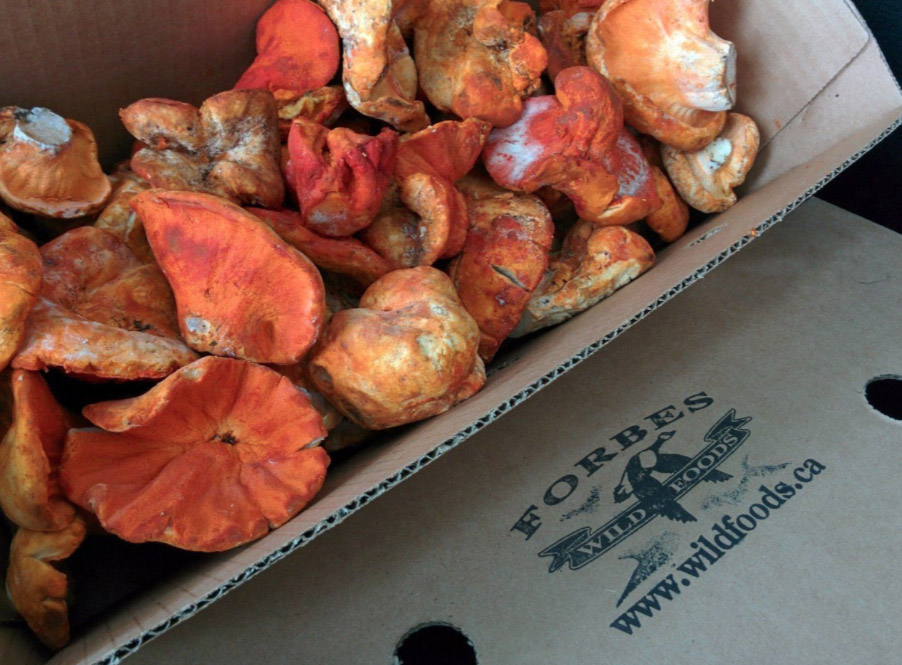
The short-stemmed russula can also be parasitized by the fungus Hypomyces lactifluorum; these parasitized mushrooms are commercially harvested and sold as “lobster mushrooms”. Forager Chef Alan Bergo, who has been hunting and cooking them for over a decade shares that the lobster mushroom (either Russula or Lactarius) has a subtle shellfish flavour that is easy to identify with no look alikes. Bergo shares that in Mexico, where they are sold at local farmers markets, they are known as Tromba de Puerco or pork horn, based on their vase-like shape and because they are cooled as a meat substitute. “They are usually boiled, then fried with tomatoes and onion, eaten with tortillas,” says Bergo.
The Cascade Mycological Society divulged that they had seen this lobster mushroom sell for as much as $40 a pound when it first hit their local markets. Forager Chef shared that in the Midwest he saw dried lobster mushrooms sell for $51/lb.
.
According to The Spruce Eats, the lobster mushroom is prized for its crustacean-like flavour, meaty consistency, and heartiness when cooking. Because the lobster mushroom only grows in the wild, sourcing it can be difficult, making them a rare, sought-after ingredient. Forbes Wild Foods adds that “In a vegetarian or seafood casserole, these mushrooms can fool diners into thinking that they are eating crab or lobster both by taste and by appearance. They are also excellent powdered and used as a rub or to make a pink cream sauce for pastas or seafood.” Forager Chef provides excellent advice on harvesting, cleaning and cooking lobster mushrooms, along with a few excellent recipes including ones for mushroom ratatouille, terrine, risotto, and cakes.

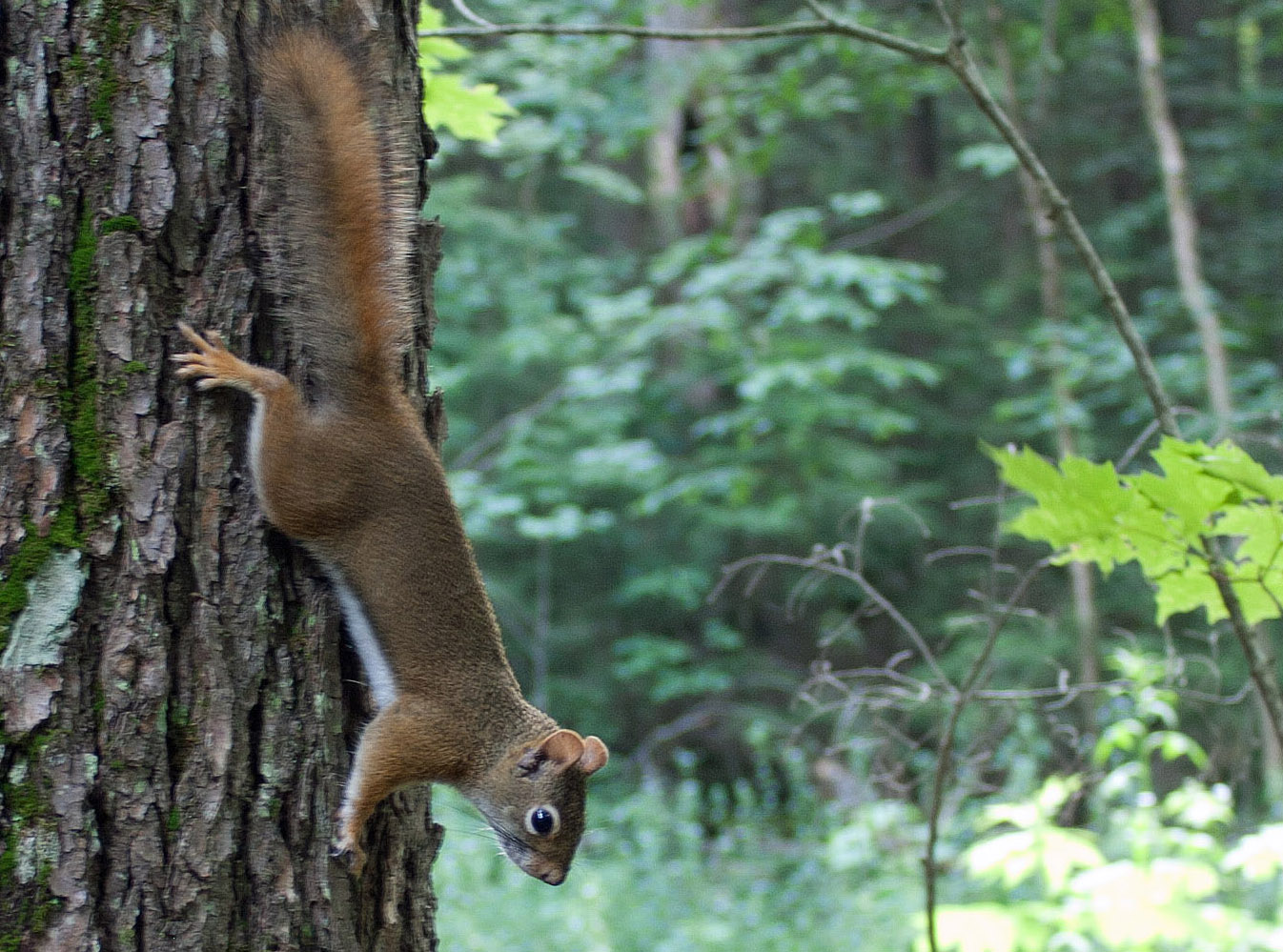
Russulas are also favourite food for slugs which can often be found nibbling on the cap or gills. Red squirrels also like Russulas. They will pick them and hang them up in trees to store them.
.
Russula brevipes as Trickster
.
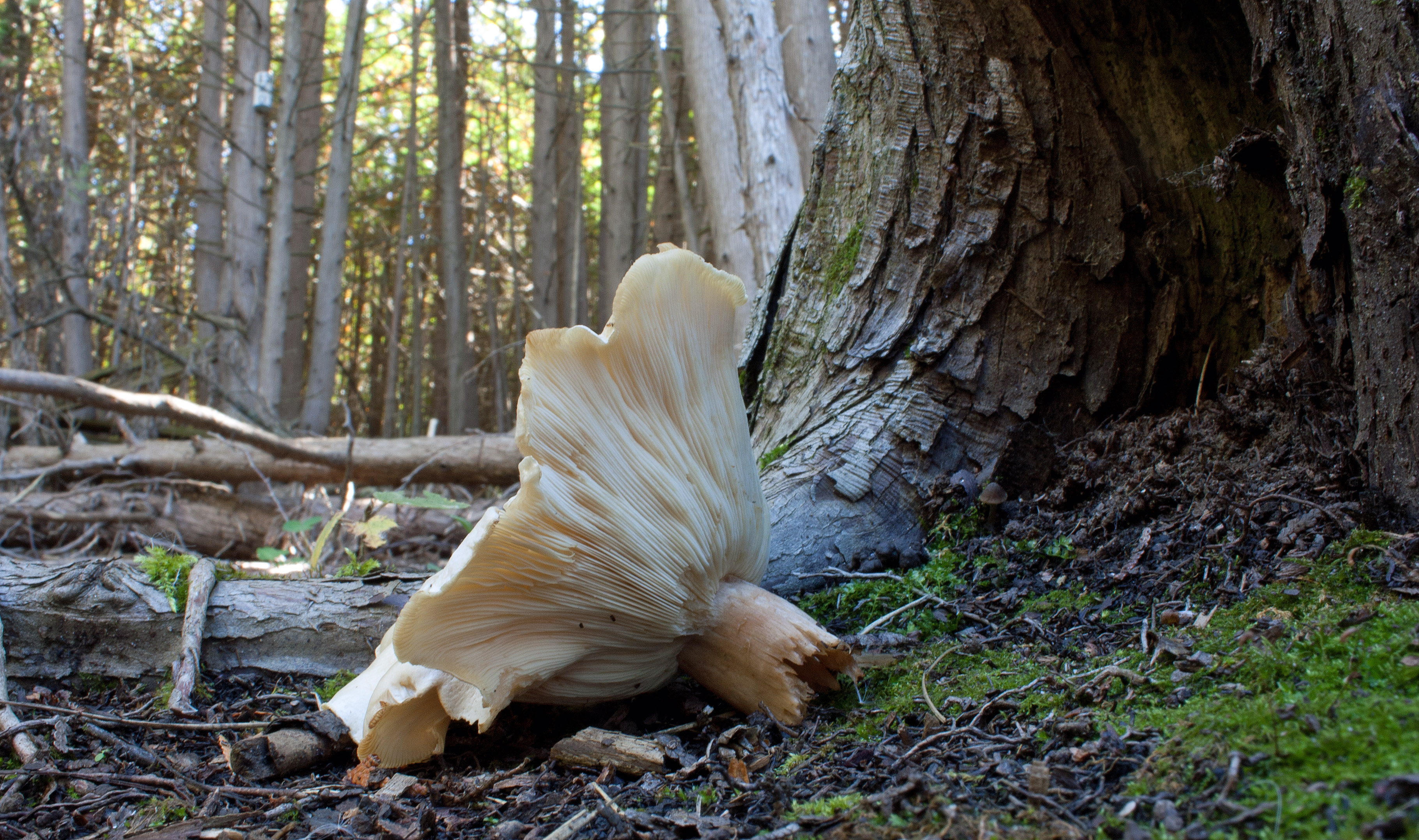
Mushroom Expert Michael Kuo writes that, “Russula brevipes … is essentially a fiction—a combination of several, or even many North American species that are in need of thorough study and revision.” Kuo goes on to say that mycologists have noted differences in ecology and morphology among the brevipes-like russalas for many years. “Some appear to be limited to conifers; others apparently associate with hardwoods. Some are western; some are Midwestern and eastern. Some have a mild taste, while others are weakly to strongly acrid. Some, when fresh, demonstrate a bluish line at the juncture of the stem and gills; others do not. Gill spacing ranges from nearly distant to very crowded.” He adds that varietal names have been applied to some as a result.
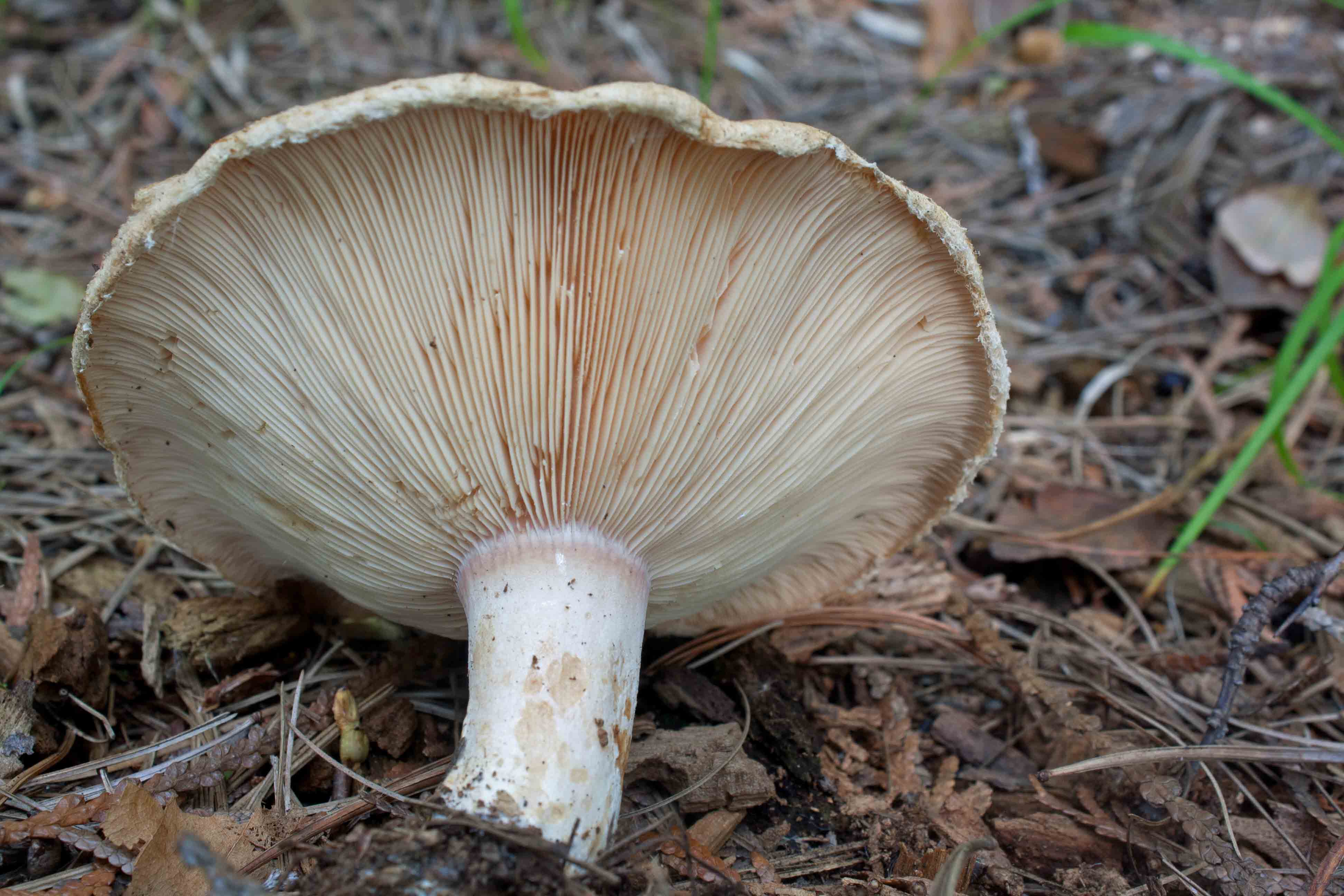
So, were the specimens I saw in Trent Nature Sanctuary Russula brevipes? Maybe; maybe not. I’m no expert, but for now—trickster or no—I’m sticking to my story.
.
References:
Barron, George. 2014. “Mushrooms of Ontario and Eastern Canada.” Partners Publishing, Edmonton, AB. 336pp.
Baroni, Timothy J. 2017. “Mushrooms of the Northeastern United States and Eastern Canada.” Timber Press, Inc., Portland, Oregon. 598pp.
Bergemann, Sarah E. et al. 2006. “No evidence of population structure across three isolated subpopulations of Russula bervipes in an oak/pine woodland.” New Phytologist 170(1): 177-184.
City of Toronto. 2015. “Mushrooms of Toronto: A Guide to Their Remarkable World.” City of Toronto Biodiversity Series. PDF. 69pp
Kuo, M. (2017, May). Russula brevipes. Retrieved from the MushroomExpert.Com Web site: http://www.mushroomexpert.com/russula_brevipes.html
Wang, P. et al. 2015. “Recent advances in population genetics of ectomycorrhizal mushrooms Russula spp.” Mycology 6(2): 110-120.

Nina Munteanu is a Canadian ecologist / limnologist and novelist. She is co-editor of Europa SF and currently teaches writing courses at George Brown College and the University of Toronto. Visit www.ninamunteanu.ca for the latest on her books. Nina’s bilingual “La natura dell’acqua / The Way of Water” was published by Mincione Edizioni in Rome. Her non-fiction book “Water Is…” by Pixl Press (Vancouver) was selected by Margaret Atwood in the New York Times ‘Year in Reading’ and was chosen as the 2017 Summer Read by Water Canada. Her novel “A Diary in the Age of Water” was released by Inanna Publications (Toronto) in June 2020.
 The Meaning of Water