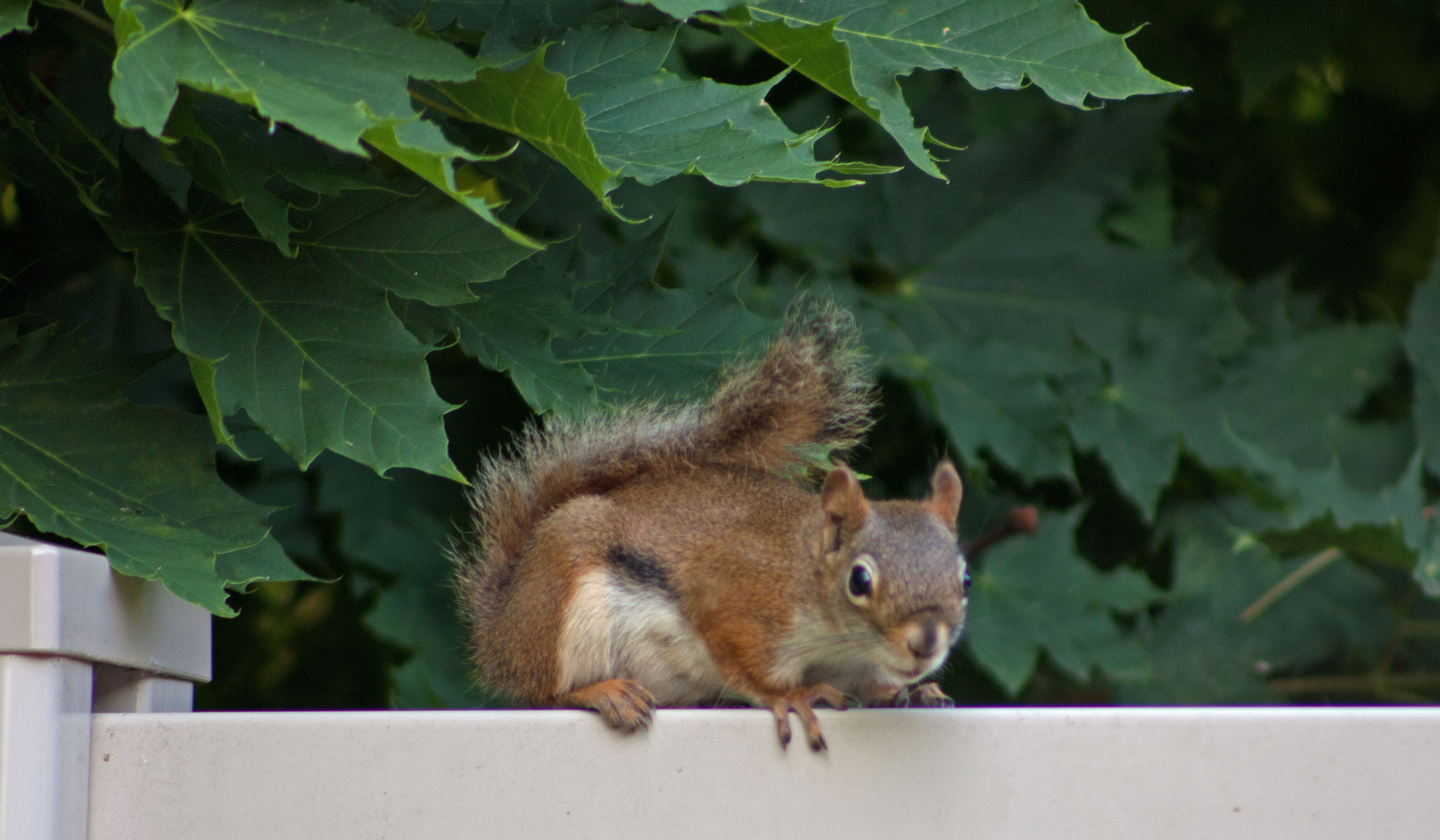
I spent this past Thanksgiving in the forest among the birds and chattering Red Squirrels. In one of my favourite places in the Trent Nature Sanctuary (where I look for the Earthstars among mossy cedars) I took some pics of bright red maple leaves amid the moss. When I rose from my crouched position, I found an apple propped in the wedge of a cedar branch next to me. Then I saw another one. And another one! Then I realized that they were everywhere! It was oddly wonderful. The little Red Squirrel (that normally scolds me when I’m in that part of the forest—obviously its territory) has been busy hoarding, putting up apples to dry for his cache. Elevating them not only aids drying, but also keeps them out of reach of insects and slugs. The dehydrated food then stores better, resisting decay over the winter.

Unlike the gray squirrel that tends to hide one or two nuts here and there, the Red Squirrel (Tamiasciurus hudsonicus) creates massive food pantries in late summer and fall. Andrew Wagner-Chazalon in Luxury Ontario tells us that they can have “as much as 50 litres of food hidden in a single cache.”
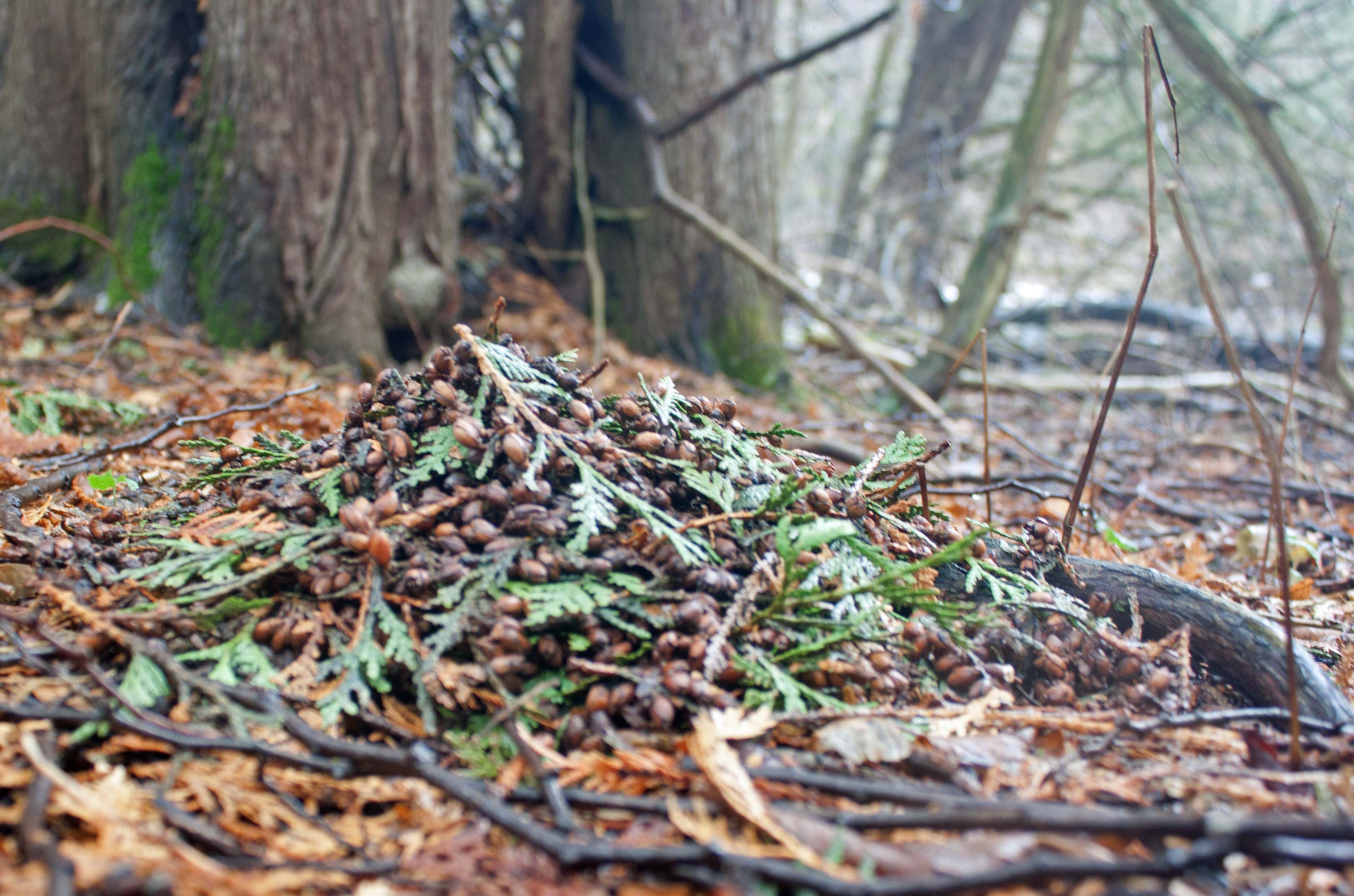
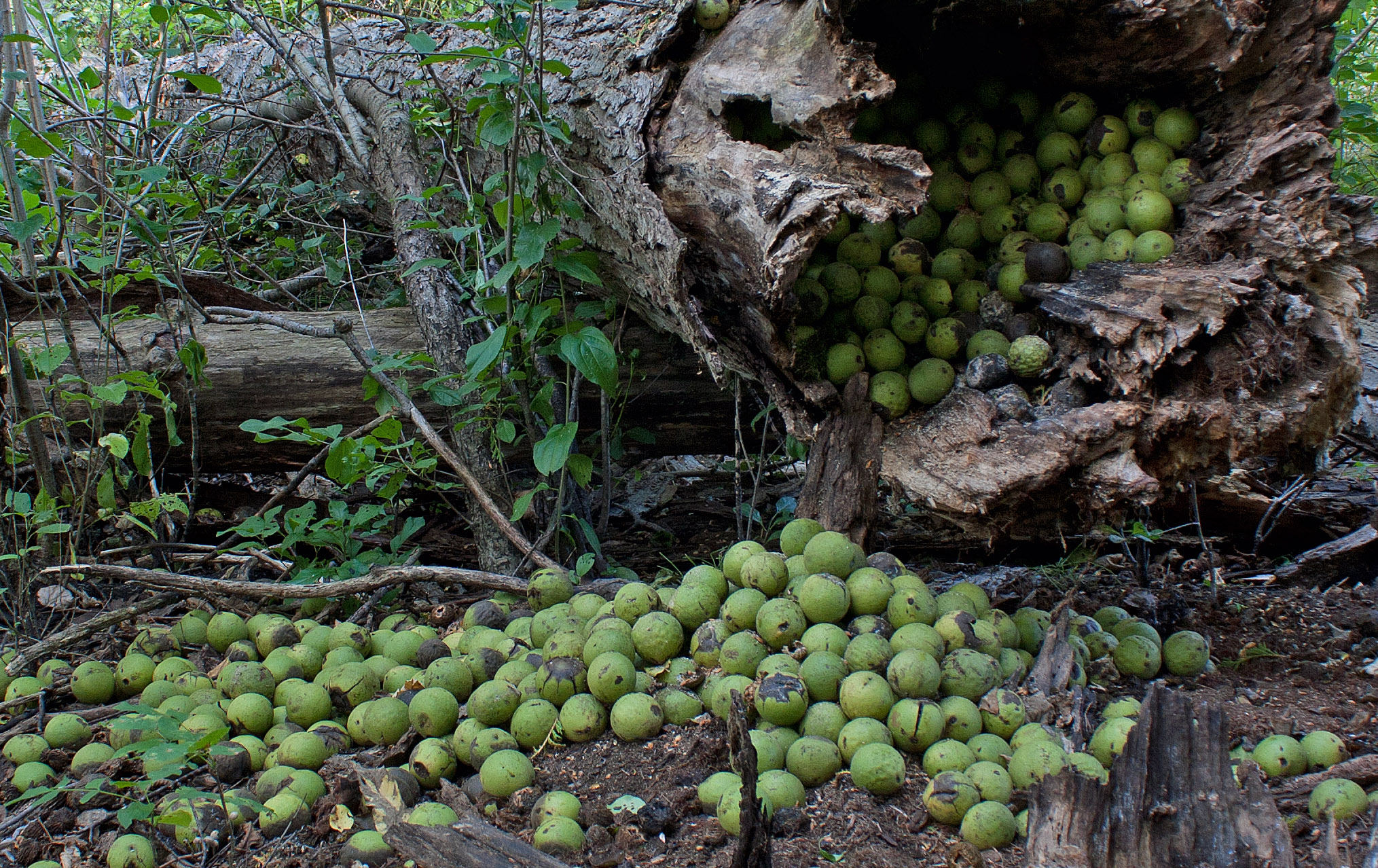
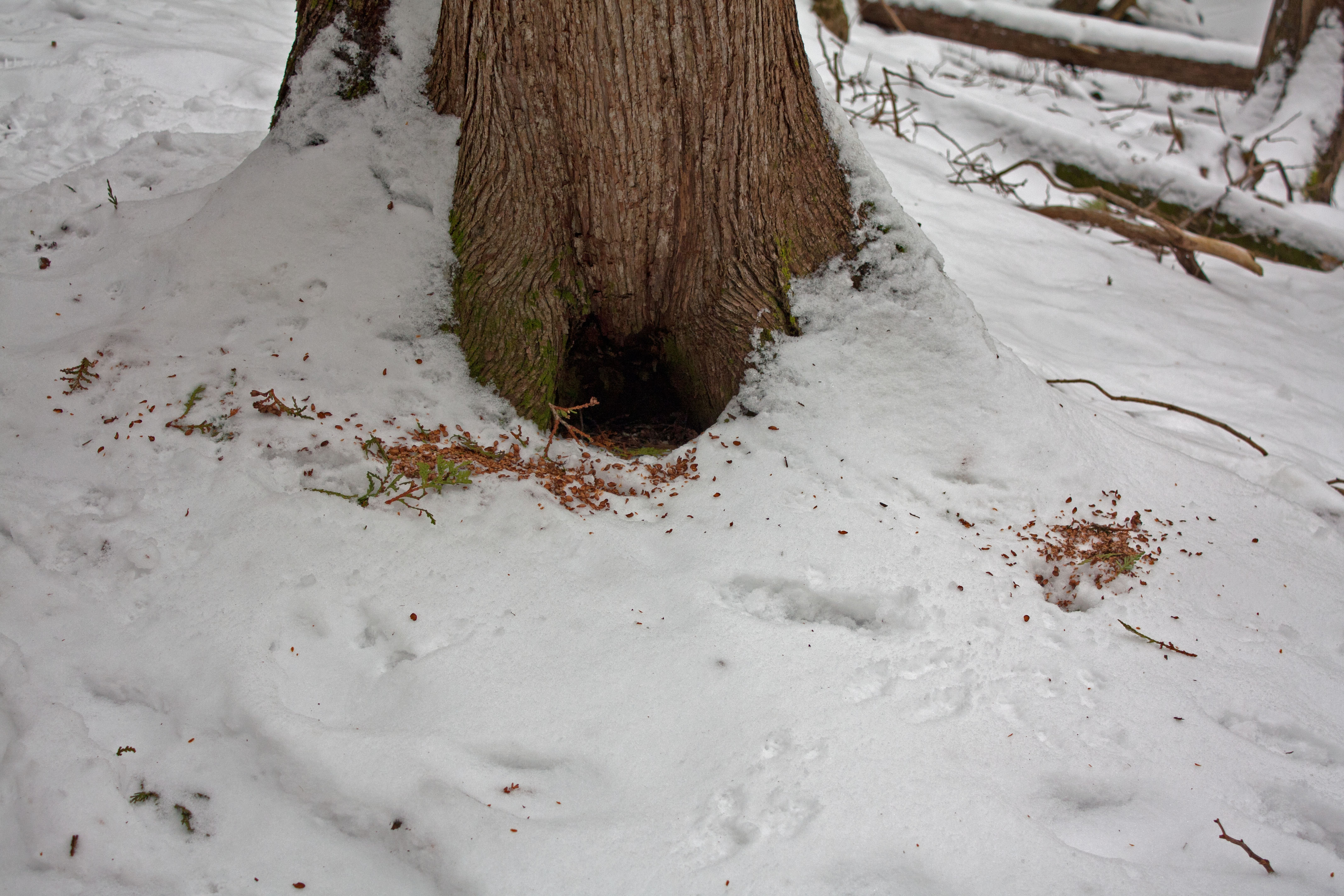
Their main food is conifer cones such as pine, spruce, fir, hemlock and cedar. They bite the stems of green cones and drop them to the forest floor, then go back later and pick them up, carrying hem to damp storage sites like hollow logs and tree cavities (the moisture keeps the cones from opening and losing their seeds). I’ve often encountered a mess of cone-laden cedar branches or a pile of spruce cones on a forest path dropped there by a busy squirrel. I’ve also seen middens of piled spruce or fir cones by a tree. Vermont photographer Susan C. Morse in Northern Woodlands shares that she has witnessed middens several feet in diameter and more than a few feet thick. She adds that they can be deliberately placed by streams or seeps or under moist logs to help keep the cones closed and preserve the seeds longer. On one of my walks, I spotted a large damp hollow log crammed with hundreds of black walnuts and a lone red squirrel stood guard on top of the log, squeaking and chattering madly at me.
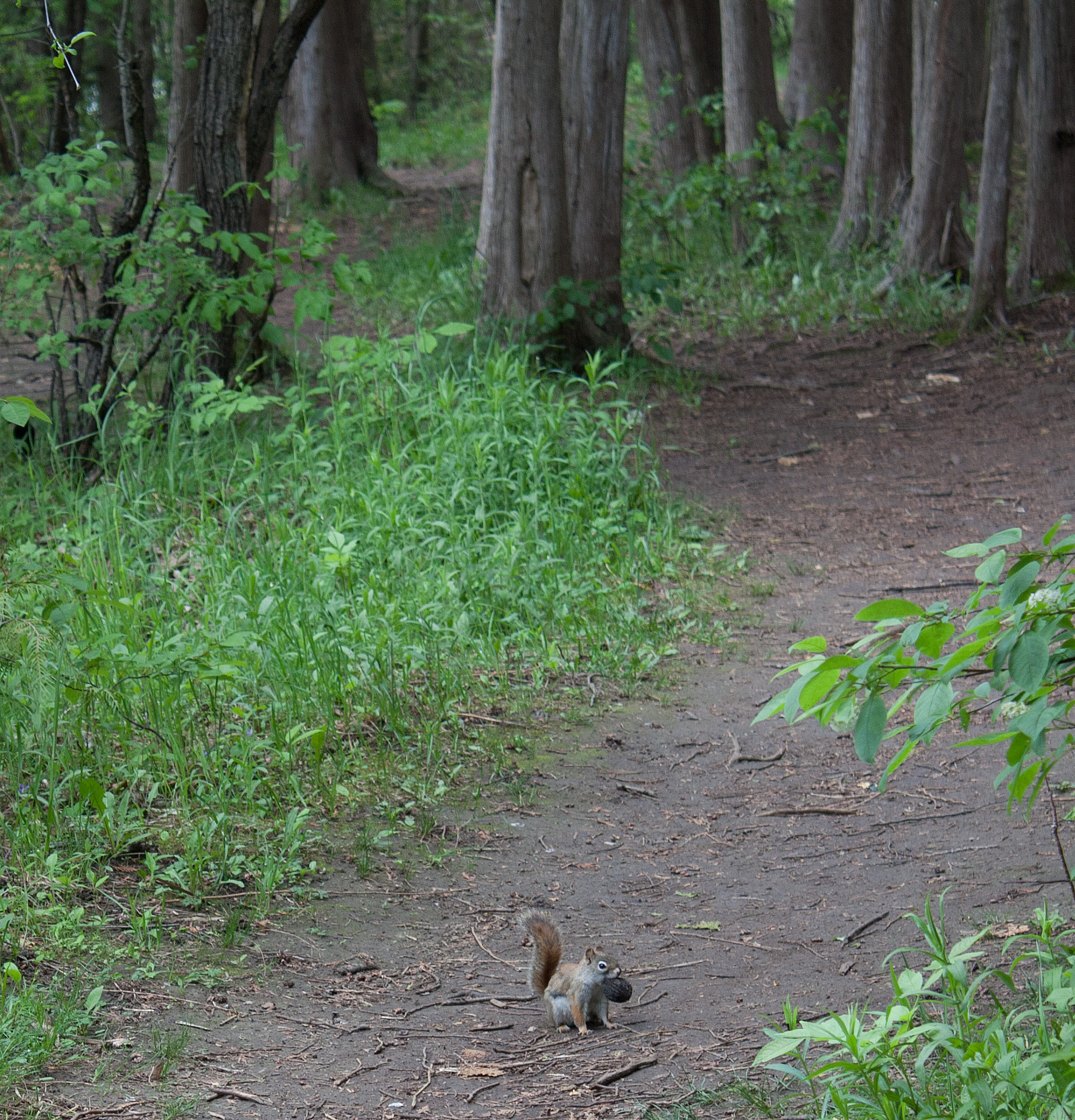
Red squirrels are known to cache mushrooms, which I’ve also seen tucked into a notch of a tree branch. They lay them out on these sunny branches to dry before adding them to their cache, often along with maple keys, cherry pits, beechnuts and other protein-rich foods. Red squirrels require these massive food stores to sustain their high energy levels. Luxury Ontario tells us that “in a single day, a red squirrel might eat the seeds from 100 spruce cones.”
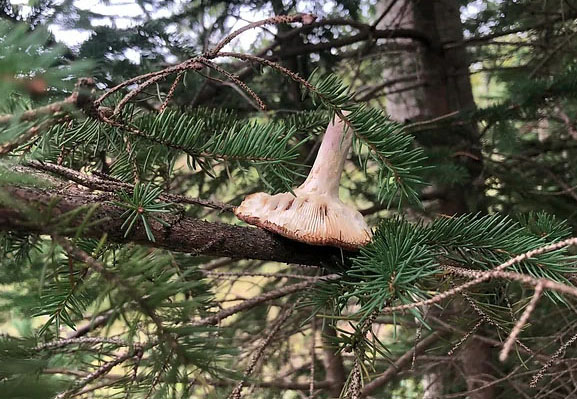
Kate MacQuarrie describes red squirrels as “true omnivores, feeding on seeds, nuts, fruit, flowers, bark, insects, bird eggs, nestlings, small mammals and miscellaneous dead things.” It’s in the fall that they have a particular penchant for mushrooms, she tells us. MacQuarrie shares that over the course of a couple of weeks, she has witnessed entire mushrooms and mushroom pieces appear in conifers, dry over a few days, then disappear. Foragers would agree that this practice is sound; dried produce resists decay and stores well over the cold, dark months. MacQuarrie shares that she most often sees the mushrooms placed upside down. She adds that “all this mushroom munching does have some ecological benefit, as Red Squirrels help spread fungal spores in their scat.”
.
The “Squirrely” Red Squirrel
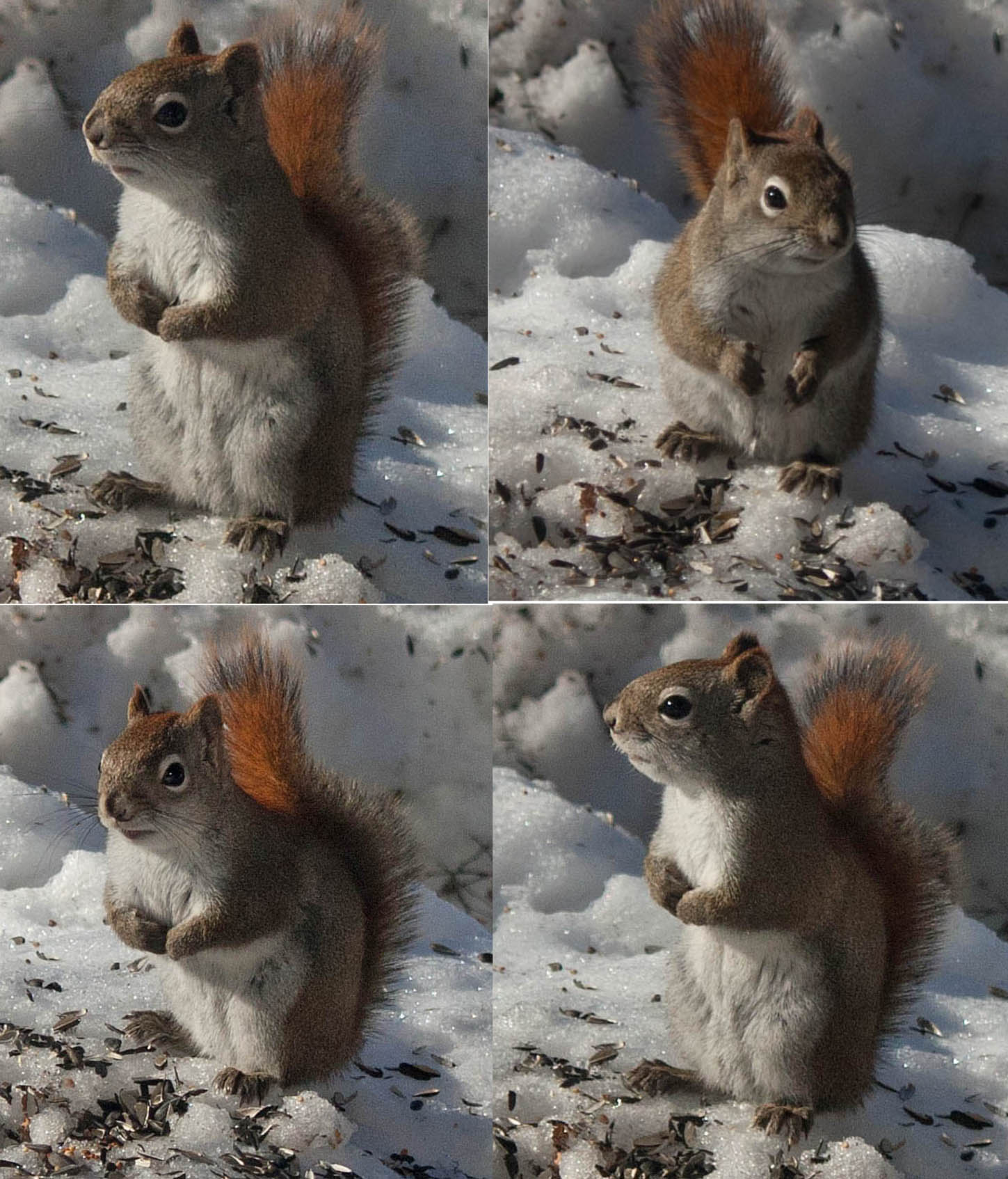
Luxury Ontario describes these red speedballs well: “Nobody has ever described a red squirrel as laid-back and casual. They seem to live with the accelerator nailed to the floor, zipping around trees and through branches with blinding speed.” Nor are they the silent type. I still remember the first time I encountered them as I first entered the Little Rouge forest near Toronto. I was met with an angry tirade of scolding chatter, stomping little feet and fierce flicking of tails. I’ve since seen one chase a large grey squirrel with the determination of a locomotive. They may be the smallest squirrels in Ontario, but they don’t seem to know it.
I’ve noticed that they are extra fierce when mating (in the late winter) and defending food caches (fall and winter). Luxury Ontario tells us that late winter is the breeding season for red squirrels, setting males into fierce chases to win the affection of females in heat. The female remains in heat for just a day and, as soon as she has mated, leaves her partner or chases him away from her territory; about a month after, she births a litter of 3 to 6 kits.
According to squirrel researcher Fritz Gerhardt, Red Squirrels constantly steal cones from each other’s caches. Gerhardt found that 25% of them changed ownership and practically all of them participated in pilfering.
Morse shares a wonderfully wild story of just how squirrely a Red Squirrel can get:
“Last year was a cone mast bust. The many squirrels living around my cabin really struggled to find enough to eat and store for the winter. For the first time in nearly 40 years, some squirrels insisted on moving into my place. They terrorized my house cats. One squirrel perched on my cook stove, eating from a box of Triscuits. It scolded me when I drew near and told me in vociferous squirrel language to “get the #$!& out of my kitchen!” Squatters’ rights indeed! They even clipped and cached the red, cone-shaped LED Christmas lights that surrounded the frame of my front door – 42 in all.”
How the Red Squirrel Invented Maple Syrup…

Luxury Ontario shares that “in early spring when their food supplies are running low, red squirrels will bite the bark of sugar maples, so the sap runs out. But they don’t drink it right away. Instead, they let the sun evaporate some of the water from the sap, and return later to drink up the more concentrated sugar. Indigenous people, seeing this, realized the sap of the maple tree was sweet, and began experimenting themselves.”
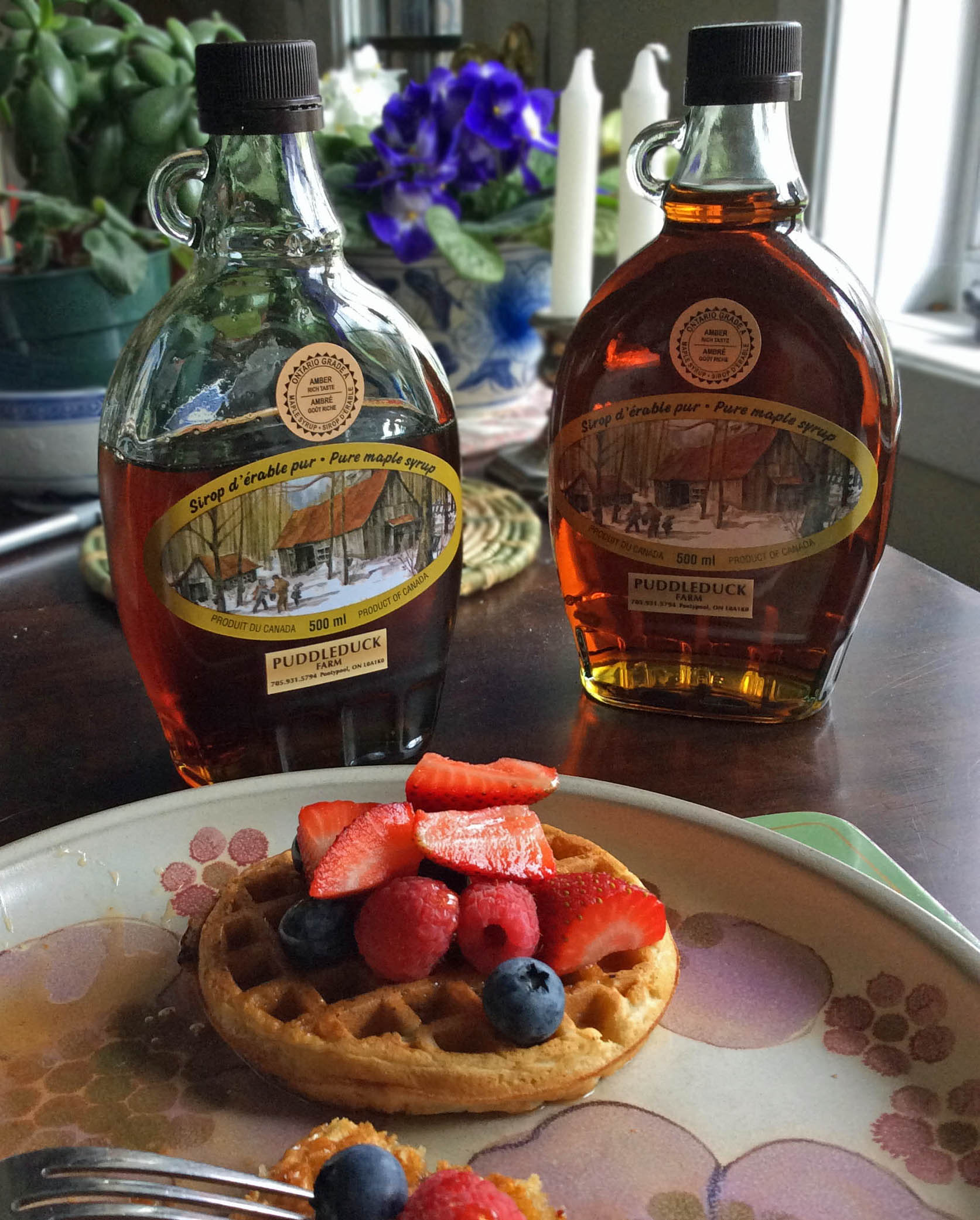
So, I profusely thank the feisty Red Squirrel for the maple syrup covered waffles and berries that I enjoy for breakfast.
Nina Munteanu is a Canadian ecologist / limnologist and novelist. She is co-editor of Europa SF and currently teaches writing courses at George Brown College and the University of Toronto. Visit www.ninamunteanu.ca for the latest on her books. Nina’s bilingual “La natura dell’acqua / The Way of Water” was published by Mincione Edizioni in Rome. Her non-fiction book “Water Is…” by Pixl Press (Vancouver) was selected by Margaret Atwood in the New York Times ‘Year in Reading’ and was chosen as the 2017 Summer Read by Water Canada. Her novel “A Diary in the Age of Water” was released by Inanna Publications (Toronto) in June 2020.
 The Meaning of Water