It was a warmish day in early spring as I walked through a mostly open mixed forest, not yet in leaf. I eventually ended up in a charming alvar, cloistered between the forest proper and a shrubby hill that bordered a popular park trail. When I first discovered the alvar, during a light snow fall, I startled two deer.

.
My walk began with an old abandoned gravel road at the end of a lane. The gravel road led to an abandoned field, a hardpan of gravel and grassland now home to a menagerie of urban garbage, rusting equipment, and brick piles—all left there over the years. I picked my way through what felt like an overgrown parking lot, but was likely just an extended part of the glacial alvar flat of mostly grasses and scattered poplar trees, to an actual trail that led up the drumlin. I headed north, drumlin sloping down either side of me. The trail took me through an open savanna of ash, hawthorn and sumac into a mature mixed beech-maple forest. The trees weren’t out in leaf yet, so I could see a fair distance through the skeletal forest. There was much to see!
.

.
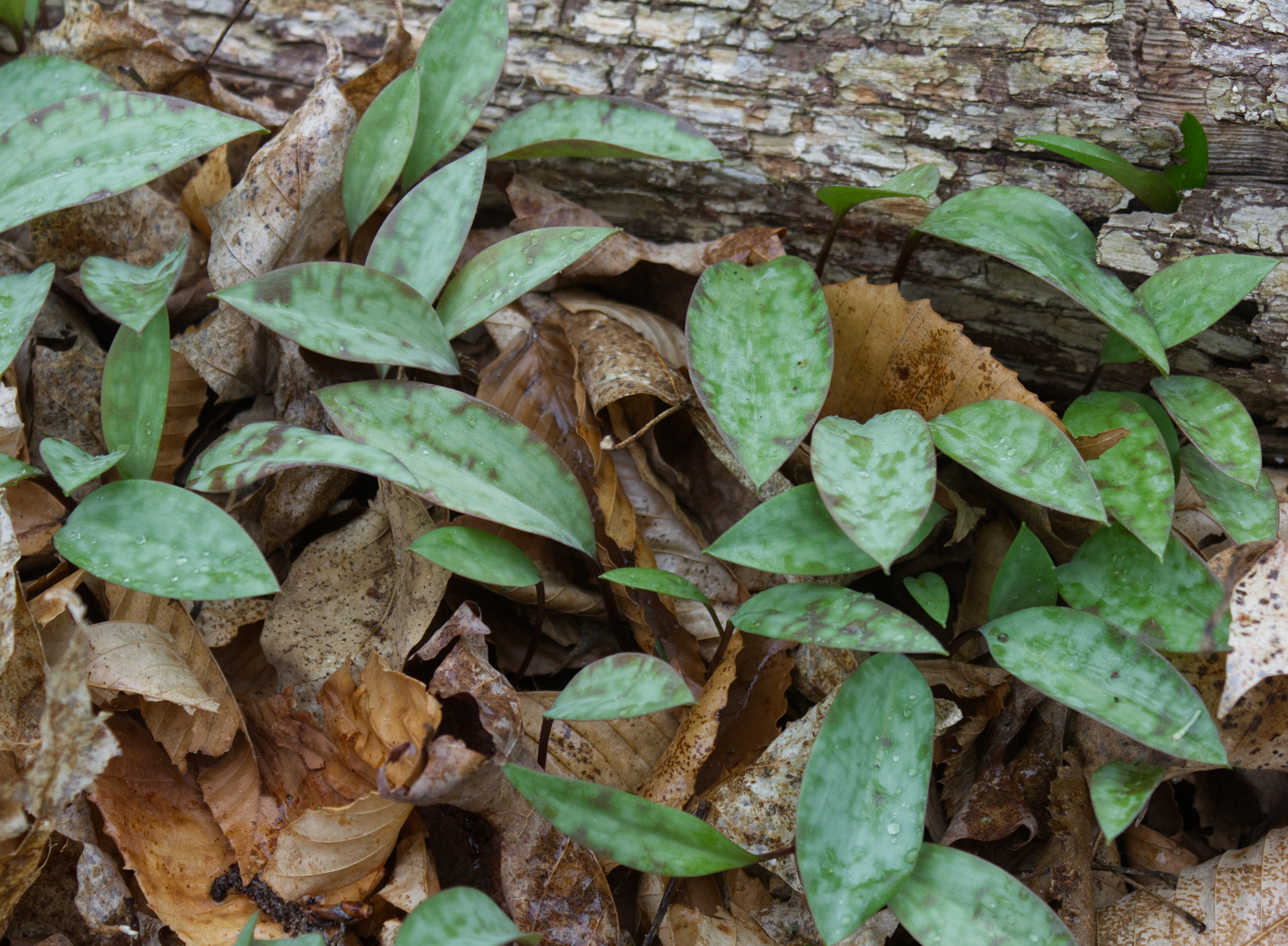
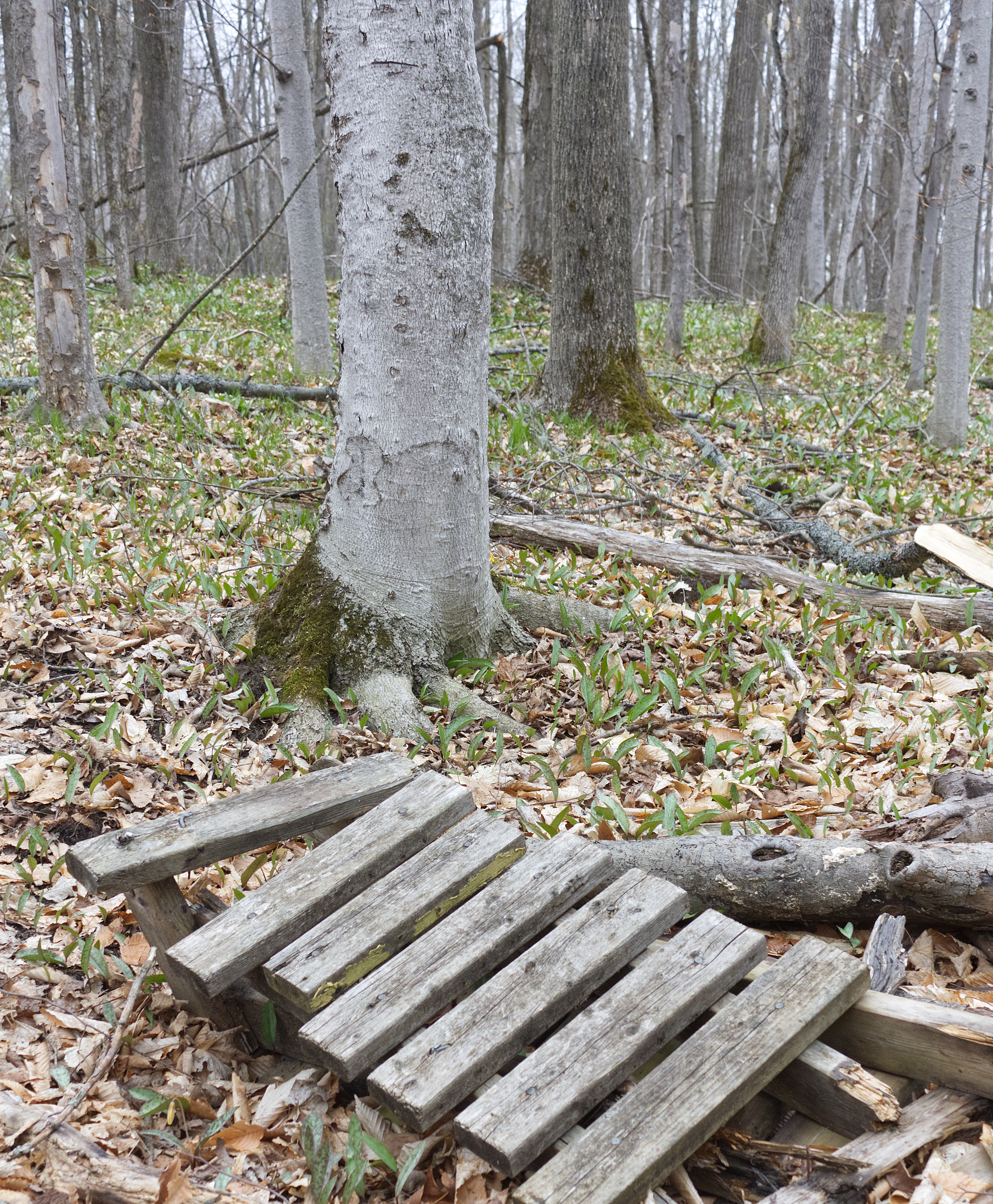
The trout lilies were barely thrusting their green-brown lanceolate leaves through the pale brown carpet of dead leaves. A few days later this same walk revealed a green carpet of new herb leaves and the odd bloom; in two weeks the forest floor would be a sea of yellow nodding flowers. I also spotted several white trilliums, some starting flower. I found them mainly nestled at the feet of several mature maple and beech trees.
.



.
I heard the frequent rustle in the dead leaves and my eyes kept flitting to catch a darting squirrel or bird. Eventually I caught the movement: a garter snake, well-camouflaged in the bed of dead leaves.

.
On one old poplar tree, I saw a rectangular hole about 7 cm by 12 cm at eye level. The hole extended deep into the wood. These are excavated by Pileated woodpeckers to find food and create nesting and roosting cavities. Beautiful red-headed birds, they also make a wonderful almost primeval quipping laugh in the forest. Of course their drumming sound reverberates through the forest.
.


.
My focus landed mostly on the bark of the bare deciduous trees. Such variation! From the smooth grey bark of the beech to the gnarly scaled bark of the maple. Or the peeling curling bark of the brilliant white birch. Or the long thin strips of cedar bark.
.


.
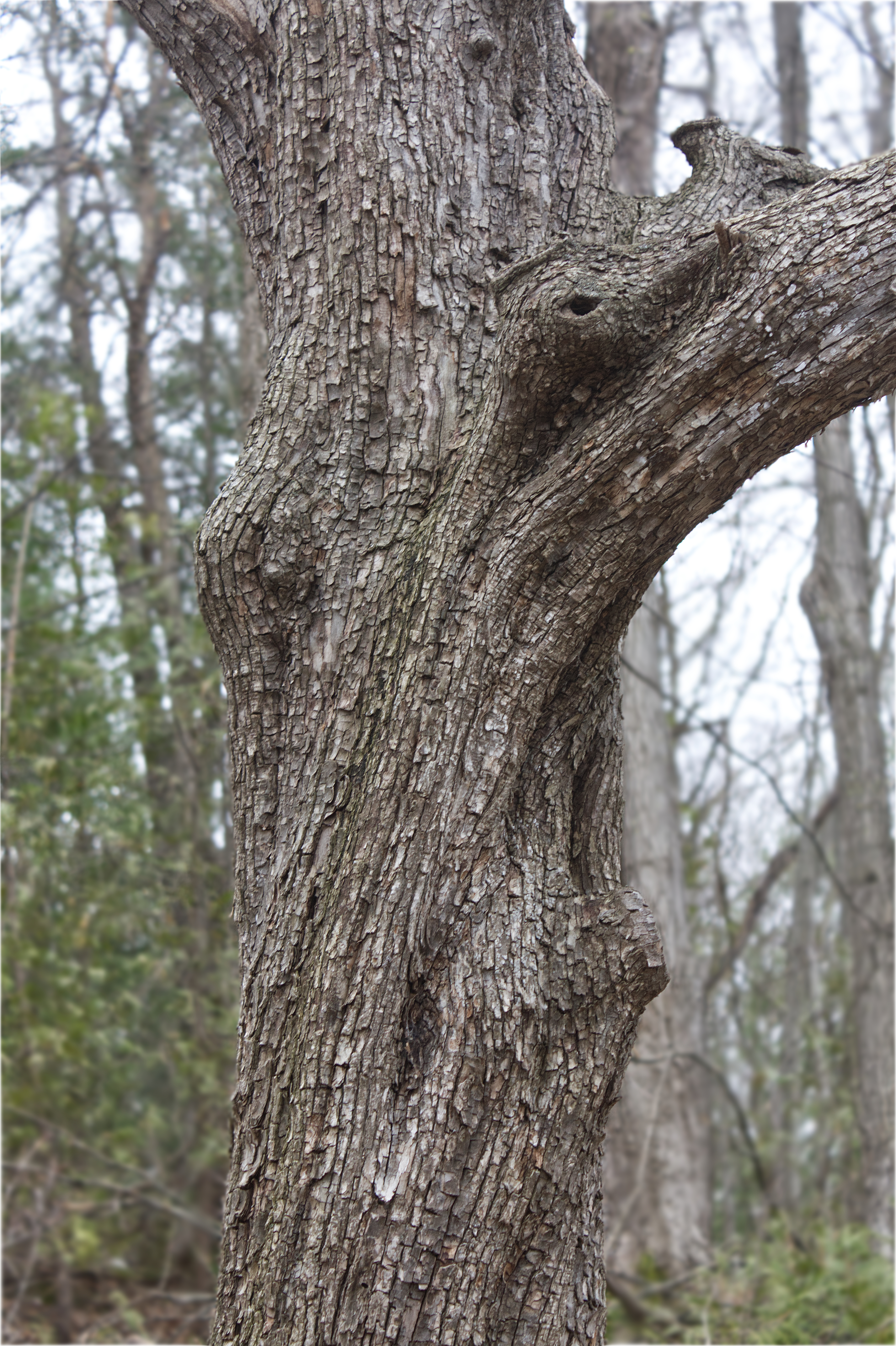
I passed beneath the open canopy of several mature sugar maples and took in their scaly bark, which often resembled rock or granite. Deep furrows resembled great crevices. I recognized several lichen friends from previous mature maple tree studies.
.

.
Most were crustose but some were common foliose lichen such as Mealy Shadow Lichen (Phaeophyscia orbicularis) and Mealy Rosette Lichen (Physcia millegrana). Crustose lichen included: Common Button Lichen (Buellia erubescens), Common Script Lichen (Graphis scripta), the Comma Lichen (Arthonia excipienda), and Candleflame Lichen (Candelaria concolor).
.


.
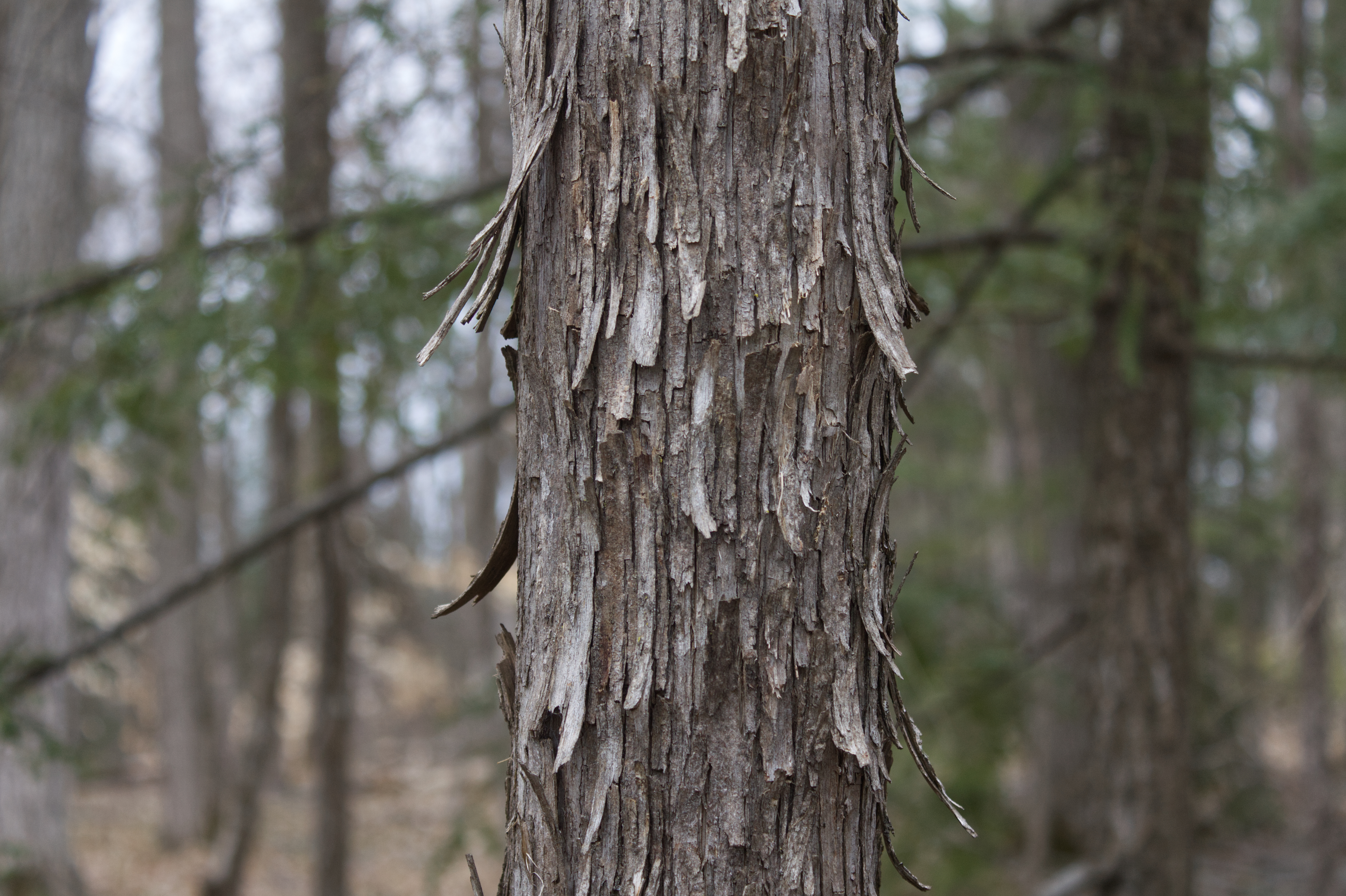
I spotted the vertically flaking bark of American Hop-hornbeam (Ostraya virginiana). Common as an understory tree in this maple-beech forest, the Hop-hornbeam belongs to the birch family and is easily identified by its shaggy, vertically peeling bark. I inspected the bark carefully and noticed that lichen formed on the flaking bark as easily as on a flat beech. I saw mostly small crustose lichen, including Powdery Goldspeck (Candelariella efflorescens). Some older trees were covered with foliose Mealy Shadow Lichen (Phaeophyscia orbicularis) and Candleflame Lichen (Candelaria concolor).
.

.
Standing next to the Hop-hornbeams was another friend: the Blue Beech. I saw a cluster of them by the trail, slim trees with smooth-grey bark that formed sinewy ripples up the trunk. The muscled bark was also covered with Mealy Shadow Lichen and Common Script Lichen, Graphis scripta. As with Hop-hornbeam, this tree grows in spaces between the taller overstory trees—a mix, depending on soil and moisture of maple, beech, hemlock, cedar, pine, basswood, oak and white and yellow birch. The Blue Beech is very shade tolerant tree, using the sunlight filtering through the upper canopy. It grows best in moist, rich and well-drained sites with a high tolerance for seasonal flooding.
.

.
The Blue Beech (Carpinus caroliniana) is not, in fact, a beech at all. Despite its resemblance to the smooth grey bark of the true beech, it, like the American Hop-hornbeam, is in the birch family. Also known as the American Hornbeam (not to be confused with the American Hophornbeam, Ostraya virginiana), this tree is appropriately called ‘musclewood tree’ or ‘muscle-beech’ for its muscle-like ridges on smooth-gray beech-like trunk. Because of its dense hard wood, it is also called “ironwood”, which is rather confusing, given that the American Hop-hornbeam (Ostraya virginiana) is also called ironwood because of its very dense and hard wood. To add to the confusion, these two trees occur in the same habitat and I have often seen them close together as I did on this occasion.
Despite the confusion of their names, these two ironwoods are easy to tell apart by their appearance: their size, the bark of the trunk, and their reproductive parts. Blue Beech is a smaller, slimmer tree; its bark is more smooth and not flaking; and its flowers and seeds look quite different to its other namesake.
.


.
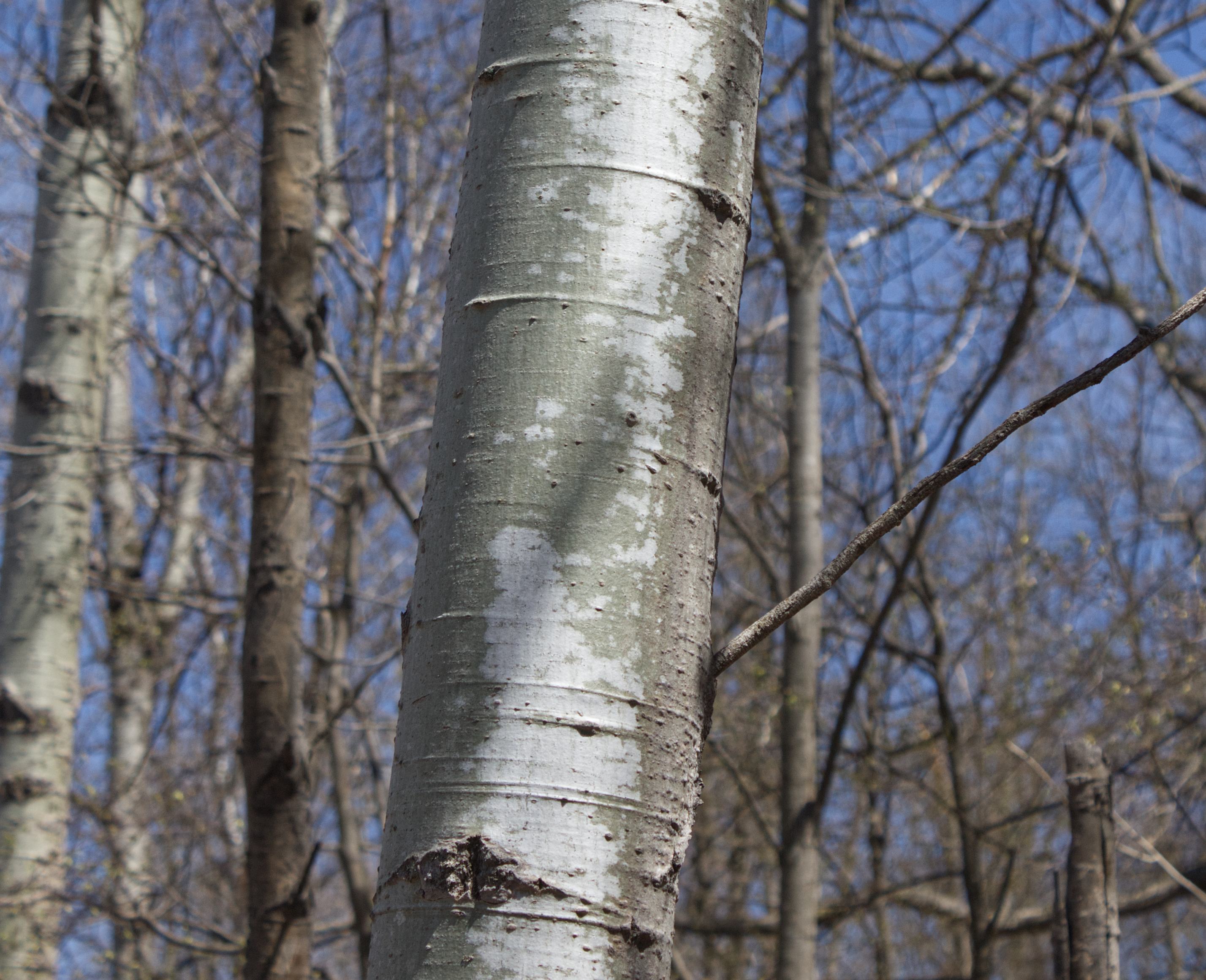
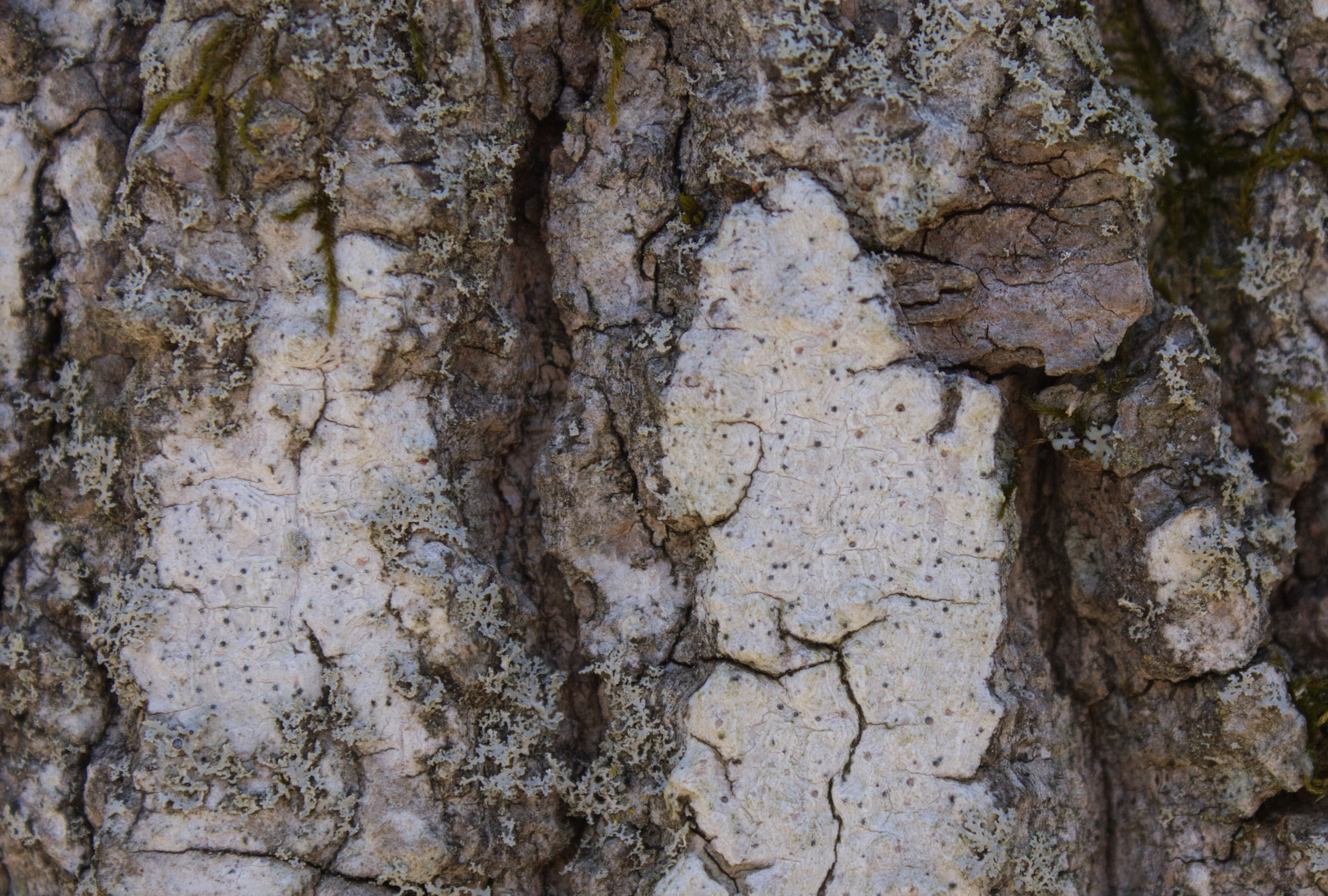
From the drumlin hill, I headed west down into the alvar, toward the main Greenway Trail. I notices that the young poplars on the edge of the forest, overlooking the alvar, were covered in patches of whitewash lichen (Phlyctis arvensis). I’d most often seen it on maple trees; but, this common crustose lichen seemed to like the smooth bark of these young poplars equally well.
.
.
Once in the alvar flats, I walked along a rocky windy trail through sumacs, junipers and stands of cedar with lowland wetland south of me.
.
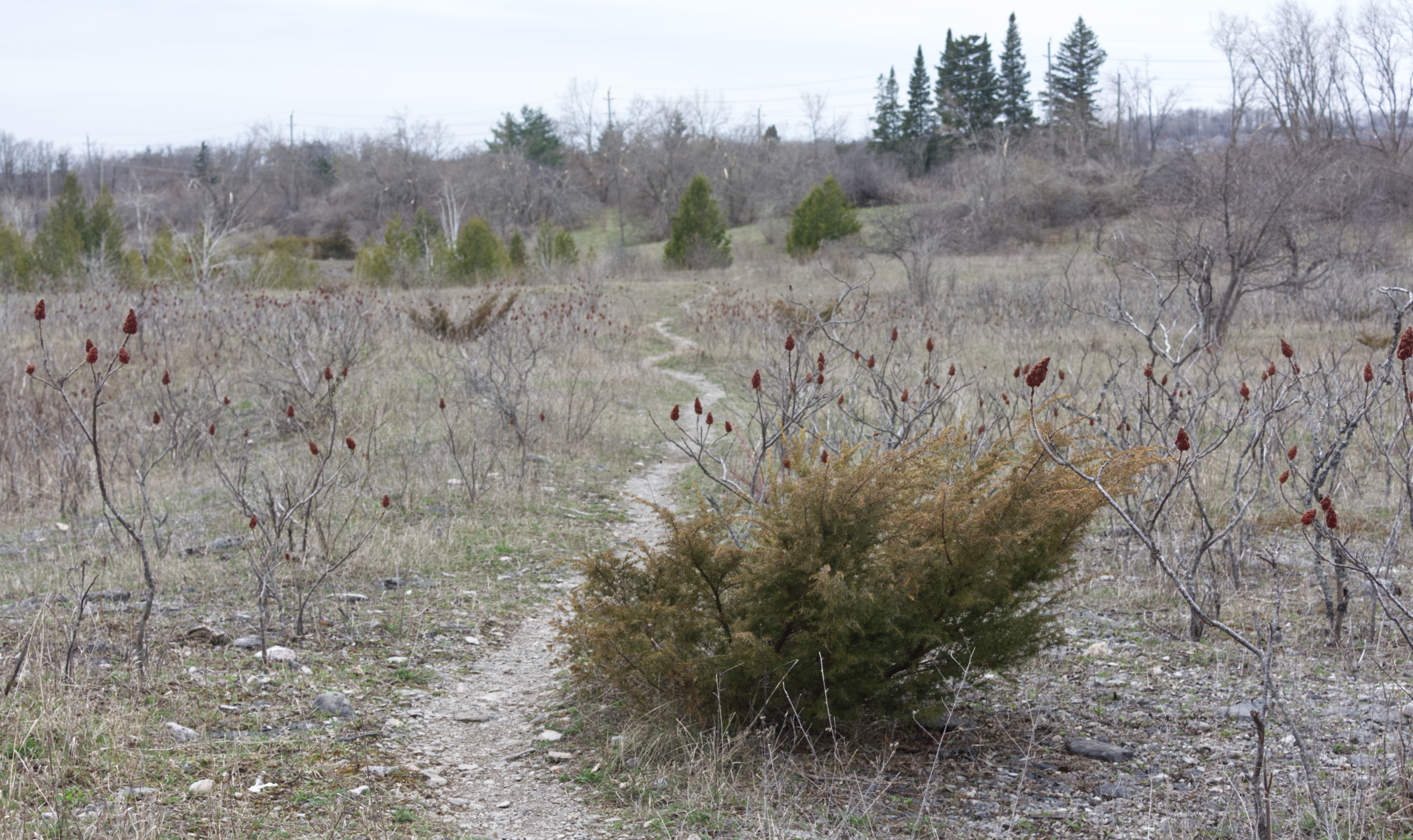
What struck me as I entered the natural bowl of this limestone meadow, was the quietude. It was completely silent. No pervasive hum of city traffic. No whine or thrum of some far machine. It felt timeless. I stopped and breathed in deeply, inhaling the quiet space into my brain.
.

.
Shortly after getting on the Greenway Trail, I noticed an abandoned Goldfinch nest in the fork of two branches of a shrub. The cup-shaped nest was lined with some soft materials, possibly spider silk, thistle down or hair. I’m told that their nests are commonly located 4 to 10 feet above the ground and usually built solely by the female.
.
The South Drumlin Nature Area & Forest

.
The main feature of this nature area is the large drumlin covered in deciduous forest. In the shape of an elongated teardrop, the hill was formed under glacial ice about 10,000 years ago. The drumlin is about 830 m long and 300 m wide, at its widest, and rises about 20 m above the surrounding landscape. The drumlin and park runs basically north-south along the Trent Canal to the east. Micro-habitats succeed one another along either side and even along the length of the NS running drumlin. The south and east regions are mostly maple-beech forest with hemlock and cedar and an understory of American Hophornbeam, white ash, and even some blue beech. The north and west regions are dominated by Largetooth Aspen, with some cedar and mature sugar maple. The Nature Area is bounded north by Nassau Mills Rd. The western side of the park runs into limestone meadow and lowland marsh that eventually meets the Greenway Trail, and to the south, by farmland and a residential development. The park is a lovely functional mixed forest ecosystem, supporting varied wildlife from deer to the Pileated Woodpecker.
.

.

.

Nina Munteanu is a Canadian ecologist / limnologist and novelist. She is co-editor of Europa SF and currently teaches writing courses at George Brown College and the University of Toronto. Visit www.ninamunteanu.ca for the latest on her books. Nina’s bilingual “La natura dell’acqua / The Way of Water” was published by Mincione Edizioni in Rome. Her non-fiction book “Water Is…” by Pixl Press(Vancouver) was selected by Margaret Atwood in the New York Times ‘Year in Reading’ and was chosen as the 2017 Summer Read by Water Canada. Her novel “A Diary in the Age of Water” was released by Inanna Publications (Toronto) in June 2020.
.
 The Meaning of Water