
.
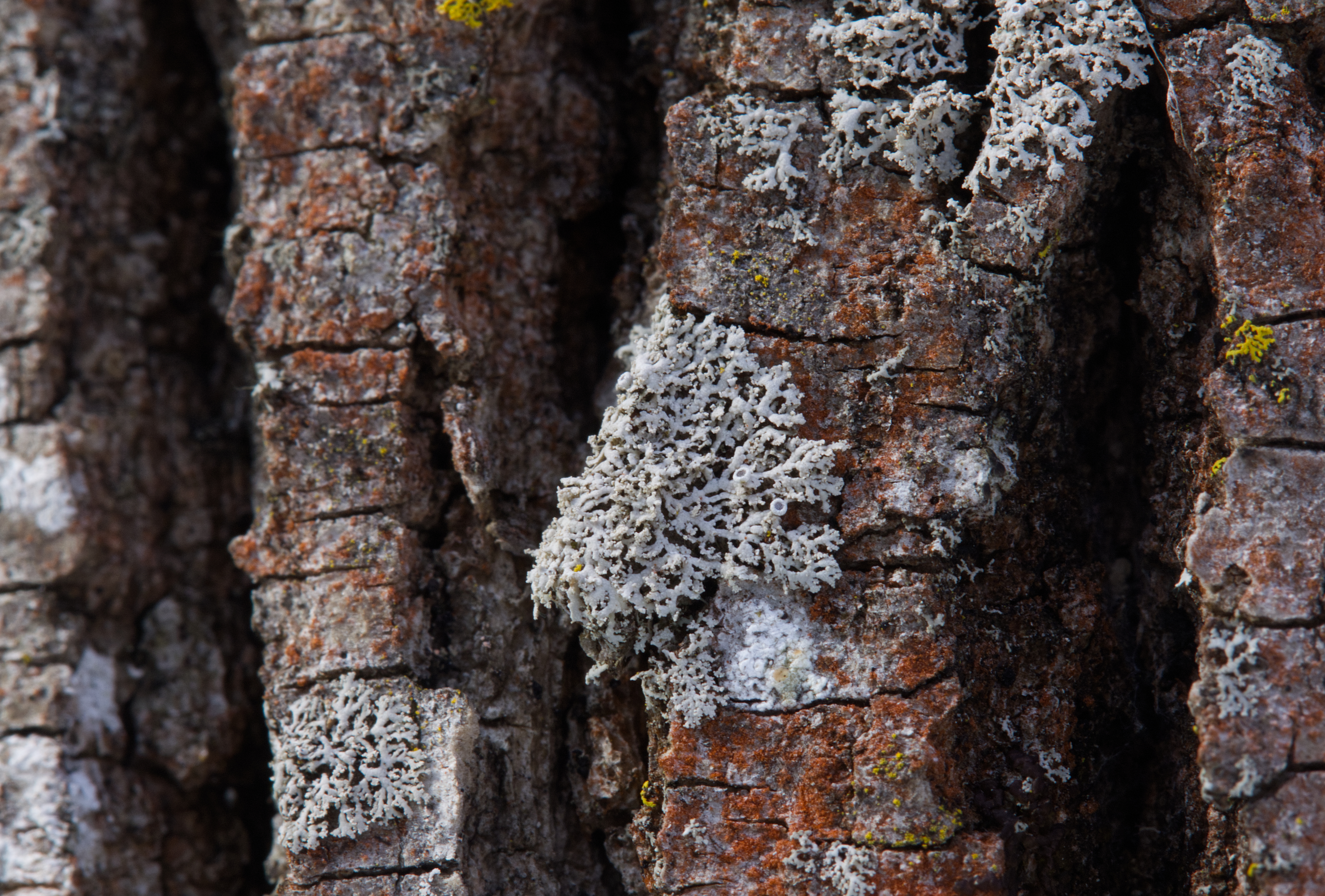
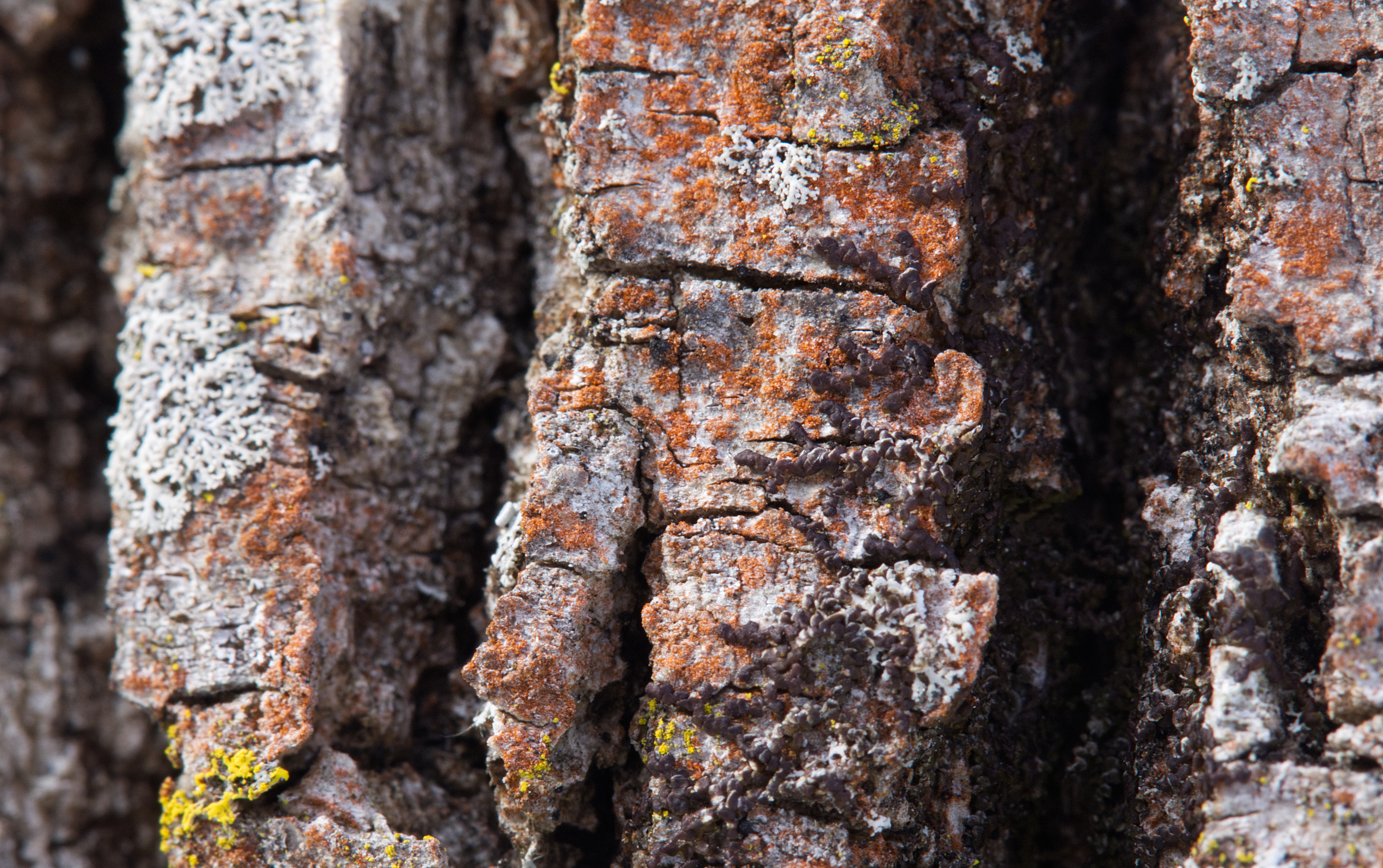
I was walking through the swamp forest of maple, beech and cedar when I entered a meadow sparsely populated with ash trees. I had to stop at one of the trees because its bark was red-orange. It was a phenomenon! What I mean is it was the Red Bark Phenomenon: a species of microscopic green algae (Chlorophyta) with red pigments that mask the photosynthetic chlorophyll. Some smart aleck named this algae the Red Bark Phenomenon. I’d seen it on a poplar tree and a maple tree in the same forest and a hemlock tree in the Catchacoma Forest. At first I thought this red film might be a crustose corticolous lichen. It reminded me of the dust lichens only red, not the typical ice green.
.
.
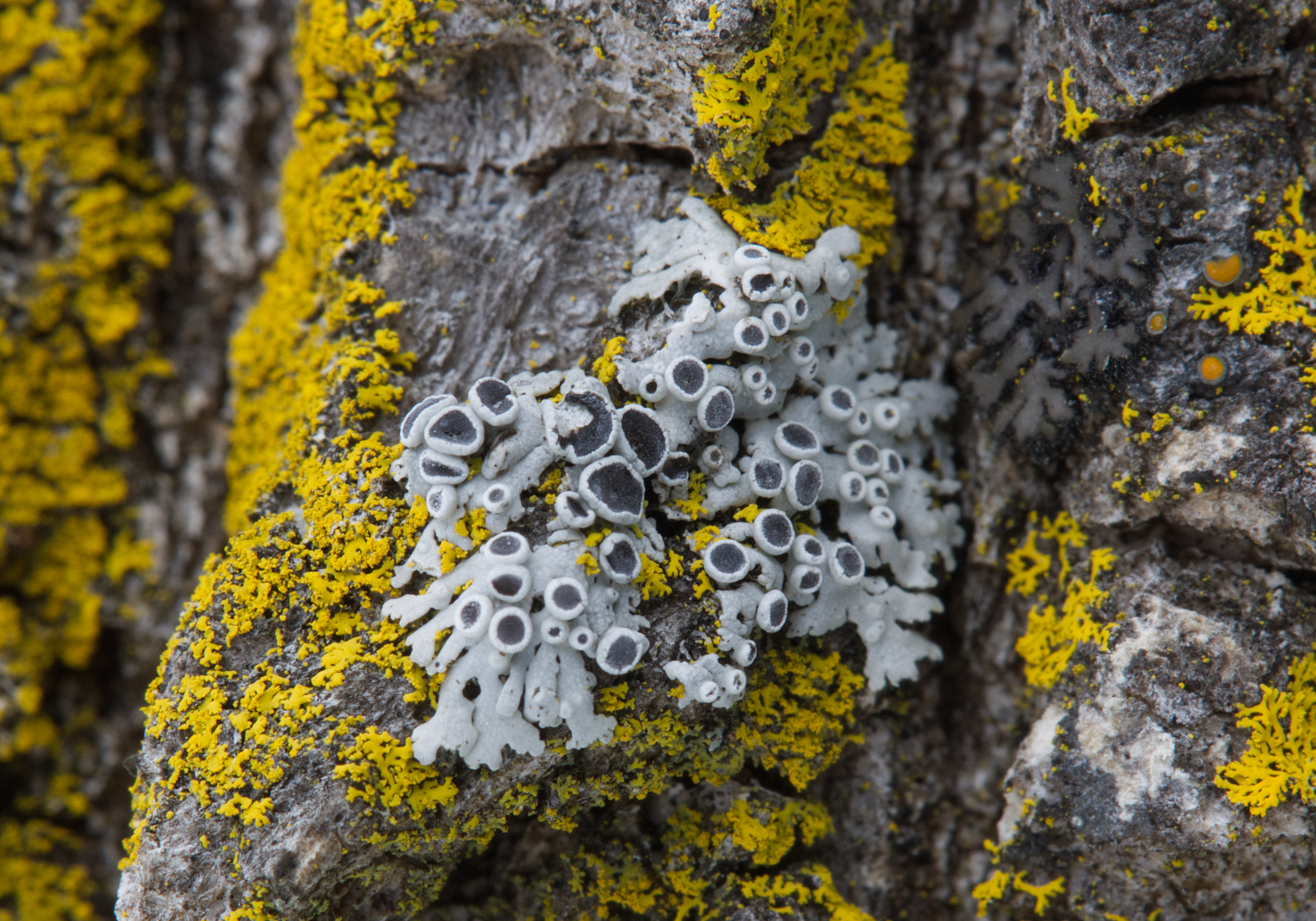
There were, after all, several corticolous lichen that I identified inhabiting the ash bark. These included: the Star Rosette Lichen (Physcia stellaris), Mealy Rosette Lichen (Physcia millegrana), Candleflame Lichen (Candelaria concolor), Common Tree Firedot (Caloplaca holocarpa), Brown-eyed Rim Lichen (Lecanora allophana), and Pom Pom Shadow Lichen (Phaeophyscia pusilloides), as well as the New York scalewort (Frullania eboracensis). Further research revealed the identity of this strange algal beast with an equally strange name.
.


Finding the truth is always an interesting and convoluted journey. Sometimes, as my sister said to me once, “you must go deep into the [bark] fissures to find the truth.”
.
Trentepohlia is The Red Bark Phenomenon

.
The real name for Red Bark Phenomenon (RBP) is Trentepohlia, a filamentous subaerial green alga that colonizes terrestrial as well as aquatic habitats. According to To Know the Land: “Trentepohlia was named by a German botanist, Carl Friedrich Philipp von Martius, after another German botanist Johann F. Trentepohl, because they were colleagues, not because the name has anything to do with the algae itself (boring!). But, just by chance, the origin of the name Pohle may have its origins in meaning “one who lives by the water/pool.” So, by strange twists, it may be accurate. Trente means 30.”

.
The genus Trentepohlia is an epiphyte on tree wood and bark, or wet rocks, and artificial substrates as well as aquatic habitats. They can also occur as endophytes in leaves and epizooically on some animals. Trentepohlia also commonly forms associations with fungal hyphae to create symbiotic lichens. Trentepohlia is a widespread photobiont of lichens. Examples include the crustose secret writing lichens Graphis, Graphina, Gyalecta and Opegrapha. Other examples of lichens with Trentepohlia include Strigula, Raciborskiella, Racodium, and Coenogonium.
.
From Homestead to Luxury Condos

.
This cosmopolitan alga is just as happy living free on its own in various terrestrial and aquatic habitats as part of a crowded lichen community. The cytoplasm of these algae contain large quantities of ß-carotenoids (an orange pigment) and haematochrome (which colours blood red). These secondary pigments likely allow a broader range of wavelengths to be absorbed to capture more sunlight energy for photosynthesis to occur.
The alga adheres to the bark, forming branching mats that create a red-orange crust or film on the bark surface. The film doesn’t penetrate the bark surface and doesn’t seem to affect the tree in the least. As with moss and some lichens who often prefer a side of a tree, I noticed that Trentepohlia seemed to prefer the north side of the ash tree. To Know the Land also noted this in their observations and suggested this might be due to micro-moisture and sunlight conditions. It’s possible prevailing winds may also play a role in colonization.
According to Horticulture for Home Gardens, trees growing near water are more likely to be colonized by these algae, which makes sense considering the moisture factor. Trees most often colonized include: white pine, eastern hemlock, various oaks and birches, American beech, apple, American elm, black cherry, chestnut, green ash, London plane tree, various maples and European larch, and various aspens.
.

.
To Know the Land tell us that asexual reproduction occurs in one of 3 ways: zoosporangia (mobile asexual spore which uses flagella to move), aplanospore (immobile spores that may nevertheless potentially grow flagella), and akinetes (dormant cells resistant to cold and desiccation, which can remain dormant until favorable growing conditions trigger germination back into a vegetative cell).
.

.
The Red Bark Phenomenon & Climate Change
Apparently, the Red Bark Phenomenon is fairly recent in occurrence, having first been observed a few decades ago in the New England states on eastern white pine and eastern hemlock then spreading fast from there into a wider range and on many other trees. Some scientists speculate that this is climate related, particularly due to changes in winter conditions such as heavier and wetter snowfall, less snow cover overall and higher annual precipitation. Because algal growth and reproduction depend on temperature, water, light, pH, and nutrients, accelerated arrival of spring and expanded growing seasons along with progressively wetter winters all work to enhance the growth of this alga.
Highly variable environments tend to support rare species: organisms that are uniquely equipped for change. These are the explorers, misfits, and revolutionaries who do their work to usher in a new paradigm. They carry change inside them, through phenotypic plasticity, physiological stress response mechanisms, or life history adaptations. Like bdelloid rotifers going dormant through anhydrobiosis. Or algae forming dormant akinete spores that survive desiccation for years before ‘hatching’ into a new organism. These mavericks are in tune with the vacillations of Nature; epigenetics-induced adaptation is the only option for keeping up with rapid and catastrophic environmental change, not to mention something as gigantic as climate change.
To Know the Land added that thanks to climate change, lichens with Trentepohlia as photobiont are expanding their range around the world, moving northward and increasing in abundance. Trentepohlia is thriving both solo and in community as a lichen.
Perhaps the future is red…
.
References:
Agrawal, S.C. 2009. Factors affecting spore germination in algae- a review. Folia Microbiologica 54:273-302.
Aptroot, A., C.M. van Herk. 2007. “Further evidence of the effects of global warming on lichens, particularly those with Trentepohlia phycobionts.” Environmental Pollution 146(2): 293-298.
Boggs J., (2019). Red Bark on Sycamore and London Planetrees. Red Bark on Sycamore and London Planetrees | BYGL (osu.edu)
Brooks, F.E. 2004. “Plant-parasitic algae (Chlorophyta: Trentepohliales) in American Samoa.” Pacific Science 2004. 58:419-428.
Brooks, F., Rindi, F., Suto, Y., Ohtani, S. & Green, M. 2015. “The Trentepohliales (Ulvophyceae: Chlorophyta): an usual algal order and its novel plant pathogen, Cephaleuros.” Plant Disease 99: 740-753.
Chapman, R. L. 1984. “An assessment of the current state of our knowledge of the Trentepohliaceae.” Pages 233–350 in D. E. G. Irvine and D. M. John, eds. Systematics of the green algae. Syst. Assoc. Spec. Vol. 27.
Cheah C. and Li D.W. (n.d.). “The Red Bark Phenomenon.” CAES. The Red Bark Phenomenon (ct.gov)
Cheah, Carole. 2016. “The Red Bark Phenomenon.” (PDF) The Red Bark Phenomenon (researchgate.net)
Holland M., (n.d.). “Red Bark Phenomenon.” Red Bark Phenomenon | Naturally Curious with Mary Holland (wordpress.com)
Mukherjee, R., Borah, S., Goswami, B. 2010. “Biochemical characterization of carotenoids in two species of Trentepohlia (Trentepohliales, Chlorophyta).” Journal of Applied Phycology 22: 569-571.
Rindi, Fabio & Juan M. Lopez-Bautista. 2008. “Diversity and ecology of Trentepohliales (Ulvophyceae, Chlorophyta) in French Guiana” Crypotgamie, Algol. 29(1): 13-43.
.
.

Nina Munteanu is a Canadian ecologist / limnologist and novelist. She is co-editor of Europa SF and currently teaches writing courses at George Brown College and the University of Toronto. Visit www.ninamunteanu.ca for the latest on her books. Nina’s bilingual “La natura dell’acqua / The Way of Water” was published by Mincione Edizioni in Rome. Her non-fiction book “Water Is…” by Pixl Press(Vancouver) was selected by Margaret Atwood in the New York Times ‘Year in Reading’ and was chosen as the 2017 Summer Read by Water Canada. Her novel “A Diary in the Age of Water” was released by Inanna Publications (Toronto) in June 2020.
.
 The Meaning of Water
One thought on “When Green Algae Turn Red: The Red Bark Phenomenon”