I write novels, mostly eco-fiction. They’re frequently set in bizarre worlds with shifty characters. The shapeshifter archetype in fiction often seems one thing but is in fact another. Like tricksters, they challenge the hero on her journey with puzzling trompe l’oeil or Goethe glass, distorting the truth while it is right there before her. In fiction the shapeshifter is often the most intriguing character of a story, whether it is Han Solo of Star Wars, Professor Snape of Harry Potter, or the cheshire cats of The Windup Girl. Genetically developed as a toy by some agri-giant, these crafty creatures could become invisible by blending into their surroundings…
.
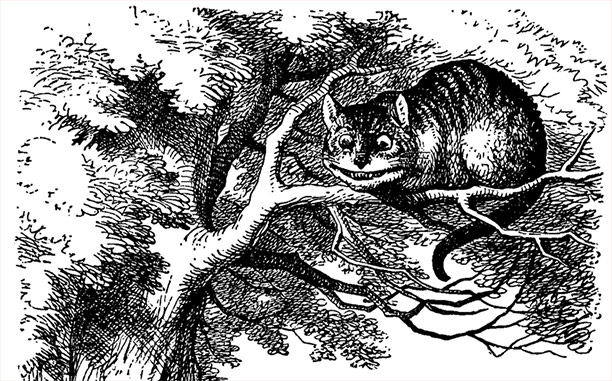
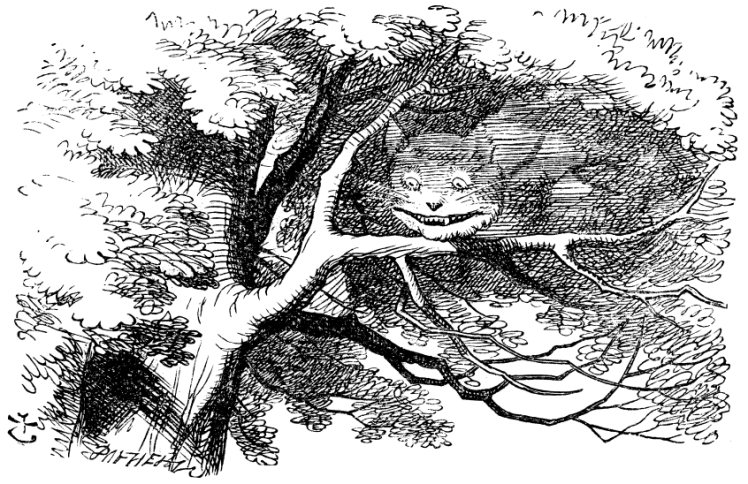
Alice in Wonderland’s Cheshire Cat (illustration by John Tenniel)
.
When I started seriously studying lichen a few years ago, I quickly realized that these tiny creatures blend in so well with their substrates of rock or tree, most people think they are part of them. Smudges of muted colour, stains of rust, smears of mossy green. Some people think they are algae (which is only partly true). Some people think they are moss. Others think they are just bark. Or part of the rock (which is also partly true).
Lichens are master shape shifters. Lichens hide in plain sight.
Not only do they hide in plain sight; they shift with the vagaries of weather and climate, manipulating themselves to exploit environmental changes to their benefit. A lichen that was battleship gray or bright pigmented orange in the dry heat of a sunny day, could turn swiftly into a brilliant green organism when wet, showing parts of itself it had previously hidden.
Lichenologist William Purvis writes that in dry conditions lichens contain up to 15-30% water and are metabolically inactive. “This enables them to survive extreme periods of drought, perhaps lasting for several months,” Purvis tells us. However, he adds that as soon as it rains or if there is a heavy dew or mist, lichens absorb water, throw off their grey cloak as their fungal cortex becomes transparent to reveal the lichen’s green photosynthetic partner, which begins to photosynthesize within minutes.
I decided to test that observation. After a storm had knocked down many tree branches, I waited for a sunny day and searched a nearby forest edge for a few dry branches colonized by several familiar, mostly foliose, lichens. One branch, likely a maple, was covered in Hoary Rosette Lichen (Physia aipolia), Hooded Rosette Lichen (Physcia adscendens), Hooded Sunburst Lichen (Xanthoria fallax), Candleflame Lichen (Candelariaconcolor), Goldspeck (Candelariella), Mealy Rosette Lichen (Physcia millegrana), City Dot Lichen (something else), and Whitewash Lichen (Phlyctis argena). With the exception of the City Dot Lichen, these were all friends I’d seen on the red maple tree I’d studied down my street. The second stubby branch was colonized by these same foliose lichen but also included a Grey-Rimmed Firedot Lichen (Caloplaca cerina) and two Shadow Lichens (Pheaophyscia spp.).
I took my sticks and went to the nearby river and dunked the branches into the water. Then I waited.
After a mere five minutes, the lichen had taken texture and colour, most of them turning from dull monochromatic grey to a sea-green or bluish-green colour. Pigmented lichen that had been fiery orange (e.g., Grey-Rimmed Firedot Lichen) turned a deep yellow, others that were bright yellow (e.g. Starburst Lichen) turned bright green (except for their soredia, which remained yellow). The transformations were fascinating.
.
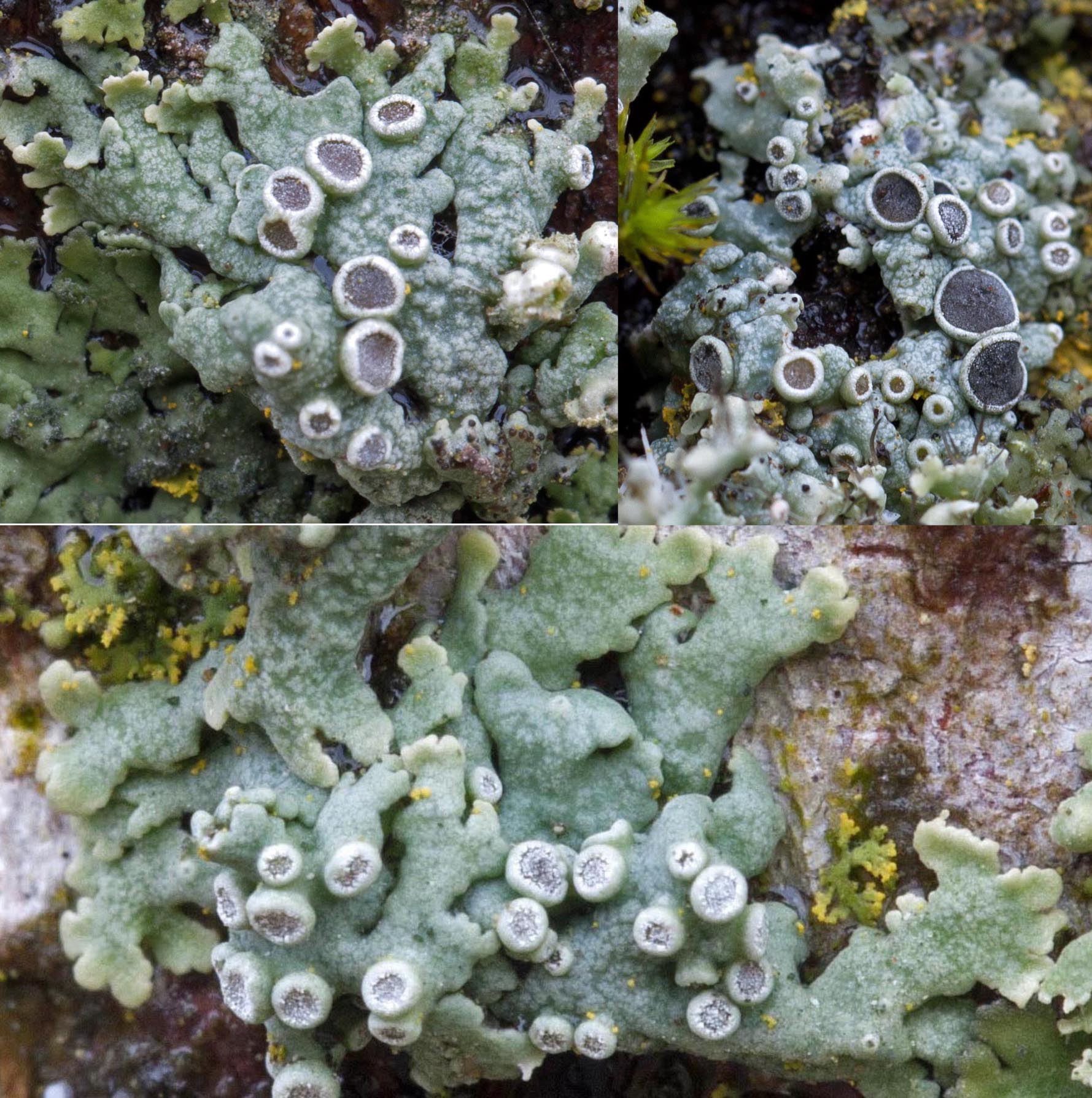
Hoary Rosette Lichen(Physcia aipolia)
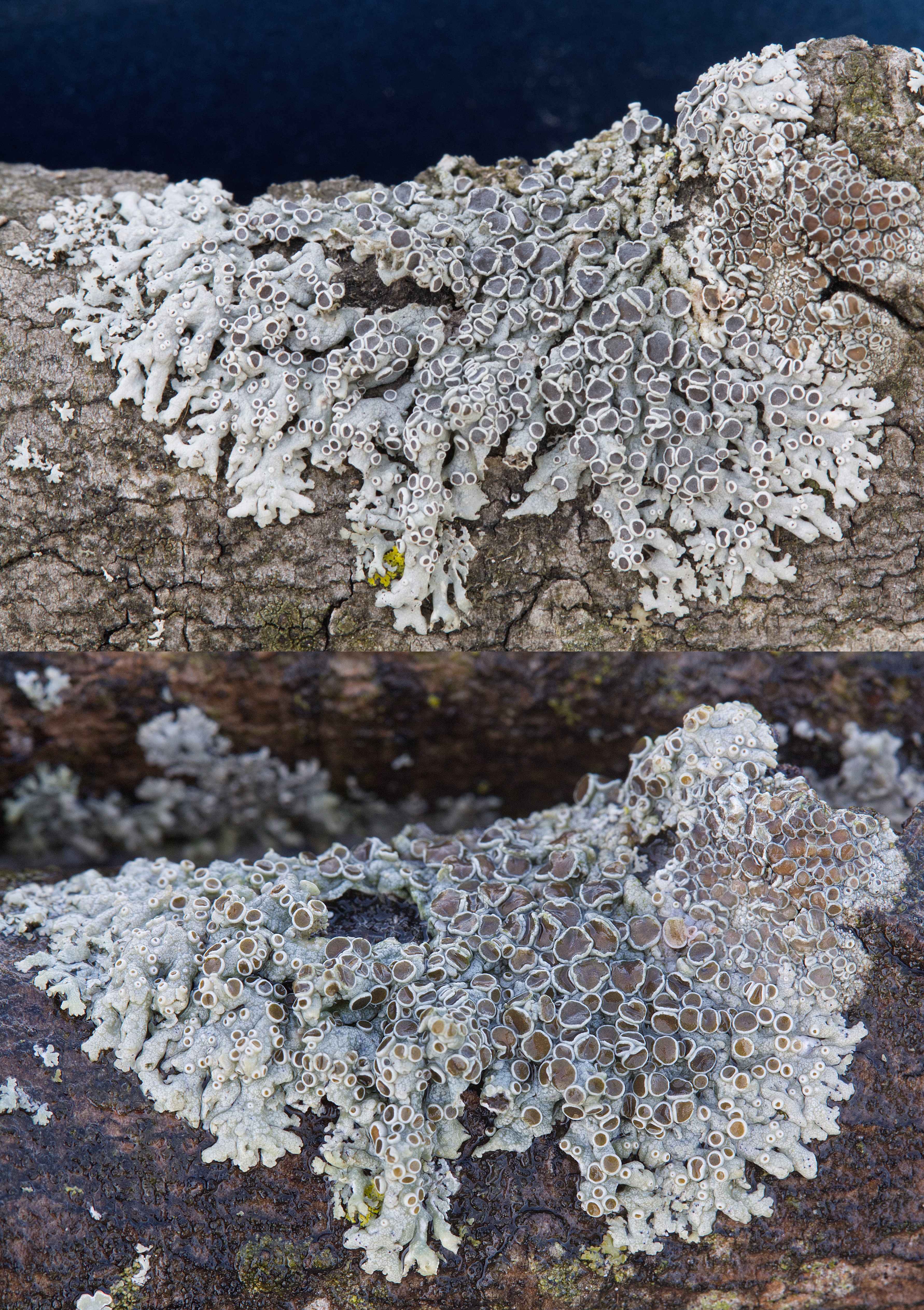
Physcia aipolia on maple branch, above dry form; below wet form. Maple branch, ON; note the less pruinated apothecia and higher maculation in the wet form (photo by Nina Munteanu)
.
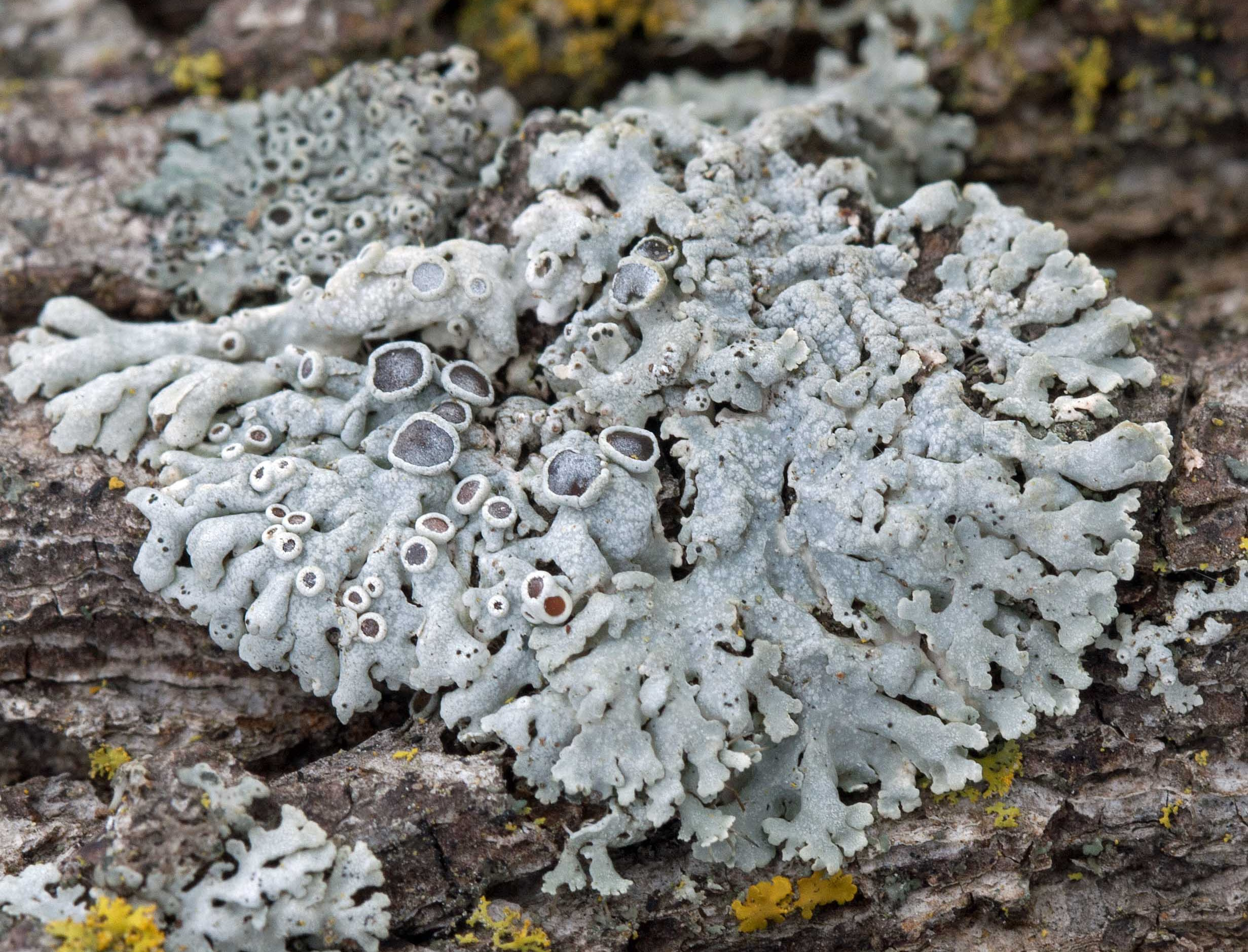
Hoary Rosette Lichen (Physcia aipolia)formed sprawling rosettes on the maple branch. When dry its thallus was bluish-grey, which turned blue-green to sea-green when wet. The upper surface was densely pruinose, covered with coarse white spots (maculae), and abundant pycnidia (tiny dark fruiting bodies). The pruination and maculation of the P. aipolia thallus was particularly marked, revealing beautiful patterns of white against a sea green background. The raised whitish maculae are places that have no or less algae present, revealing the underlying fungal tissue; these are often found in the genus Physcia and particularly in Physcia aipolia and P. biziana.
.
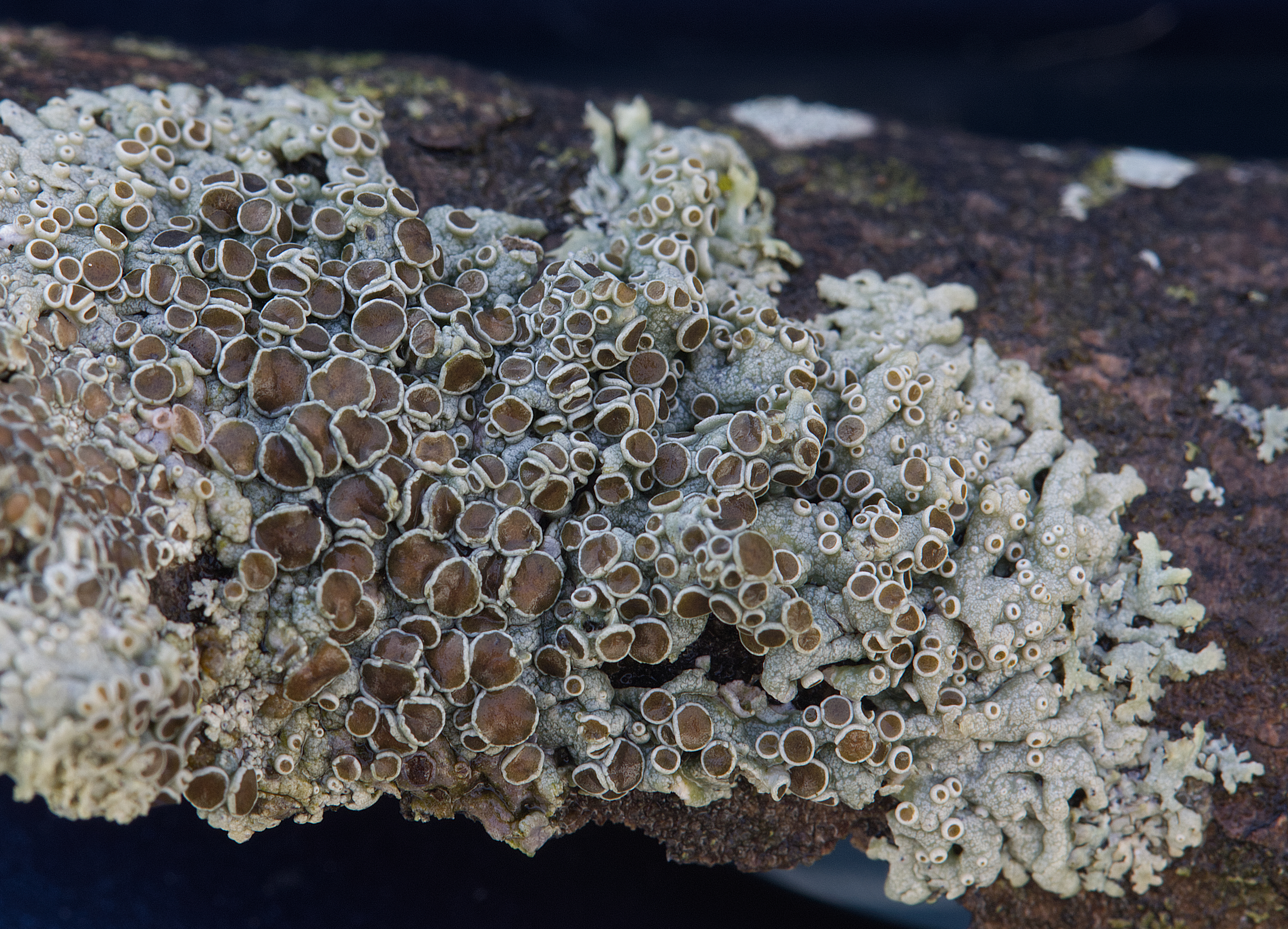
Physcia aipolia in its wet form; note cleared light brown apothecia and darker greenish thallus with more distinct maculae. Maple branch, ON (photo by Nina Munteanu)
.
Apothecia (disk-like fruiting bodies) were common, often clustered at the centre, and dark brown to blue, particularly the smaller younger ones; most of the disks (epithecia) looked bluish and powdery when dry because they were covered in dense pruina (whitish dust or bloom). When wet, the epithecium (the surface of the hymenium, the central disk of the apothecium fruiting body). seemed to ‘clear up’ from its dusty bluish-brown to light reddish-brown.
I had previously seen a marked difference for Physcia biziana in its dry and wet forms. This species is known for its distinct colour change and other marked differences over its sister Physcia stellaris; P. biziana turns a deep sea-green with more marked maculae when wet.
.
Physcia biziana in its dry form on a red maple, ON (photo by Nina Munteanu)
Three views of Physcia biziana in its wet form; note bright green colour and marked maculae. Red maple tree, ON (photo by Nina Munteanu)
.
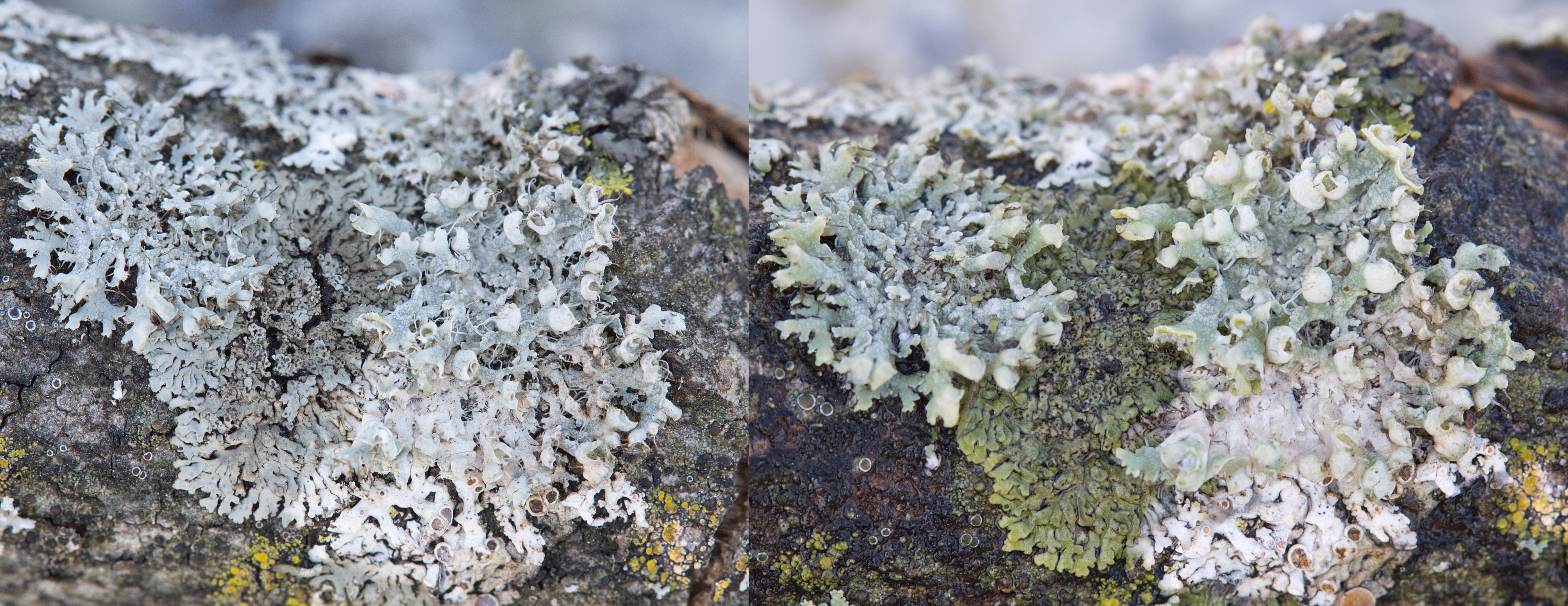
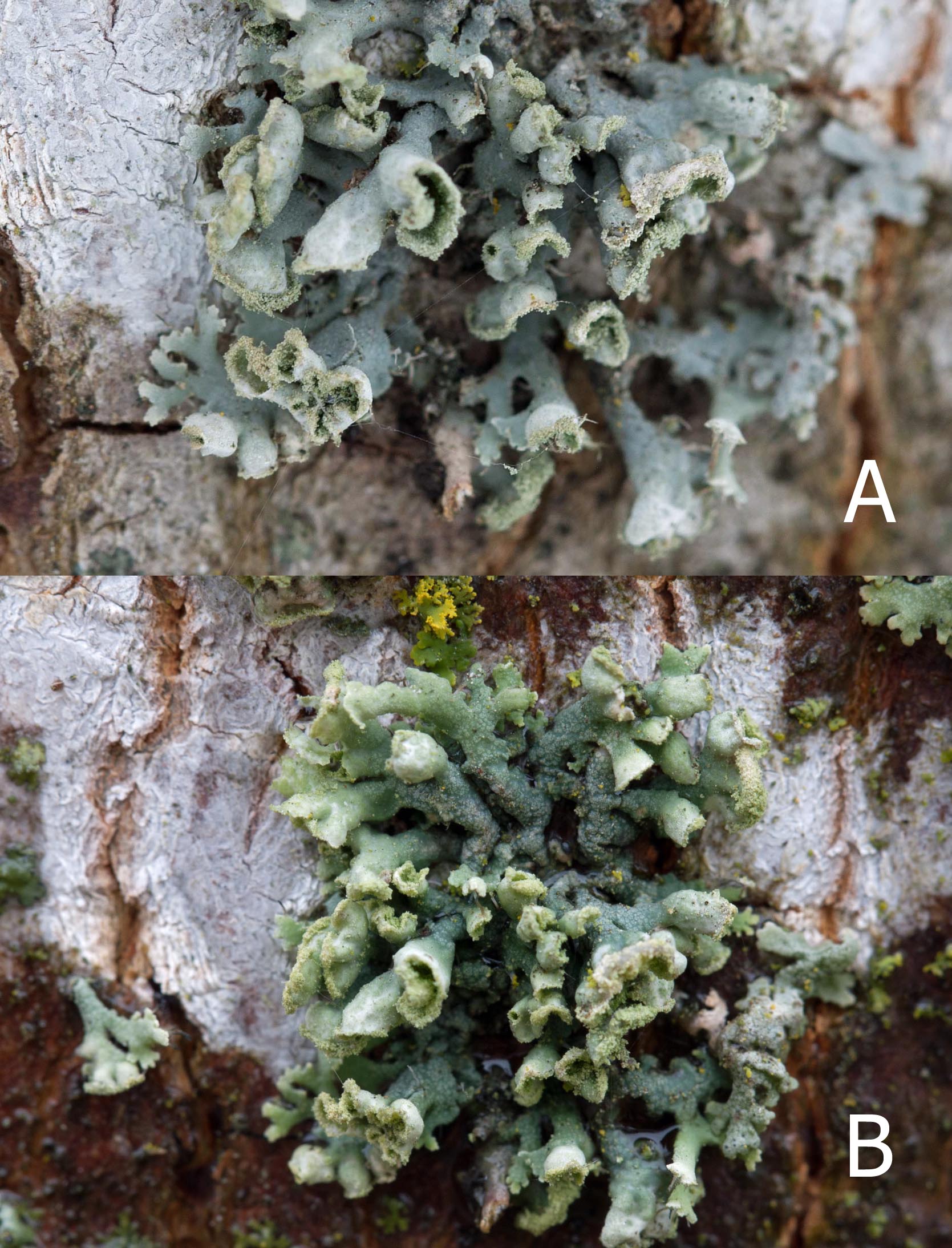
Hooded Rosette Lichen (Physcia adscendens)
Physcia adscendens in its dry (left) and wet (right) forms; note Phaeophyscia orbicularis (between the two P. adscendens patches) also showing changes from dry (grey) to wet (dark green). maple branch, ON (photos by Nina Munteanu)
.
Hooded Rosette Lichen (Physcia adscendens) was a strange looking green-grey foliose lichen that distinguished itself with ostentatious inflated pale helmet-shaped hoods (soralia that contain cream-coloured soredia) on raised lobes. Another distinguishing feature included the long white dark-tipped hairs (cilia), curly ‘whiskers’ that extended out from the tips of its lobes. When wet, Physcia adscendens took on a deep green Mediterranean Sea colour, showing more marked white mottling (maculae) on the thallus.
I’d seen marked changes in this lichen on a red maple tree in December. There, the lichen went a dark sea-green when wet.
.
Physcia adscendens, showing its dry (top) and wet (bottom) forms. Red maple, ON (photos by Nina Munteanu)
.
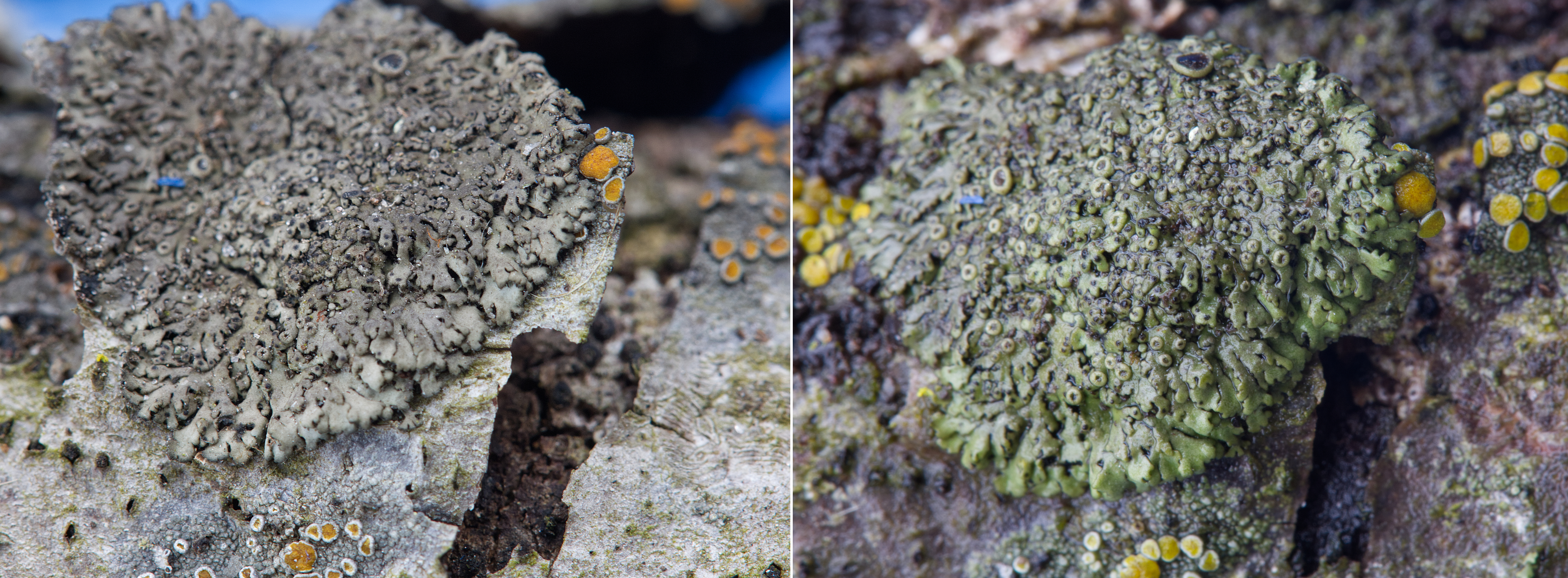
Mealy Shadow Lichen (Phaeophyscia orbicularis)
Phaeophyscia orbicularis, showing its dry (left) and wet (right) forms. Poplar branch, ON (photo by Nina Munteanu)
Phaeophyscia orbicularis in its dry (left) and wet (right) forms; note the crustose/squamulose thallus of Grey-Rim Firedot Lichen (bottom of image), which looks gray and hard on left when dry and soft and green on right when wet. Poplar branch, ON (photo by Nina Munteanu)
.
Mealy Shadow Lichen (Phaeophyscia orbicularis) is a foliose lichen that spreads across tree bark and other surfaces, usually in well-lit, nutrient-rich environments. Its orbicular lobes are elongate, spreading out often in a rosette and covered in soralia that produce powdery soredia (asexual reproductive structures) usually closer to the centre of the rosette. When dry this lichen was dark grey with slightly lighter grey edges. When wet, it turned dark olive green with brighter green edges. It’s soralia remained a pale version of the thallus.
.
Phaeophyscia orbicularis (left) in fairly dry form with Xanthophyta (right). Maple branch, ON (photo by Nina Munteanu)
Phaeophyscia orbicularis (left) in wet form with Xanthophyta (right). Maple branch, ON (photo by Nina Munteanu)
.
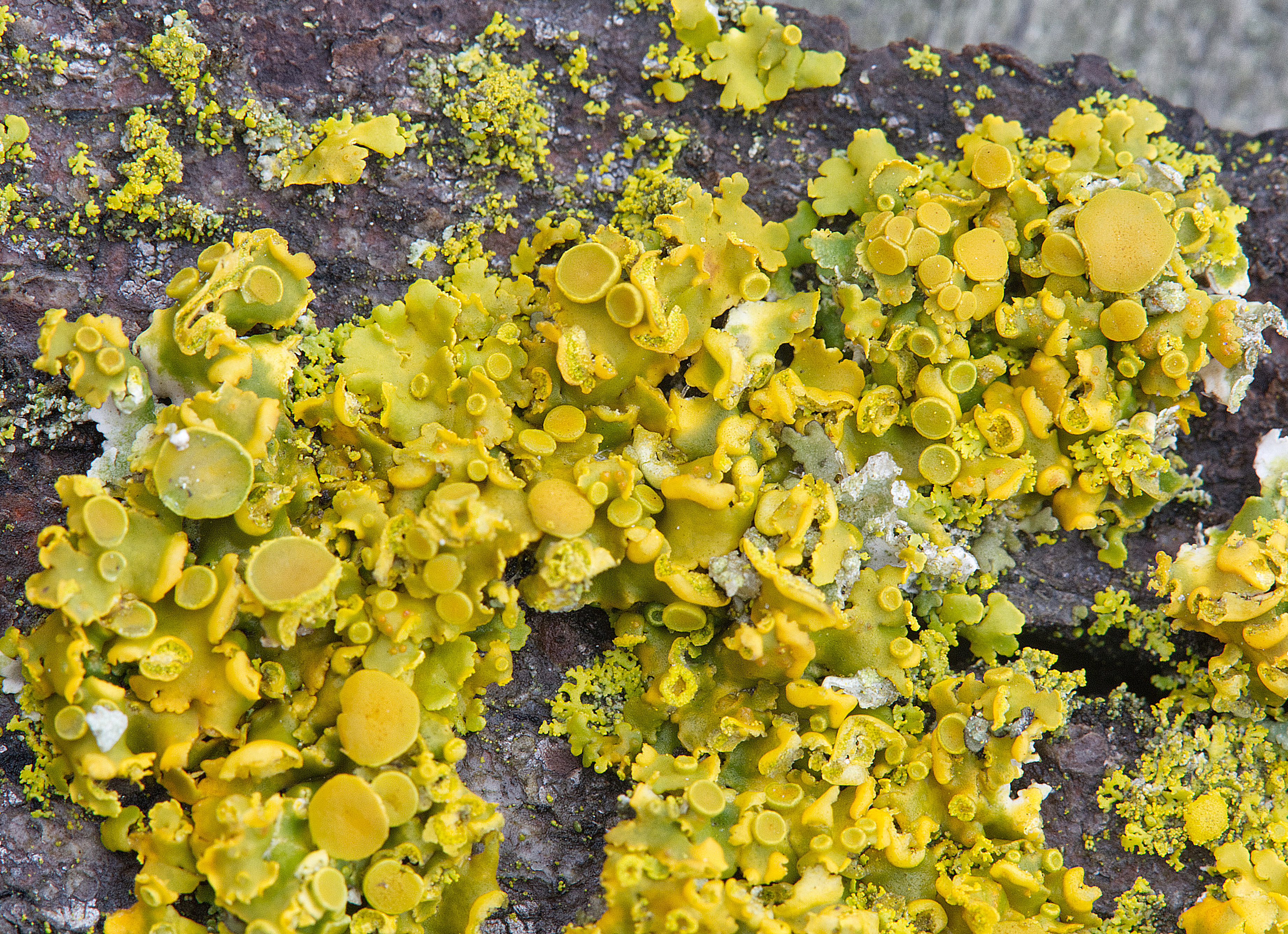
Hooded Sunburst Lichen (Xanthoria fallax)
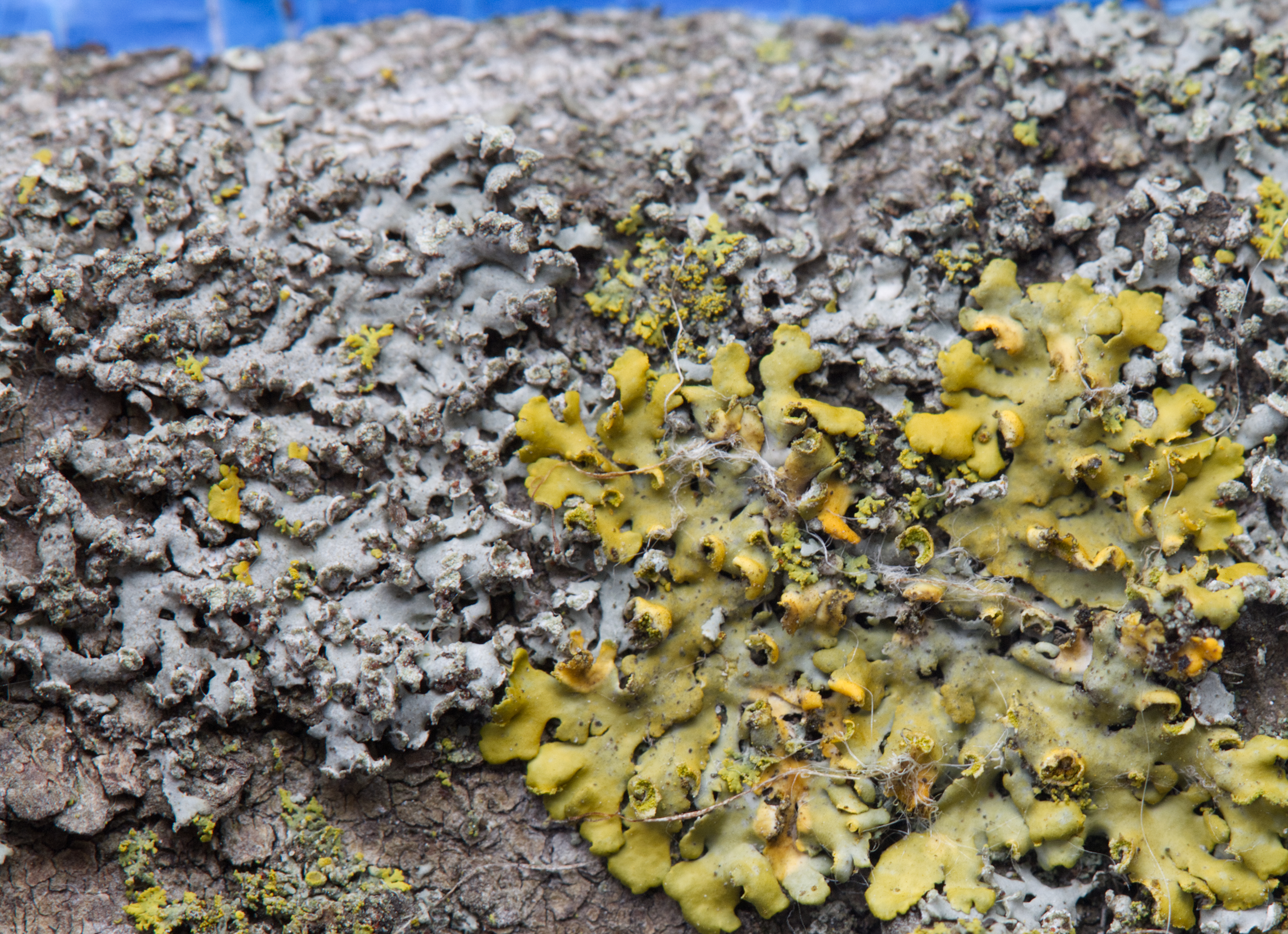
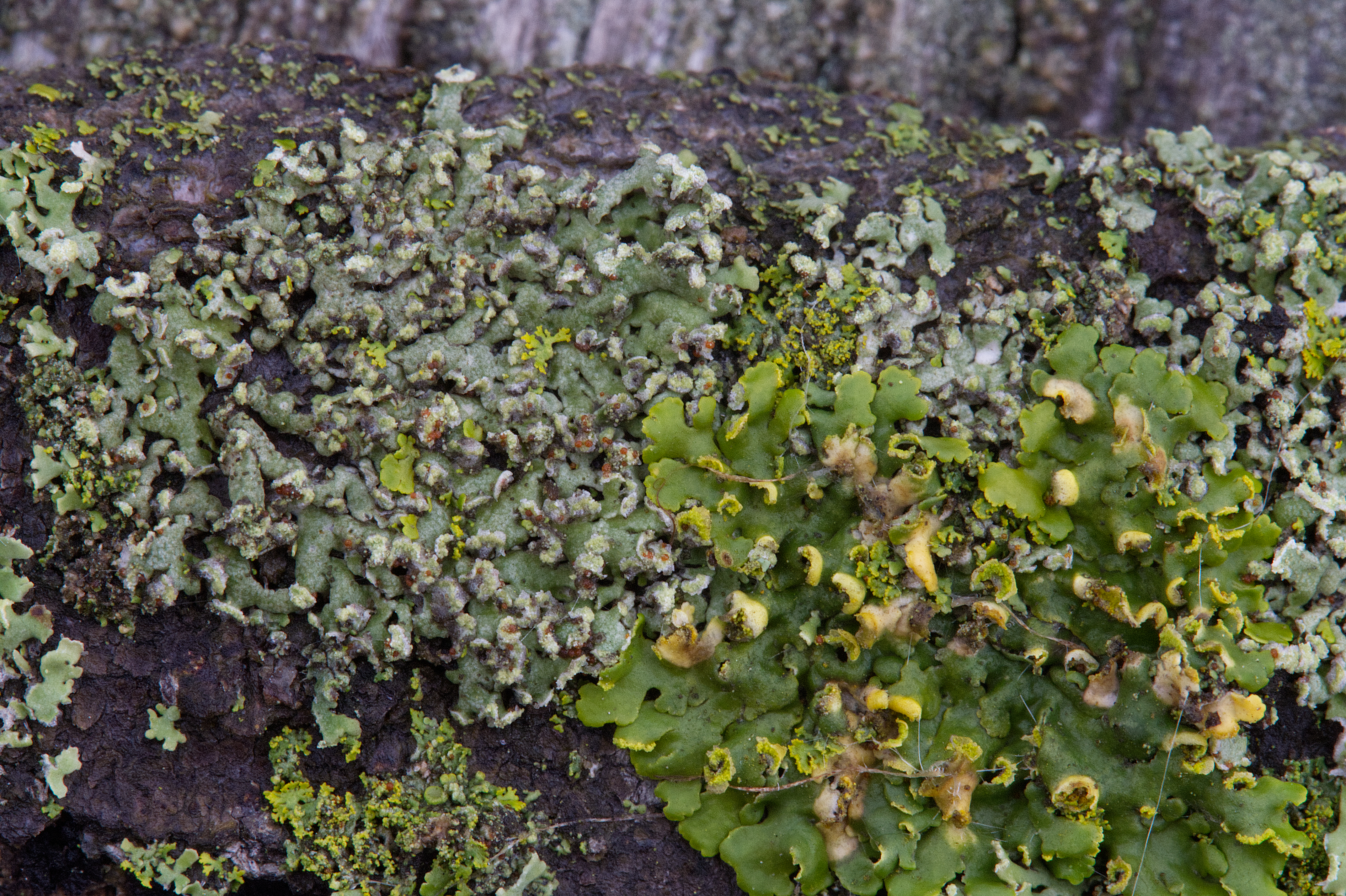
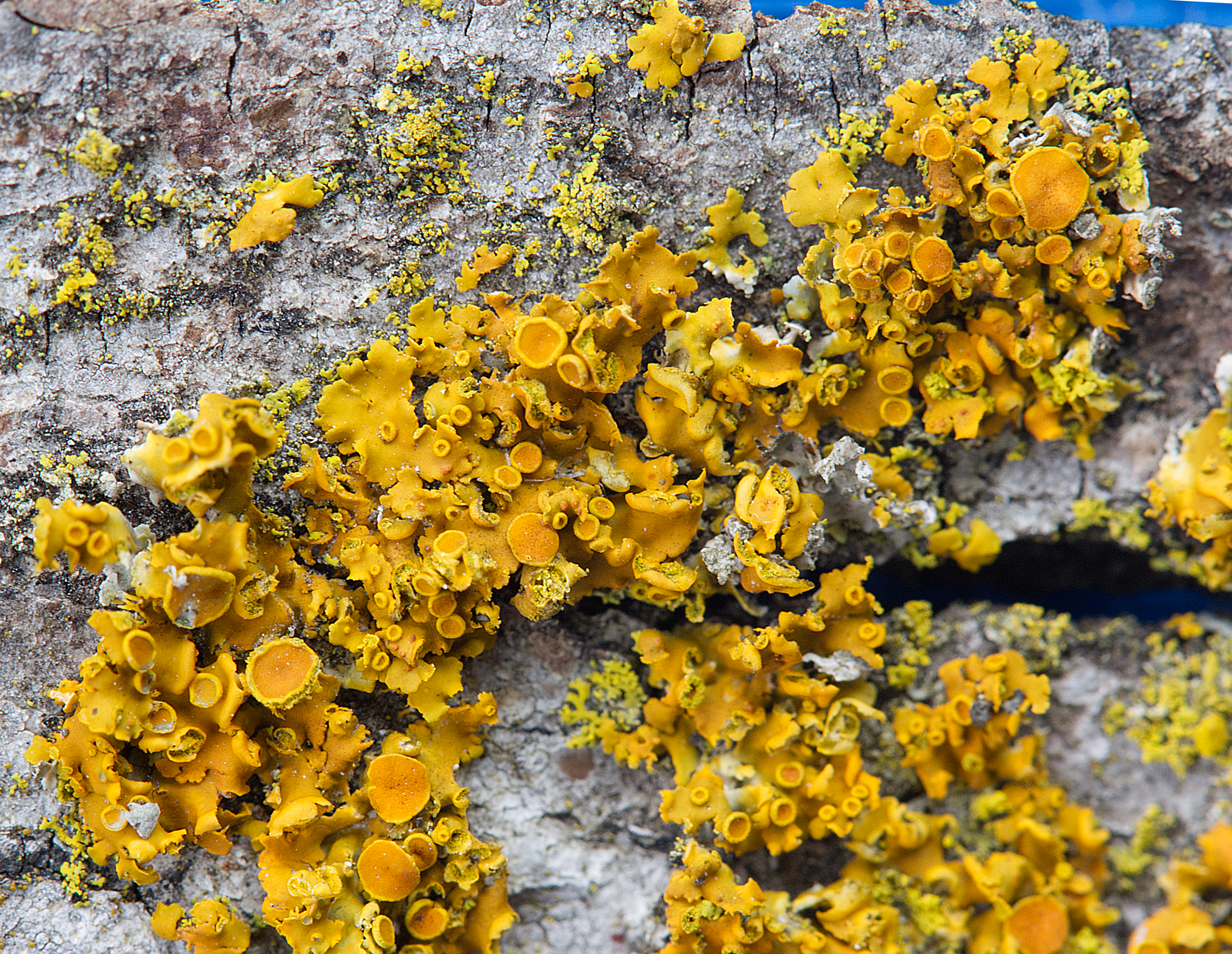
Xanthoria fallax in its dry form, ON; note the tiny yellow lichen at top, Candelaria concolor. Tree bark, ON (photo by Nina Munteanu)
Xanthoria fallax in its wet form. Tree bark, ON (photo by Nina Munteanu)
.
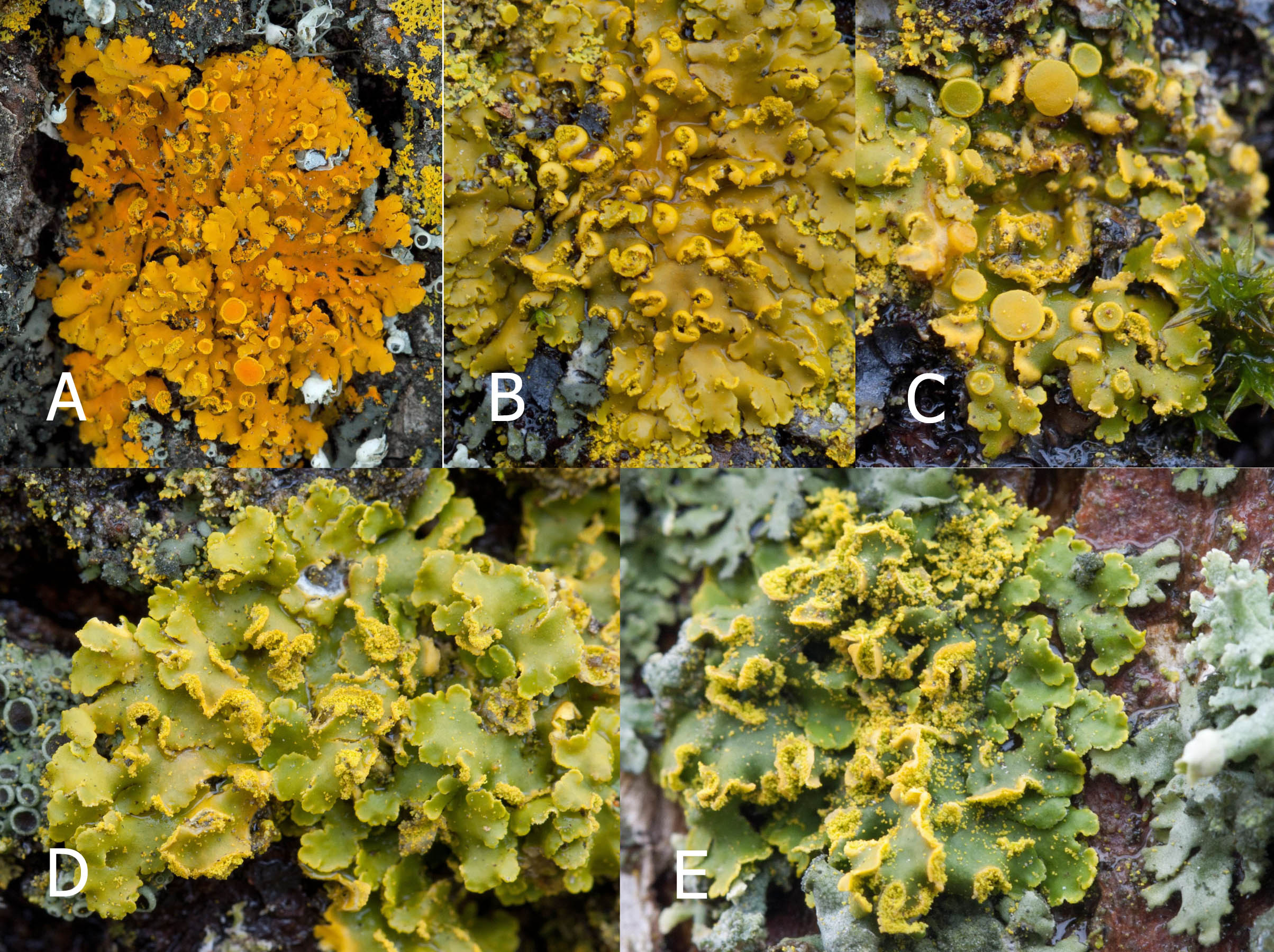
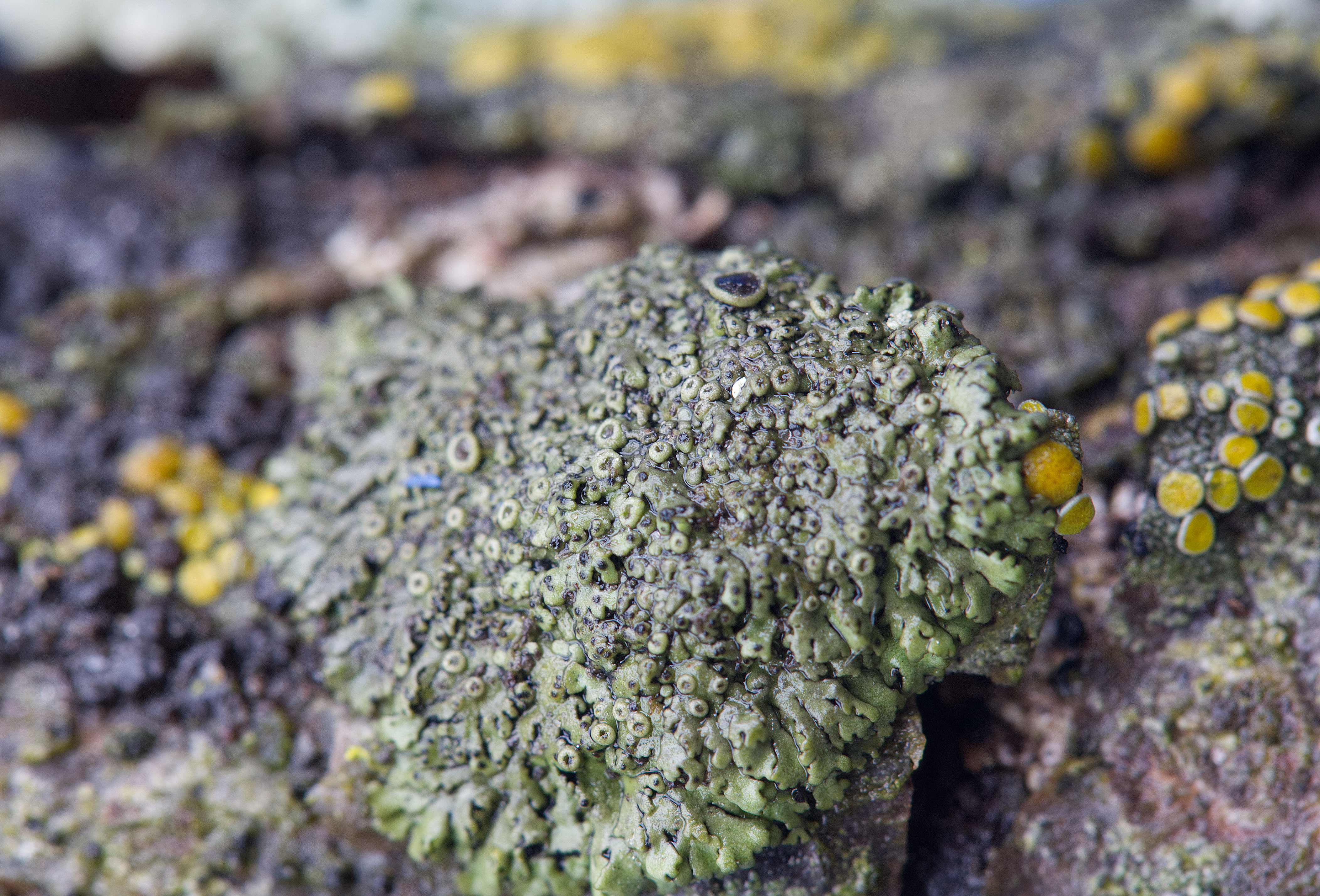
Hooded Sunburst Lichen (Xanthoria fallax) in dry conditions formed orange-yellow rosettes on the maple branch. When wet, the lobes of Xanthoria fallax turned first yellowish then greenish to full green; their yellow powdery soredia on the edges formed a bright contrast. Several colonies had lecanorine apothecia (sexual disk-like fruiting bodies) with the orange disk considerably darker than the dry thallus. This lichen contains the anthraquinone pigment parietin, which gives it its stunning orange-yellow colour when dry, and helps it absorb UV-B radiation.
.
Various forms of Xanthoria fallax from most dry (A) to its most wet (E) form. Red maple, ON (photos by Nina Munteanu)
.
Candleflame Lichen (Candelaria concolor)
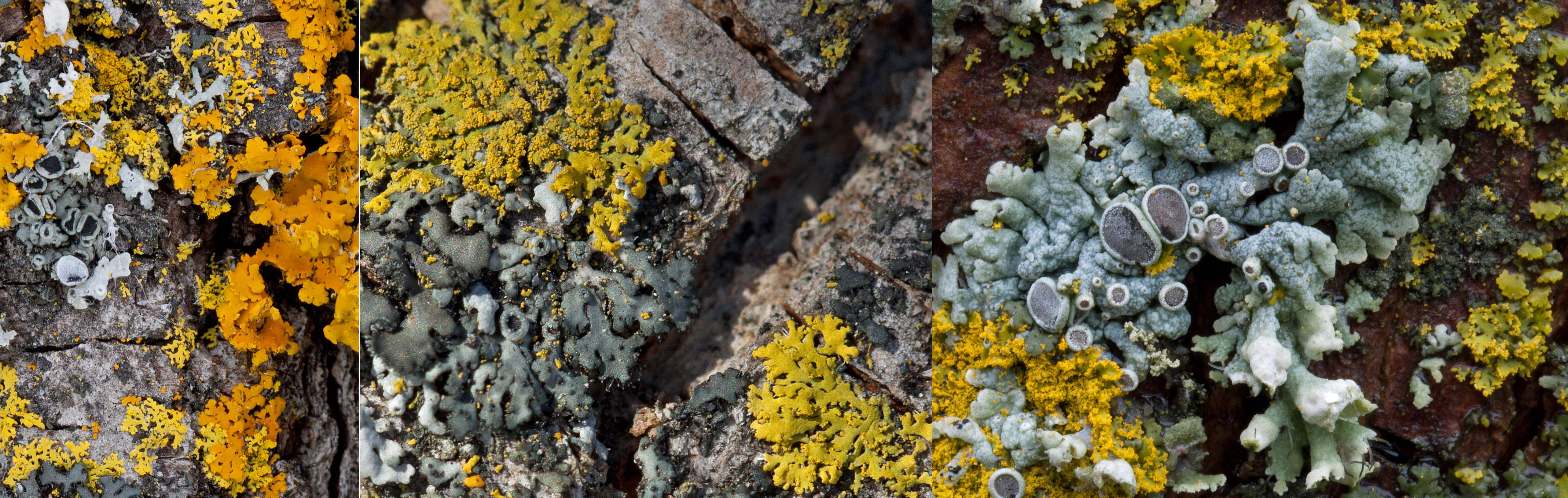
Candelaria concolor in varying forms from very dry (left) to slightly dry (middle) to very wet (left). Note dry form of Xanthoria (orange) in left image, dry form of Phaeophyscia orbicularis (grey) in middle image, and wet form of Physcia biziana (blue-green) and P. adscendens (sea green) in right image. Red maple, ON (photos by Nina Munteanu)
.
Candleflame Lichen (Candelaria concolor) formed chaotic rosettes scattered throughout the branch. This little lichen is a bright lemon yellow when dry. During wet conditions, it turns yellow-green to green. Yellow granular soredia are common, particularly on the lobe margins and at times so dense to obscure the lobes. They are visible on the edges of the wet green thalli on the right image.
.
Goldspeck Lichen (Candelariella)
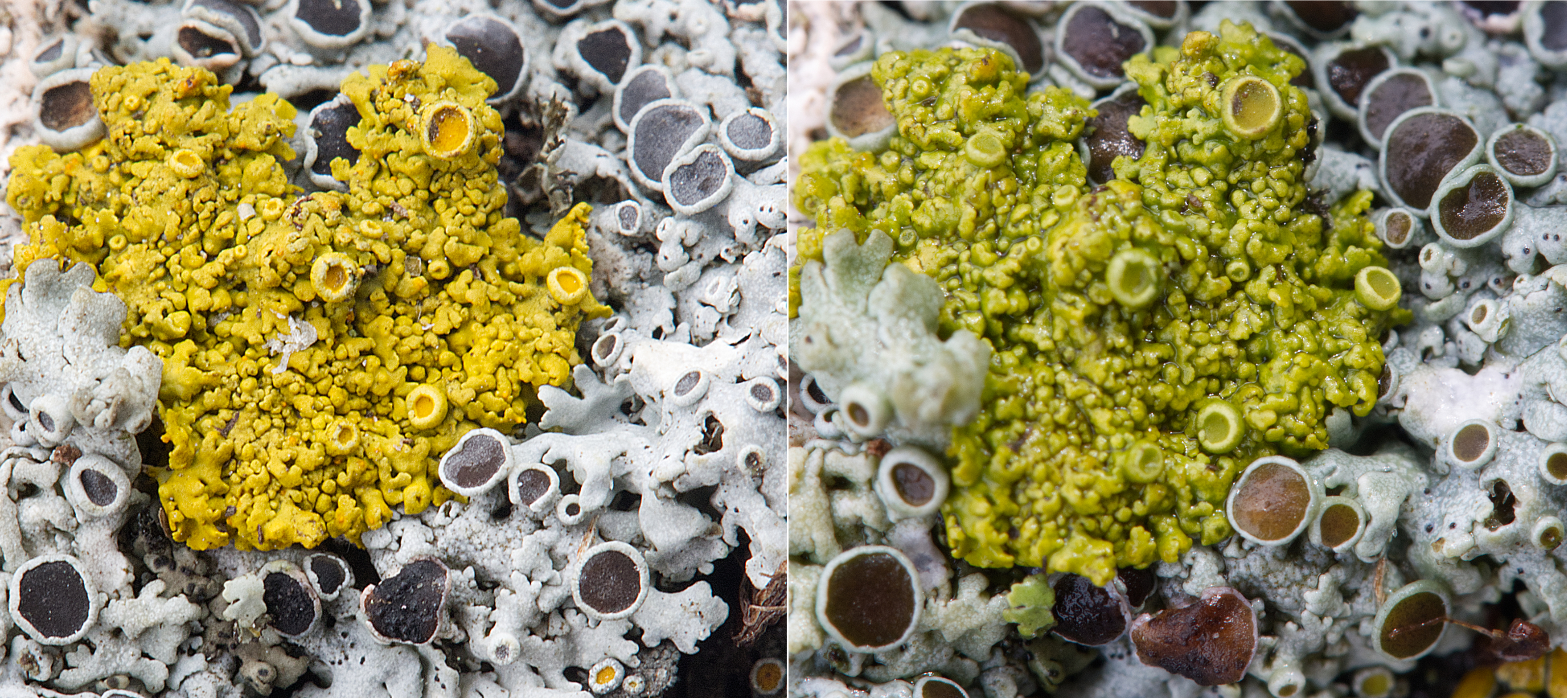
Candelariella in its dry (left) and wet (right) forms. Poplar branch, ON (photos by Nina Munteanu)
.
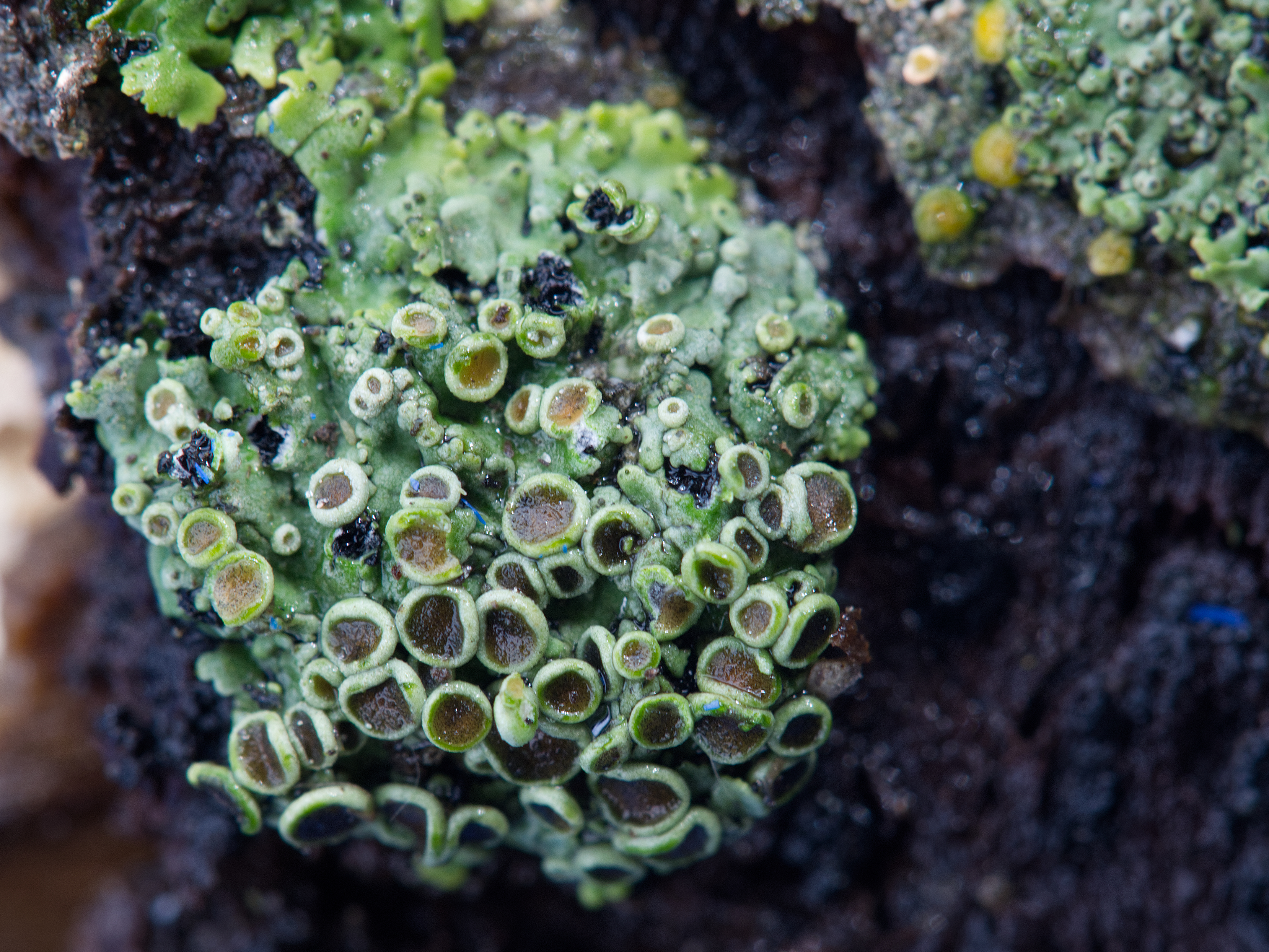
Goldspeck Lichen (Candelariella) was a tiny lichen that looked more squamulose, scale-like or granular (areolate) than foliose, although I did note more foliose-like lobes on the thallus edge. Some species of Candelariella are known to take on this growth form. In its wet-greenish form, the lichen showed its squamules more readily. When dry, the epithelia of their apothecia were bright orange with a pale yellow rim (thaline margin or exciple); when wet the rims were pale green like the rest of the thallus and the epithelia were darker green.
The second branch was populated by the same lichen, again mostly Hoary Rosette Lichen, along with Hooded Rosette Lichen, Mealy Shadow Lichen, and Sunburst Lichen. This branch was additionally populated by a firedot lichen.
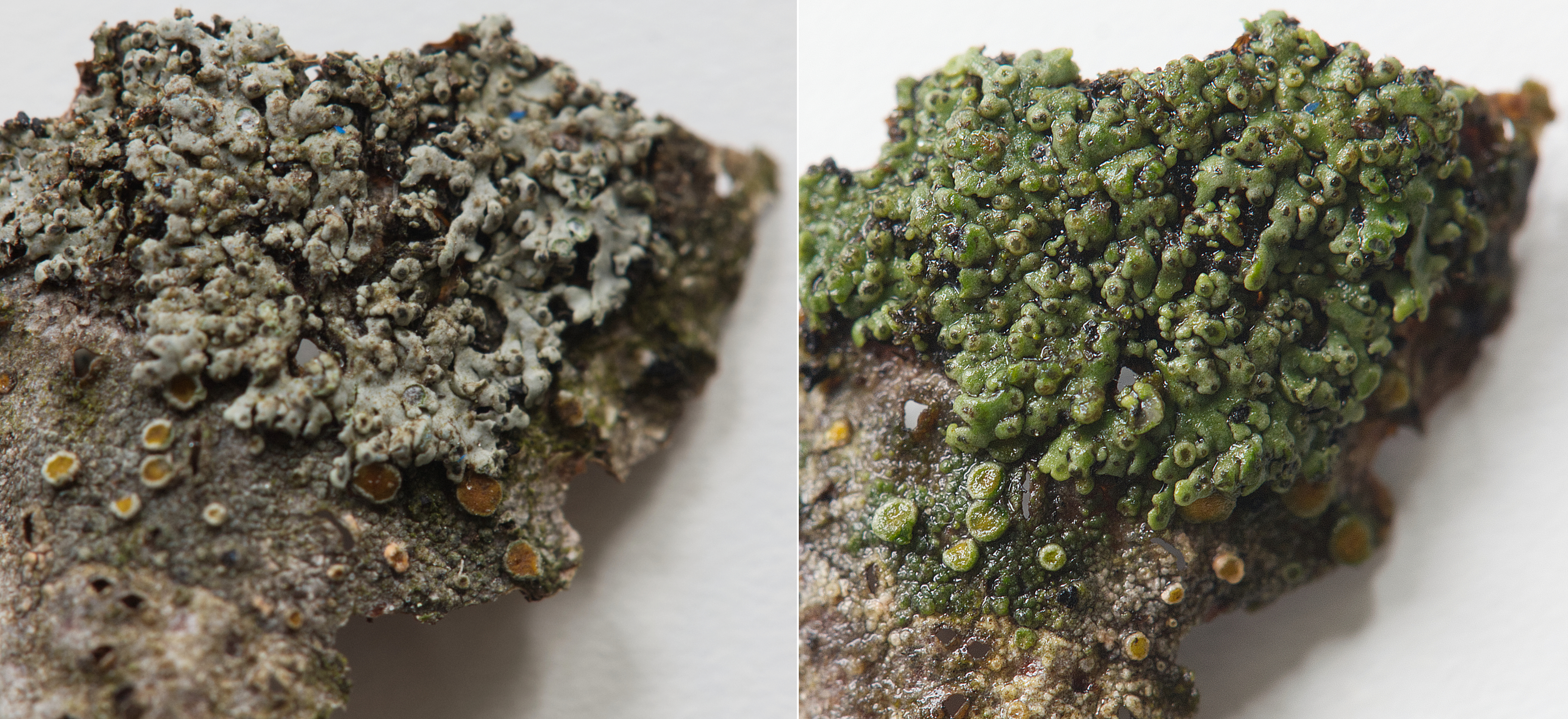
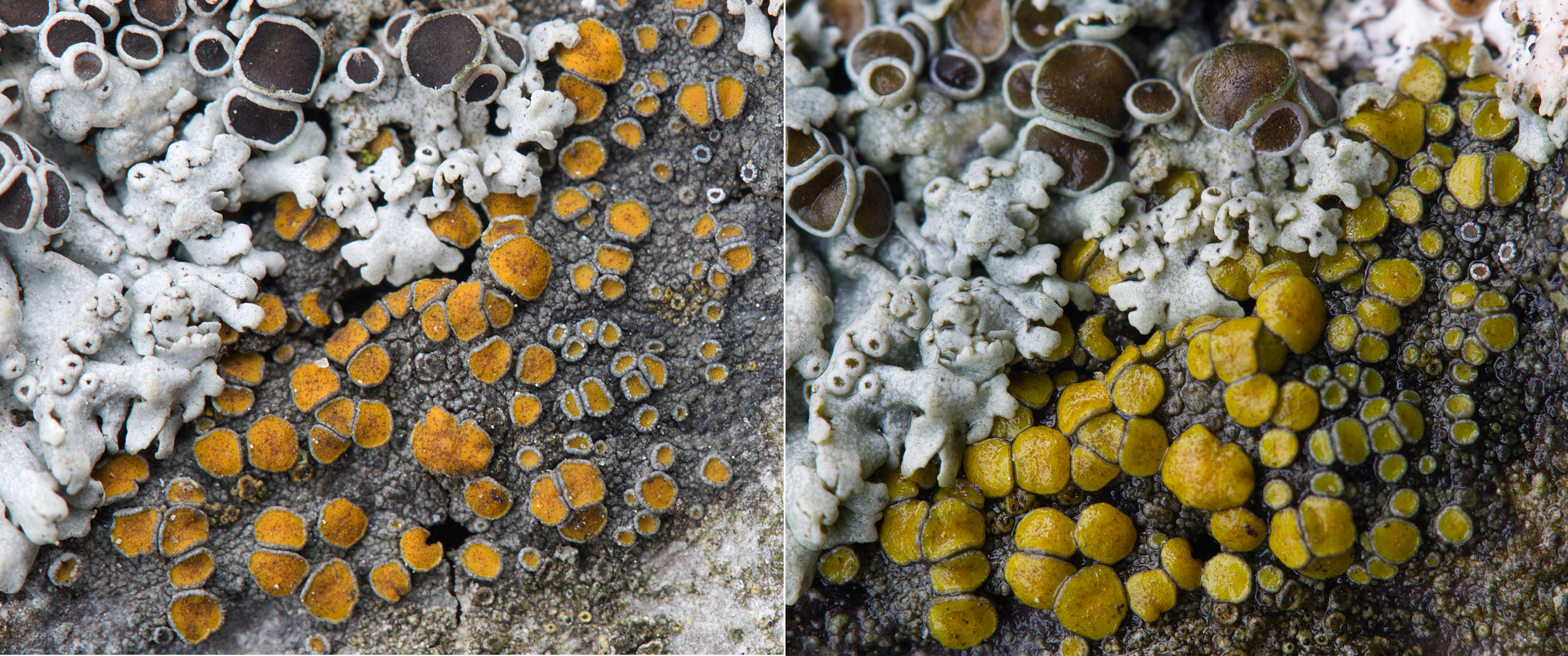
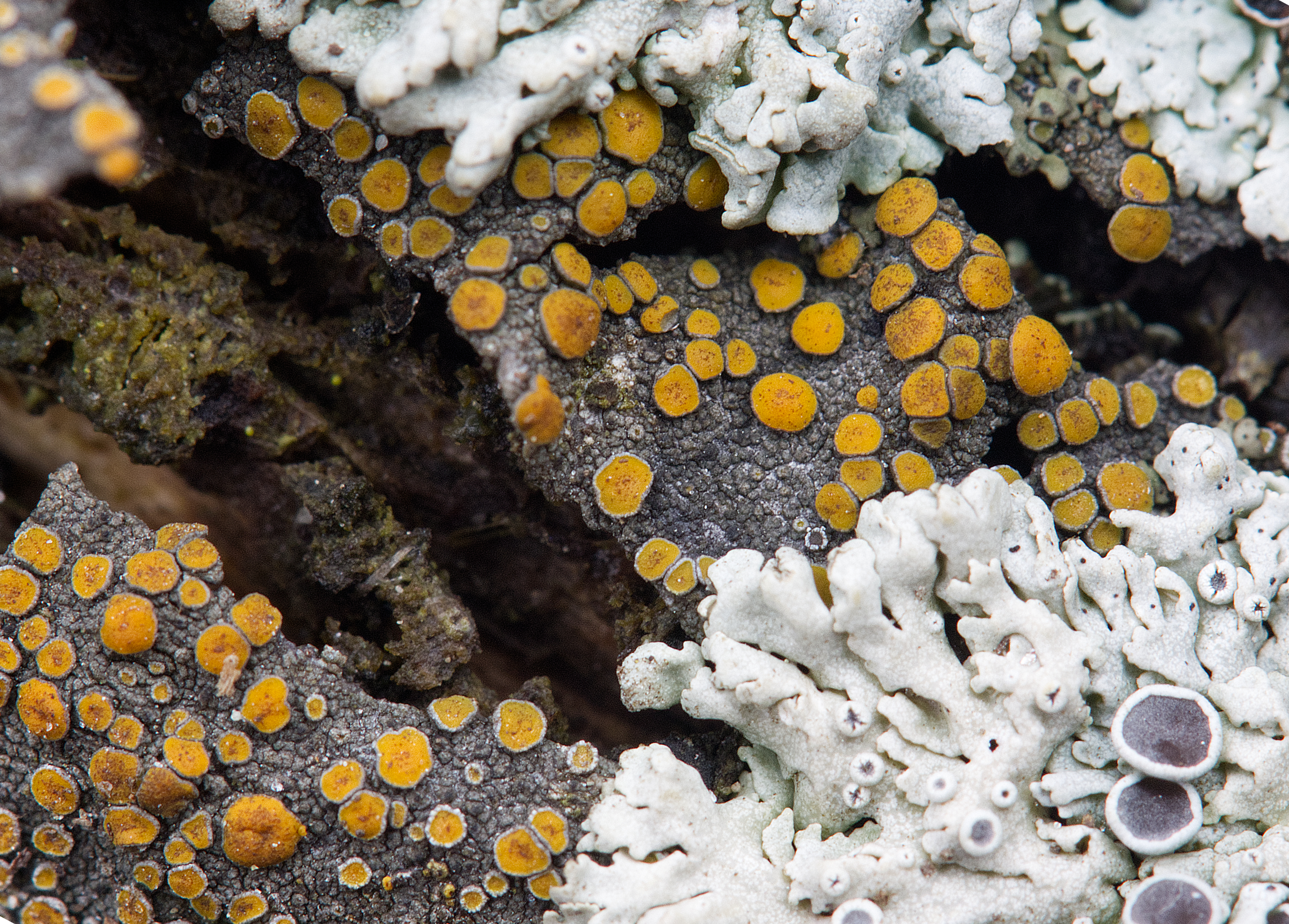
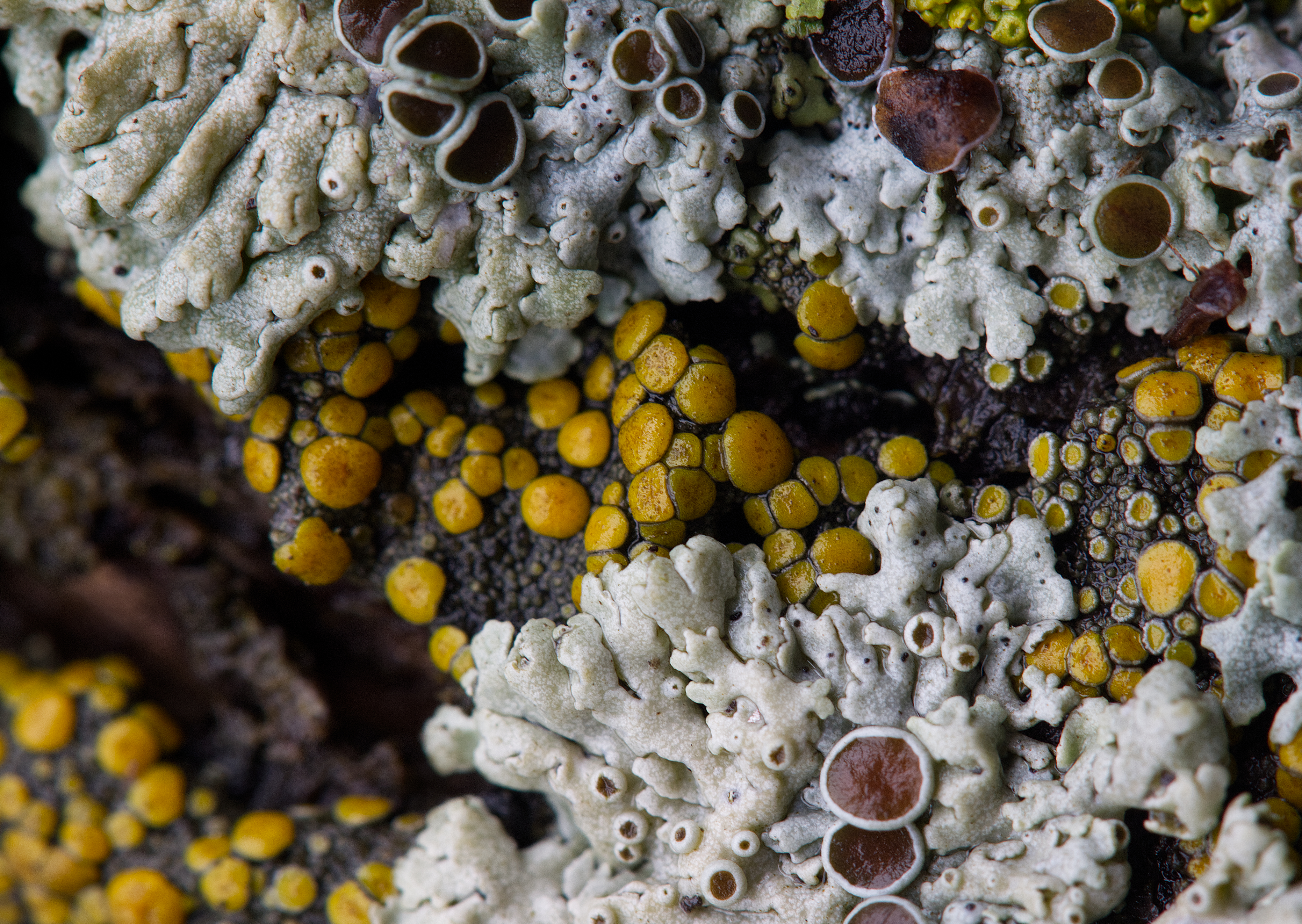
Grey-Rimmed Firedot Lichen (Caloplaca cerina)
Caloplaca cerina showing its dry (left) and wet (right) forms; note Physcia aipolia in both dry and wet forms, particularly its apothecia. Poplar branch, ON (photos by Nina Munteanu)
.
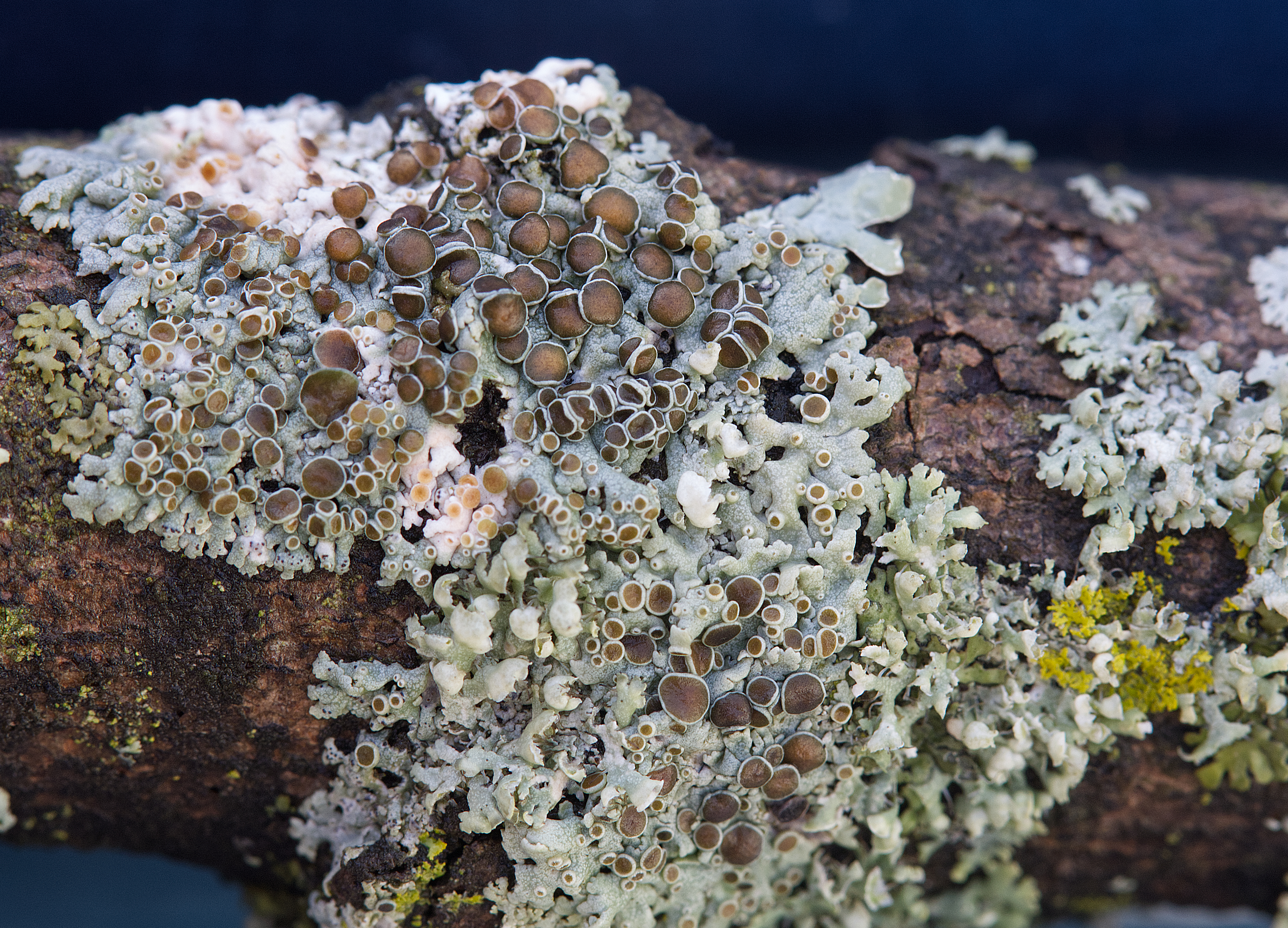
Grey-Rimmed Firedot Lichen (Caloplaca cerina) prefers nutrient-rich basic bark of twigs and branches, particularly of trembling aspen, elder, ash, sycamore, and willow. Lichenologist Joe Walewski tells us that firedot lichens thrive on bark that is in low acidity, stable and fairly absorbent; they are often seen on elm, maple, and aspen bark. I figured that the second branch was a poplar.
.
Caloplaca cerina and Physcia aipolia in their dry forms. Poplar branch, ON (photo by Nina Munteanu)
Caloplaca cerina (with bloated yellow apothecia) and Physcia aipolia (with apothecia cleared of pruination) in their wet forms. Poplar branch, ON (photo by Nina Munteanu)
.
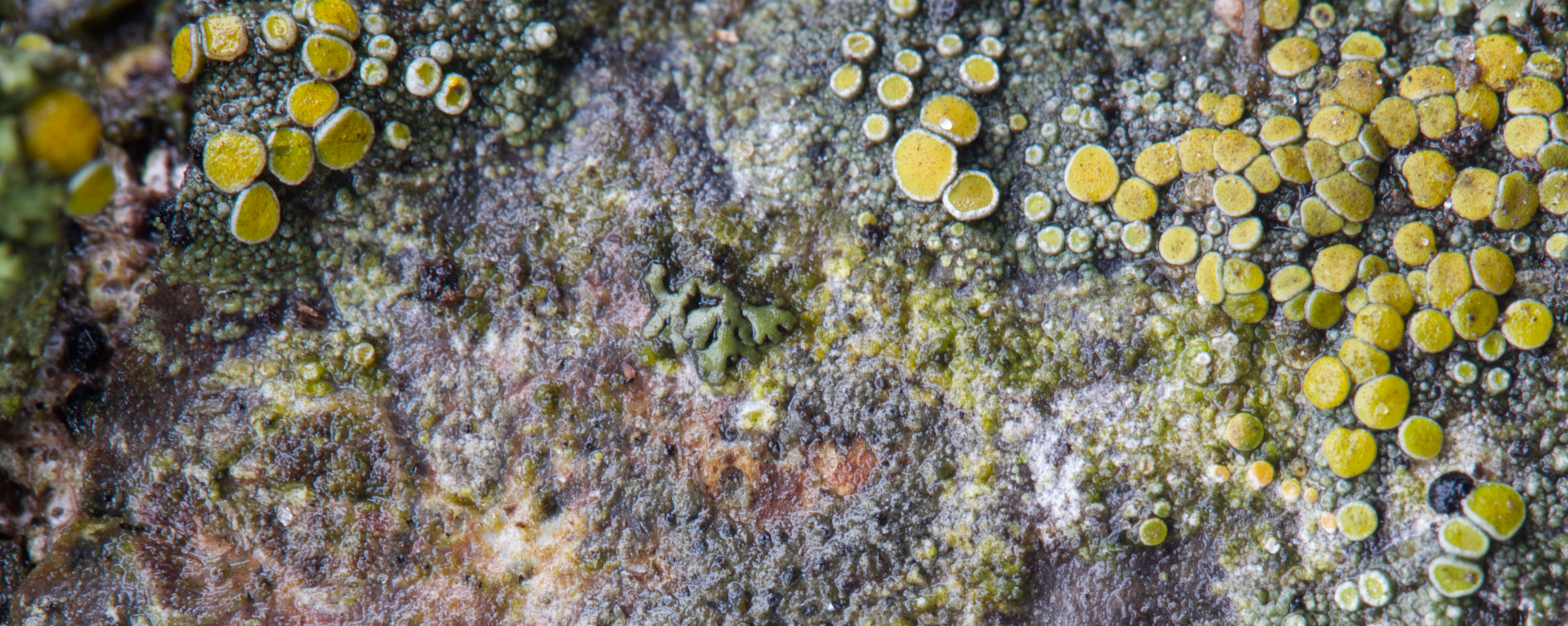
Caloplaca cerina is known for its bright orange apothecia (epithecia) with grey margins, and dark grey areolate crustose thallus when dry. When wet, the dark grey areolate crustose thallus transformed into what looked more squamulose, shiny and dark olive green; the apothecia transformed to deep yellow with flecks of deep orange on the epithecium and its margin remained dark grey.
.
Caloplaca cerina, showing its squamulose greenish thallus and scattered bloated yellow apothecia. Poplar branch, ON (photo by Nina Munteanu)
How do you catch a shapeshifter?
Alice in Wonderland’s Cheshire Cat disappears (illustration by John Tenniel)
.
Named after Alice in Wonderland’s Cheshire Cat, the cheshires of The Windup Girl exemplify the cost of unintended consequence to ambitious yet myopic engineering. Not only do the cheshires wipe out the house cat; they become pests, agents of chaos, roaming the streets of Bangkok and outmaneuvering their would-be captors. Experiments-turned victims-turned adapted survivors of a vast unintended consequence of human greed, the cheshires epitomize a future that Nature is inexorably creating in response to imposed human rule. Take note…
.
Shadow lichen in its brilliant green wet form. Poplar branch, ON (photo by Nina Munteanu)
Shadow lichen in its wet form. Poplar branch, ON (photo by Nina Munteanu)
.
In the natural world of non-fiction, Lichen conduct wonderful intrigue in a world of constantly shifting markers. Lichen adapt to change by embracing a shifting world and a changing climate. For this reason, they will no doubt outlive us all, just as they have predated us by millennia.
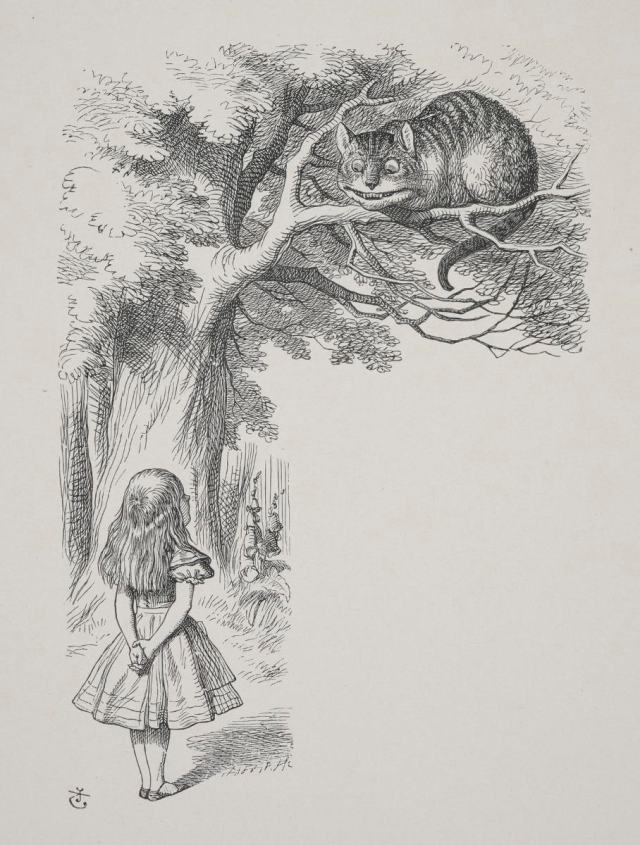
Alice meets the Cheshire Cat in “Alice in Wonderland”, illustration by John Tenniel
.
How do you catch a shapeshifter? The answer is, you don’t; you can only follow it, like Alice did, and let it lead you to what the future brings.
Wet forms of several lichens including Physcia aipolia, Physcia adscendens, Candelaria concolor,Phaeophyscia orbicularis, and Candelaria concolor. Poplar branch, ON (photo by Nina Munteanu)
.
Nina Munteanu is a Canadian ecologist / limnologist and novelist. She is co-editor of Europa SF and currently teaches writing courses at George Brown College and the University of Toronto. Visit www.ninamunteanu.ca for the latest on her books. Nina’s bilingual “La natura dell’acqua / The Way of Water” was published by Mincione Edizioni in Rome. Her non-fiction book “Water Is…” by Pixl Press (Vancouver) was selected by Margaret Atwood in the New York Times ‘Year in Reading’ and was chosen as the 2017 Summer Read by Water Canada. Her novel “A Diary in the Age of Water” was released by Inanna Publications (Toronto) in June 2020.

 The Meaning of Water