When I recently moved back to the Vancouver area of British Columbia to stay after living in Ontario for over a decade, I fell right away into the habit of visiting the coastal rainforests—mostly giant Douglas fir-Western Red Cedar and Western Hemlock; damp forests lush with riotous growths of ferns, moss, fungi and lichen. I found myself wandering these forests with an abiding joy of one who has finally come home.
.
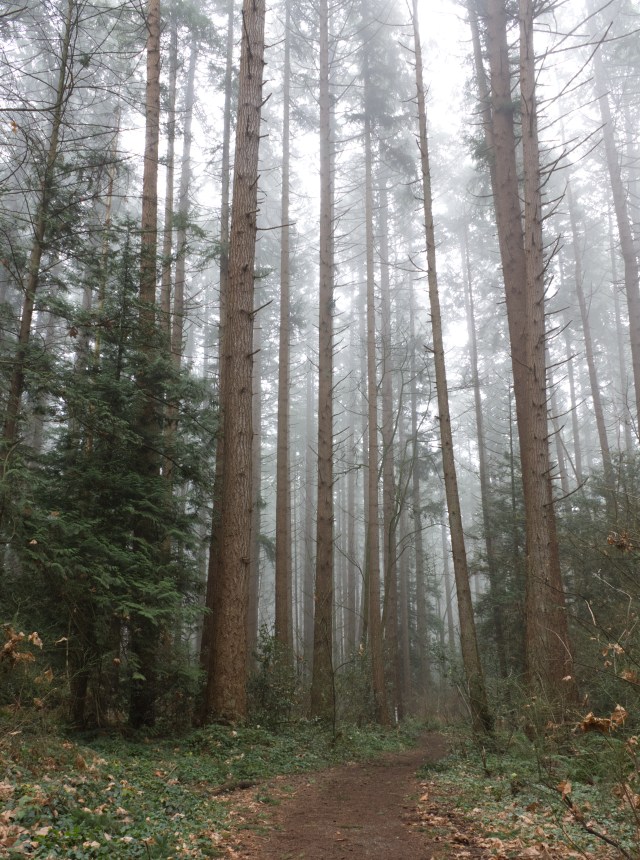
Douglas fir trees in a December morning mist, Watershed Park, BC (photo by Nina Munteanu)
.
Inhaling the intoxicating fresh aroma of conifers, moist vegetation, and humus, I crane my neck to gaze up high at the tall canopy that seems to touch the heavens. I’m in Watershed Park. The stately Douglas fir trees rule this forest, tall majestic trunks soaring high to capture the western light. Beneath their deep green canopy, a cornucopia of texture and colour—a bazillion shades of green and brown—carpet the understory and the spongy ground. Rapt with joy at witnessing and experiencing this complex ecosystem, I fall silent with reverence. I listen to the silence of the forest, and it eventually yields subtle notes of forest life talking to itself. Trees and shrubs murmur softly, tickled by a rustling wind. A few birds call out. Mostly bluejays, shrill notes echoing. I hear the haunting trill of two eagles overhead. A few chickadees sing cheerfully as they flit effortlessly from branch to ground and back to branch again. Two squirrels bash through the undergrowth in lively chase—as if they rule the forest. Maybe they do…
.
The Douglas Fir: A Giant Among Giants
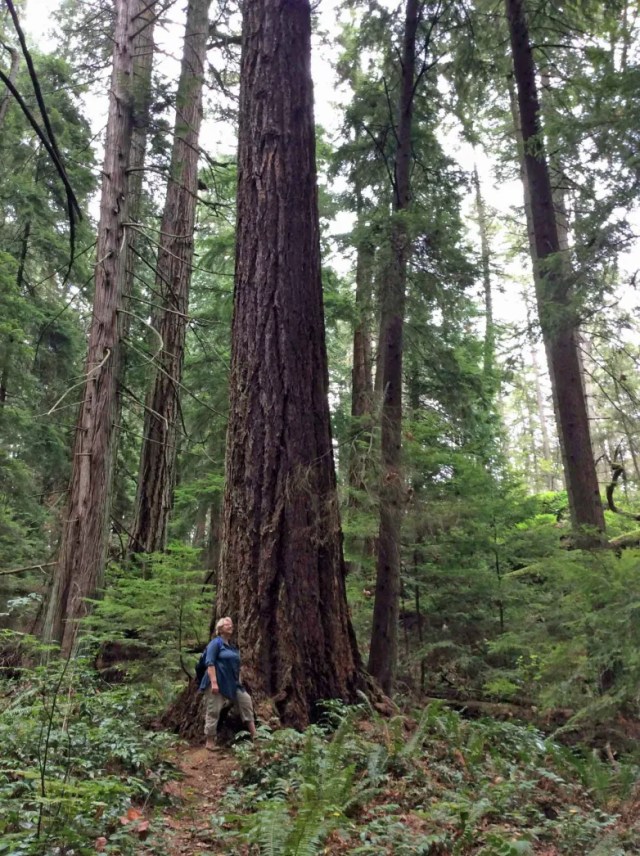
Despite its common name, the Douglas fir (Pseudotsuga menziesii) is not a true fir, of the genus Abies; the genus Pseudotsuga means “false hemlock”. Douglas firs are medium-sized to extremely large evergreen trees, 20–100 metres (70–330 feet) tall (although only those on the coast reach heights near 100 m) and commonly reach 2.4 m (8 ft) in diameter. I’m told that there are records of former coast Douglas firs exceeding a height of 120 m (390 ft), making them the tallest trees on Earth. Historical specimens with heights exceeding 120 m (400 ft) include the Lynn Valley Tree near Vancouver and the Nooksack Giant in Maple Falls in Washington State.
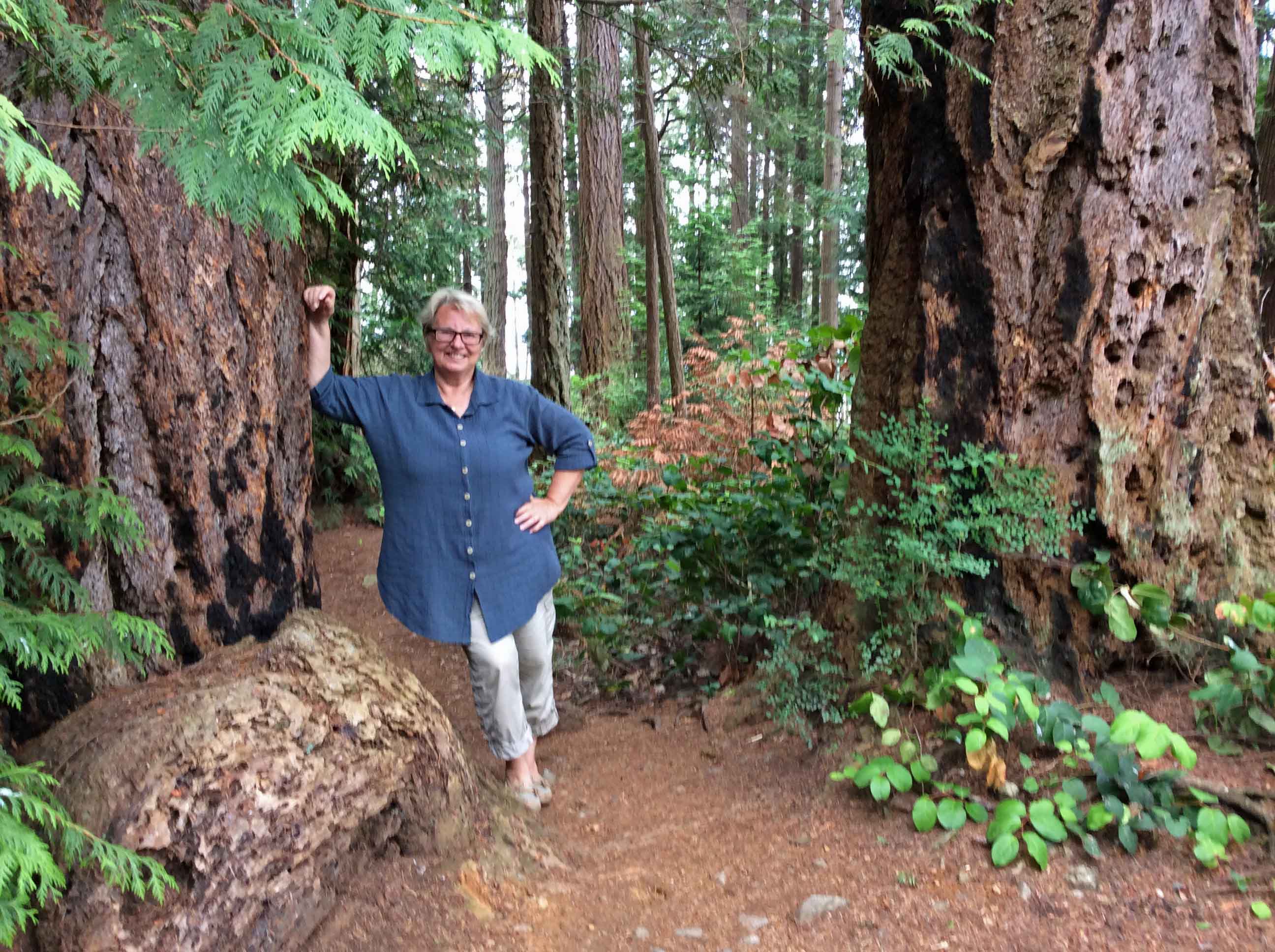
Author stands next to a giant Douglas fir, Lighthouse Park, BC (photo by Nina Munteanu)
.
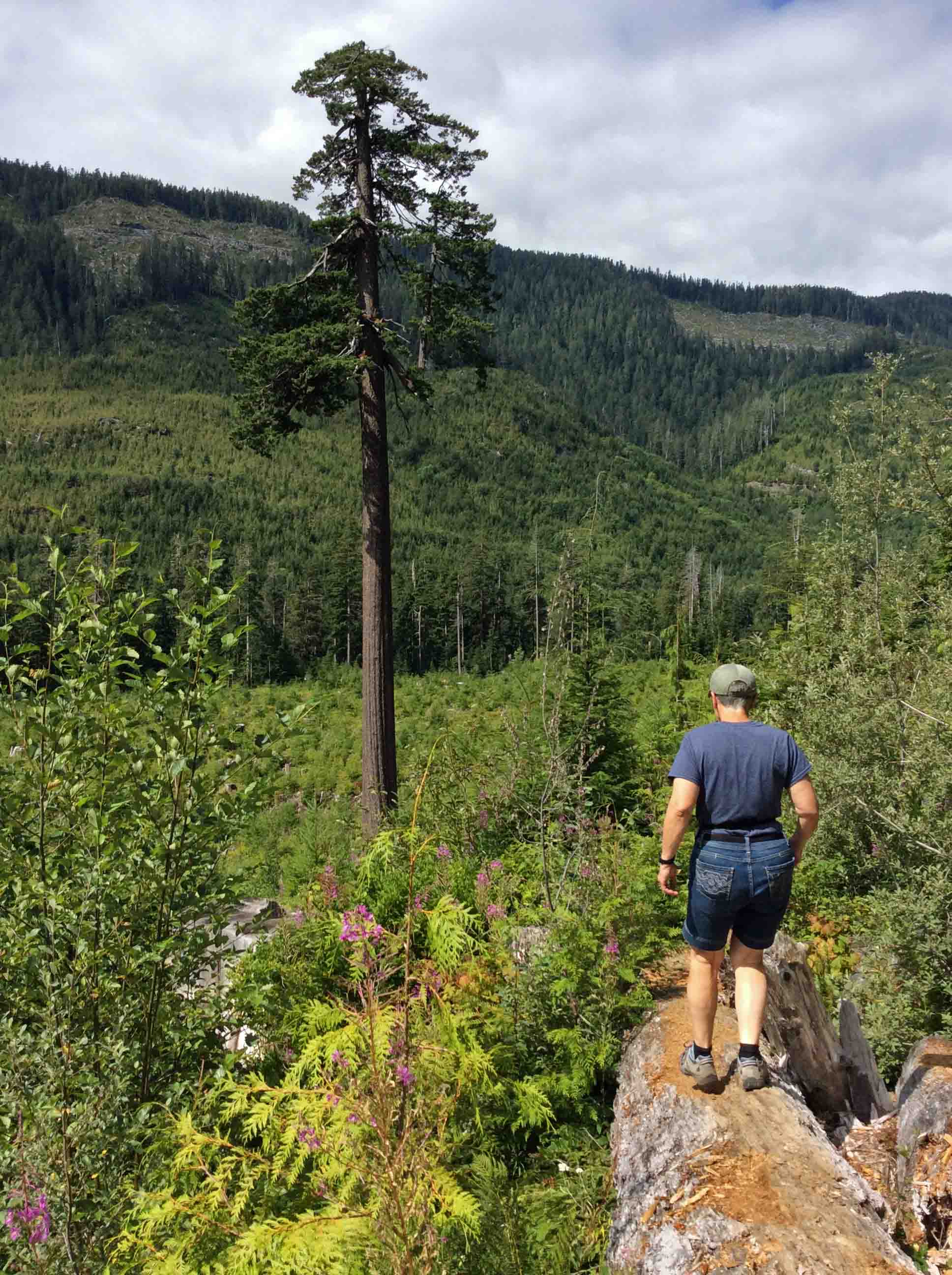
And then there’s Big Lonely Doug, a giant Douglas fir tree north of Port Renfrew on Vancouver Island, which was saved by a forester from logging. At 66 m high with a girth of 12 m, and over 1,000 years old, Big Lonely Doug is one of the largest Douglas fir trees in the world. In 2011, logger Dennis Cronin discovered this enormous tree while surveying a patch of forest to be logged for timber. He wrapped green ribbon around the tree’s nearly 12-metre circumference and saved it from being cut.
.
Friend Anne walks toward Big Lonely Doug, near Port Renfrew, BC (photo by Nina Munteanu)
.
After the forest around it was gone, and images of a single enormous tree left standing on its own in the middle of a clear-cut began to be circulated, the tree, located just outside Port Renfrew on Vancouver Island, became a symbol for the dwindling old-growth forests in British Columbia,” writes Harley Rustad in the Globe and Mail.
Mature “old-growth” Douglas-fir forests are primary habitats for the red tree vole (Arborimus longicaudus) and the spotted owl (Strix occidentalis). Small mammals (moles, shrews, and chipmunks) rely on the seeds of Douglas fir, consuming an estimated 65% of each annual seed crop. The Douglas squirrel harvests and hoards great quantities of Douglas-fir cones; it also eats mature pollen cones, the inner bark, terminal shoots, and developing young needles.
Male Douglas fir cones are yellowish red and 5–12 mm long. Female cones are green when young, maturing to reddish-brown or gray, 6–10 cm long. The cones are pendulous, with persistent scales, unlike those of true firs, and distinctive long, three-pointed bracts which protrude above each scale and resemble the two feet and tail of a mouse. Douglas fir leaves are flat needles that resemble fir needles but occur singly rather than in fascicles; they also completely encircle the branches.
.
Watershed Park: an Example of a Douglas Fir Rainforest
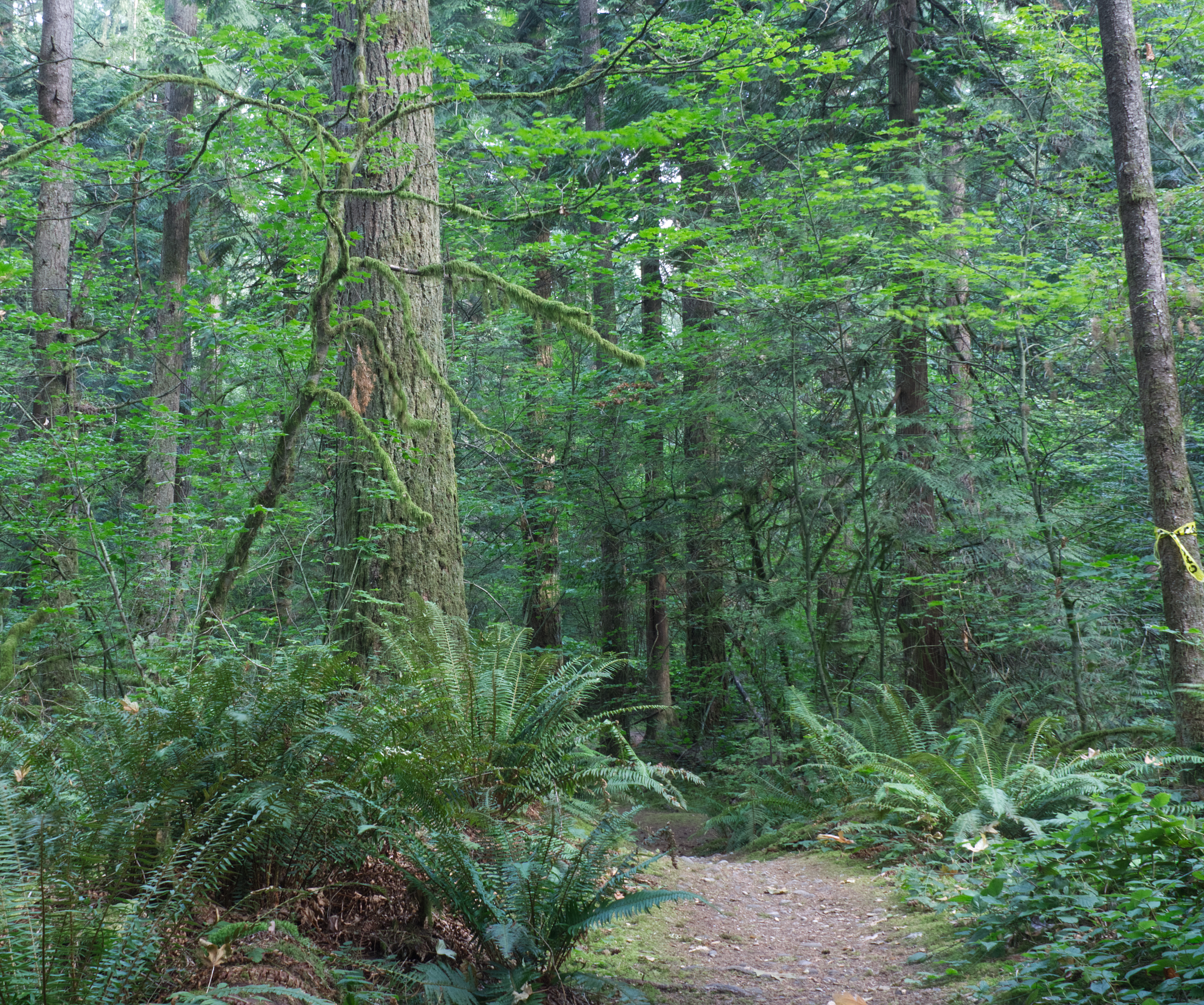
One of the many trails through Watershed Park, BC (photo by Nina Munteanu)
.
Watershed Park in Delta, BC, is an example of a regenerated coastal temperate rainforest (CTR) ecosystem, dominated by Douglas Fir, Western Hemlock, and Red Cedar. This ecosystem thrives on abundant Pacific moisture that helps create lush complex forests providing critical habitats for biodiverse communities and immense carbon storage.
This biodiverse ecosystem protects vital watercourses next to Burns Bog and offers many trails for hiking/biking through lush undergrowth of Sword Ferns, huckleberries and vine maples. This 153 hectare second-growth park demonstrates nature’s recovery from logging (in the early 1900s), and supports salmon habitat restoration efforts. The park serves as a key urban green space for recreation and wildlife near a residential area.
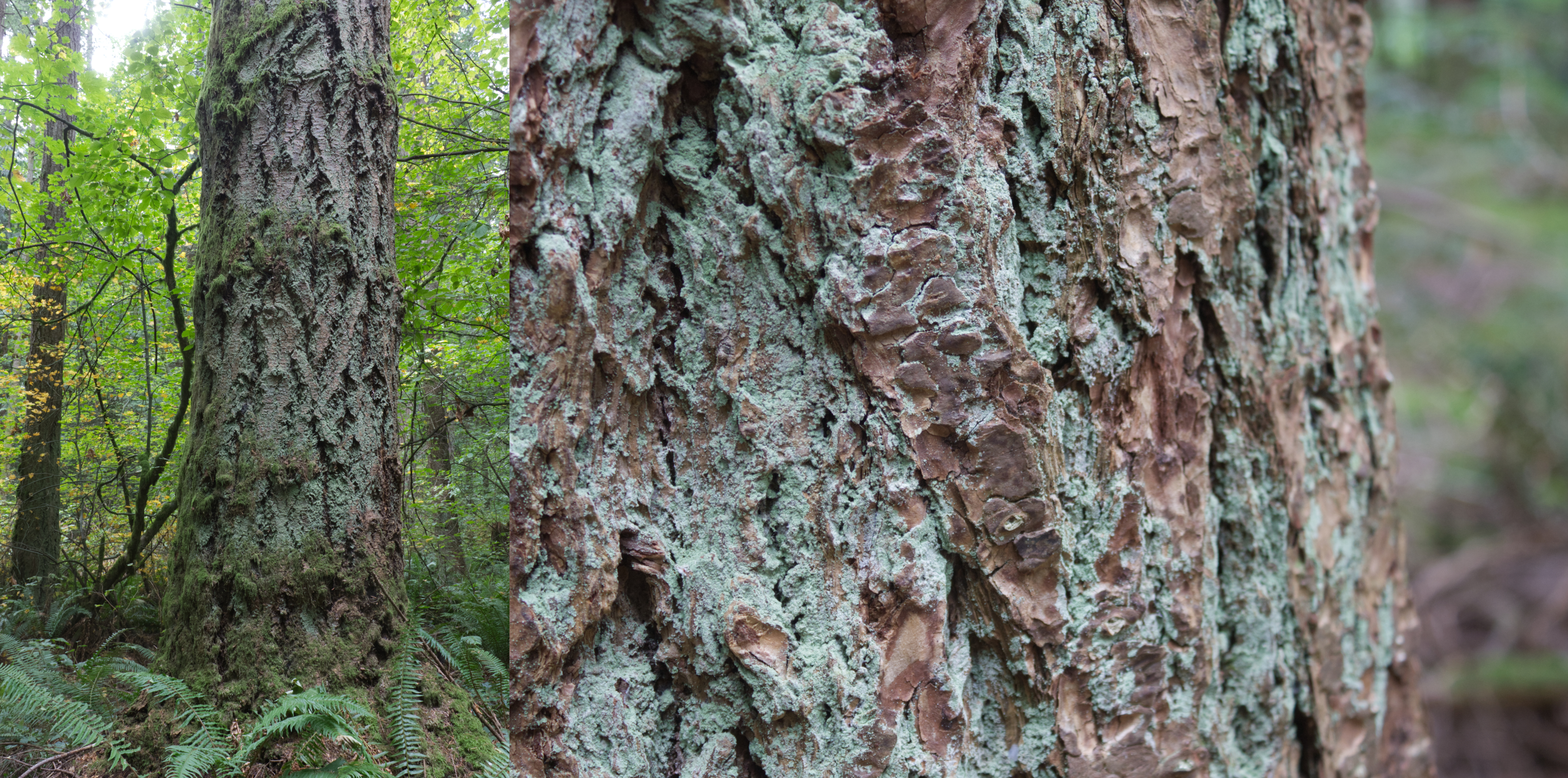
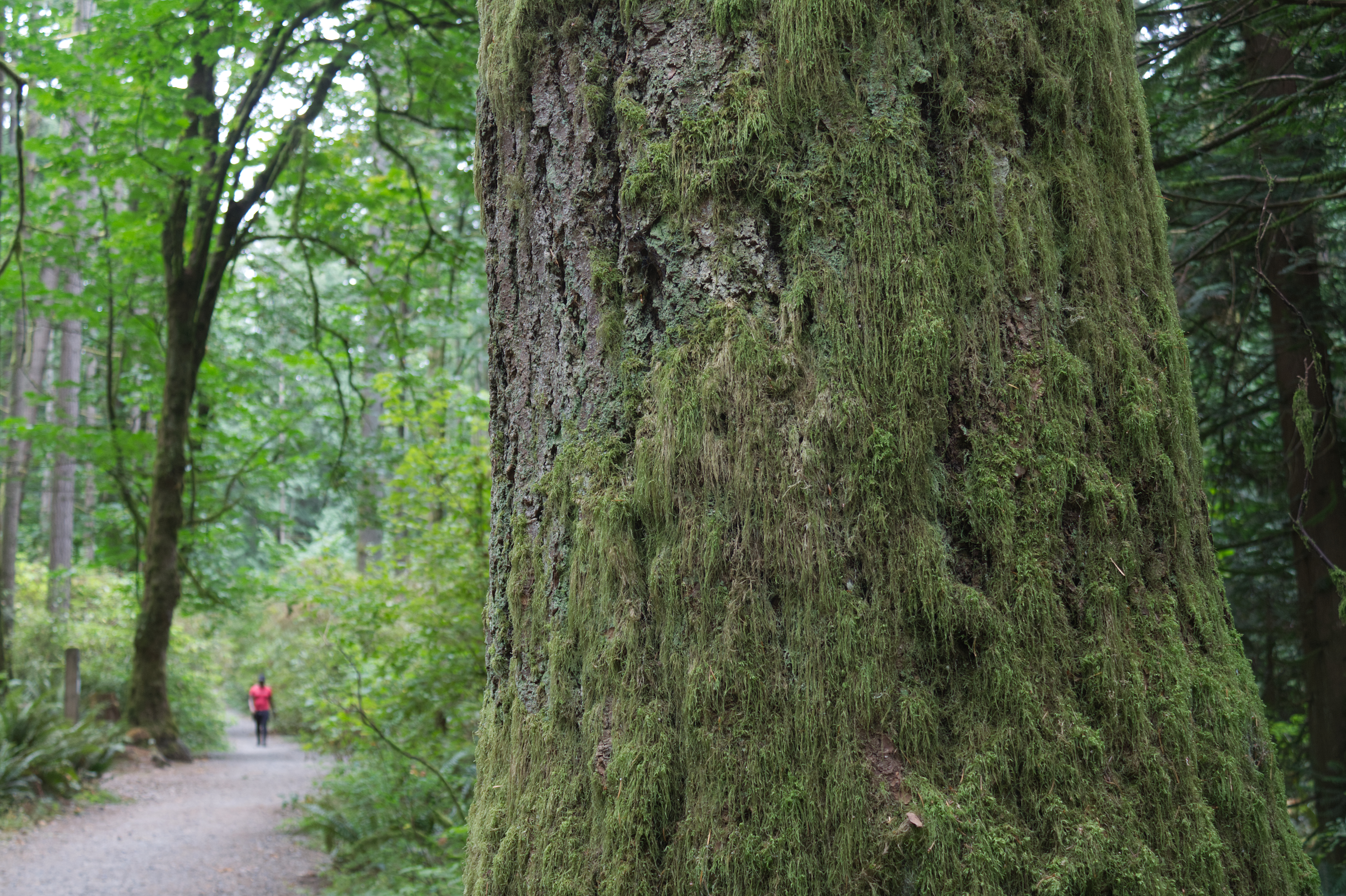
Douglas fir tree covered in moss and lichen, Watershed Park, BC (photo by Nina Munteanu)
.
Watershed Park is named for the aquifer beneath the park. The aquifer of groundwater sits in a layer of gravel and sand under pressure, below a thick layer of clay. The park’s artesian springs come from the water filtering through the layers of clay and gravel up to the surface under pressure. Starting in 1910, the artesian springs of Watershed Park provided water for the Ladner and Kittson Parkway areas since 1910. Today, it provides about 5% of Delta’s drinking water. Down the hill of Tower Trail, is a pump and water faucet where locals come to fill up with fresh spring water.
.
Douglas Fir: Bark & Beyond
Nina stands between two giant Douglas fir trees, showing deeply furrowed bark, riddled with holes by birds, Lighthouse Park, BC (photo by M. Ross)
.
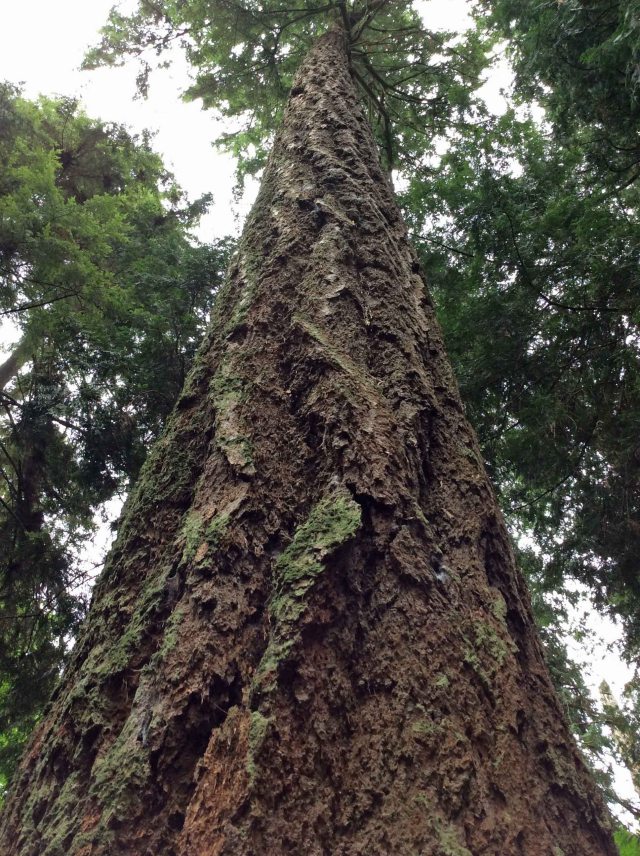
The bark on young trees is thin, smooth, gray, and contains numerous resin blisters. The bark of mature trees, usually over 80 years, is very thick and corky, growing up to 36 cm thick with deep vertical fissures caused by the gradual expansion of the growing tree. Mature bark varies from dark brown to lighter colored, developing multiple layers, and making the Douglas-fir one of the most fire-resistant tree native to the Pacific Northwest.
.
Aside from its tall canopy providing a shaded habitat and home for a biodiverse community, the bark of the Douglas fir is an entire ecosystem, supporting many micro-communities of moss, corticolous lichen and fungi. It is an entire world that changes from bottom to top.
Looking up a deeply furrowed Douglas fir; note the spiral nature of the furrows. Lighthouse Park, BC (photo by Nina Munteanu)
.
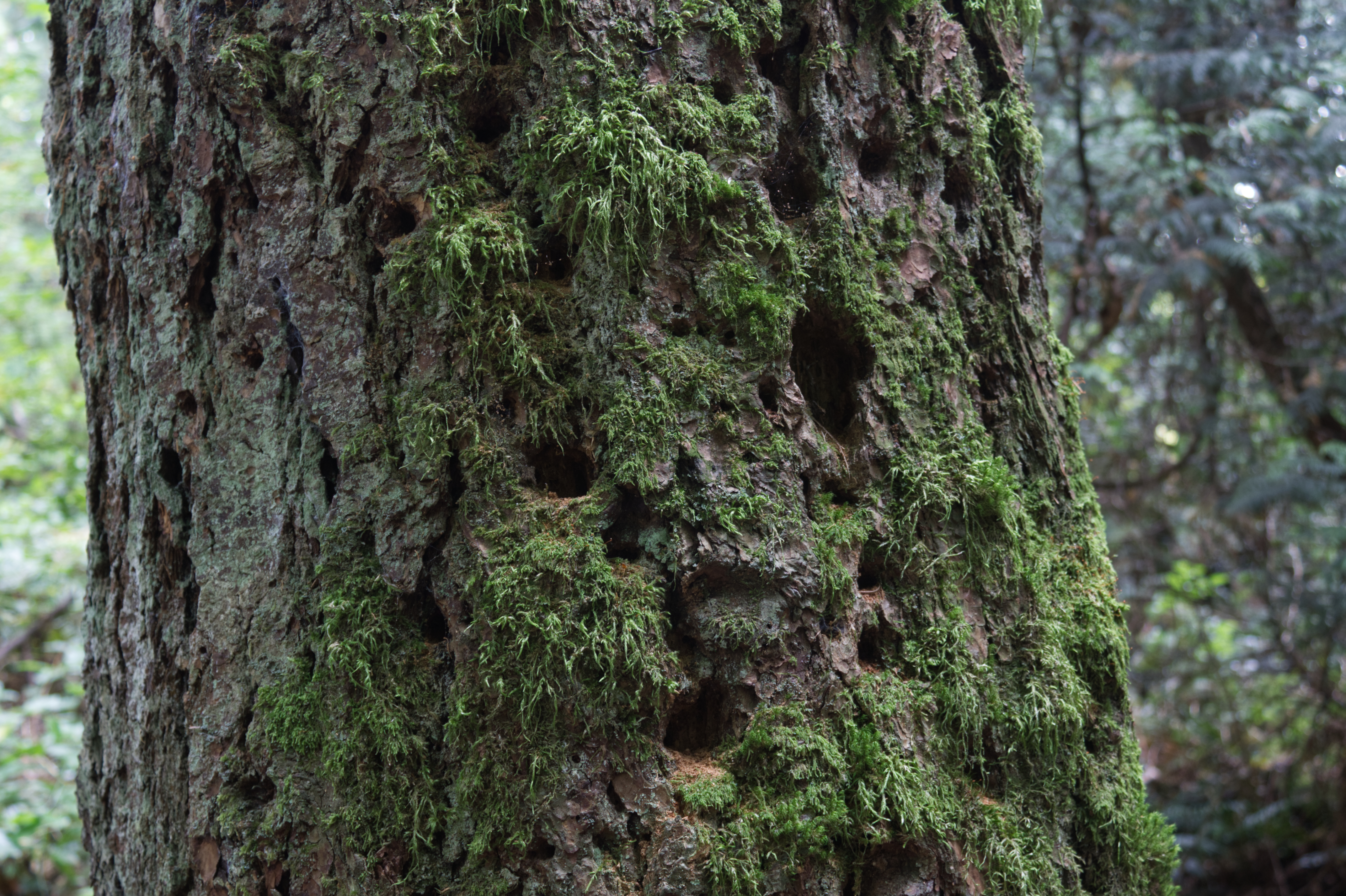
Douglas fir tree riddled by Norther Flicker holes, Watershed Park, BC (photo by Nina Munteanu)
.
I found one particular tree drilled with many northern flicker holes. The woodpeckers create deep, three inch diameter holes as nests, leaving a bed of wood chips at the bottom. The birds also peck at wood for insects, creating smaller dim-sized holes in straight, horizontal lines.
.
Plagiothecium curvifolium covers Douglas fir bark, Watershed Park, BC (photo by Nina Munteanu)
.
Amid the holes, I found a dense cover of curved silk-moss (Plagiothecium curvifolium); this tiny and lovely ribbon-like moss covered much of the tree trunk. Its main habitats include shaded, moist coniferous woodlands, where it grows on decaying logs, stumps, soil, humus and the bases of trees, especially those with acidic bark such as Douglas fir (with pH as low as 3.3). The liverwort Cephalozia lunulifolia (renamed Fuscocephaloziopsis lunulifolia) was growing like lace amid Plagiothecium curvifolium. Also known as moon-leaved liverwort, Cephalozia is a slender bryophyte, less than 1 mm across, with incurved pincer-like or moon-shaped leaves. It likes moist environments and prefers rotting logs, peaty banks or moist humus-rich soils.
.
Various views of Plagiothecium colonizing a Douglas fir trunk, Watershed Park, BC (photo by Nina Munteanu)
.
Douglas fir covered in stringy moss and powder lichen, Watershed Park, BC (photo by Nina Munteanu)
.
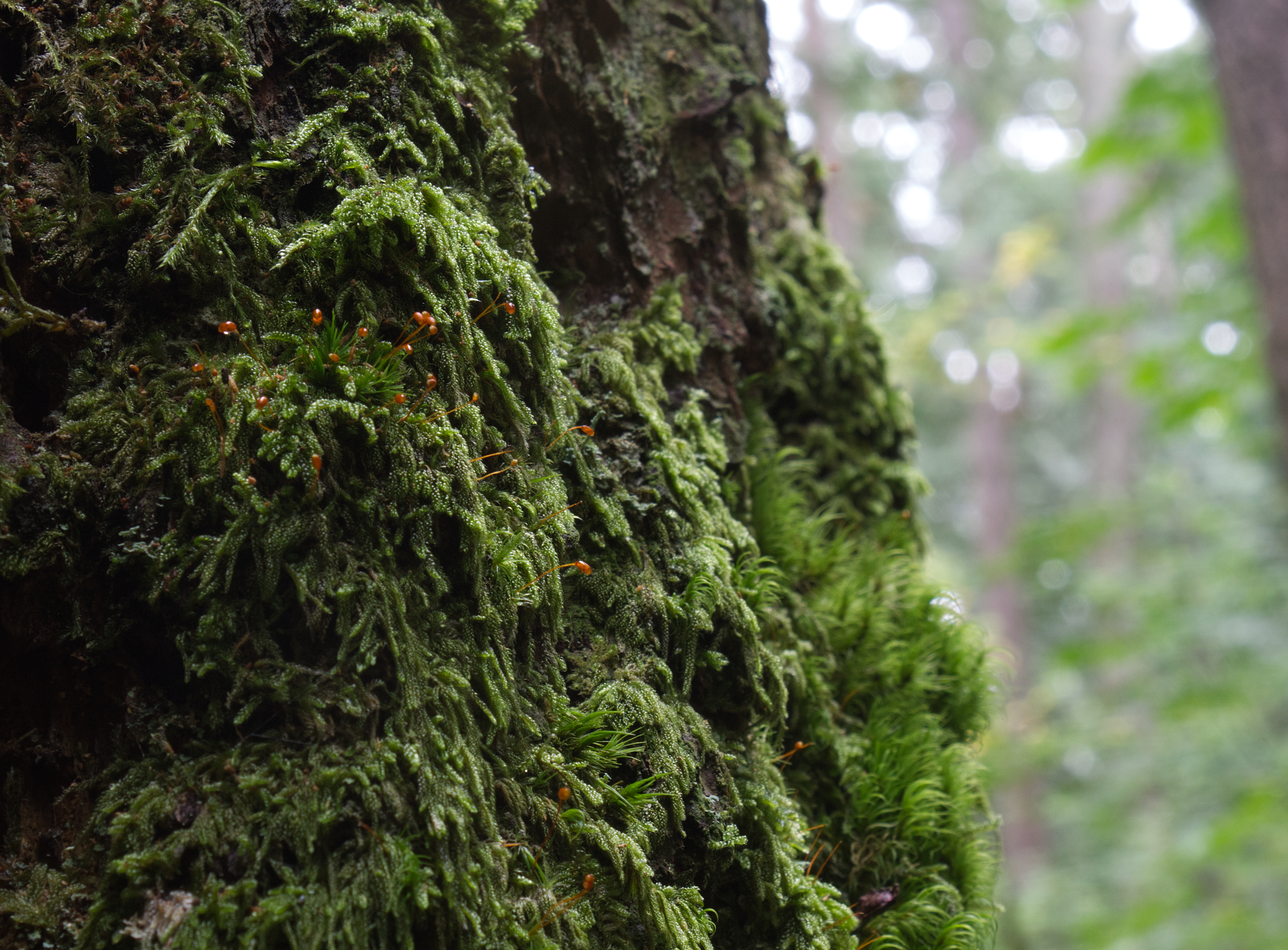
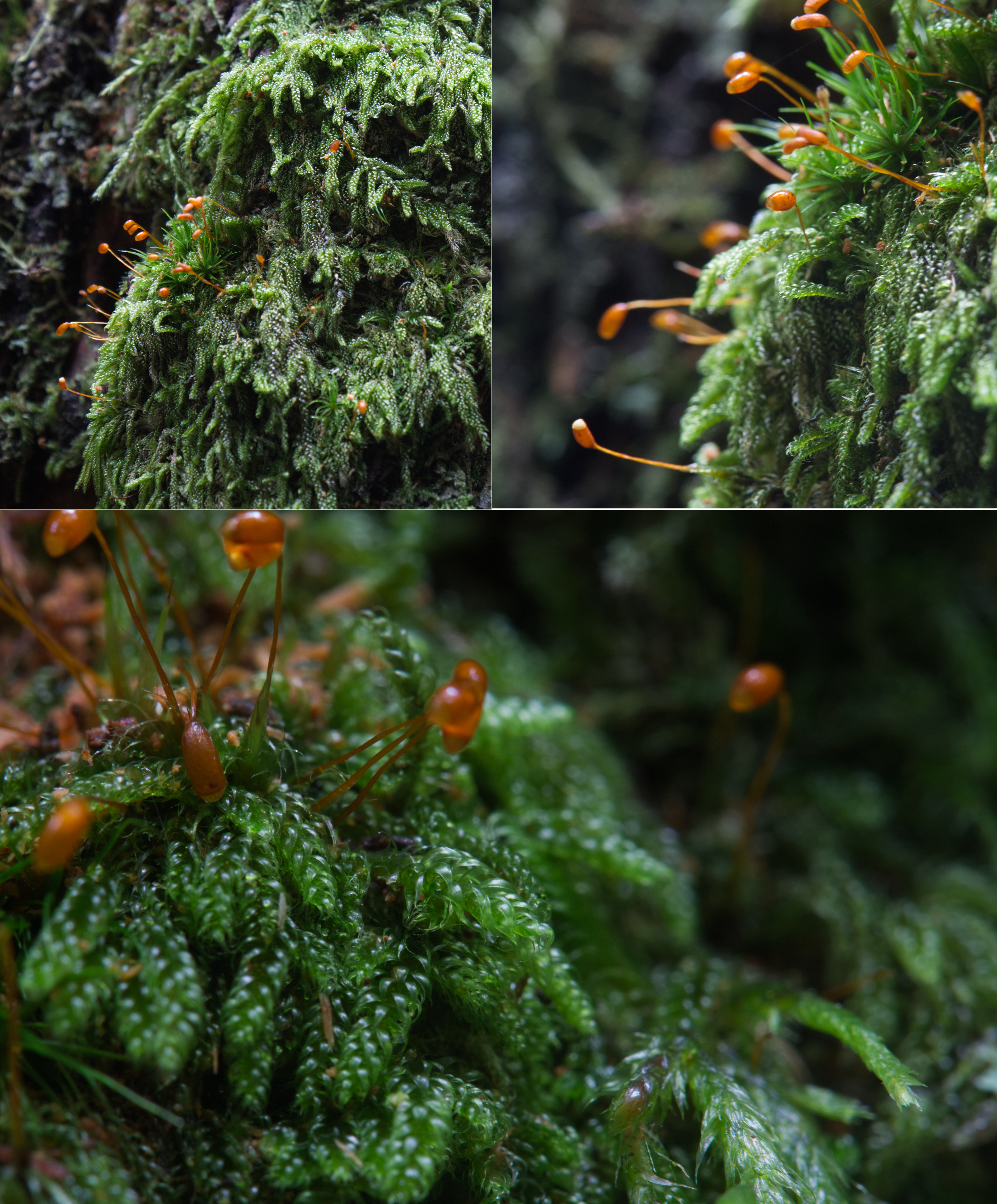
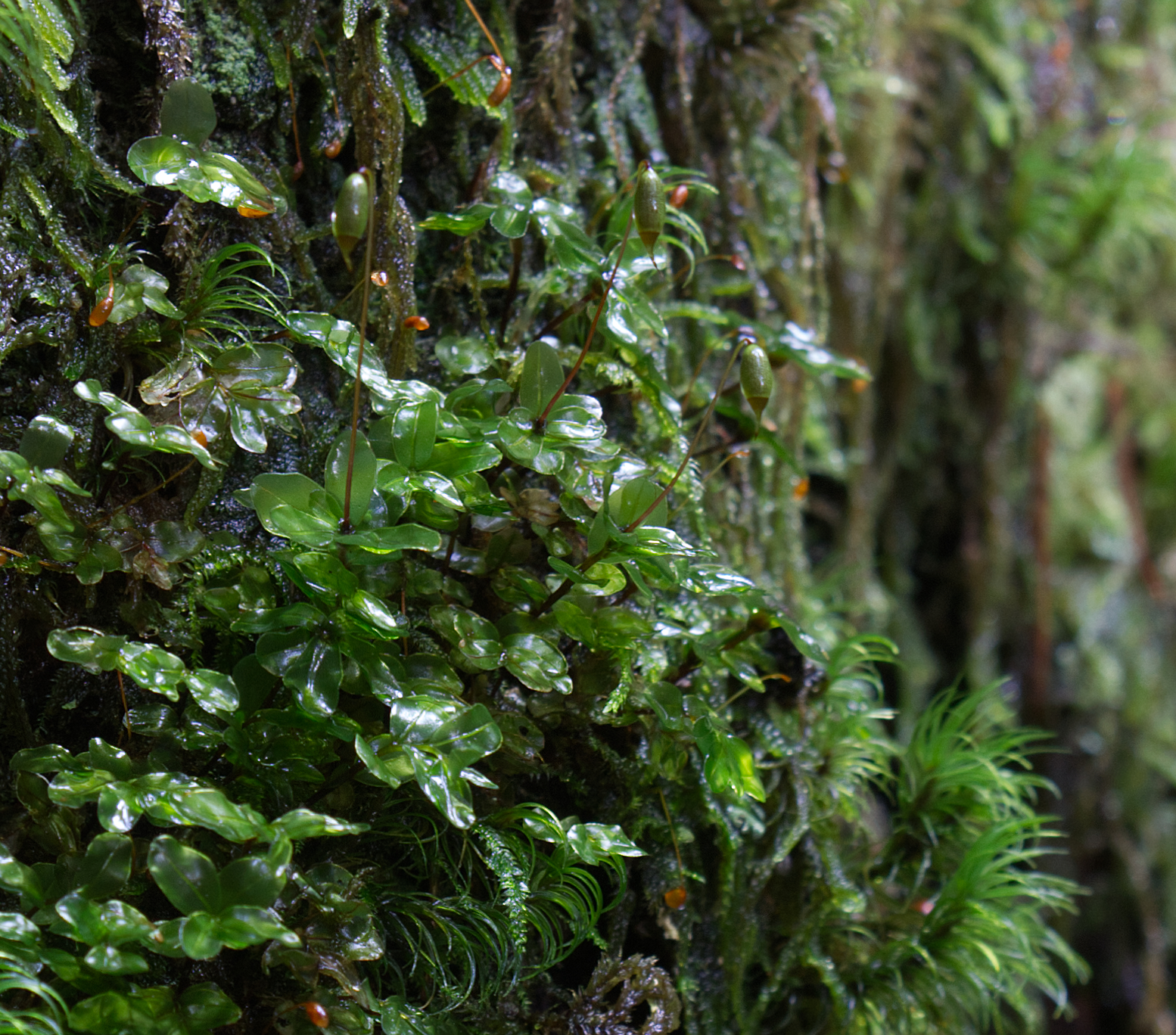
In late winter, I also found small patches of Large Leafy moss or fan moss (Rhizomnium glabrescens) with sporophyte capsules. Rhizomnium is considered the most common species of leafy moss in low elevation forests such as Watershed Park. Like the versatile liverwort Cephalozia, it is also known to prefer rotten logs, humus or soil over rocks as a habitat; and yet there it was flourishing on the acidic bark of the Douglas fir.
.
Rhizomnium glabrescens with sporophytes (green capsules) amid Dicranium moss on a Douglas fir tree, Watershed Park, BC (photo by Nina Munteanu)
.
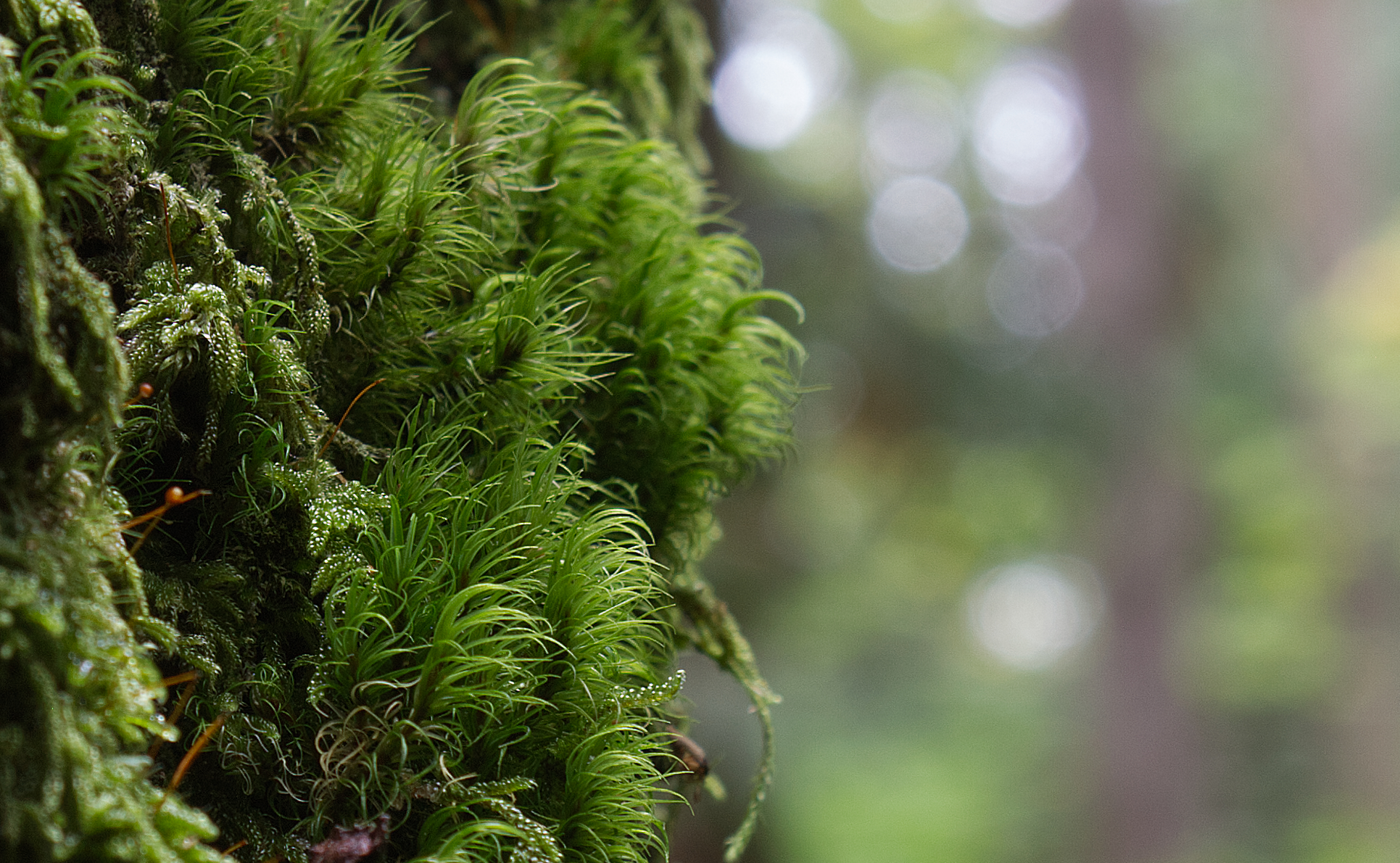
Along the tree trunk I also saw strings of Cat-tail moss (Isothecium stoloniferum) and puffy bright green tufts of curly mountain fork moss (Dicranum montanum).
.
Dicranum montanum colonizing Douglas fir bark, Watershed Park, BC (photo by NIna Munteanu)
.
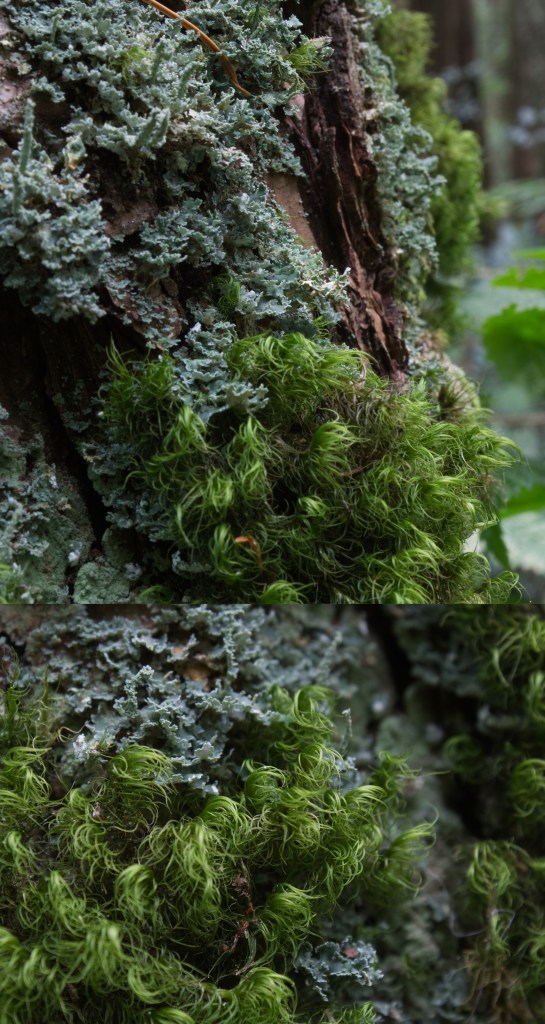
Tucked in with the moss were extensive patches of greenish-grey lichen: squamules and distinctive horn-like stalks called podetia (fruiting bodies) of the Common Powderhorn (Cladonia coniocraea). This versatile lichen commonly grows on many substrates in shaded moist places, including litter or bare ground, fence posts, decaying wood such as rotting logs and stumps, and the bark of trees.
Dicranum moss and Common Powderhorn lichen colonize Douglas fir bark, Watershed Park, BC (photo by Nina Munteanu)
.
Dust lichen growing on several Douglas fir trees, Watershed Park, BC (photos by Nina Munteanu)
.
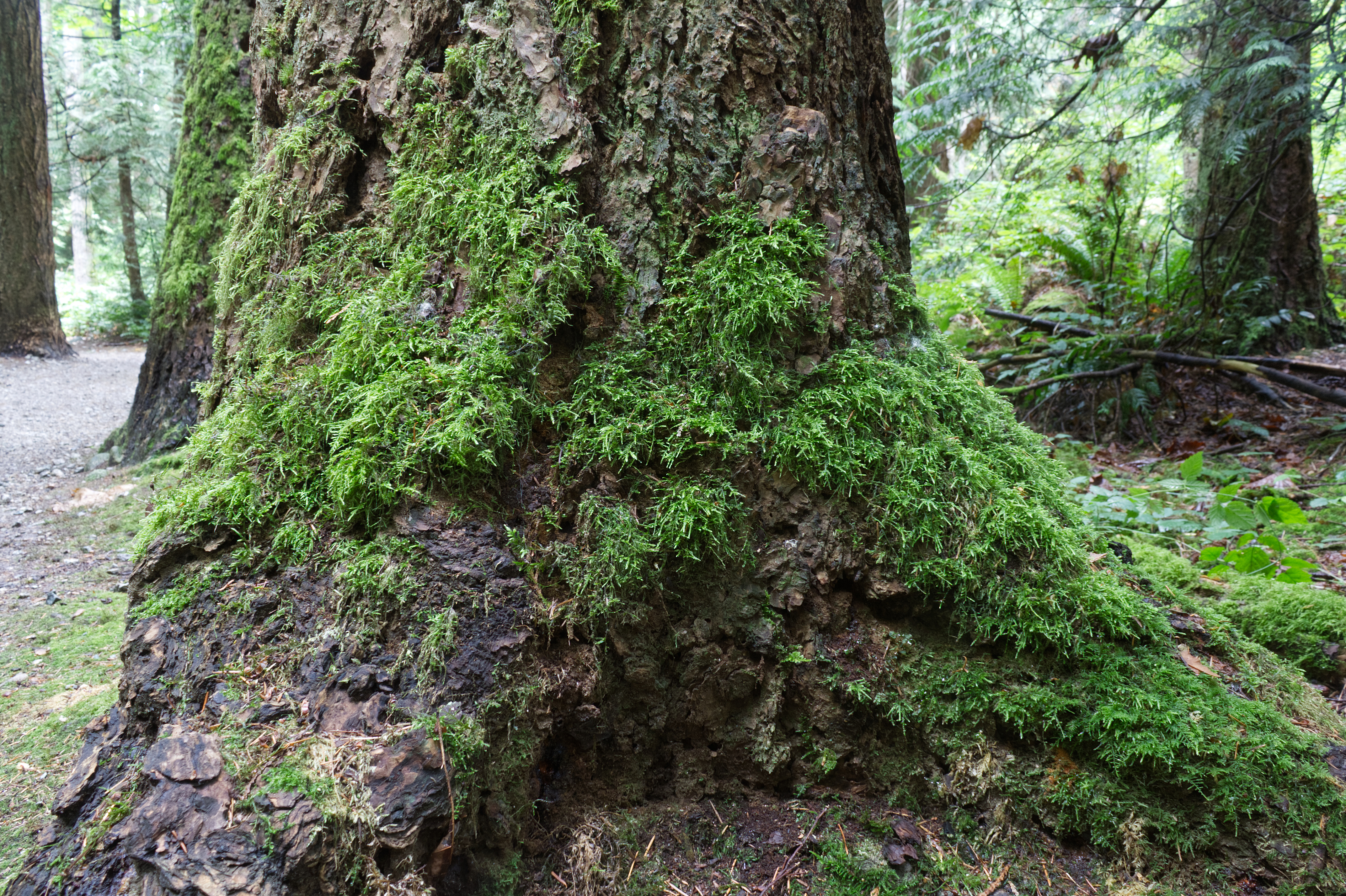
The base of a Douglas fir tree covered in silk moss, Oregon Beaked moss and Mountern fern moss, Watershed Park, BC (photo by Nina Munteanu)
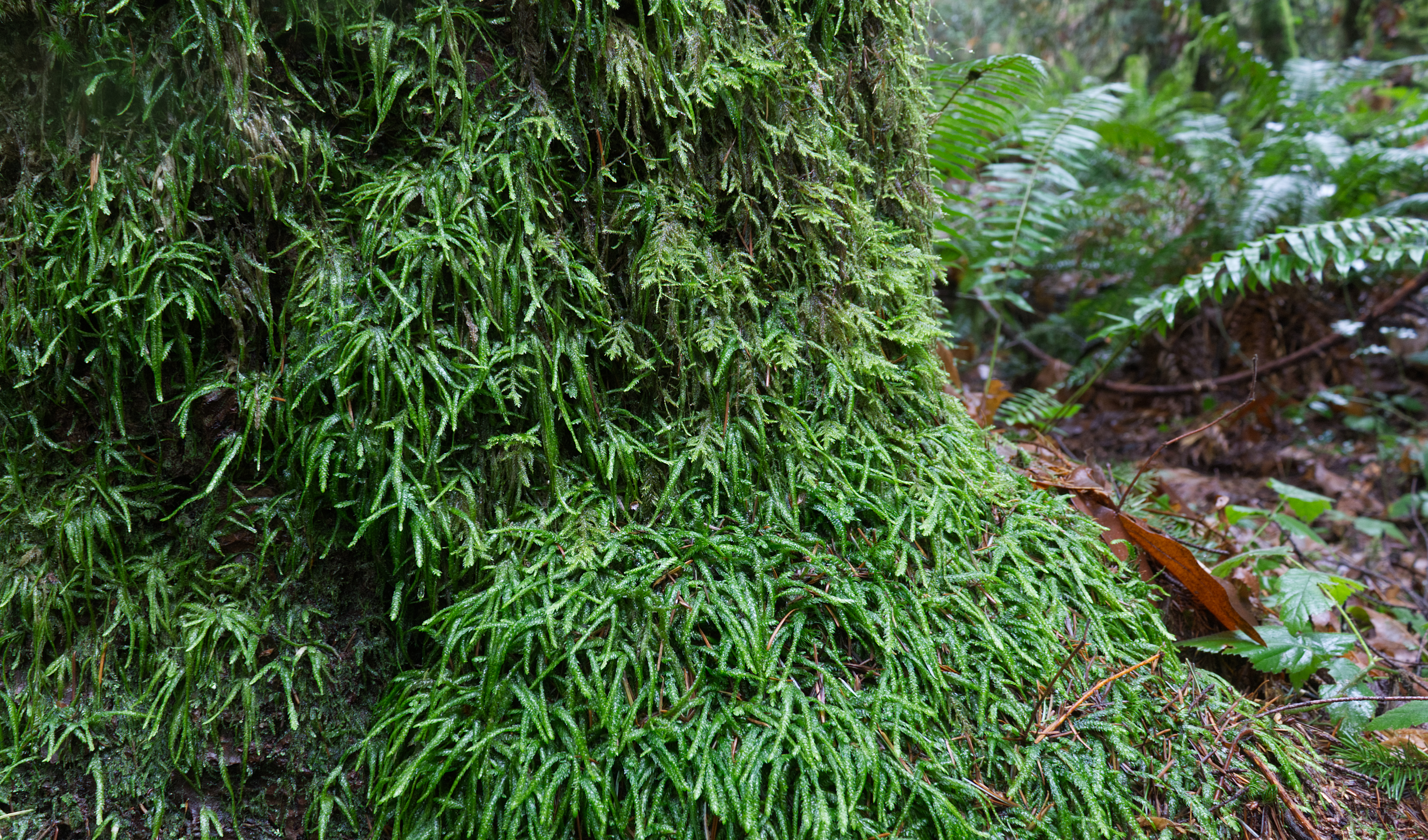
Waved Silk moss at the base of a Douglas fir tree, Watershed Park, BC (photo by Nina Munteanu)
.
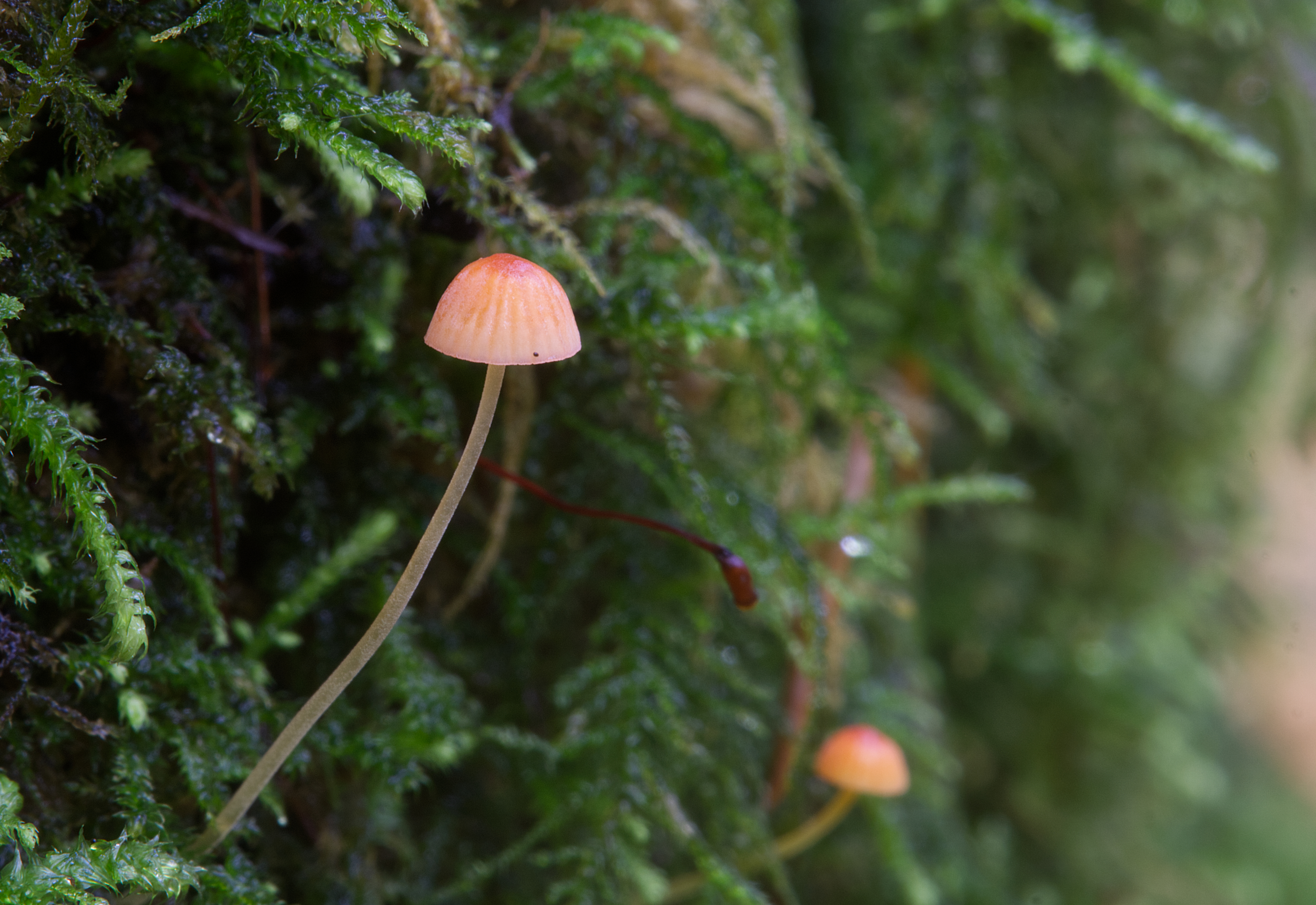
At the base of the Douglas fir tree, I found healthy clusters of waved silk moss (Plagiotheium undulatum), looking like light green thick caterpillars, and feathery Oregon beaked moss (Kindbergia oregana) as well as Mountain fern moss, (Hypocomium splendens) on the ground around the tree. Douglas fir trees also support many tiny fungi, like the tiny blushing Mycena acicula growing amid the mossy bark.
.
Tiny Mycena acicula grows amid the moss on a Douglas fir tree, Watershed Park, BC (photo by Nina Munteanu)
.
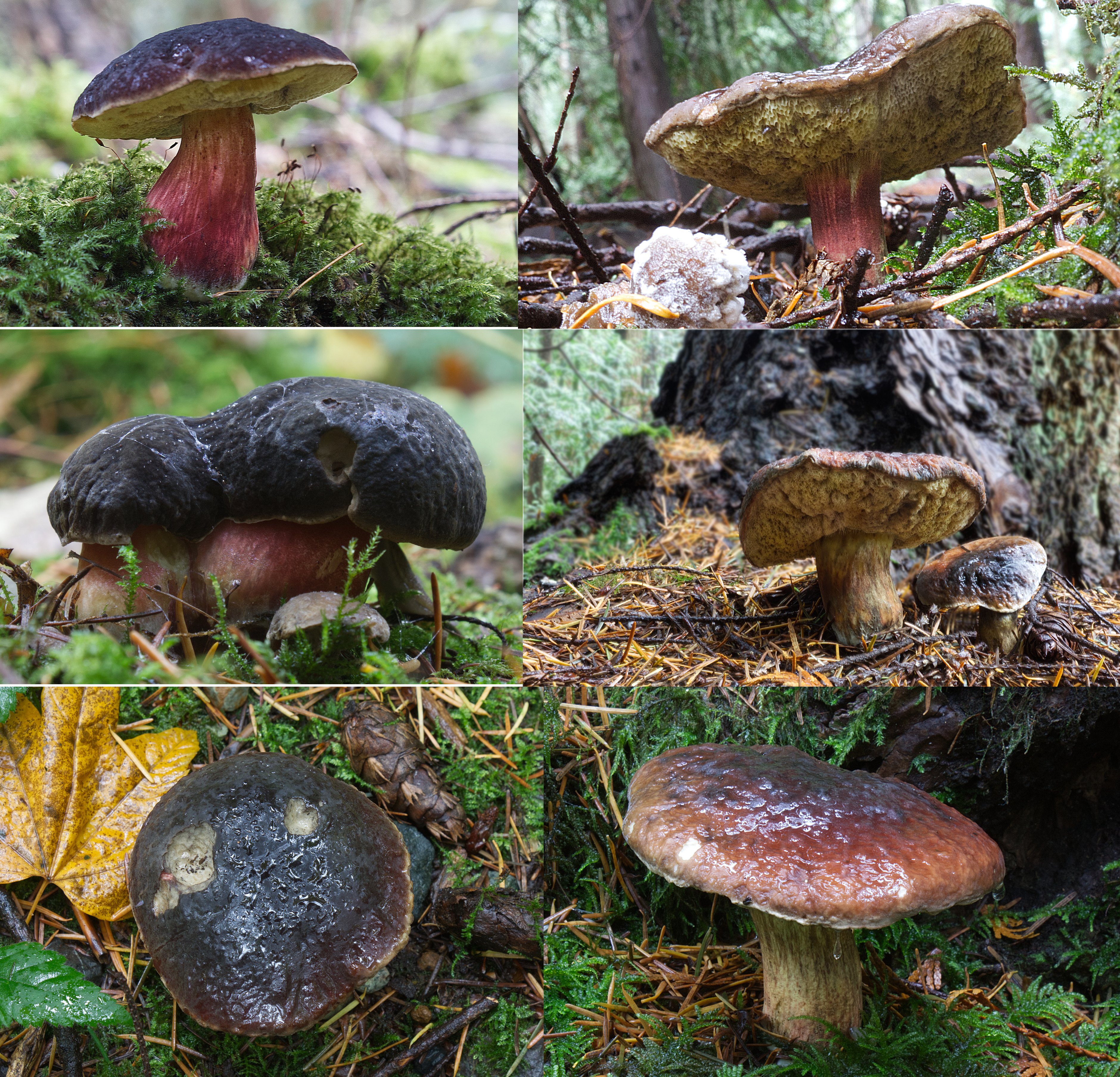
Various views of young (left) and mature (right) Zellers Boletes near Douglas fir trees, Watershed Park, BC (photos by Nina Munteanu)
.
In late October, clustered near several Douglas fir trees, I discovered boletes with charcoal gray cap and stunning bright red stem. They were medium-sized with stunning reddish stipes and slate gray caps. When I returned home, I identified this fungus as Zeller’s Bolete (Xerocomellus zelleri), a mycorrhizal mushroom, whose fungal hyphae form sheaths around the rootlets of ectomycorrhizal trees and shrubs and exchanging nutrients with them in a mutualistic relationship. Xerocomelluszelleri only lives in western North America from British Columbia south to Mexico.
.
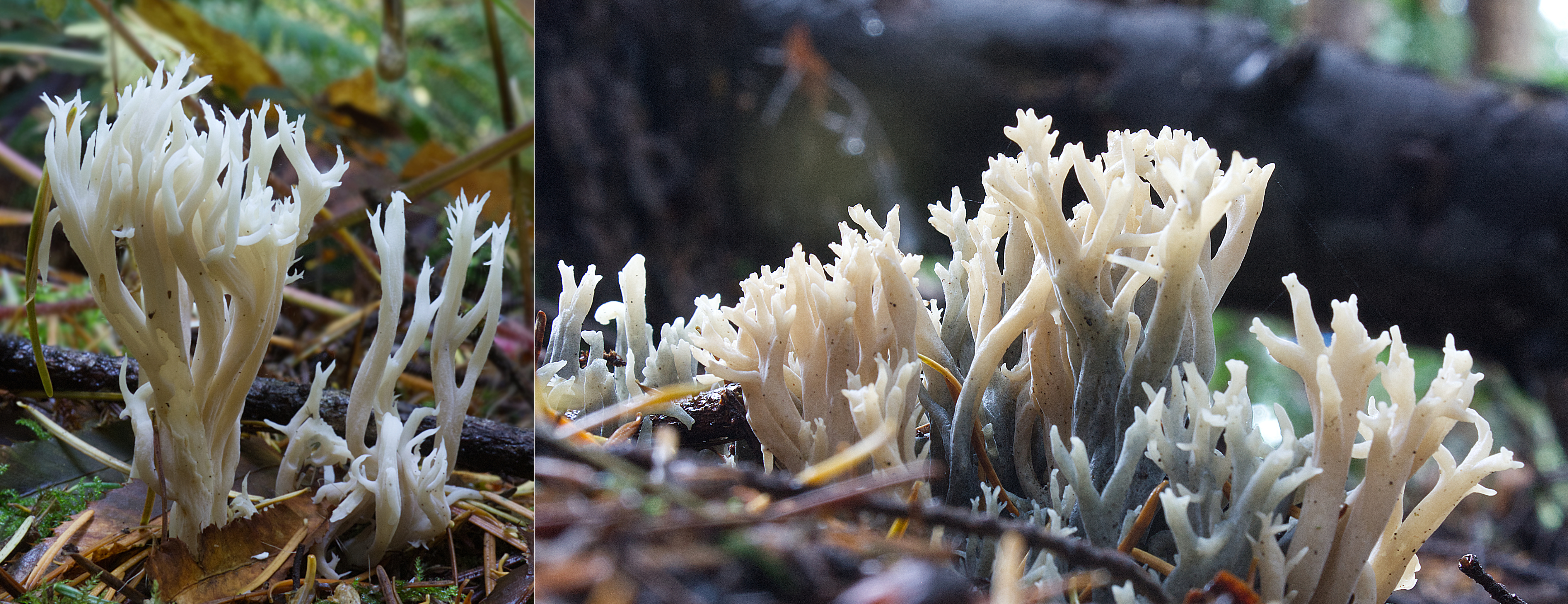
Left: white coral mushroom; right: white coral mushroom with parasitic fungus, Watershed Park, BC (photos by Nina Munteanu)
.
Spreading their creamy-coloured fruiting bodies on the step moss-covered ground near Douglas fir trees with which they form a mycorrhizal relationship, were many colonies of White Coral mushroom (Clavulina coralloides). Also called Wrinkled Coral fungus or Crested Coral fungus, these delicately beautiful creamy white branching mushrooms are actually quite tiny, reaching about 2 cm high, and typically found in moist, shaded areas during late summer and fall, often under conifers or hardwoods.
I noticed that some of the fungi were turning blue-grey from the base up. This, I later found, is caused by the parasitic ascomycete fungus Helminthosphaeria clavariarum, which spreads from the base up, presumably drawing nutrients from the host. The parasitic fungus doesn’t seem to affect the coral fungus much, except its appearance. One source mentioned that H. clavariarum can cause more sparse and abnormal branching in the host fungus.
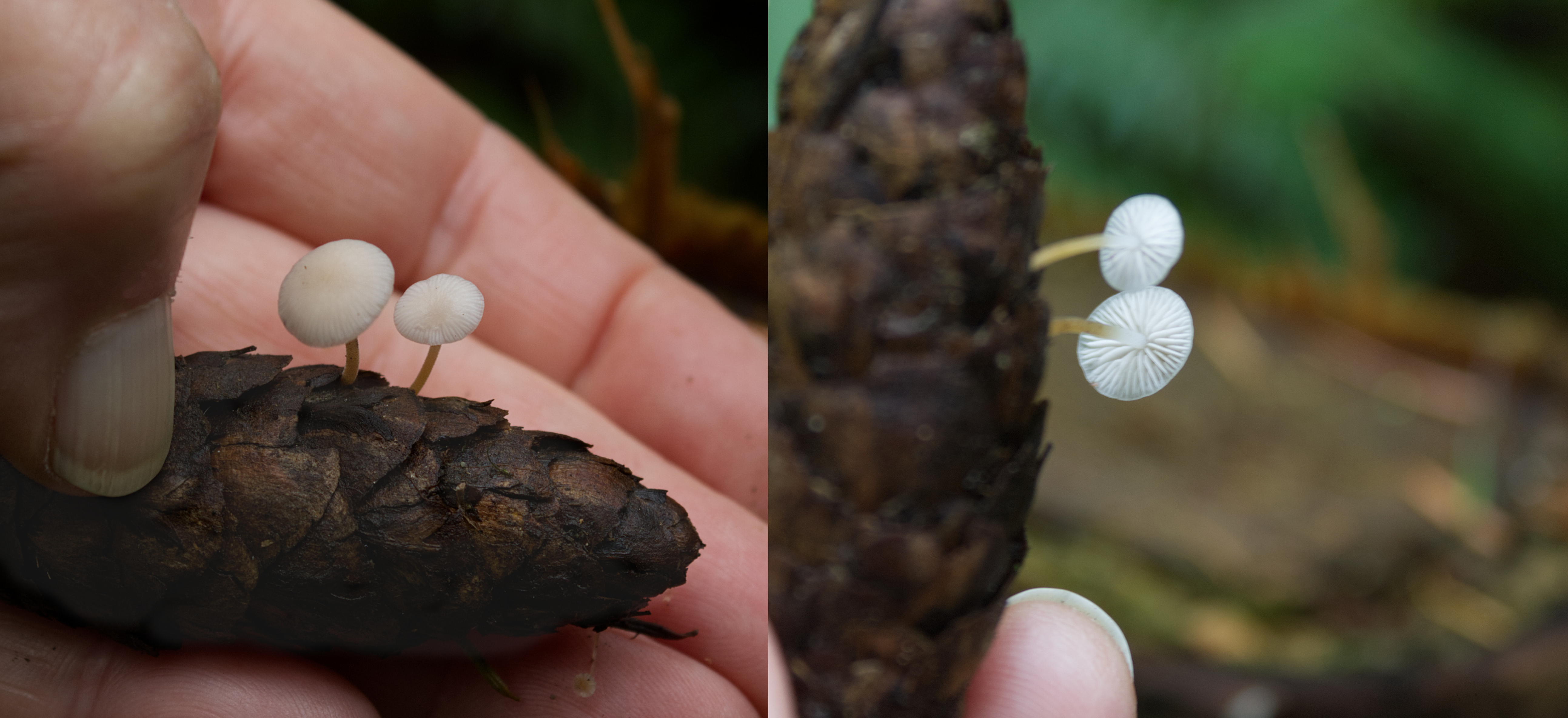
I also spotted several Douglas fir cones with tiny white mushrooms sprouting from them. These are simply known as Douglas fir cone mushrooms (Strobilurus trullisatus), common in the Pacific Northwest and often a sign that the mushroom season is beginning.
.
Two views of the tiny Douglas fir cone mushroom, Watershed Park, BC (photos by Nina Munteanu)
.
References:
Brockman, C. Frank. 1968. “Pseudotsuga menziesii” In: “Trees of North America: A Guide to Field Identification.” Golden Press. New York. pp. 44–45.
Russell, Tony; Cutler, Catherine; Walters, Martin. 2014. “Pseudotsuga menziesii: The Illustrated Encyclopedia of Trees of the World”. Anness Publishing Ltd. London. p. 120.
Rustad, Harley. 2018. “Big Lonely Doug: The Story of One of Canada’s Last Great Trees.” House of Anansi Press. 328pp.
Large Douglas fir tree covered in cat tail moss on one of the trails in Watershed Park, BC (photo by Nina Munteanu)
.
Nina Munteanu is a Canadian ecologist / limnologist and novelist. She is co-editor of Europa SF and currently teaches writing courses at George Brown College and the University of Toronto. Visit www.ninamunteanu.ca for the latest on her books. Nina’s bilingual “La natura dell’acqua / The Way of Water” was published by Mincione Edizioni in Rome. Her non-fiction book “Water Is…” by Pixl Press (Vancouver) was selected by Margaret Atwood in the New York Times ‘Year in Reading’ and was chosen as the 2017 Summer Read by Water Canada. Her novel “A Diary in the Age of Water” was released by Inanna Publications (Toronto) in June 2020.




 The Meaning of Water