.
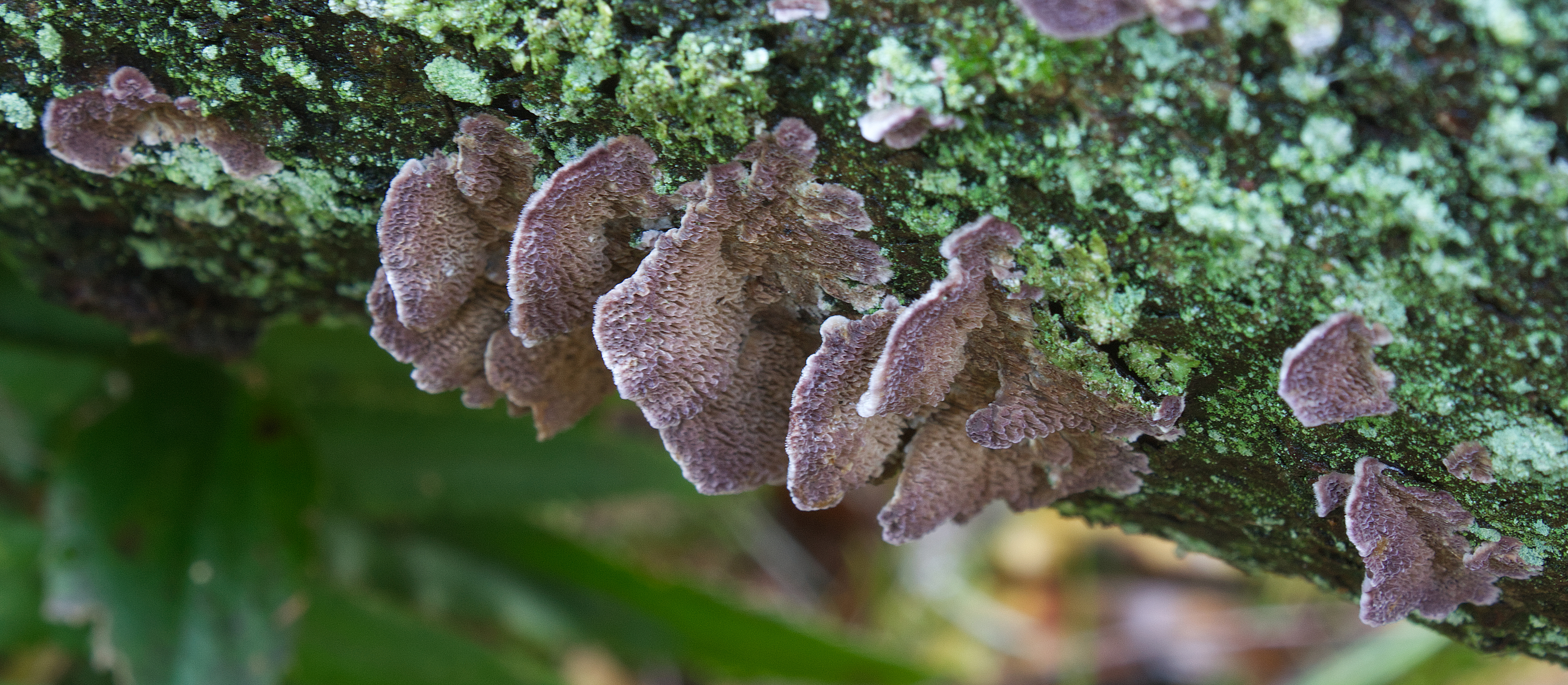
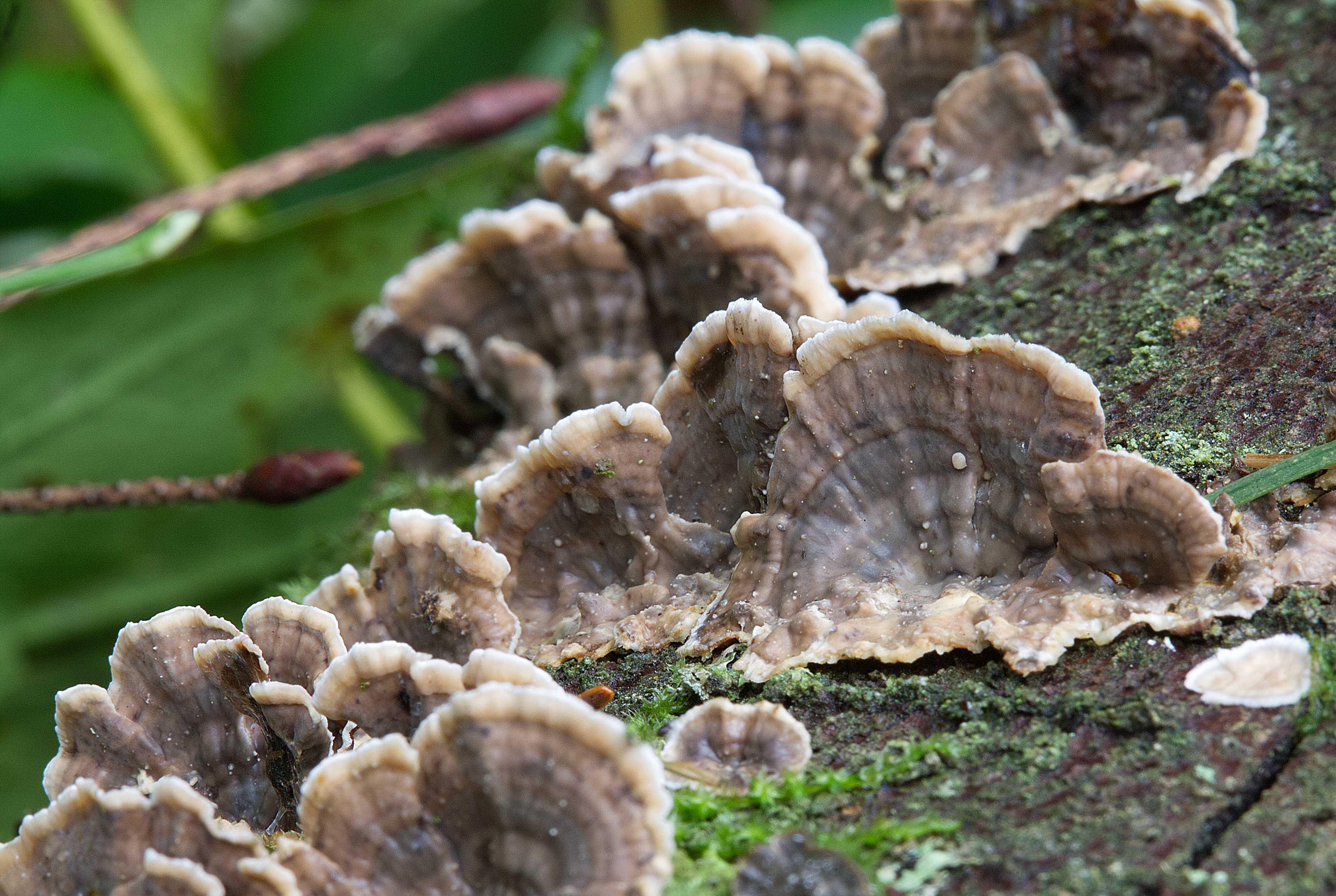
On a recent walk in my favourite local forest Watershed Park, I was exploring small pathways off a main trail and came across a little-used trail, no doubt because a large log lay across it. On the fallen log that was losing its bark, I found several clusters of a small bracket mushroom that I first thought were dull small Turkey Tail mushrooms with similar zoned markings on their upper surface; but on closer inspection, I saw that their undersides were toothed pores and unmistakably purple. This attractive shelf fungus had spread amoeba-like across a large area of the decaying, separated bark of the Douglas fir log. One large slab of bark had in fact dislodged from the decaying log and lay on the ground, covered in this purple-hewed fungus. The clusters were often surrounded by ‘hairs’ (which I later learned were on the flat caps of these mushrooms). It reminded me of the white to blue webby margin (the fungal partner) of the Mapledust Lichen Lecanora thysanophora: a fibrous prothallus that resembled asbestos fibres—the radiating fungal hyphae and actively growing region of the lichen.
.
.
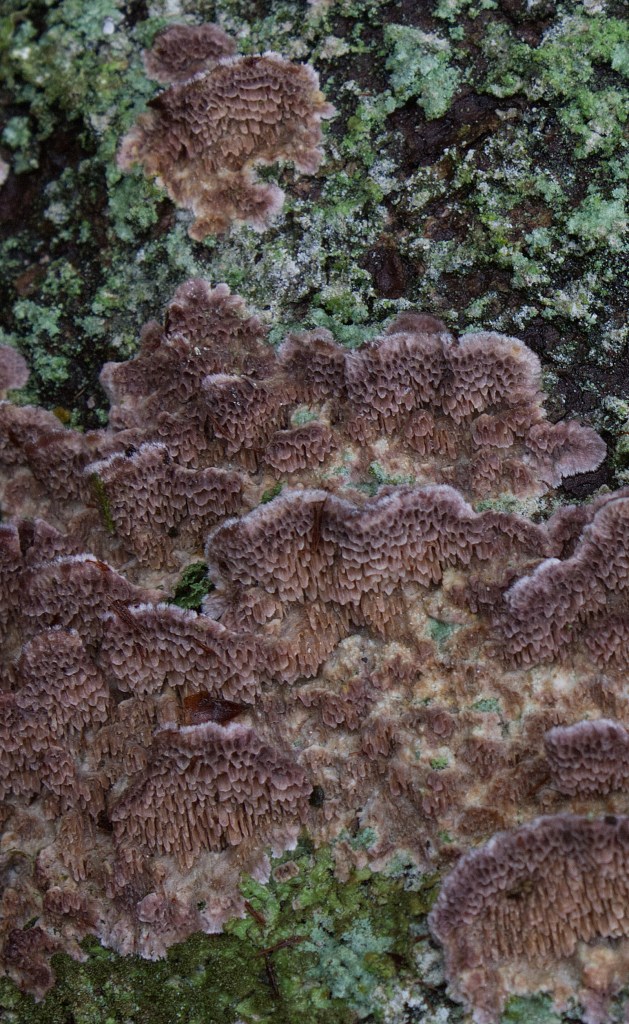
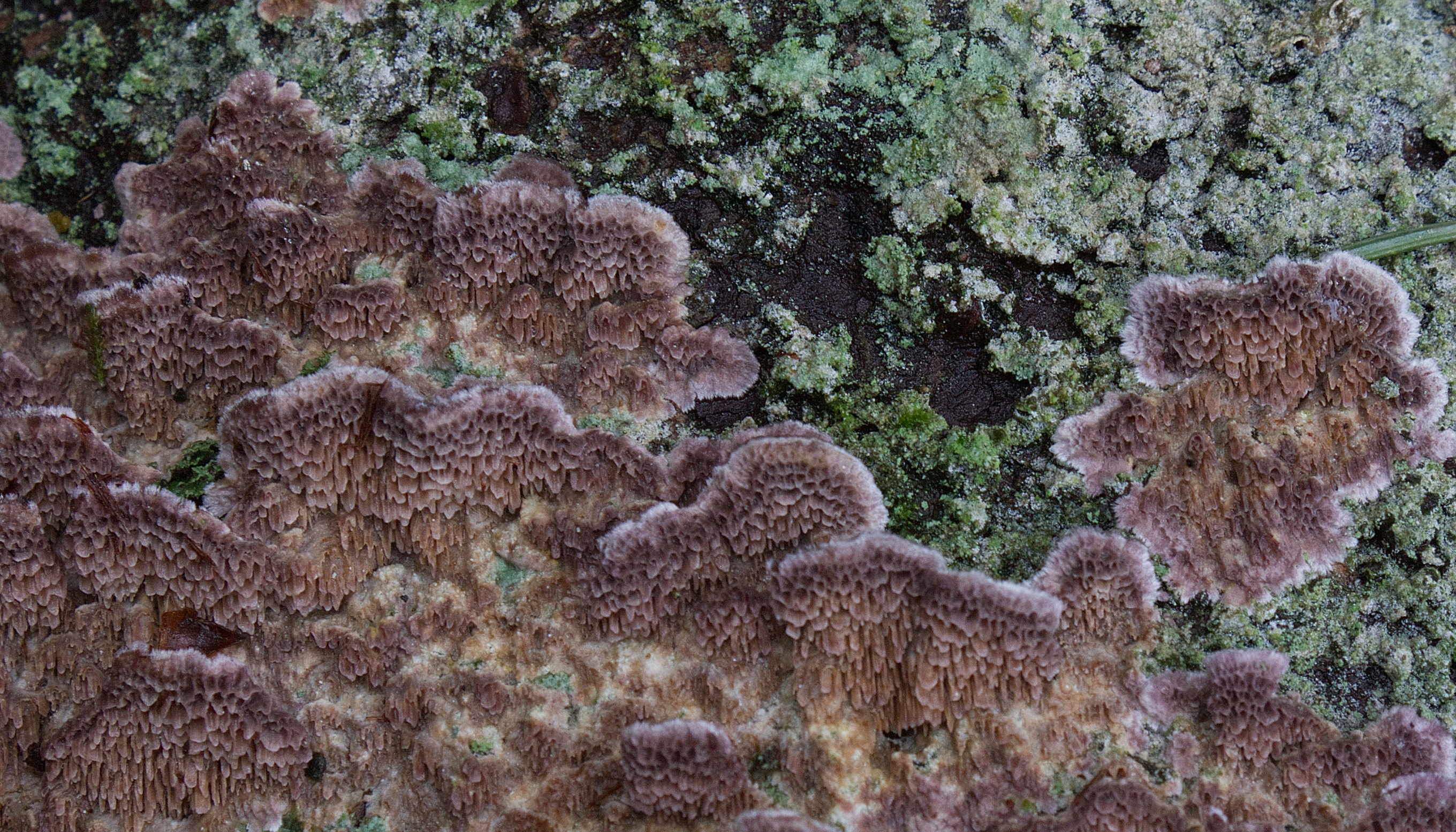
I identified this polypore as Trichaptum abietinum, a common small polypore that colonizes dead and decaying sapwood of conifers (particularly fir trees). I know why this fungus is also called the Violet Toothed Polypore. They are also known as Purplepore Bracket, Violet Tooth or Purple Tooth, and Pitted Sap Rot Purplepore. The genus name Trichaptum means ‘with clinging hairs’ referring to its hairy cap.
.
Identifying Trichaptum abietinum
.
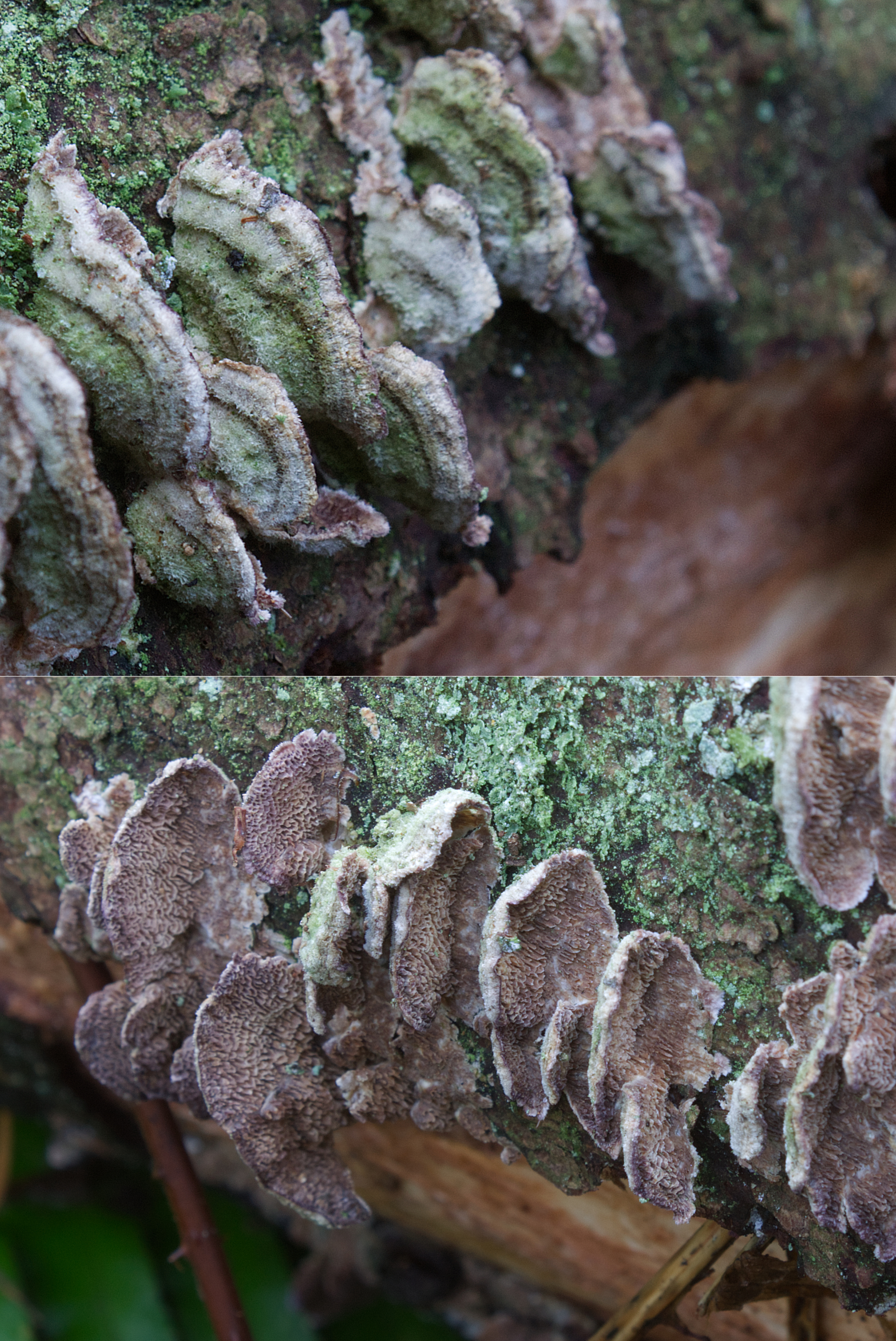
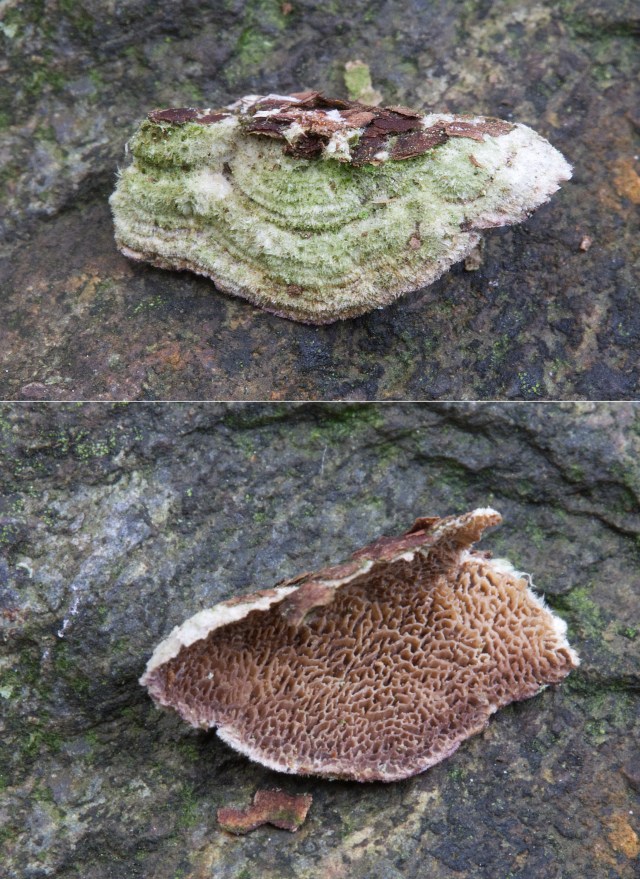
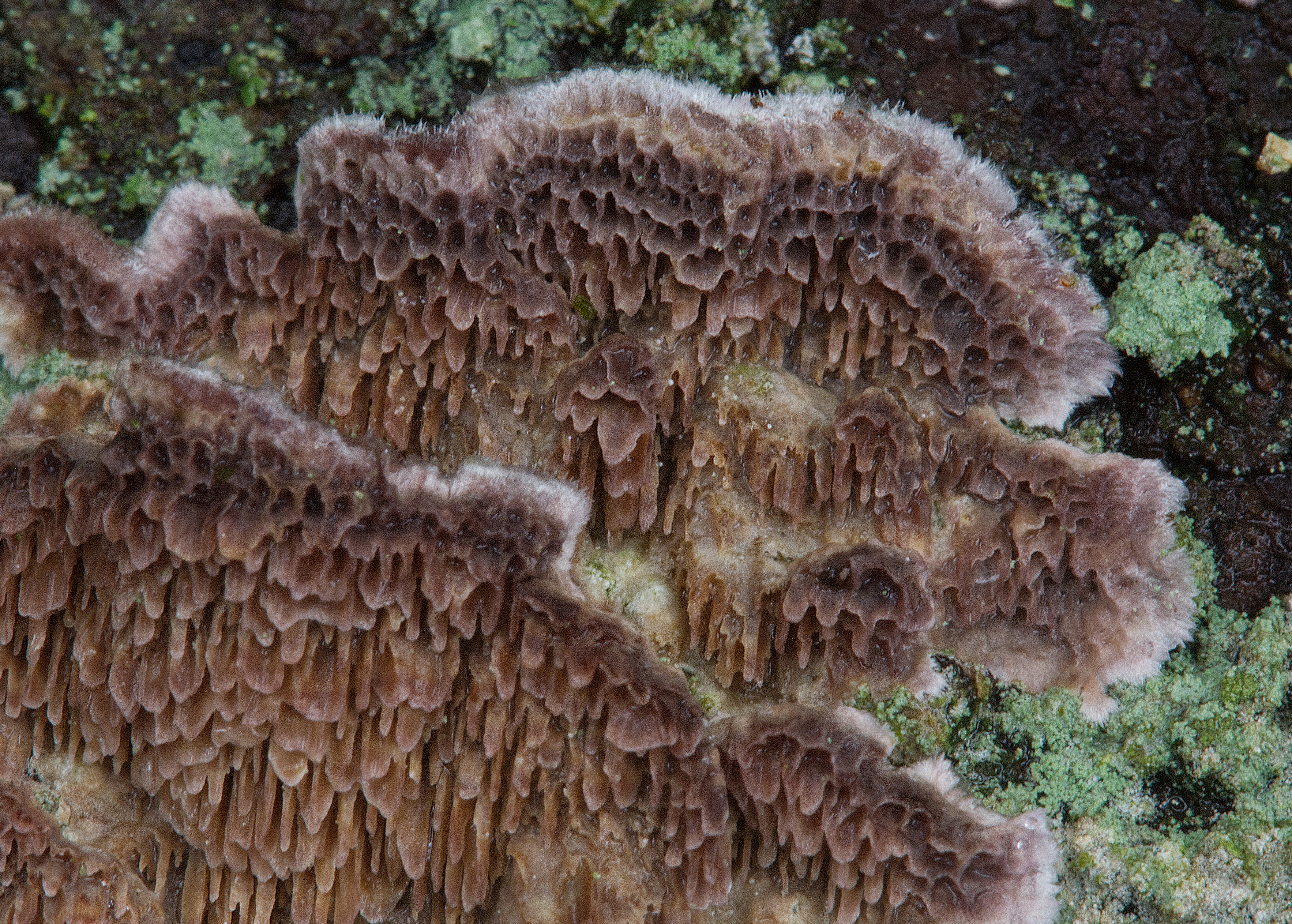
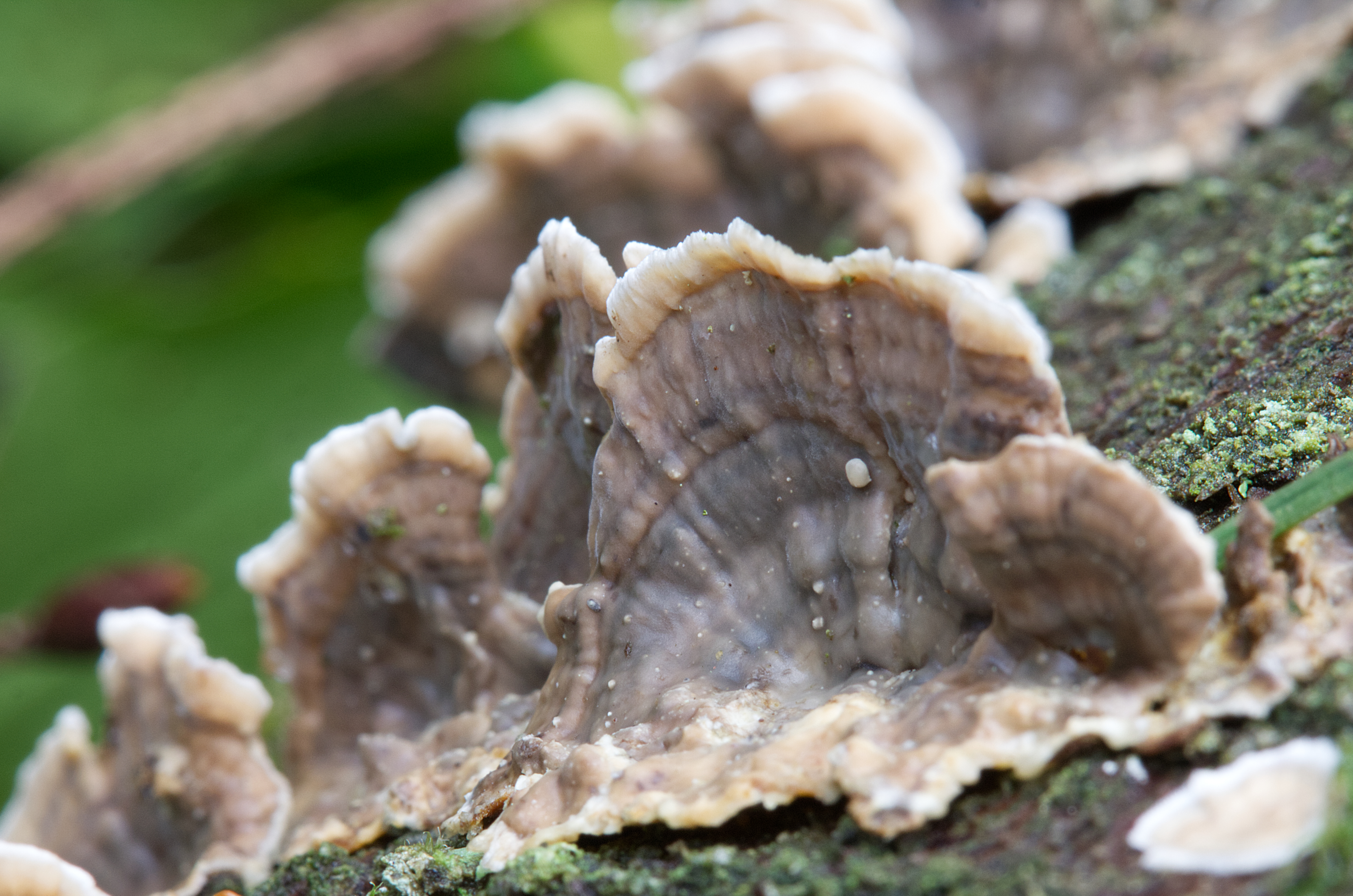
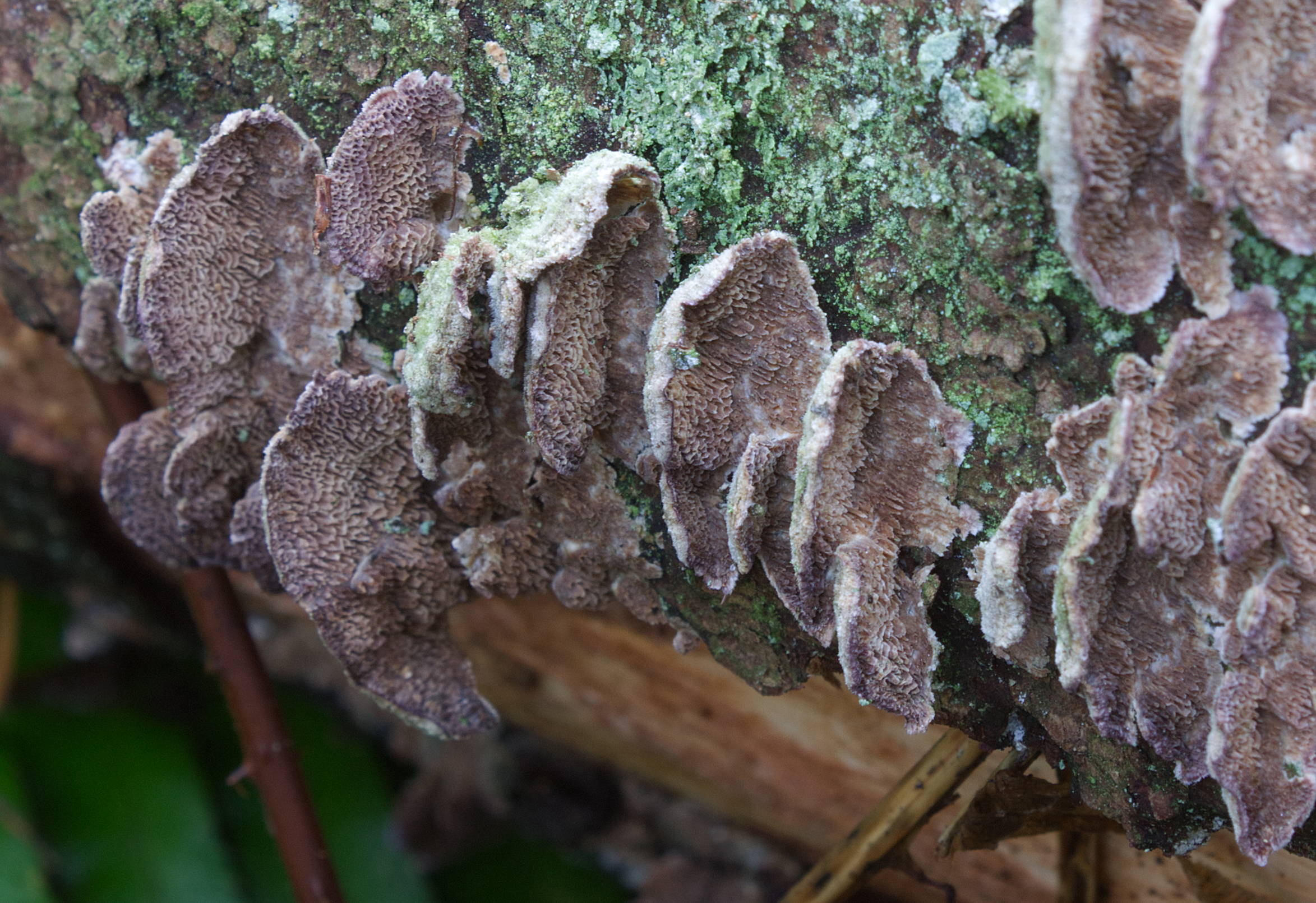
The violet toothed polypore is stemless, attaching directly to its wood or bark substrate in overlapping clusters. The infertile side of the cap is sometimes absent or with just a folded-over edge, but usually present as semicircular or fan-shaped, flat and small, banded with colours, much like Turkey Tail mushroom, that range from off-white to ochre and dark brown. When the mushroom is young there is often a distinct violet along with a fuzzy to hairy edge. The cap surface is often covered with opportunistic green algae taking up residence. The pores of the fertile side start out violet, often vibrant purple, and fade with age to buff or brown, still retaining a violet tint. The pore tubes are packed close together, resembling a sponge and purple when young, fading to lilac or brownish with age. As the polypore ages, the pores become tooth-like (spine-like) as the fruiting body matures.
Top: Violet Toothed Polypore algae-covered upperside of hairy cap; bottom: pore-tubes of fertile underside. Douglas fir log, Watershed Park, BC (photo by Nina Munteanu)
.
.
Habitat, Distribution and Hosts of Trichaptum abietinum
.
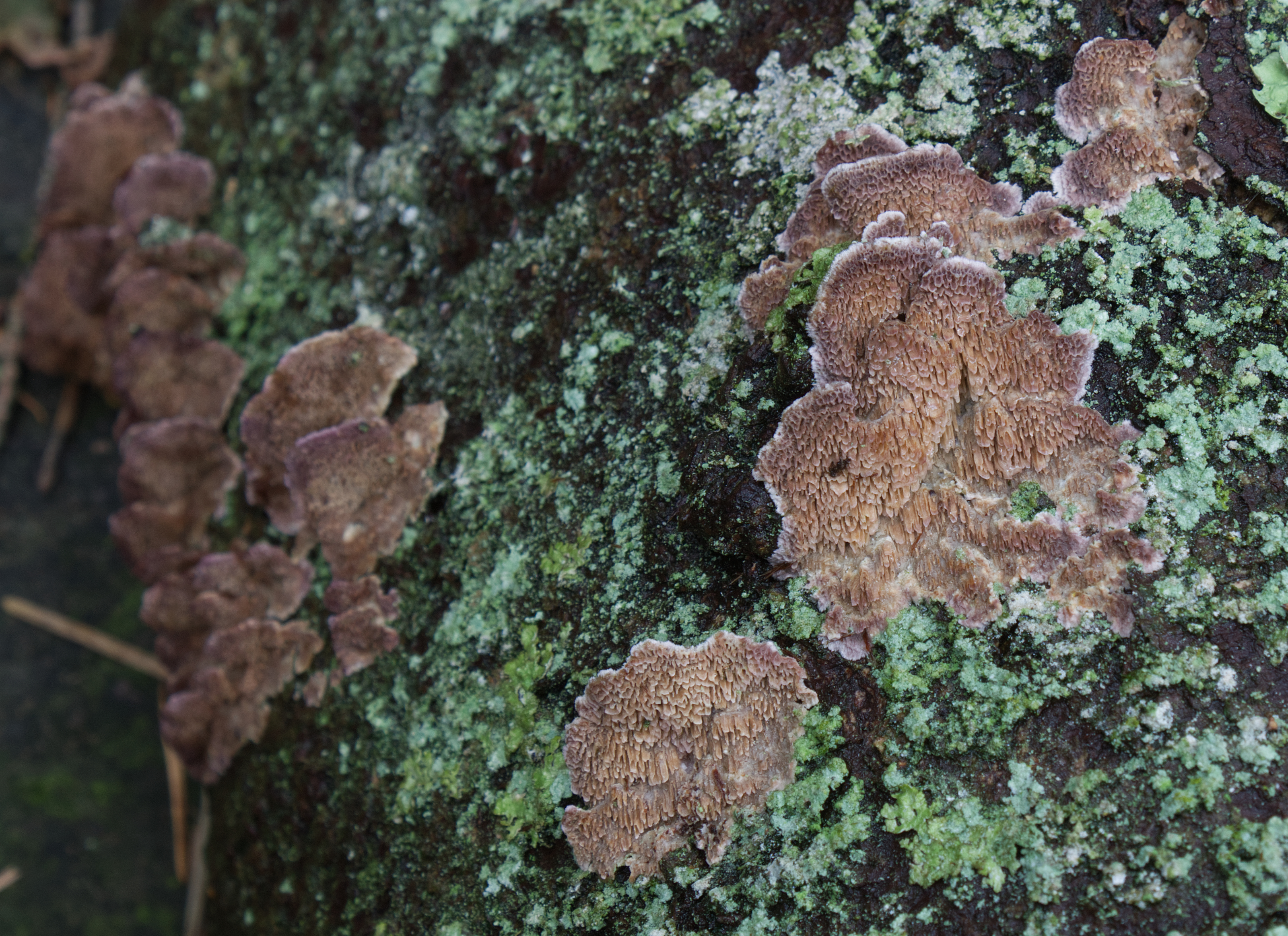
Trichaptum abietinum is a saprobic fungus, living on dead or dying organic matter and typically found on decomposing stumps and logs of fir and spruce. This fungus is widely distributed on a variety of tree hosts. Jenny at Mushroom Appreciation tells us that these polypores typically “grow in overlapping clusters, tiers or shelves on wood. They never grow on the ground. It’s not uncommon to find entire logs covered in them.”
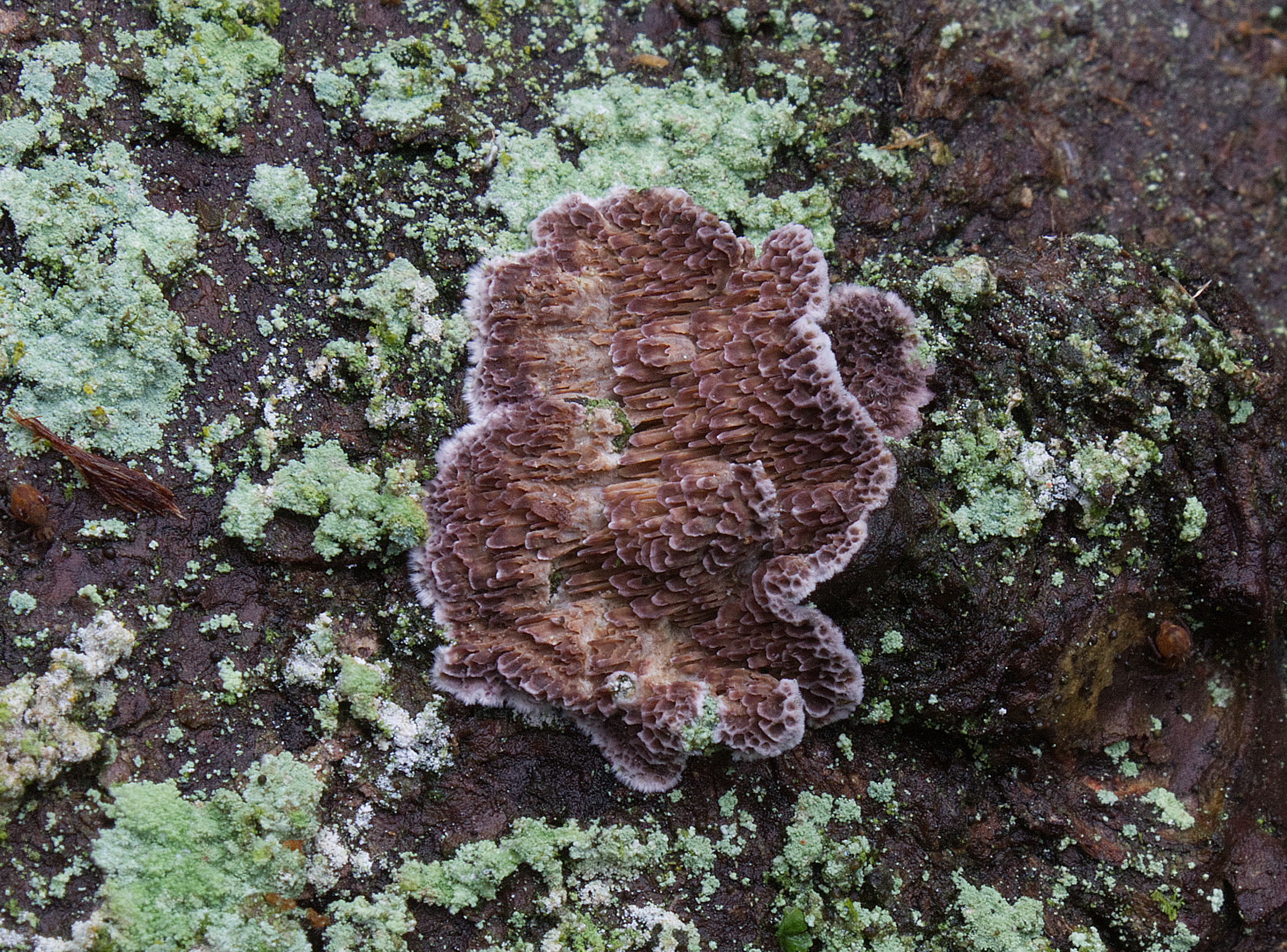
B.E. Callan of the Canadian Forest Service tells us that this sapwood-decaying basidiomycete “causes distinctive pitted sap rot in many conifers throughout Canada…It is a pioneer decay fungus of dead conifers.” Endemic to Canada, Trichaptum abietinum is found in every forested province and territory, colonizing the sapwood of recently dead trees of a wide variety of conifer species of fir, spruce, Douglas fir, pine, cedar, and hemlock. The fungus is rarely found colonizing live trees, except where large wounds have exposed the sapwood. The white pitted rot degrades the cellulose and lignin in the wood, turning the sapwood light yellow or tan. As the decay advances, small elongated white areas develop parallel to the grain of the wood. These areas eventually form pits, honeycomb patterns in cross section. Later stages of wood become lacy.
.
.
Callan tells us that in western North America, Pitted Sap Rot may be associated with Douglas fir killed by the Douglas fir beetle (Dendroctonus pseudotsugae), which typically attacks weakened or dying trees. According to the Government of BC, the beetle is more prevalent in the interior of BC, rarely causing large-scale damage on coastal forests that it does inland.
.
Edibility of Trichaptum abietinum
There is no currently known medicinal use for the violet toothed polypore. However, as a saprophytic fungus, this mushroom plays an important role in the ecosystem by decomposing dead wood and returning nutrients back to the soil for use by the remaining ecosystem inhabitants.
.
Post Script:
.
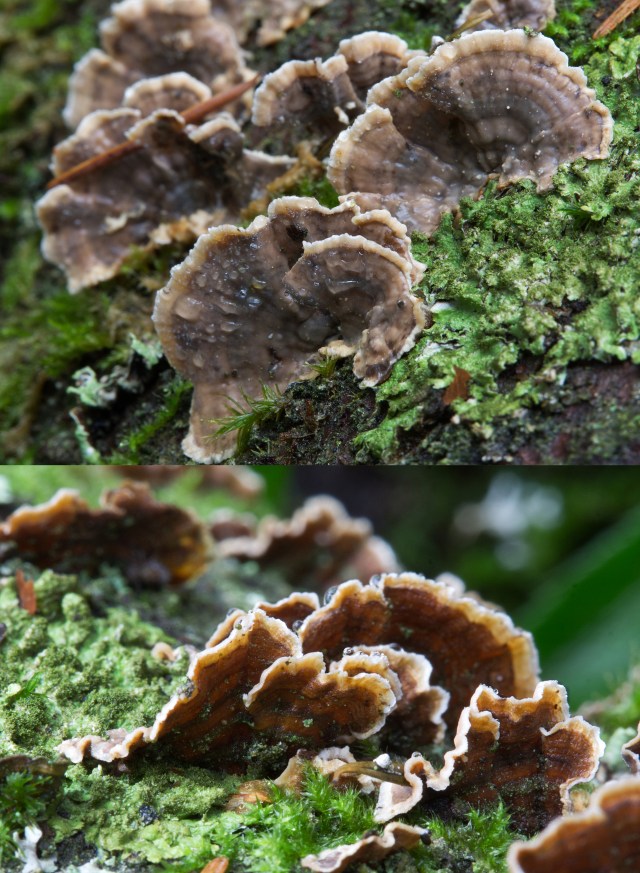
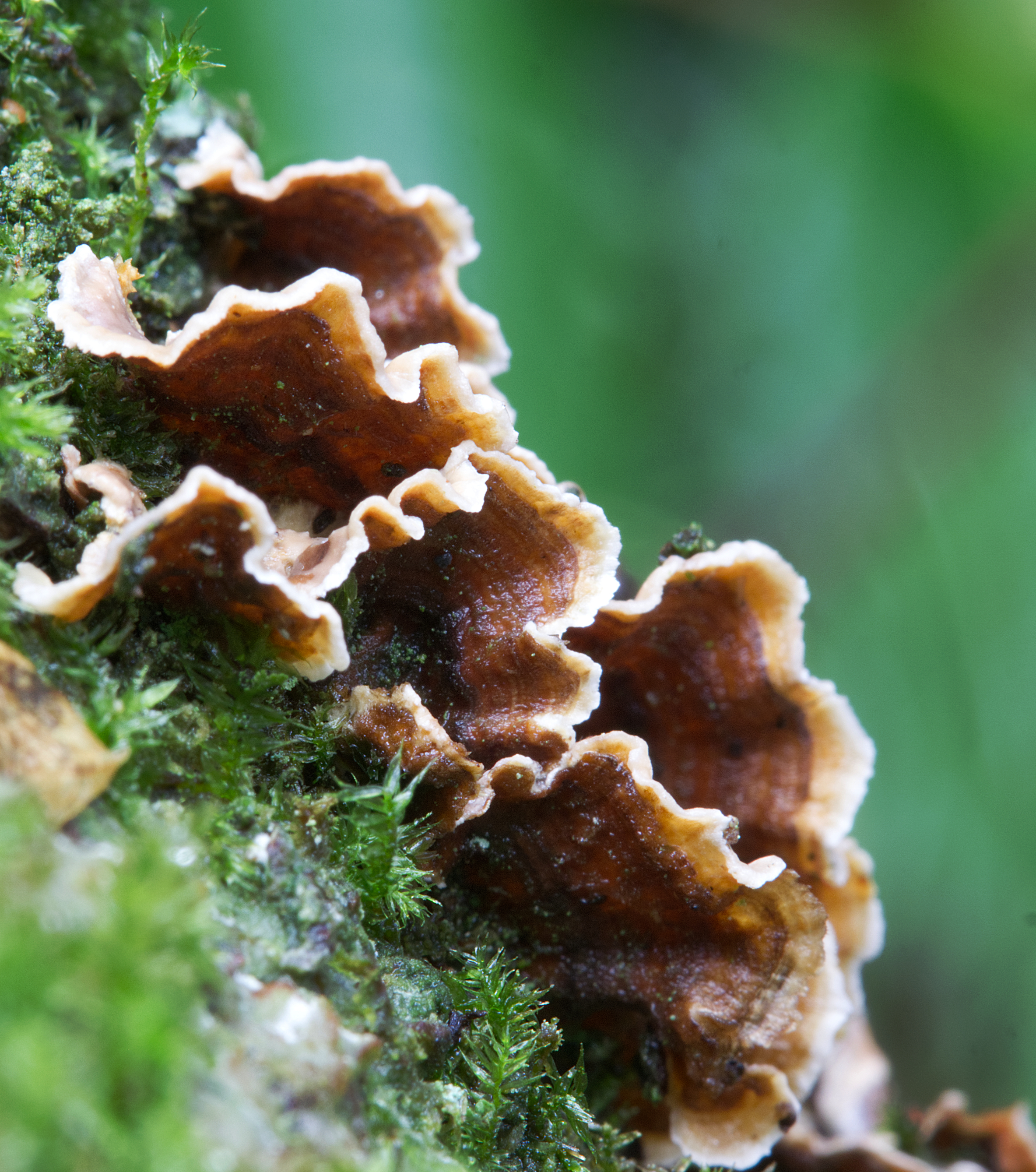
After my photo shoot, I continued my walk and just metres away, I found what I thought were more Violet Toothed Polypore on another fallen log. I shot both upper and lower sides and found quickly that this was indeed not Violet Toothed Polypore, but False Turkey Tail (Stereum ostrea), with its smooth striated underside. Also called Golden Curtain Crust this saprophytic wood decay fungus grows on tree bark and highly resembles Turkey Tail (Trimetes versicolor), which is a polypore and contains pores on its underside. The species name ostrea after the word for ‘oyster’, describes the shape of Stereum. I laughed out loud; when I first saw Violet Polypore, I mistook it for small False Turkey Tail and when I first saw False Turkey Tail, I mistook it for Violet Toothed Polypore!
False Turkey Tail fungus. Top: upper side; bottom: underside. Douglas fir log, Watershed Park, BC (photo by Nina Munteanu)
.
Either way, both were small—no more than a centimetre—and almost nondescript at first glance; their tan to brown—green-tinged—upper surface blended in with the bark. But on closer inspection of their undersides, both revealed a uniquely stunning and beautiful miniature world.
.
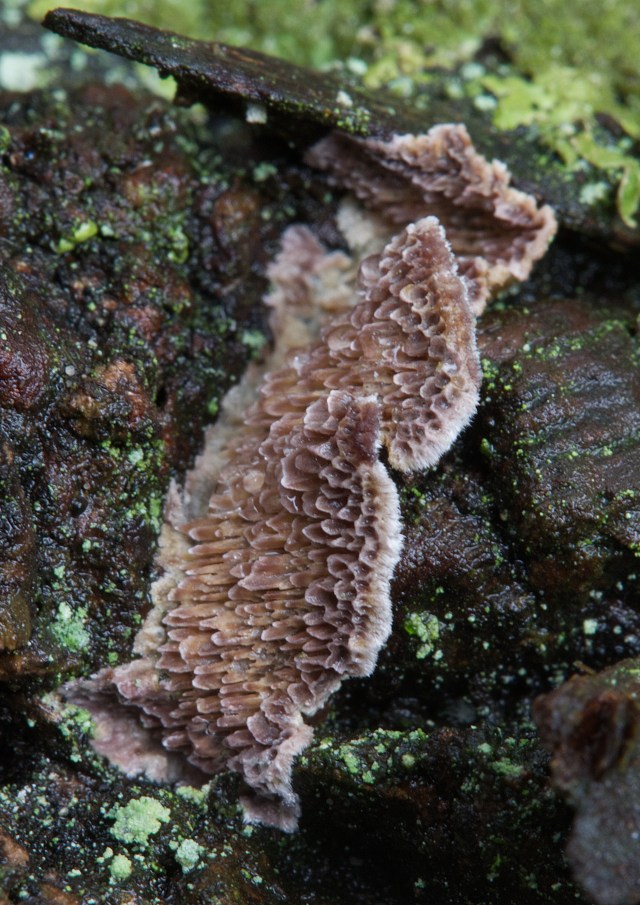
The delicate lilac ‘teeth’ of the Violet Toothed Polypore’s underside reminds me of stalactites of a limestone cavern; friends have variously described it as reminding them of the inside of a geode, coral, a honeycomb, or close-up of a shark’s skin. While the upper side of the False Turkey Tail resembles a pearly sea shell, its underside resembles a stained glass window with brilliant concentric bands of various colours.
Violet Toothed Polypore on lichen-spattered wet log, Watershed Park, BC (photo by Nina Munteanu)
.
.
References:
California Fungi. “Trichaptum abietinum.”
Callan, B.E. 2024. Pitted sap rot. In J.P. Brandt, B.I. Daigle, J.-L. St-Germain, A.C. Skinner, B.C. Callan, and V.G. Nealis, editors. Trees, insects, mites, and diseases of Canada’s forests. Natural Resources Canada, Canadian Forest Service, Headquarters. Ottawa, Ontario.
First Nature. “Trichaptum abietinum.”
Kuo, Michael. 2016. “Trichaptum abietinum.” MushroomExpert.com.
.
.

Nina Munteanu is a Canadian ecologist / limnologist and novelist. She is co-editor of Europa SF and currently teaches writing courses at George Brown College and the University of Toronto. For the lates on her books, visit www.ninamunteanu.ca. Nina’s bilingual “La natura dell’acqua / The Way of Water” was published by Mincione Edizioni in Rome. Her non-fiction book “Water Is…” by Pixl Press (Vancouver) was selected by Margaret Atwood in the New York Times ‘Year in Reading’ and was chosen as the 2017 Summer Read by Water Canada. Her novel “A Diary in the Age of Water” was released by Inanna Publications (Toronto) in June 2020.
.
 The Meaning of Water