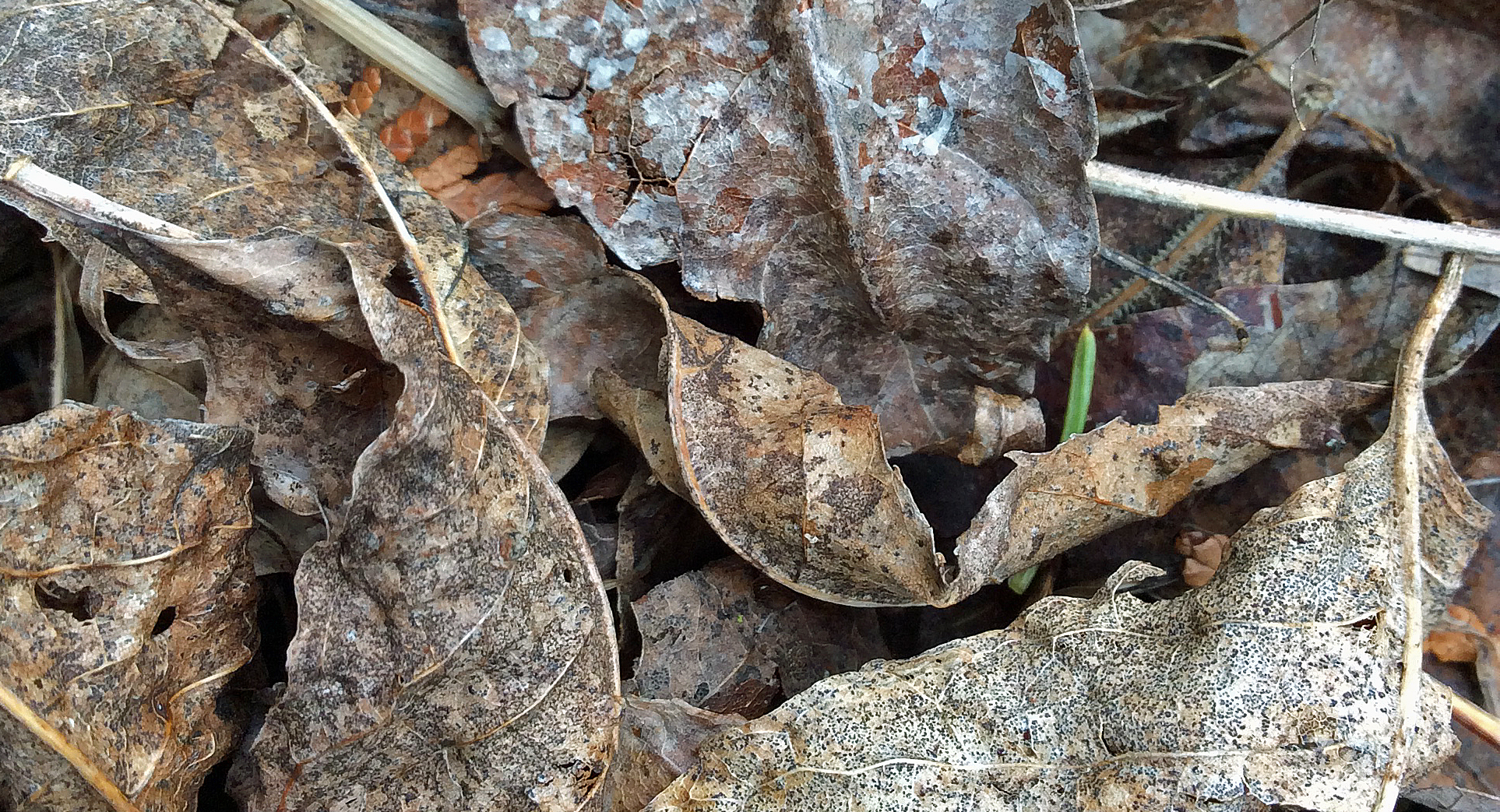
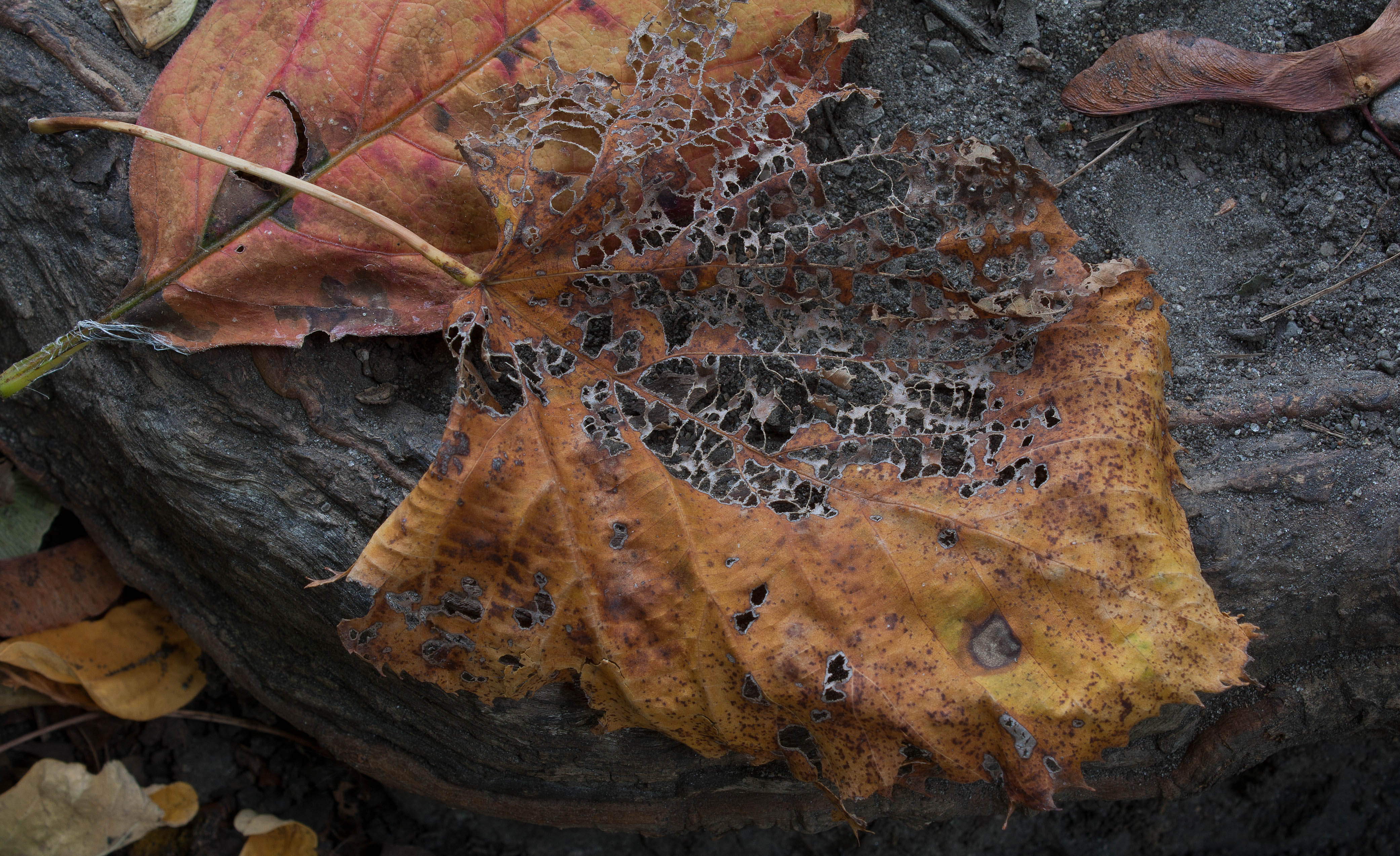
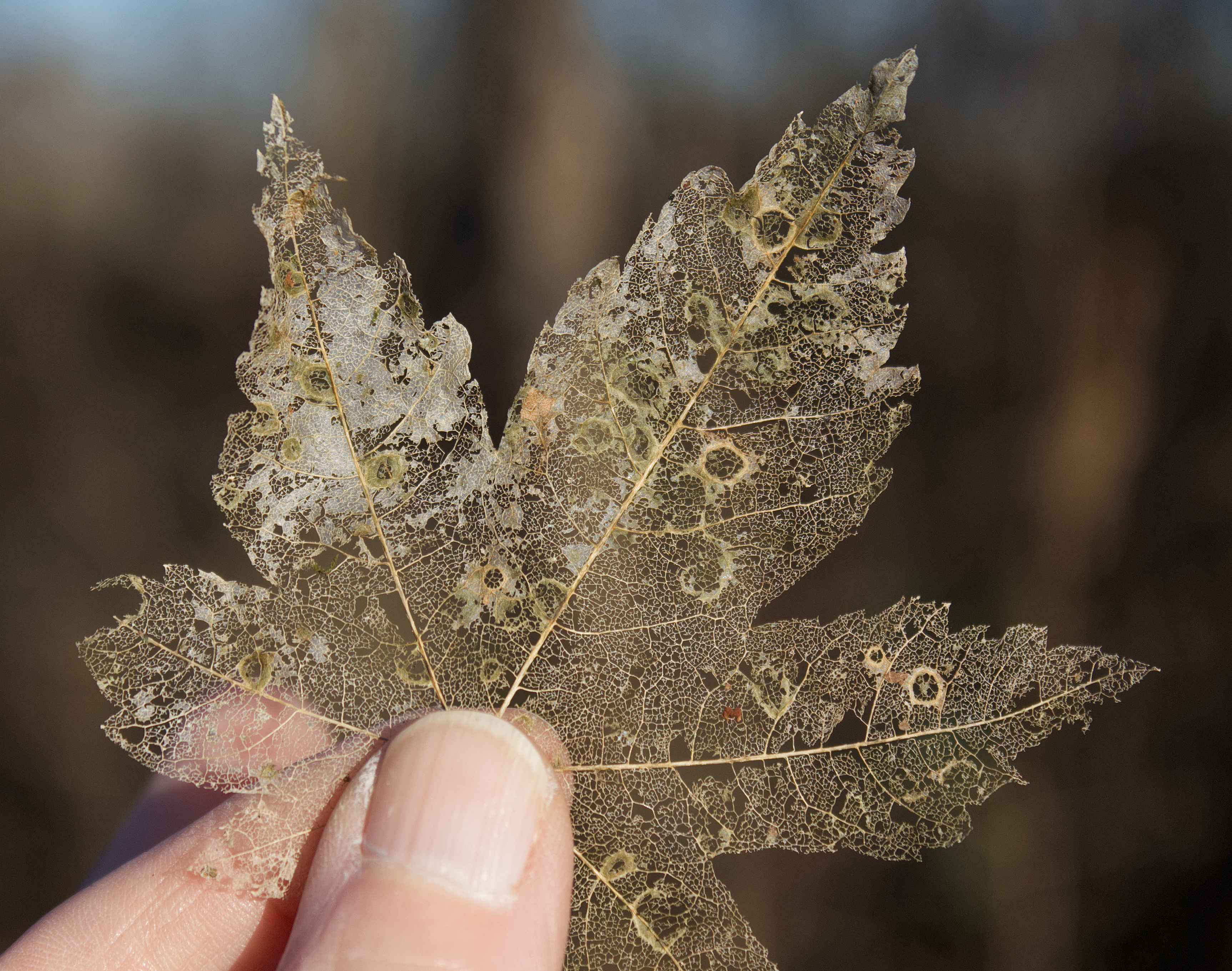
On one of my walks in the damp forest of early winter, I noticed several leaves that had turned lacy, revealing delicate patterns of vein structures left after the softer green tissue had decomposed or been eaten. These beautiful gossamer leaves caught my imagination and curiosity. I found out that there is a word for these reticulated ‘stained-glass’ leaves: skeletonization, a natural decomposition process that turns some leaves into skeletons and returns nutrients to the soil for access by the rest of the living ecosystem.
.
.
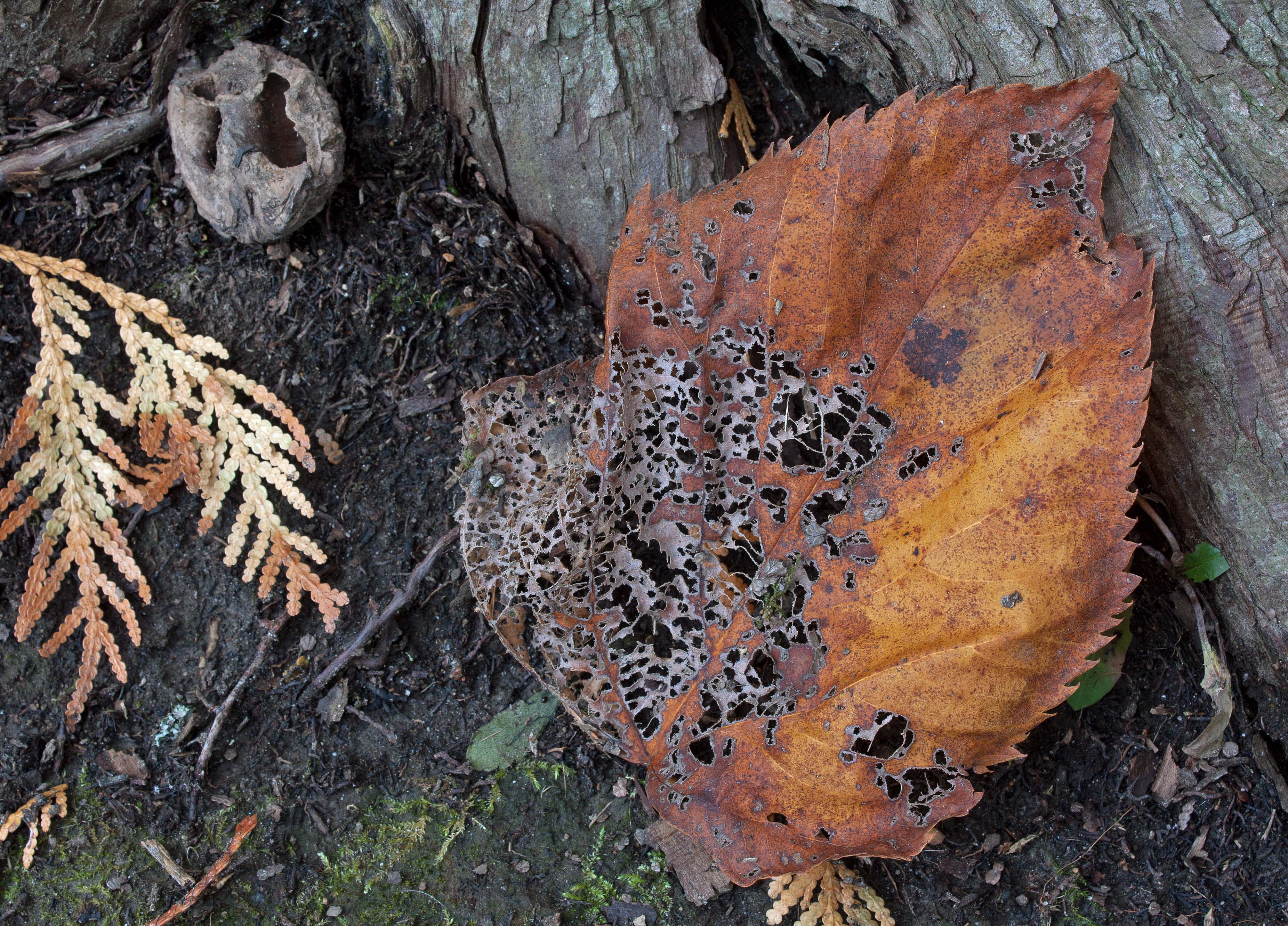
Leaf skeletonization is primarily carried out by a combination of fungi, bacteria, and invertebrates that break down the softer leaf tissue (pulp), leaving only the tough, lignin-rich veins behind. Lignin, by the way, forms the cell walls of most plants and forms 20-35 % of the dry mass of wood; this tough substance resists being dismantled by fungi and bacteria. The leaf’s decay process occurs at different rates according to climate, and soil conditions. The size, thickness, structural and chemical composition of a leaf also plays a role. For instance, leaves with more lignin will decay more slowly. Levels of suberin and cutin—waxy water-resistant compounds on leaf surfaces—also tend to slow decay. Typical leaf skeletonizers belong to what one site calls “members of the FBI“—fungus, bacteria and invertebrates):
- Invertebrates (adults and larvae such as caterpillars, beetles or grasshoppers and springtails and aquatic larvae of mayflies, stoneflies and caddisflies) chomp on the leaf’s tender flesh, leaving behind the tougher veins
- Saprophytic Fungi and Bacteria break down and help decompose the leaf’s fleshy parts, leaving behind the tougher veins
The following excerpt from “Decomposers: The Unsung Forest Allies” by Maria Cristina Alves, provides a good description of the process:
“In nature, decomposition takes time, with different decomposers involved at different times, and for different types of plants. The voluminous leaves and stems of deciduous trees are generally decomposed within a year of falling on the forest floor. Leaf litter is quickly invaded by the hyphae of fungi—the white thread-like filaments that are the main body of a fungus. Mushrooms appear mostly in late summer and autumn, and are merely the fruiting bodies of fungi trying to spread their growth during fall and winter. The hyphae draw nutrients from the litter and break down the dead plant material. As the decay becomes more advanced, bacteria—as well as various invertebrates, including springtails, slugs and snails—play a role, with earthworms arriving in the last stages.”
.
.
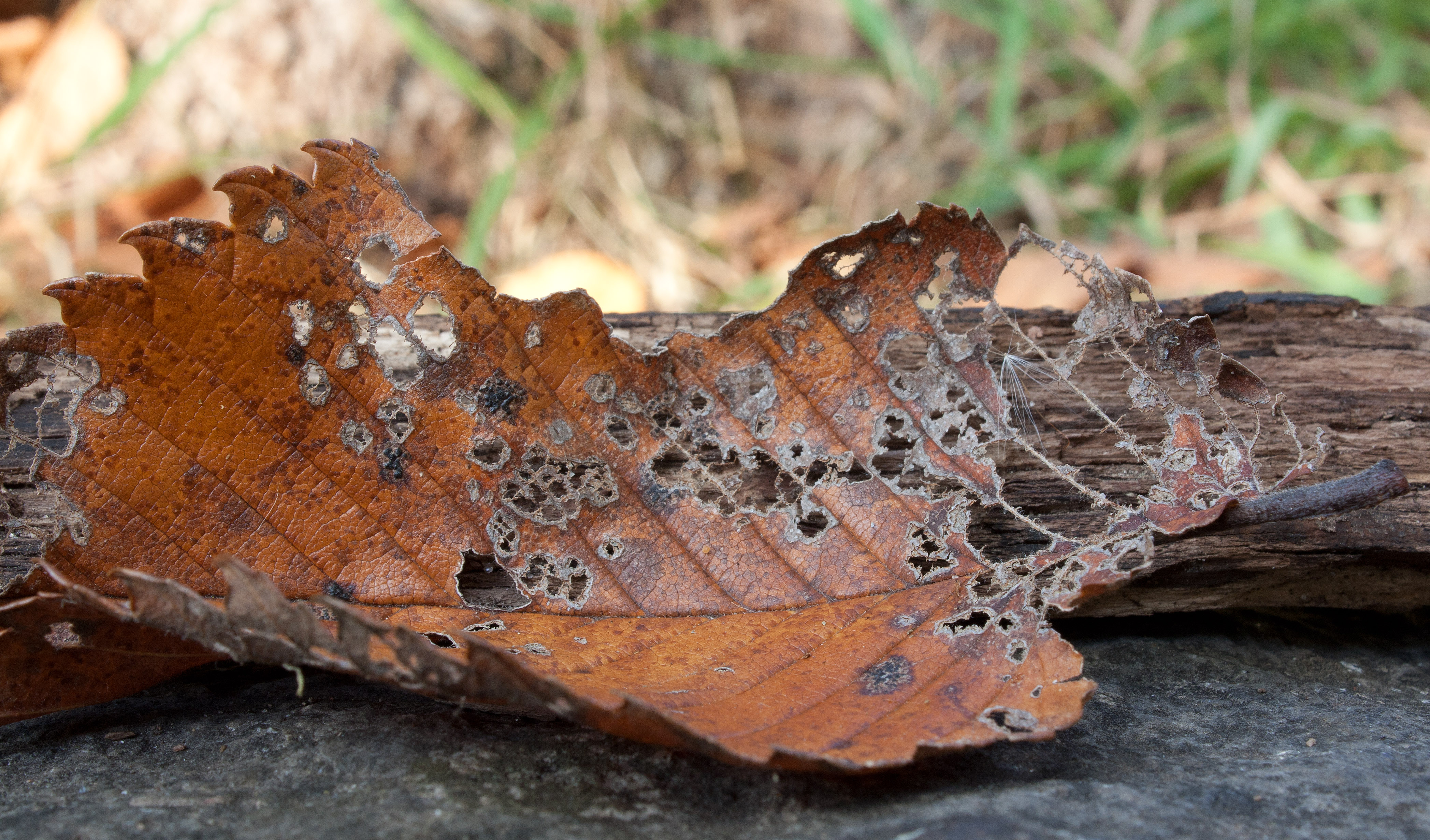
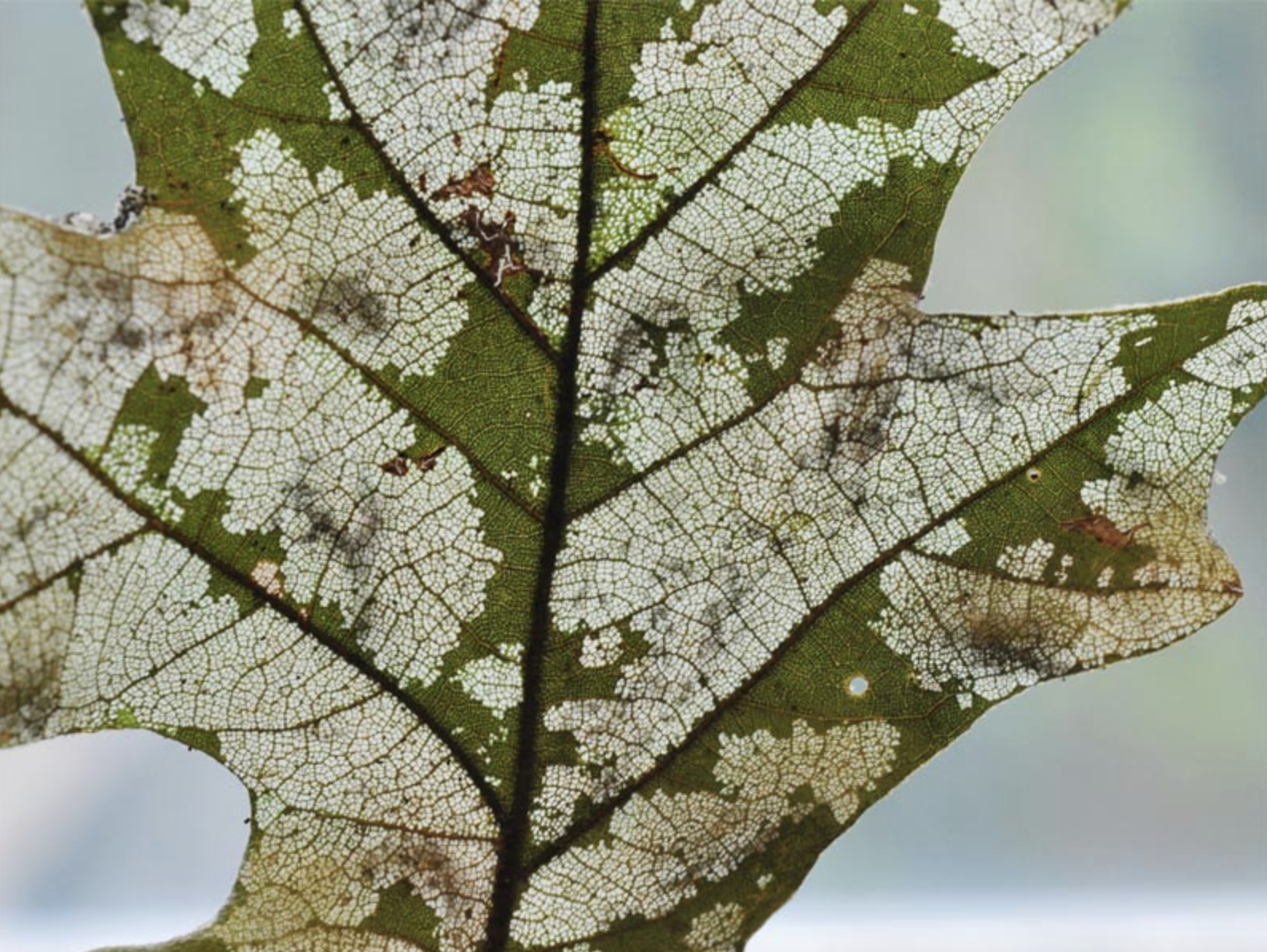
Invertebrates are the most common leaf skeletonizers, usually the larval (caterpillar) stage of many moth species, but adult beetles and sawflies also contribute to this type of damage. Leaf skeletonization can occur on still living leaves by adult insects and their larvae (e.g. Japanese beetles), which scrape off the green tissue, avoiding the veins, and giving the leaf a stained-glass appearance. While damage to large, healthy trees is often just cosmetic, heavy or repeated infestations can weaken plants. Examples of some common invertebrate leaf skeletonizers and their preferred host include:
.
- Birch skeletonizer (Bucculatrix canadensisella): this moth skeletonizes leaves and forms small oval-shaped white silken moulting webs on their undersurface. Hatched larvae enter the leaves and feed as miners. They eventually emerge and feed on the undersurface of the leaves. Heavy infestations result in complete skeletonization of the leaf, which dries out and turns brown in late summer, dropping prematurely.
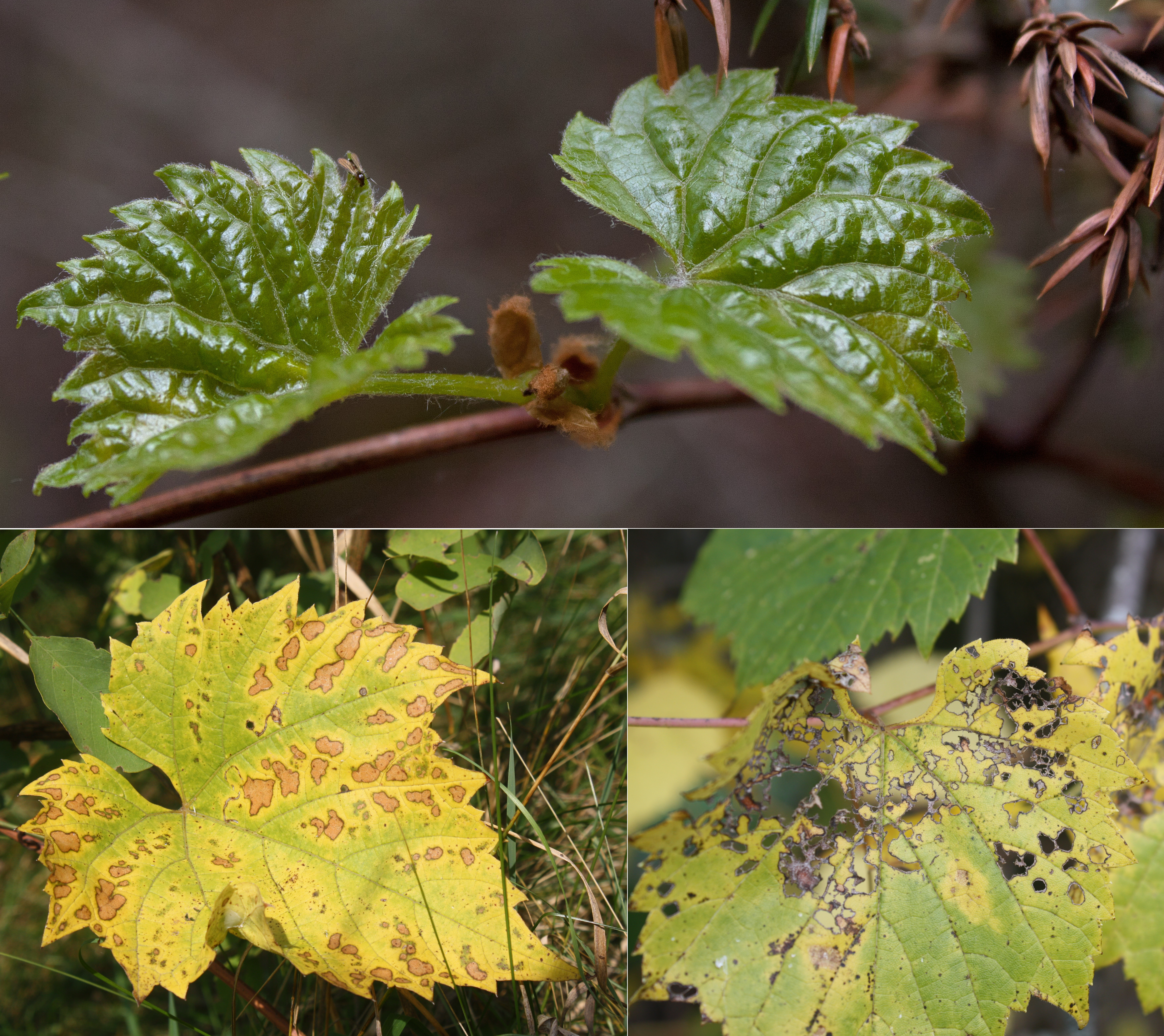
- Grapeleaf Skeletonizers (e.g., Harrisina americana and Harrisina metallica): These moth caterpillars feed in groups on grapevines and Virginia creeper, and their bristles can cause skin irritation if touched.
- Oak Skeletonizer (Bucculatrix ainsliella): These moth larvae feed on the undersides of oak leaves, creating a lacy appearance.
- Japanese Beetle (Popillia japonica) is an example of a beetle that skeletonizes leaves in both their larval and adult stages, preferring plants in the rose family (e.g. roses, apples, peaches, cherries, plums, and grapes) and trees such as maples and lindens.
- Sawflies: The larvae of sawflies, which are a type of non-stinging wasp (related to bees and ants), are also common leaf skeletonizers.
.
.
Saprophytic Fungi play a major role in leaf skeletonization of fallen leaves. They are the ecosystem’s primary decomposers and the only organisms capable of efficiently breaking down lignin and cellulose—major structural components of plant cell walls that make the veins resistant to decay. Fungi (particularly white-rot fungi) are the only major organism that can breakdown lignin, a complex polymer in wood, preventing woody debris buildup.
.
.
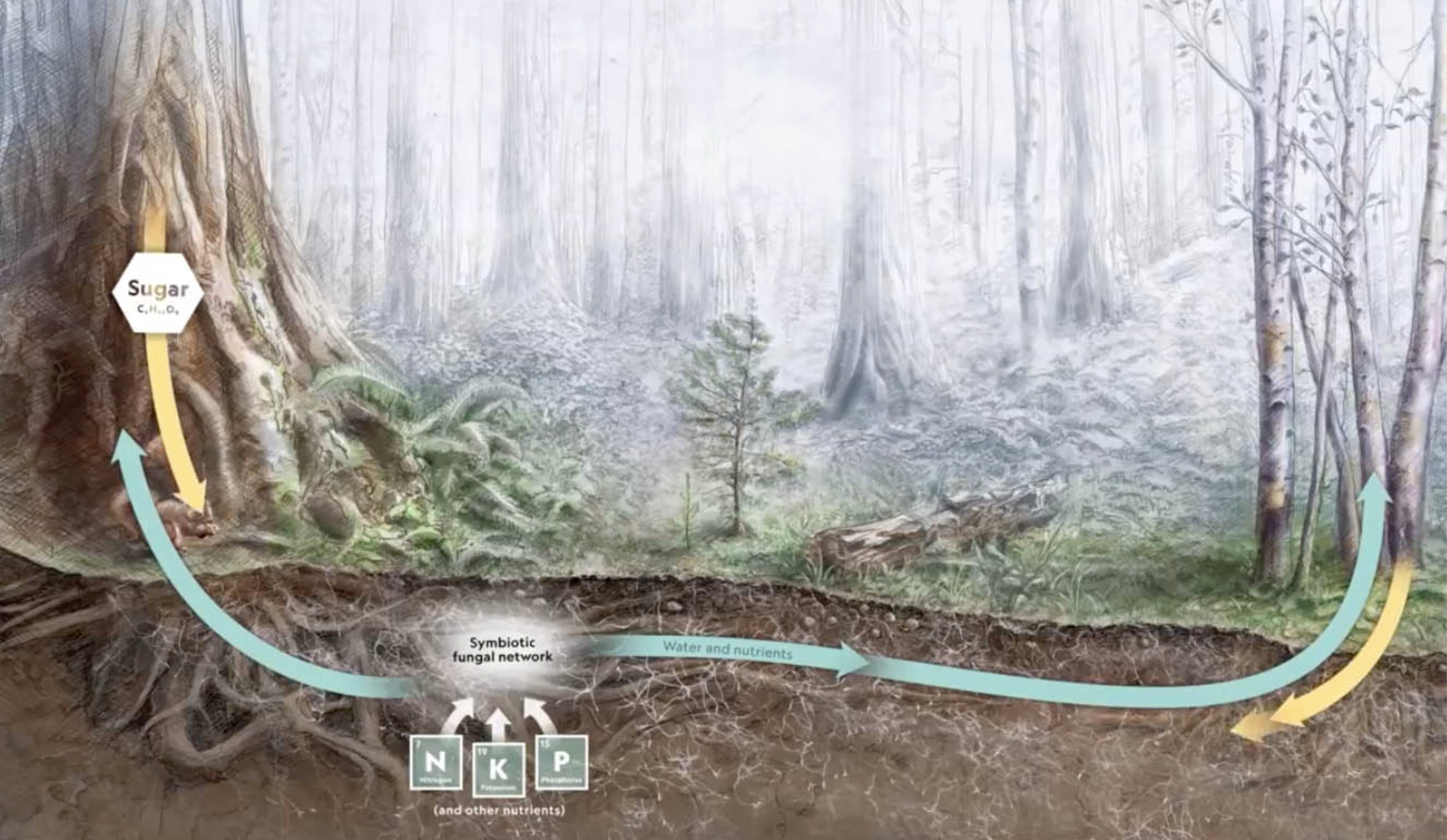
Fungi start the decomposition process by secreting enzymes that break down these complex organic compounds (e.g. cellulases to break down cellulose and hemicellulose), releasing essential nutrients—carbon, nitrogen, water, and others—back to the soil, where they become available to living plants. The fungi further this process by forming underground symbiotic relationships with plant root systems—called mycorrhizal networks—directly transferring nutrients to where they are needed.
Fungal diseases (e.g., Anthracnose, Leaf Spot) cause blotches or overall yellowing on living leaves that eventually dry out and fall, often leaving holes or tattered edges. This is not the same as natural skeletonization, given it begins on the living leaf.
Bacteria don’t contribute to leaf skeletonization directly, but help in the later stages of tissue decay; however certain bacteria such as Xylella fastidiosa cause what’s called bacterial leaf scorch by clogging the leaf’s veins (xylem), turning the leaf margins brown, and premature leaf drop, skeletonizing the branch or tree. Oaks (especially red oaks), elms, and sycamores are most frequently affected.
.
Identifying Leaf Skeletonizers
.
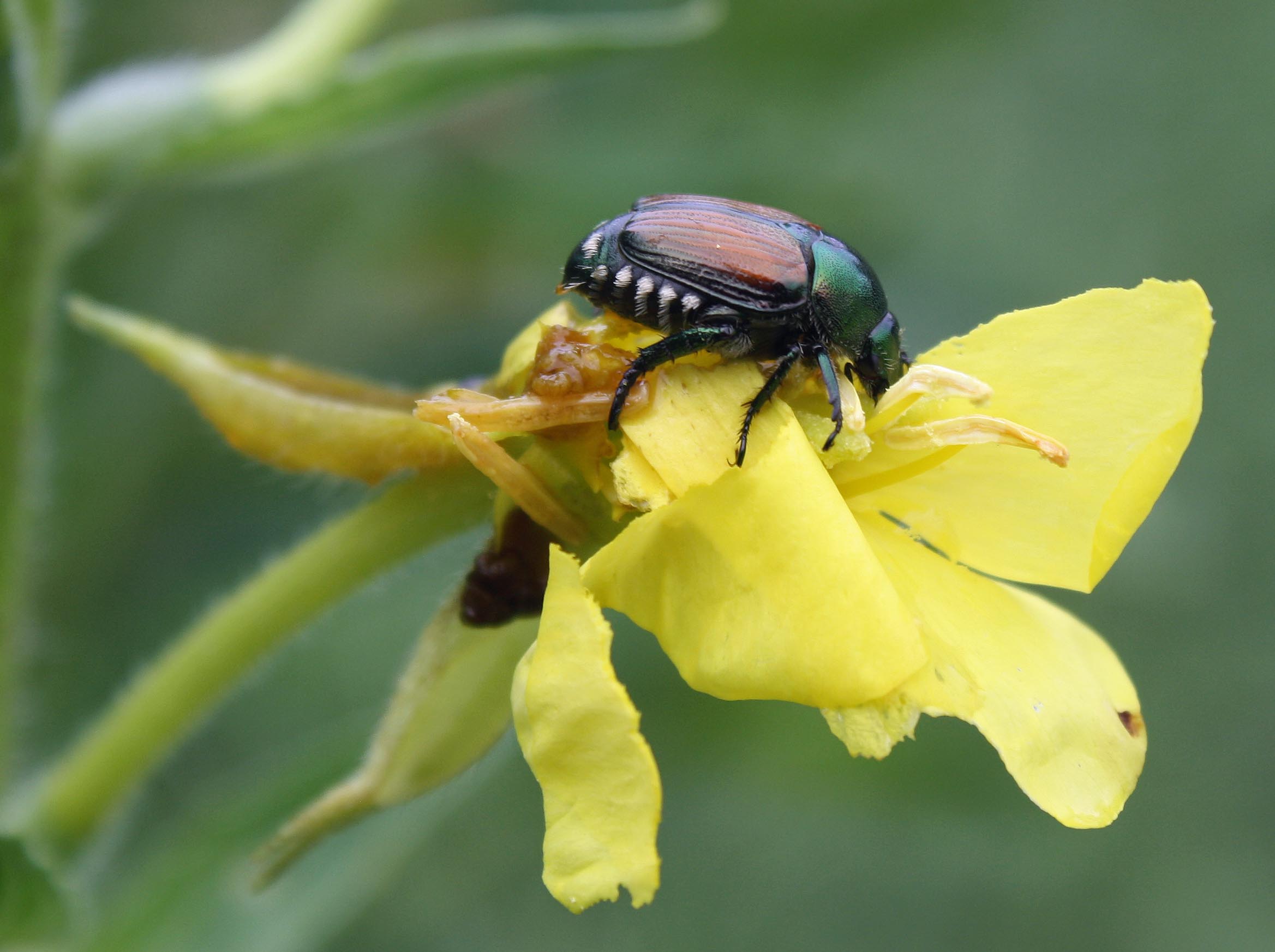
The best way is to look closely at the host plant and look for clues. Sometimes the culprit is right there, still doing their work; I saw many Japanese beetles on basswood and linden trees and caught one still gorging on an evening primrose flower. The damage pattern may also reveal the specific handiwork of the skeletonizer (e.g., upper or lower leaf surface, if leaves are folded or rolled). Physical signs, such as fine black insect droppings (frass), may remain on the leaf or white silky webs or cocoons can be seen on a leaf or nearby substrate. The work of the skeletonizer can also be identified by their preference. For instance, different skeletonizers prefer certain plants (e.g. grape, oak, birch).
.
.
Poplars are commonly skeletonized by moths, sawflies, catterpillars and leaf beetles:
- Satin Moth (Leucoma salicis): The larvae of this invasive moth seriously defoliate poplars and willows. They overwinter as larvae and resume feeding in the spring, consuming all but the main veins. The adult moth is satiny white.
- Poplar Sawfly (Cladius grandis): The larvae of this sawfly feed gregariously on the underside of leaves, leaving a skeletonized appearance. They are yellow/orange with black spots and a black head when fully grown.
- Poplar Tentmaker: This caterpillar uses silk to roll or tie leaves together into “tents” and feeds inside, consuming all except the main veins.
- Poplar Leaf Beetle (Melasoma populi): Both adults and larvae chew holes in and feed on the leaves, which can result in a skeletonized appearance, making it the most significant defoliator in poplar nurseries
.
.
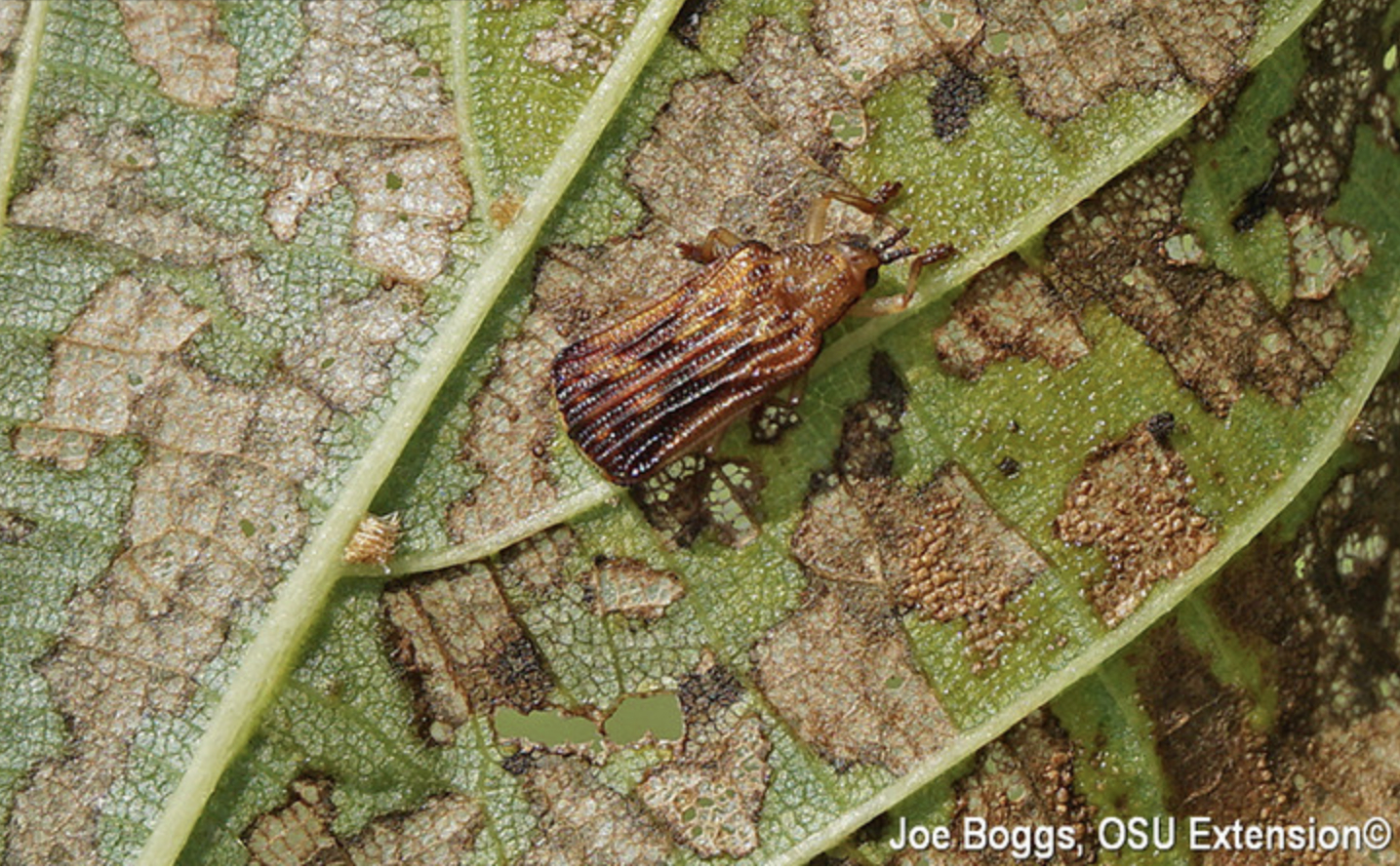
Basswood leaves are commonly skeletonized by the basswood leaf miner. Living, still green leaves of the basswood (as well as American elm and American Hophornbeam) are known to be eaten and skeletonized by this insect; affected trees are reported in northern Ohio to “flame” with a golden reddish-brown colour in the late summer as a result. Compared to the skeletonizing of the large Japanese beetle, which chews through the entire leaf except its veins, the Basswood leaf miner only surface skeletonizes (called scarifying). This is because the mandibles of these small adults are too small to chew completely through the leaf; they only remove the leaf surface.
.
.
When A Leaf Falls
.
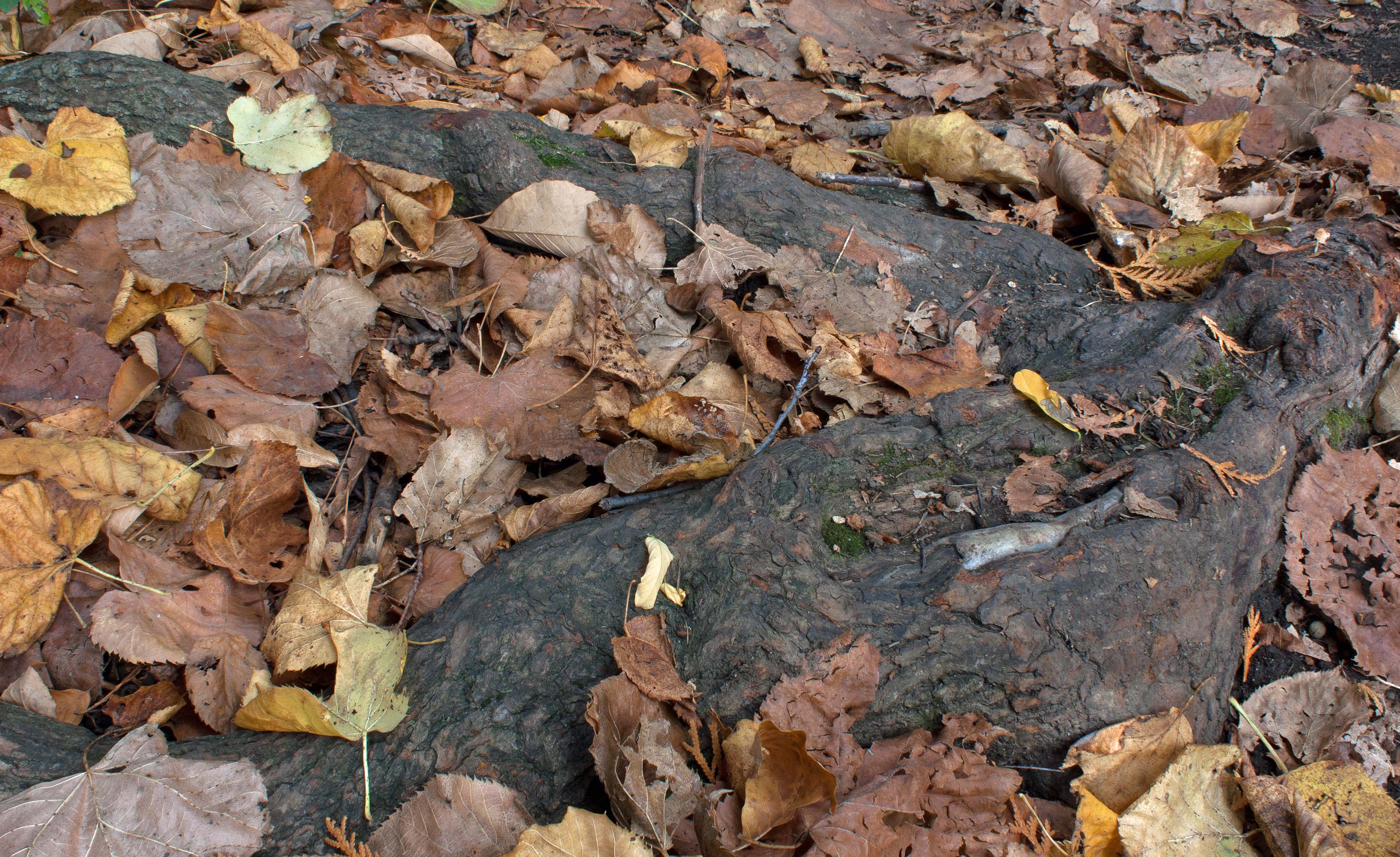
According to leaf litter biologist Jane Marks, biologist at Northern Arizona University, dead leaves provide a primary food base for life up the food chain, from fungi and bacteria that initially colonize the leaves, and the insects that chew them, up to the birds and fish that eat the insects. This creates a “brown” food web more expansive than the “green” food web the leaves nourish when they are still alive, writes Marks.
A fallen leaf is broken down by fungi, bacteria and invertebrates (e.g. insects) that shred and consume leaf material. The insect waste is, in turn, eaten by other insects, birds and, if in water, fish. The leaf’s carbon and nitrogen is assimilated and released at various stages in the process. Fungi make the leaf easier for the bacteria to break down the leaf materials and prepare for insect consumption.
.
.
References:
Alexander, Rebecca. Year. “Leaf Skeletons and Shadows.” Plant Answer Line.
Alves, Maria Cristina. “Decomposers: The Unsung Forest Allies.” Chesapeake Bay Environmental Center. https:// bayrestoration.org/decomposers-unsung-forest-allies [accessed 6/9/2022].
Boggs, Joe. 2018. “Basswood Leafminer Damage Becoming Evident.” Buckeye Yard & Garden onLine, August 7, 2018.
Engelbrecht, Christine. “Helpful Fungus Among Us.” Iowa State University Extension and Outreach. https://www. extension.iastate.edu/news/2006/jan/071801.htm [accessed 6/9/2022]
Government of Canada. “Birch skeletonizer.” Tidcf.nrcan.gc.ca.
Hassall, Richard. 2012. “Nature’s Recyclers: Insects, Fungi and Bacteria,” Conservation Jobs, February 21, 2012.
Marks, Jane. 2019. “Revisiting the Fates of Dead Leaves That Fall into Streams.” Annual Review of Ecology, Evolution, and Systematics 50: 547-568.
.
.

Nina Munteanu is a Canadian ecologist / limnologist and novelist. She is co-editor of Europa SF and currently teaches writing courses at George Brown College and the University of Toronto. Visit www.ninamunteanu.ca for the latest on her books. Nina’s bilingual “La natura dell’acqua / The Way of Water” was published by Mincione Edizioni in Rome. Her non-fiction book “Water Is…” by Pixl Press (Vancouver) was selected by Margaret Atwood in the New York Times ‘Year in Reading’ and was chosen as the 2017 Summer Read by Water Canada. Her novel “A Diary in the Age of Water” was released by Inanna Publications (Toronto) in June 2020.
.
 The Meaning of Water