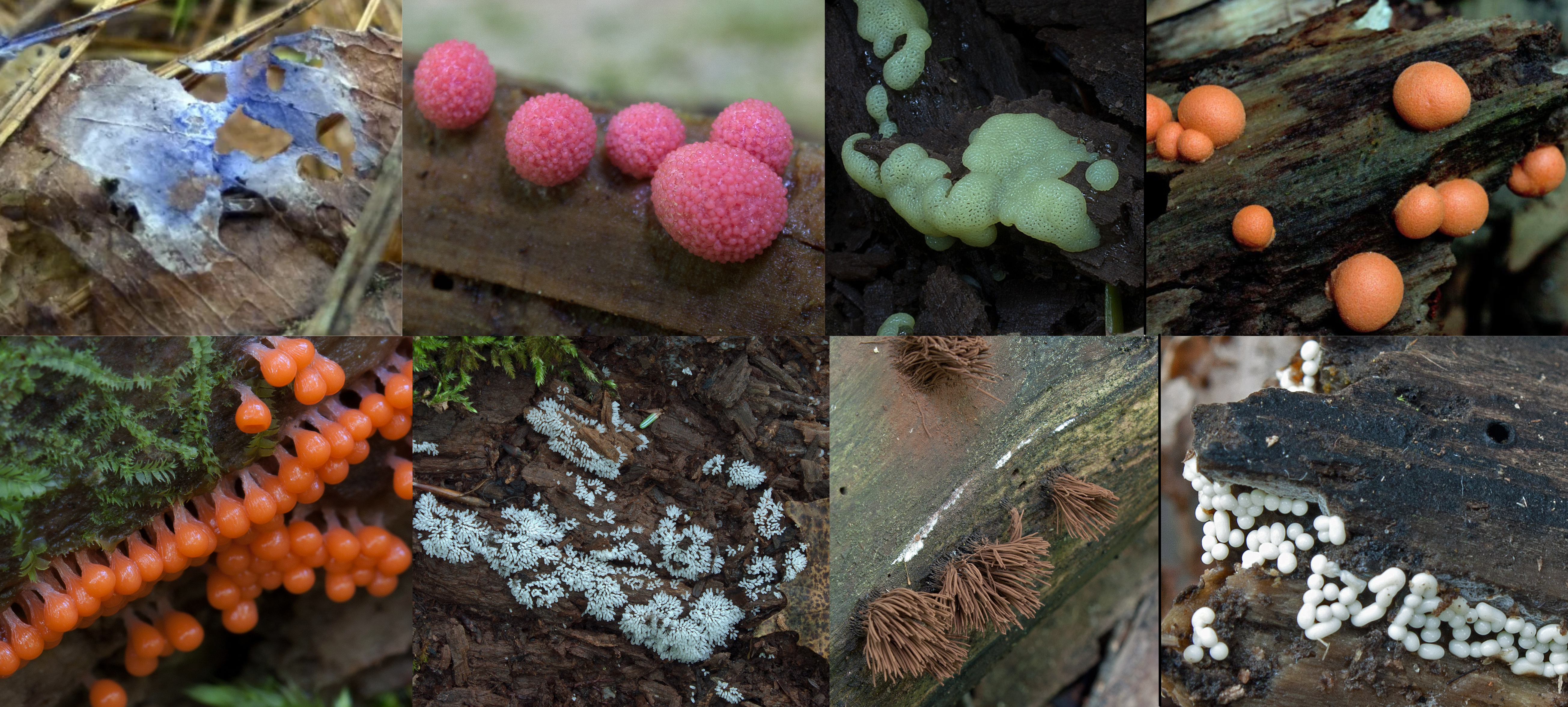
Following my earlier article on slime molds, I felt the need to share my encounters with members of this incredible group of largely ignored and misunderstood creatures. As with many fungi and lichen that seem to be invisible in plain sight, slime molds—despite their often bright colours when in their fourth stage of growth—appear mostly invisible and are considered … well … icky slime to be avoided and ignored. I’m reminded of Woody Allen’s quote: “I love nature; I just don’t want to get any of it on me.”
.
.
Slime molds are not plants, animals or even fungi—they’re protists, and are more closely related to the wily amoeba. If you think that’s cool-weird, slime molds are also known for solving mazes and for having 720 sexes; though, what sex means to an organism so fluid and lacking cell walls remains a mystery. H. R. Smith of Bay Nature magazine explains:
“The 720 sexes fact comes from slime molds’ ability to fuse, smushing two single-celled bodies into one new single-celled creature. Their sexual compatibility depends on three genes that have, respectively, 16, 15, and three loci-which, mathematically, can combine in 720 different ways.”
What’s cool about their maze intelligence is that individual slime molds display excellent memory that is shared with the ‘hive mind’ of the colony. Smith shares that “when two Physarum polycephalum individuals merge into a new single-celled organism, that new cell seems to have some memories of bad meals past. If one parent learned to steer around salt or powdered caffeine to get to something better, its descendant will, too.”
Individuals are tiny but they normally live colonially, fusing and splitting at will and when they gather to form a more conspicuous plasmodial phase—appearing as slimy blobs, swarming networks of oozing cobweb-like structures that creep—they become more visible. (It’s not that they visibly move—the motion is tiny and incremental—but it’s as though we still recognize movement on some level.) In this stage they also often take on bright colours such as bright green, orange, pink, purple, blue, lemon yellow or flaming red. They also come in the ordinary colours of Nature’s brown and black. Slime molds feed on bacteria and fungal spores and other tiny things, growing on decaying organic material such as logs, snags, and stumps, leaf litter and other forms of humus and detritus.
Slime molds are in constant motion and change—even when they aren’t moving. Like many fungi, slime mold fruiting bodies are transient and ephemeral. The day after I witnessed a bright orange display of Hemitrichia fruiting bodies on a dead Big Leaf maple tree, they had faded to a dark purple—hardly visible. All to say that slime molds are constantly oozing to find food and always changing. Smith tells us that “a slime mold might look like it is infesting a plant, but it is a benign presence—the amoeboid equivalent of pausing on a park bench before continuing onward.”
Slime mold is as old as dirt. And I really mean that. In truth, they have little to no fossil history, being soft-bodied and tiny—mostly microscopic. The grouping is polyphyletic: consisting of multiple clades widely scattered across the Eukaryotes.
I’ve met several slime molds during my walks in the various mixed coniferous-deciduous forests of Ontario and British Columbia. Here are some:
.
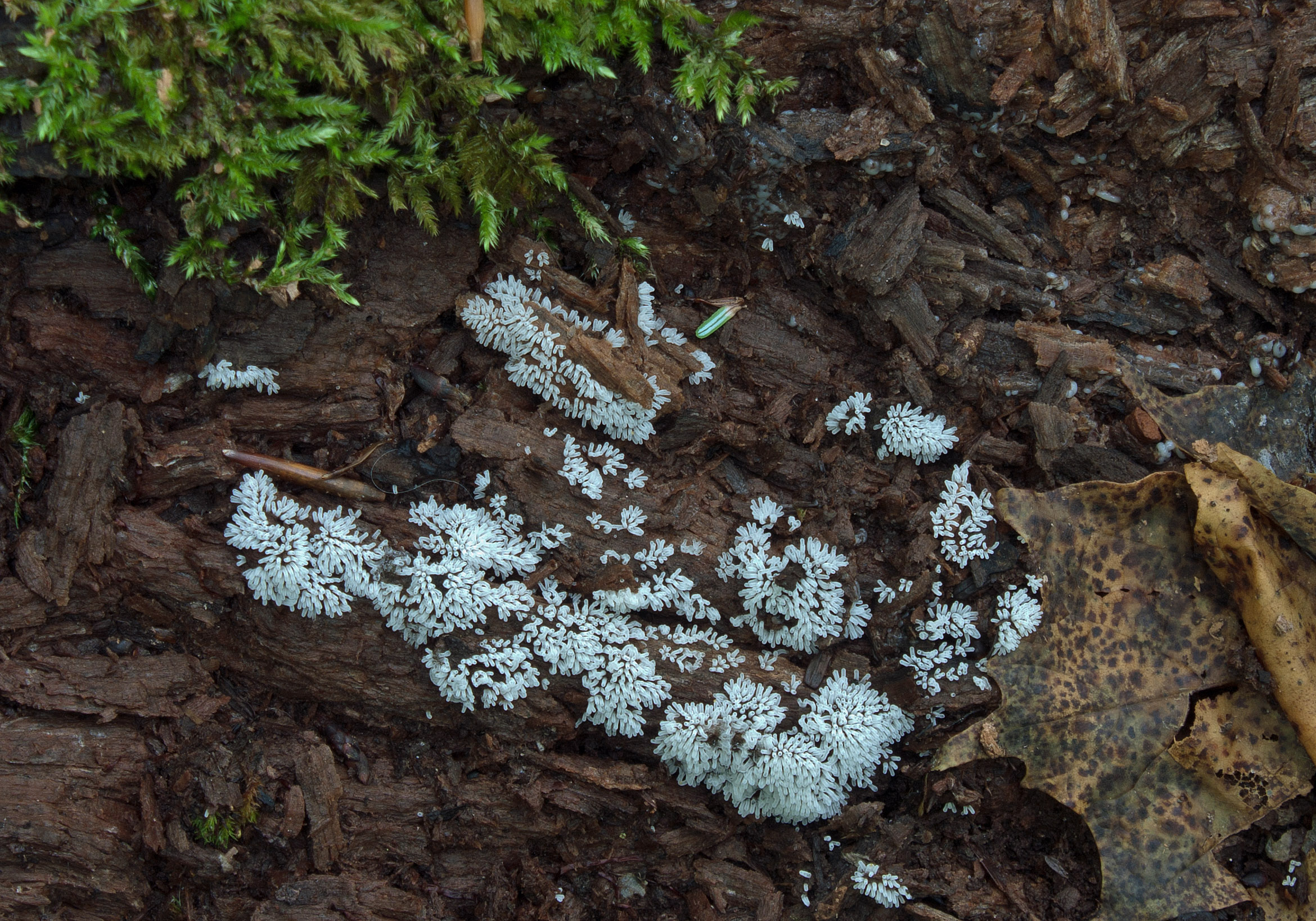
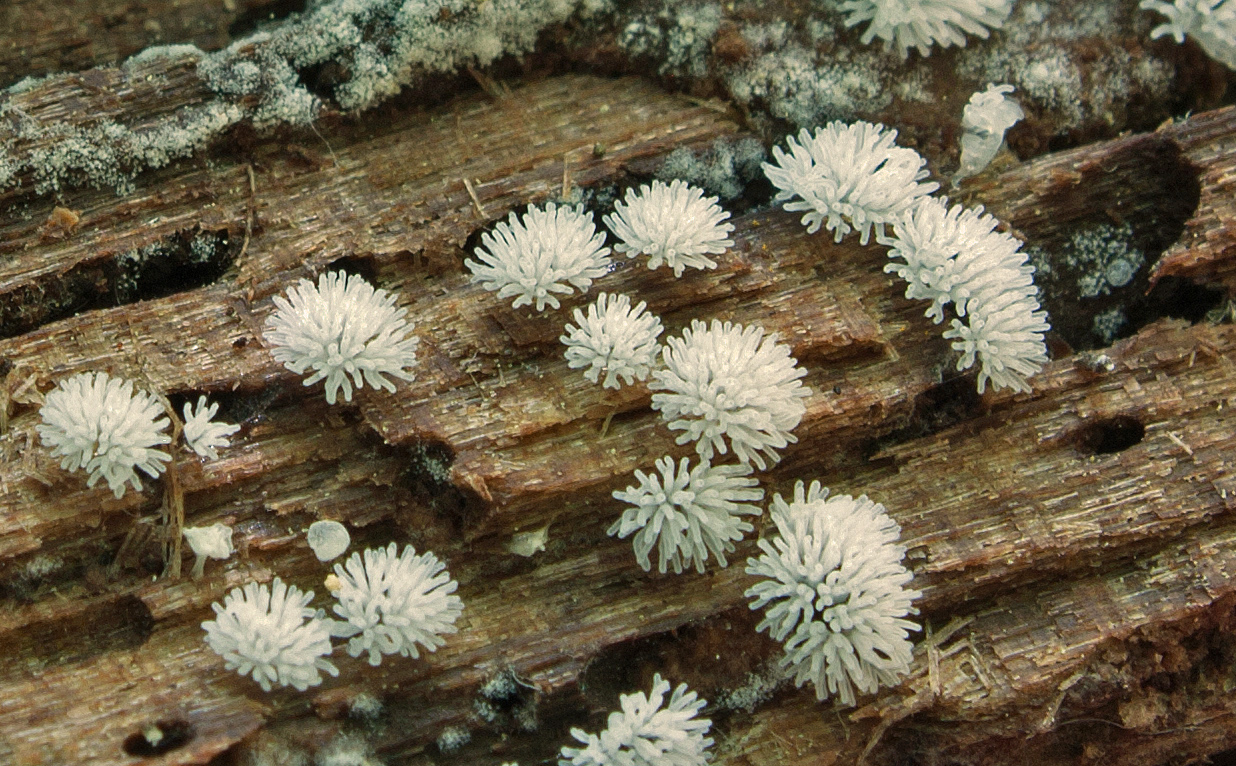
Common Coral Slime Mold (Ceratiomyxa fruticulosa)
.
Mark S. Burnham Old-Growth Mixed Forest: I found this beautiful translucent to whitish finger-like slime mold nestled in the folds and cracks of a decaying maple log in an old-growth forest in Ontario in summer. The sporangia (visible part of the slime mold) can be found in various forms. Common forms I encountered include simple pillar or filiforme (pillar-like projections), fruticulus (clusters of finger-like projection), and arbuscular (branched like tiny trees). Also called White Finger Slime (for obvious reasons), its ‘fingers’ are tiny, 1-2 mm in size. Ceratiomyxa was first described in 1729 by Pier Antonio Michell.
.
.
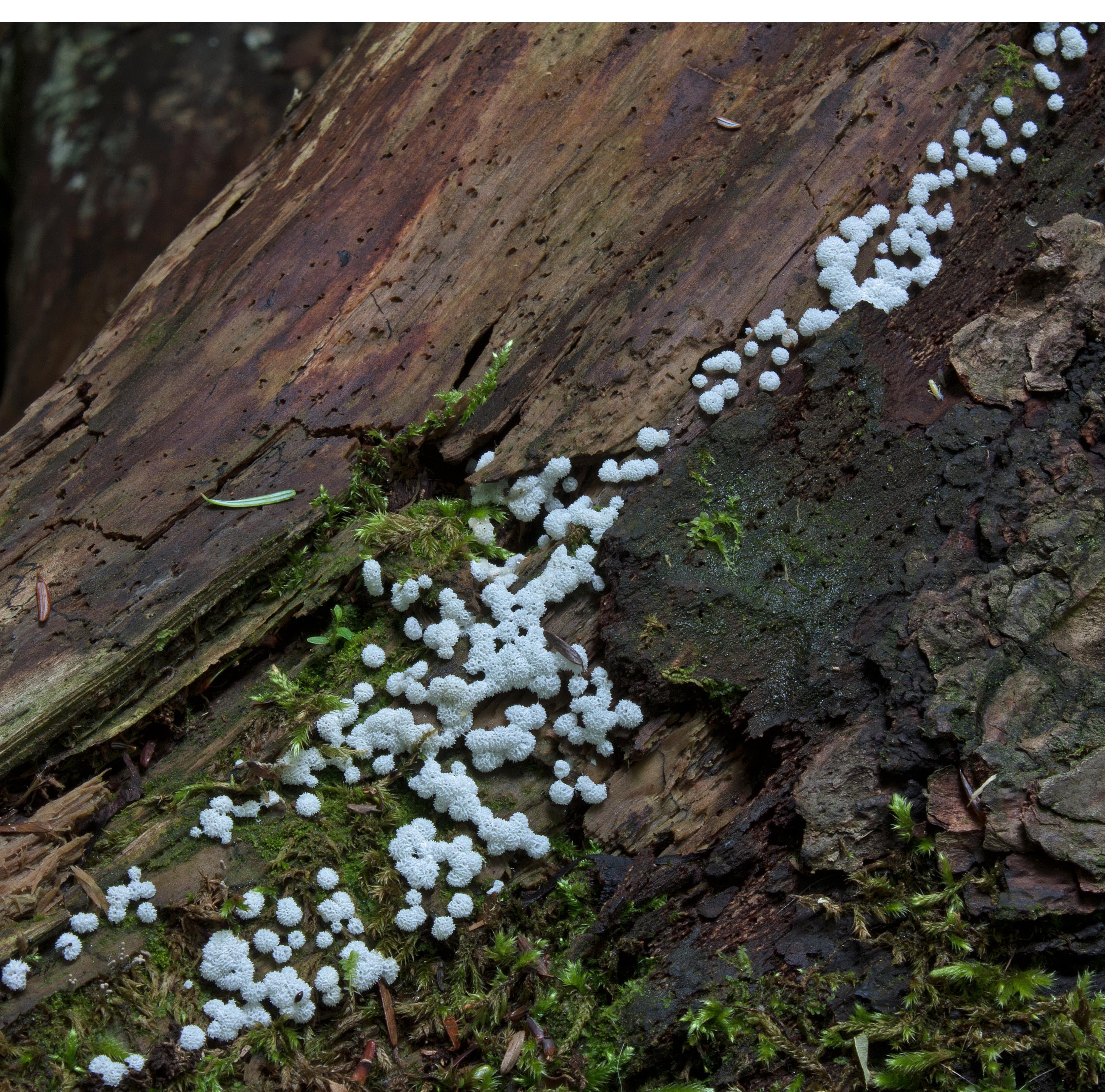
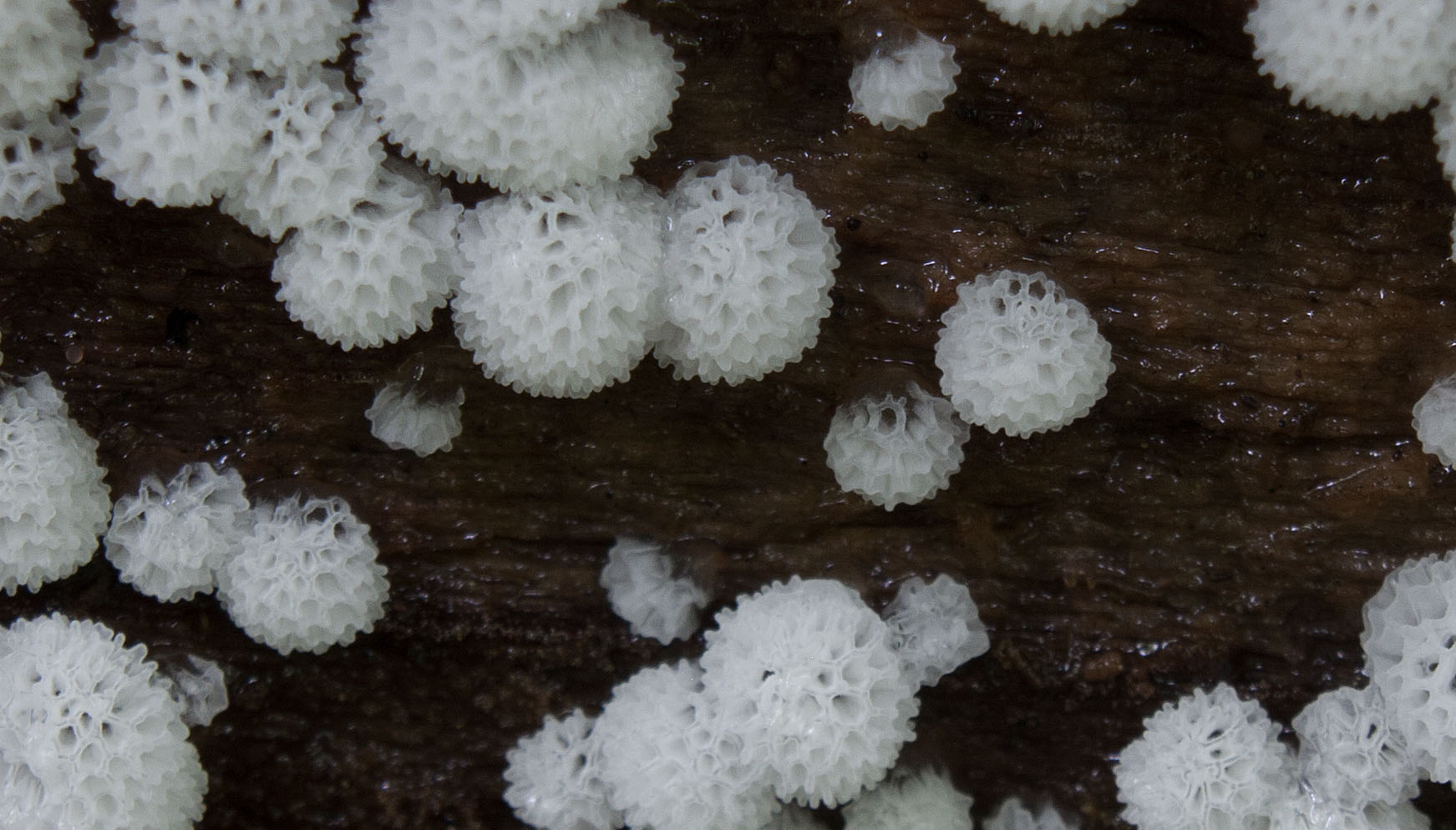
Honeycomb Coral Slime Mold (Ceratiomyxa porioides)
.
Mark S. Burnham Old-Growth Mixed Forest: I found this beautiful whitish honeycomb patterned slime mold nestled in the folds and cracks of a decaying beech log in an old-growth forest in Ontario in summer. The sporangia form porous, sponge-like structures that look like miniature geodesic domes.
.
.
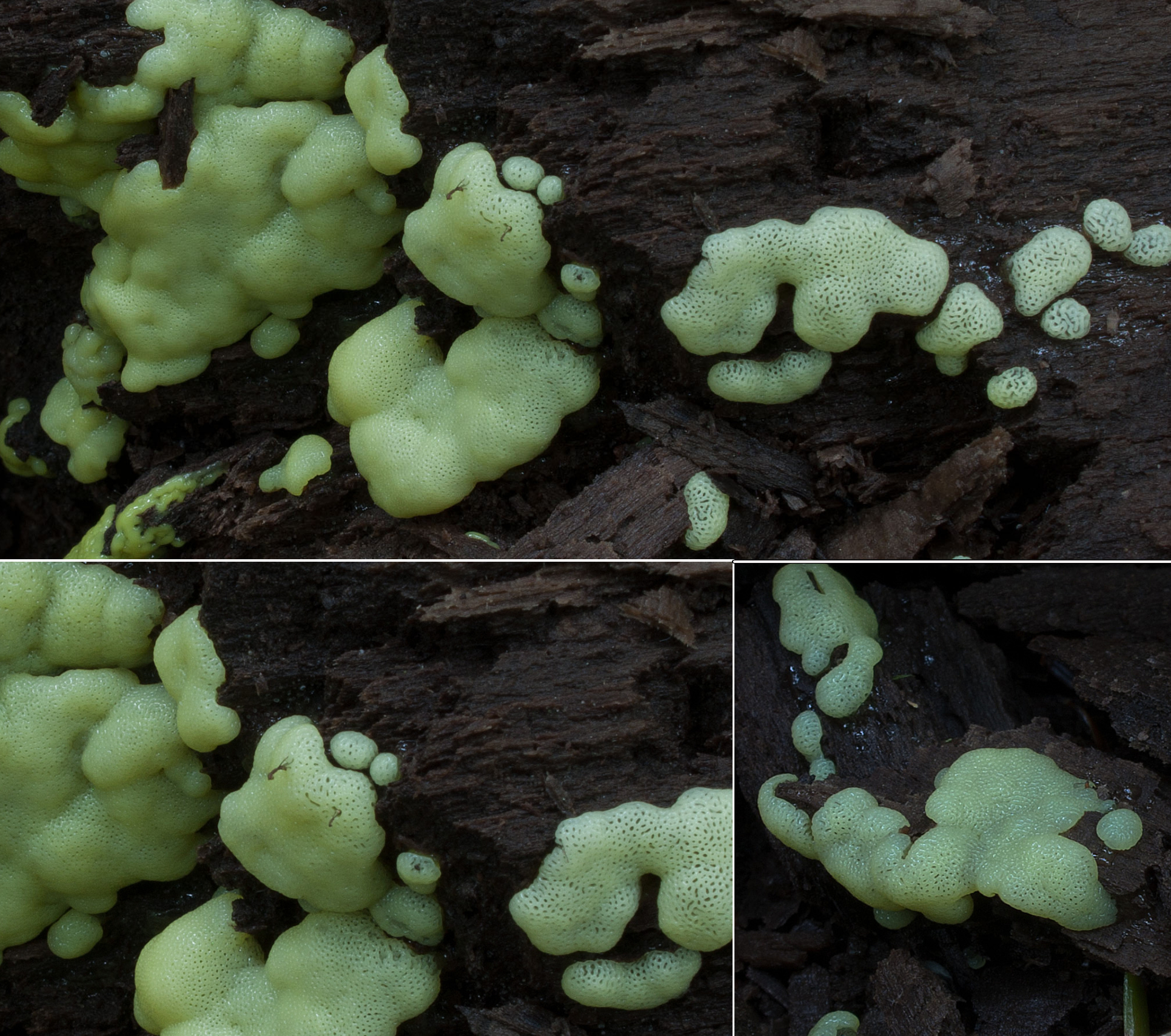
I also saw this stunning green version of the Honeycomb Coral Slime Mold on a rotting sugar maple log in an old-growth Ontario forest in summer. The ice-green sporangia were startling against the rotting brown wood.
.
.
Salmon Eggs Slime Mold (Hemitrichia decipiens)
.
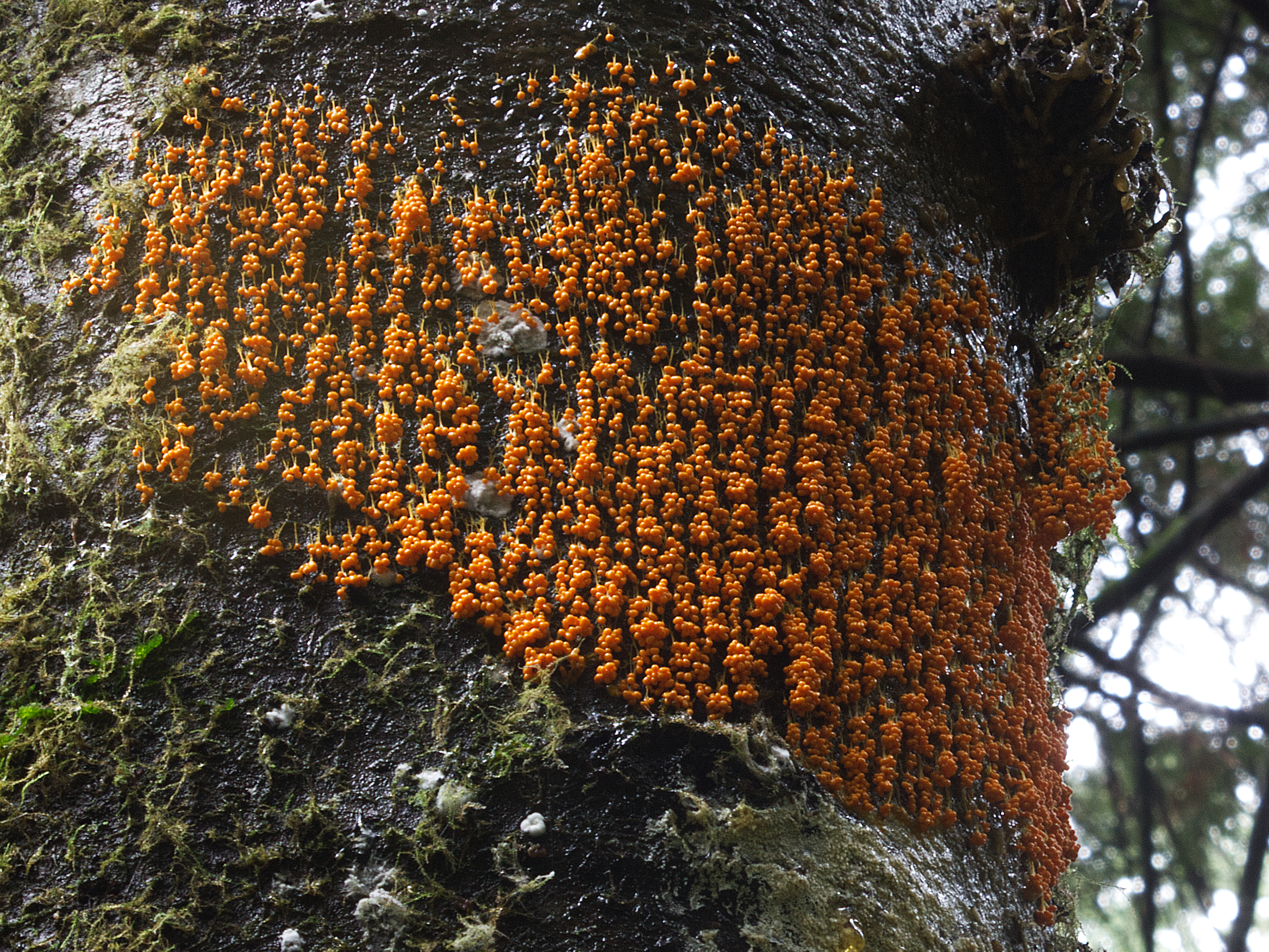
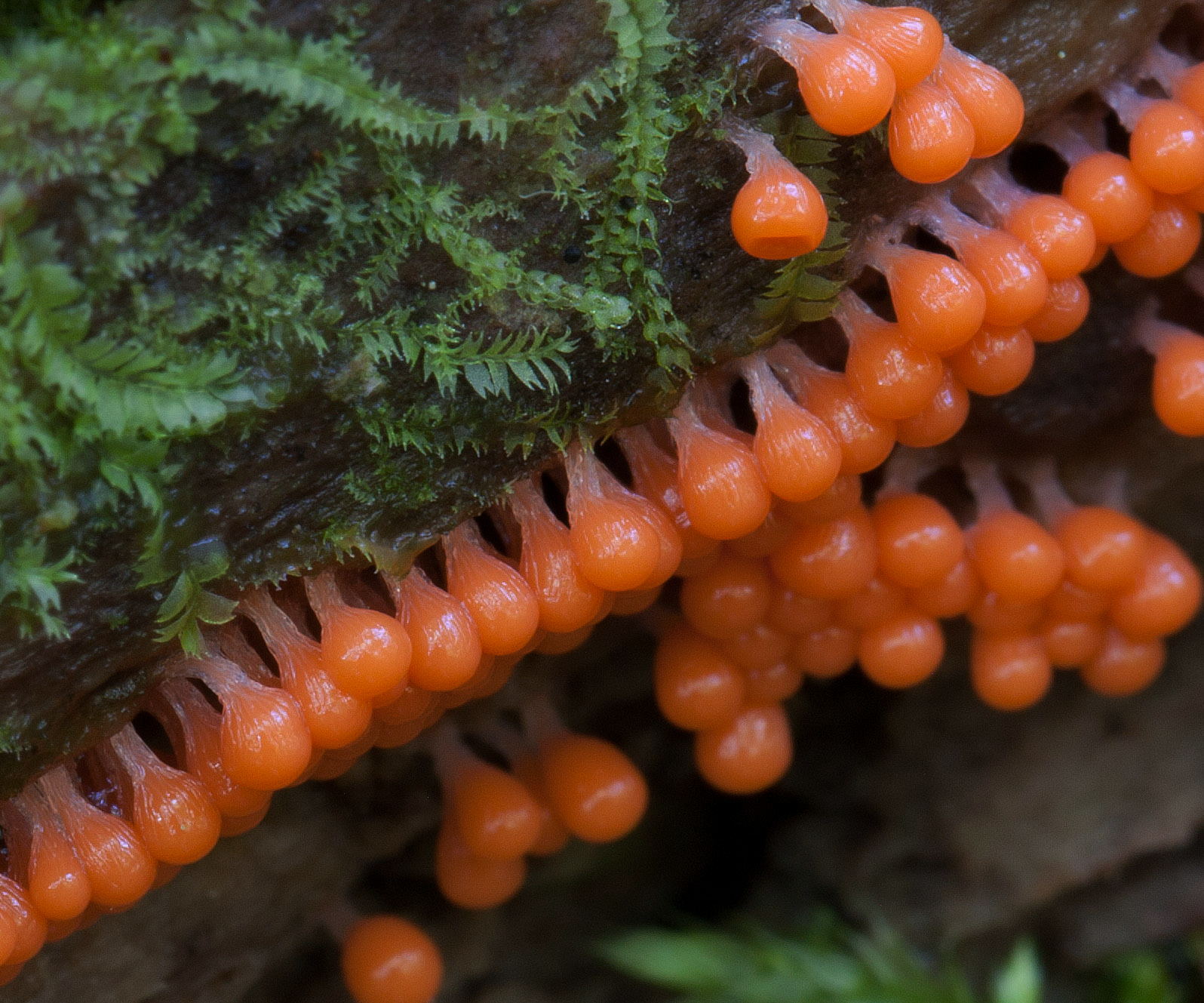
Douglas fir Rainforest of Watershed Park, BC [early winter] & Mixed Maple-Beech Forest of Trent Nature Sanctuary, ON: I first found Hemitrichia high up on a Big leaf maple snag, a bright orange smear over the dark brown bark in a BC Douglas fir rainforest in winter. Closer inspection through magnifying camera lens revealed a sea of orange blobs hanging like grapes off hyaline ‘stems’ attached to the bark. They looked familiar. I’d documented similar tangerine blobs on a rotting ash log in an Ontario forest, which I’d originally identified as Leocarpus fragilis (Insect Egg Slime Mold) but now consider to also be Hemitrichia decipiens, given their bright orange colour, robust stalks, and inhabiting a decaying mossy log rather than a live plant (more Leocarpus’s style).
.
.
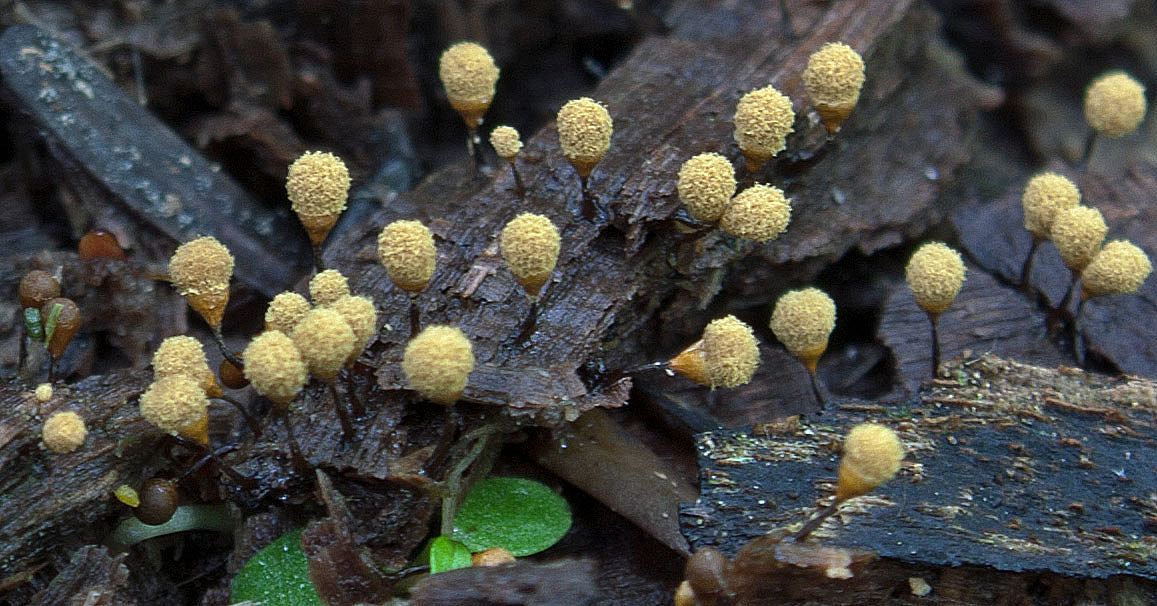
Push Pin Slime Mold (Hemitrichia calyculata)
.
Mark S. Burnham Old-Growth Forest: I found this tiny slime mold with distinctive poofy ‘hairdos’ scattered on a decaying beech log in a mixed old-growth forest in Ontario in the summer. The yellow-gold ‘wildly hairy’ sporangia sat on slender dark reddish brown stalks and measured from 1-3 mm tall. The stalks expanded at the top to form distinct funnel-shaped cups that held the sporangia. The ‘hairdos’ are an intricate collection of capillitial fibers that hold the tiny spores. The ‘flyaway hairs’ are actually free elators. These cosmopolitan slimes prefer decaying wood and (less commonly) bark, particularly of broadleaf trees.
.
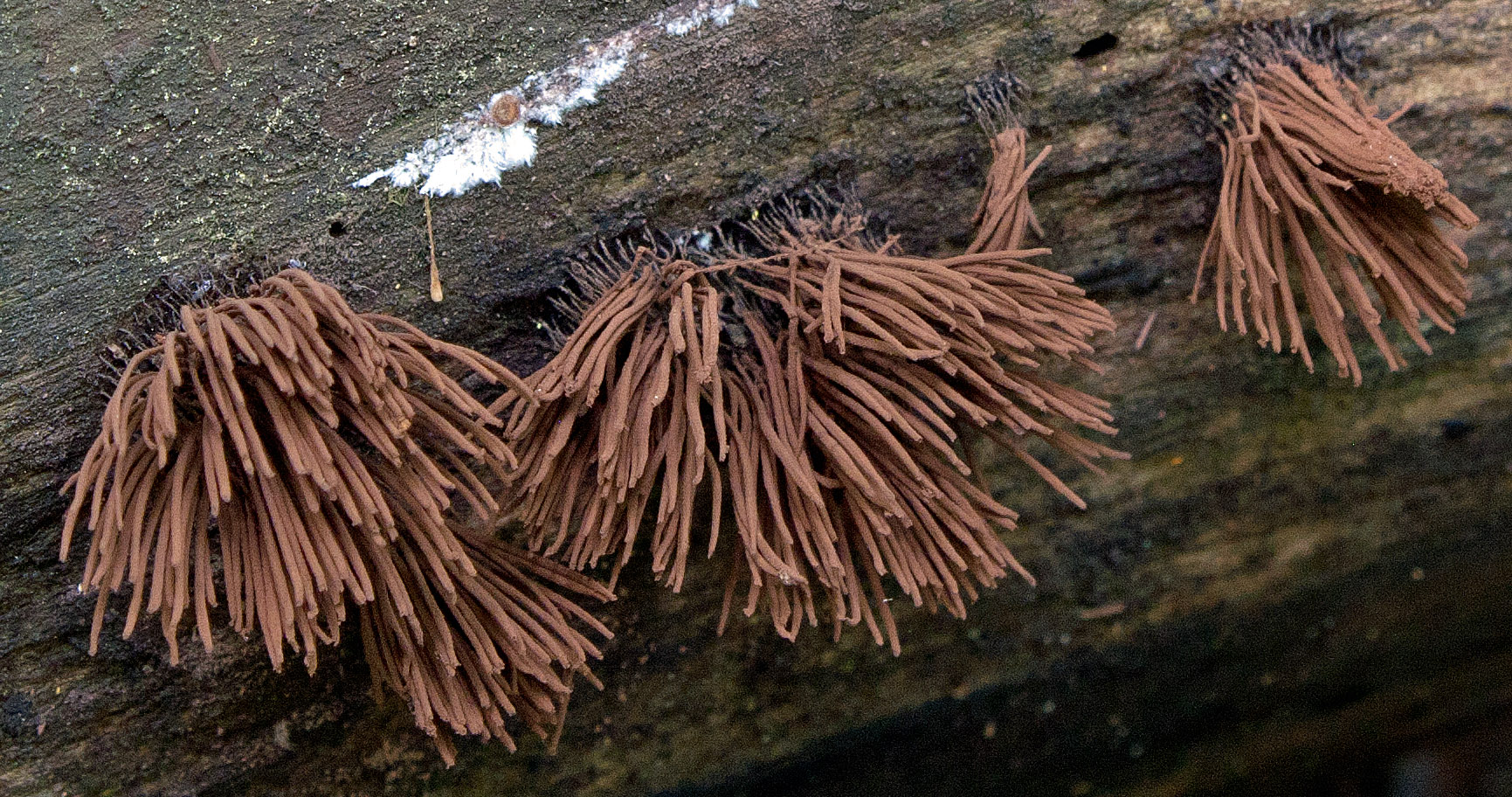
Tree Hair Slime Mold (Stemonitis axifera)
.
Riparian Cedar Forest, ON: I found this beauty growing on the side of a rotting ash log that had fallen across a path in an Ontario riparian forest in the summer. Also called Chocolate Tube Slime, Stemonitis form dense bundles or clusters of tall thin black-stalked light brown ‘dusty’ sporangia that resemble a Mohawk hairdo. Typically growing on decaying wood, Stemonitis molds are tiny, about 1 to 1.5 mm wide and 2 cm tall. The slime mold was first described (as Trichia axifera) by Jean Baptiste François Pierre Bulliard in 1791. Thomas Huston MacBride transferred it to the genus Stemonitis in 1889. I’m told that Stemonitis axifera needs about 20 hours to make its fruiting bodies—which are a coveted food for slugs.
.
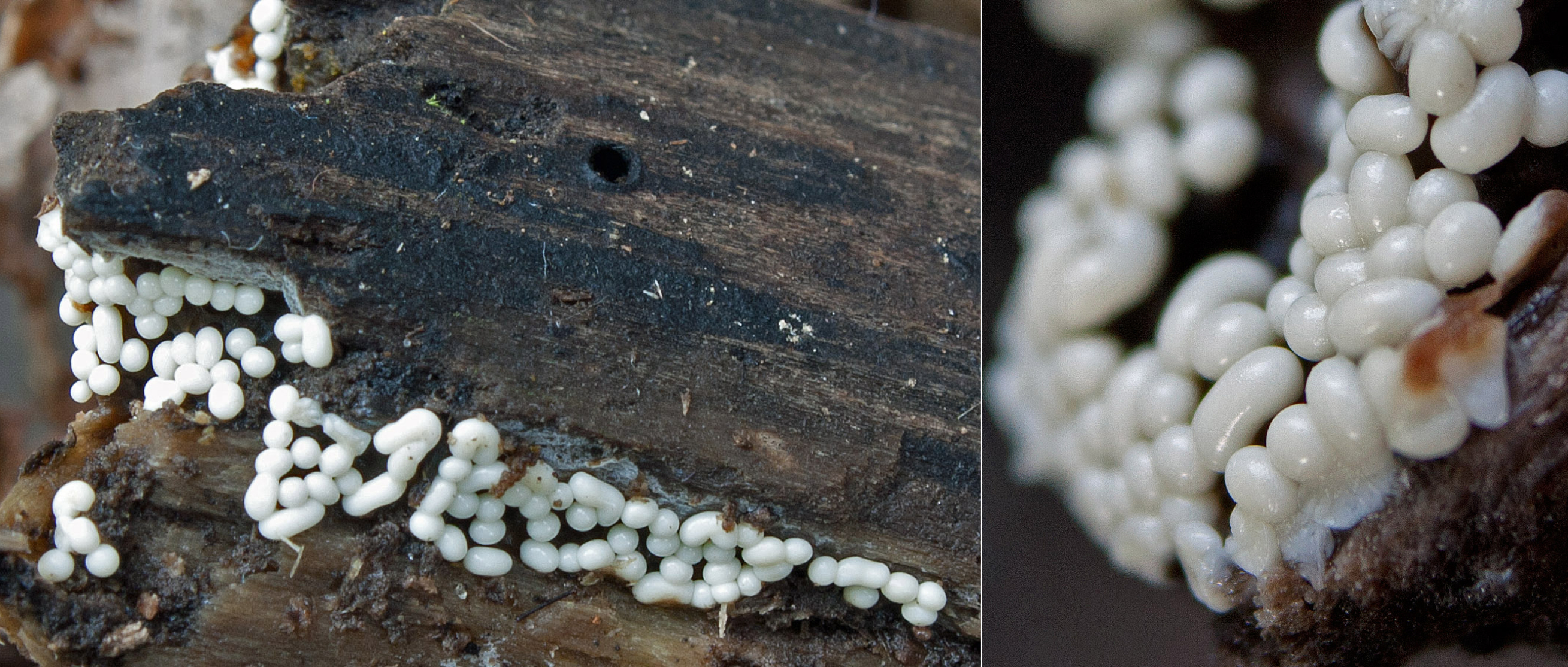
False Coral Slime Mold (Trichia varia)
.
Mixed Maple-Beech Forest of Trent Nature Sanctuary, ON: I discovered these attractive tiny ‘bean-like’ white blobs on a rotting log in a mixed forest in Ontario in summer. This cosmopolitan slime typically grows on decaying litter or logs, preferring shaded areas of forests. They often associate with bryophytes.
.
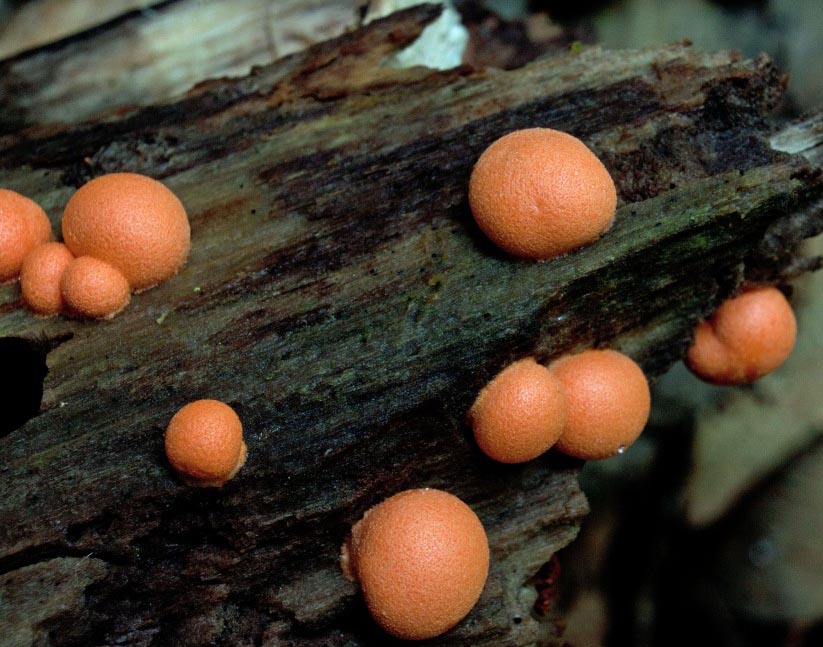
Wolf’s Milk Slime Mold (Lycogala epidendrum)
.
Mixed Maple-Beech Forest of Trent Nature Sanctuary, ON: l first found clusters of tiny orange and grey balls on a decaying beech log in a mixed Ontario forest in late fall. Wolf’s milk changes its colour with age. At the pink or orange stage, the flesh is a pink paste-like substance resembling toothpaste. By the grey stage, dried greyish spores will eject if the ball is squeezed.
.
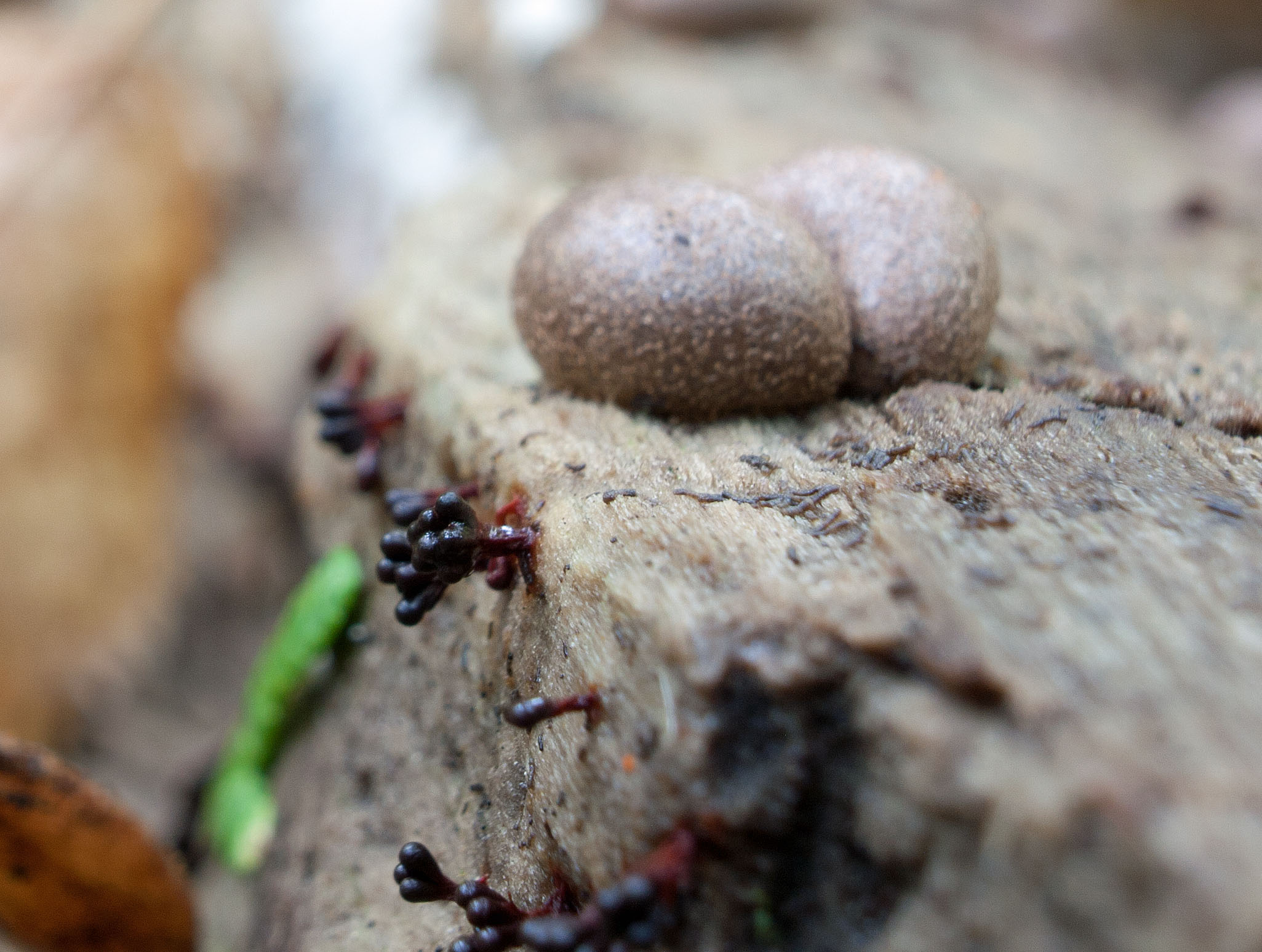
Wasp’s Nest Slime Mold (Metatrichia vesparia)
.
Mixed Maple-Beech Forest of Trent Nature Sanctuary, ON: While I was busy photographing the Wolf’s Milk Slime Mold on the decaying log in late fall, I inadvertently captured another very tiny slime mold. When I recognized this, I returned with a focus on this one. Called Wasp’s Nest Slime Mold because of lkjlkjlkjl, Metatrichia vesparia measures about 3 mm high with an orangey stalk and ‘bubbles’ of reddish sporangia. Previously called M. vesparium, the name change occurred in 1969. I’m told that this slime prefers decaying wood, but can also be found living on living tree bark and herbivore dung.
.
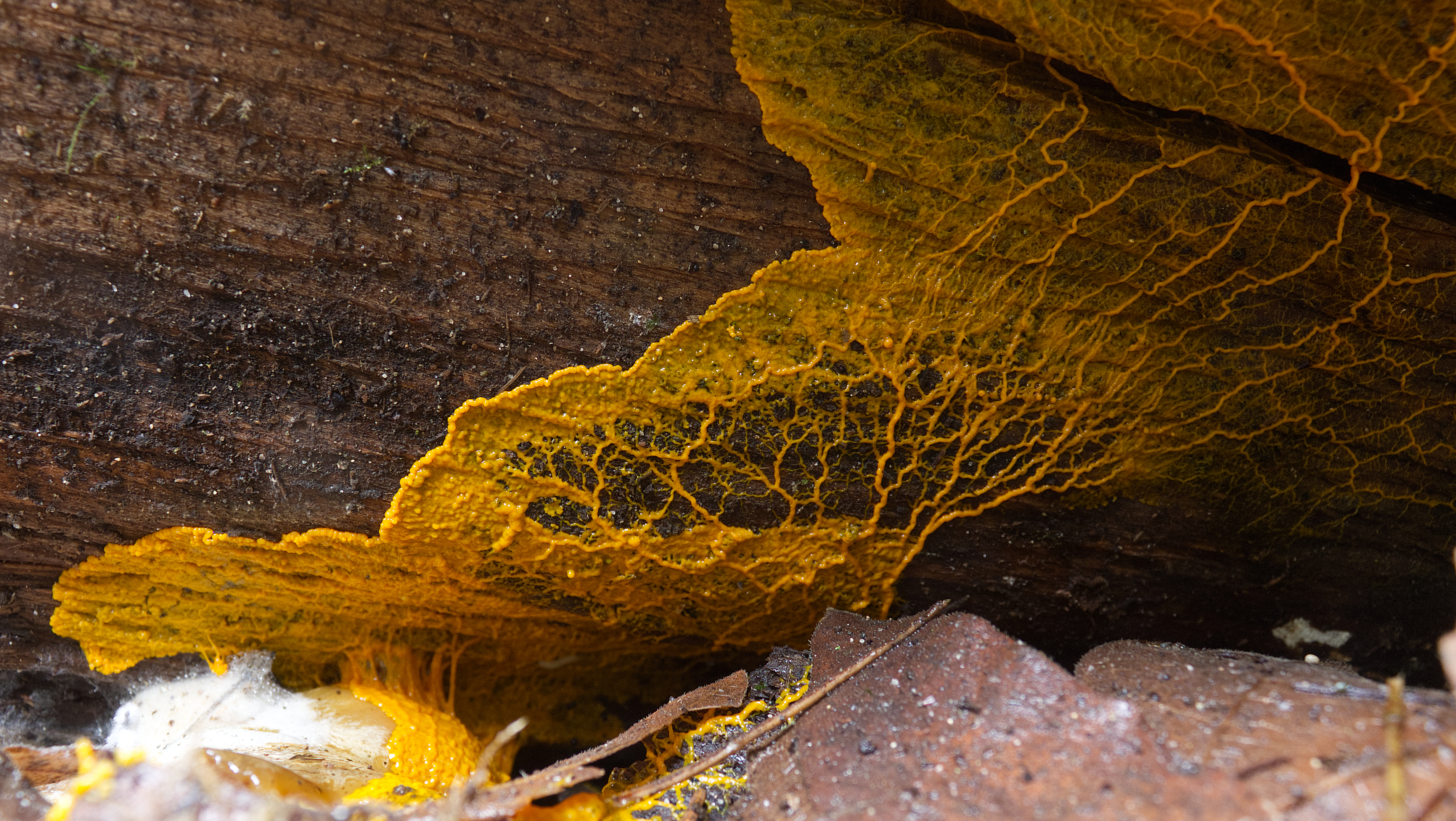
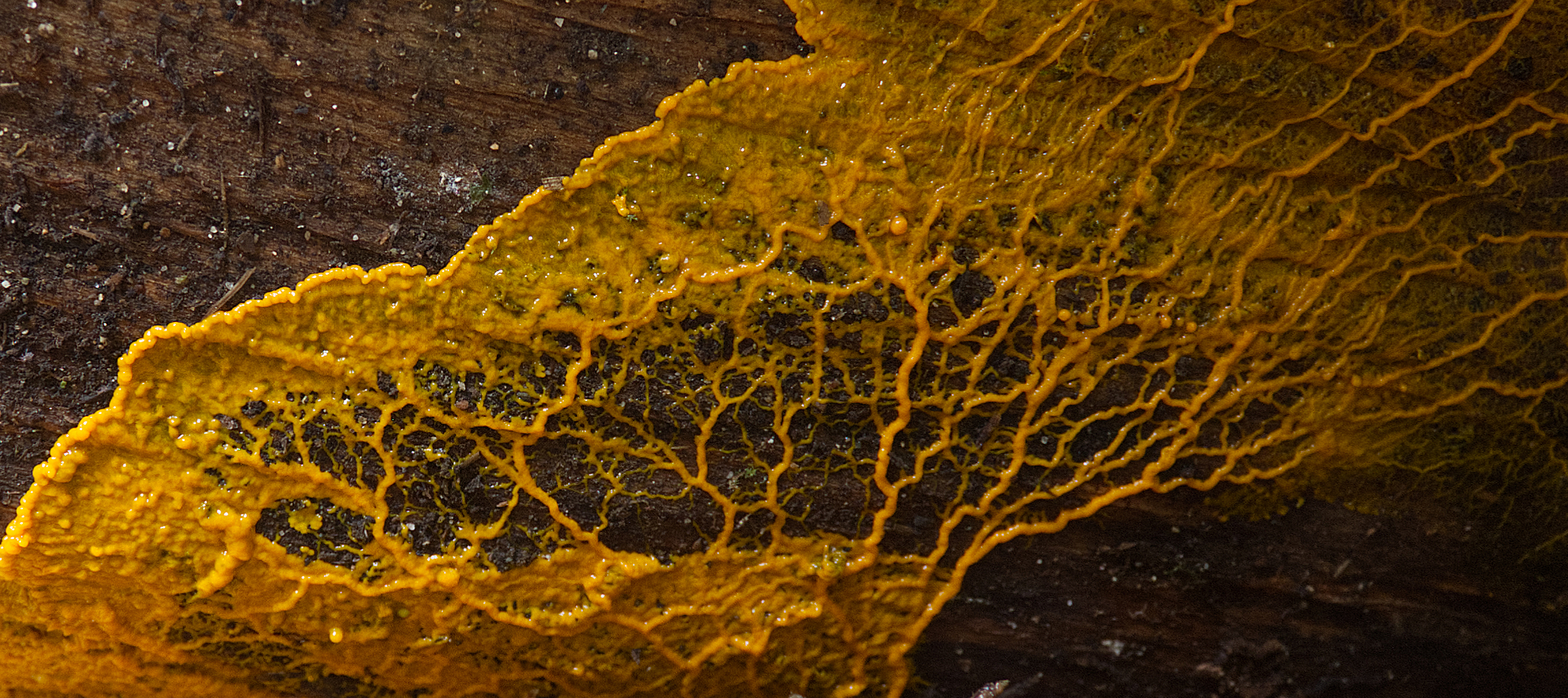
Many-Headed Slime Mold (Physarum polycephalum)
.
Douglas fir Rainforest of Watershed Park, BC: I found this colony spreading across the belly of a fallen log—likely a Douglas fir—already colonized by oyster fungi and Turkey Tail in winter. These plasmodial Myxomycetes form sprawling networked branches as they pulse and creep at 1-5mm/hr, sometimes doing a sprint at 1 mm/sec through active cytoplasmic streaming. These slimes use rhythmic contraction and cytoplasmic streaming to respond to environmental stimuli. They are rather famous slimes, given the research done on them and their known ability to learn and share information.
.
.
These are just the slime molds I’ve encountered so far in my few years of active search for them. There will, no doubt, be a Part 3 and even Part 4, as I see more and more of them. After all, there are at least a thousand known on this planet, found globally on every continent and thriving in damp forests, desserts and even Antarctica. And, given their fluid nature and constant motion, that number will continue to grow as slime molds evolve to take over the planet. (One could argue that they already have; we just haven’t noticed yet.)
Remember, it’s the thing you don’t see that usually gets you in the end. Slime molds rule!
.
References:
Smith, H.R. 2023. “A Slime of One’s Own.” Bay Nature magazine, January 3, 2023.
.

Nina Munteanu is a Canadian ecologist / limnologist and novelist. She is co-editor of Europa SF and currently teaches writing courses at George Brown College and the University of Toronto. Visit www.ninamunteanu.ca for the latest on her books. Nina’s bilingual “La natura dell’acqua / The Way of Water” was published by Mincione Edizioni in Rome. Her non-fiction book “Water Is…” by Pixl Press(Vancouver) was selected by Margaret Atwood in the New York Times ‘Year in Reading’ and was chosen as the 2017 Summer Read by Water Canada. Her eco-fiction clifi novel “A Diary in the Age of Water” was released by Inanna Publications (Toronto) in June 2020. Her most recent novel Gaia’s Revolution, an eco-fiction political thriller, was released in March 2026 by Dragon Moon Press.
.
 The Meaning of Water