.
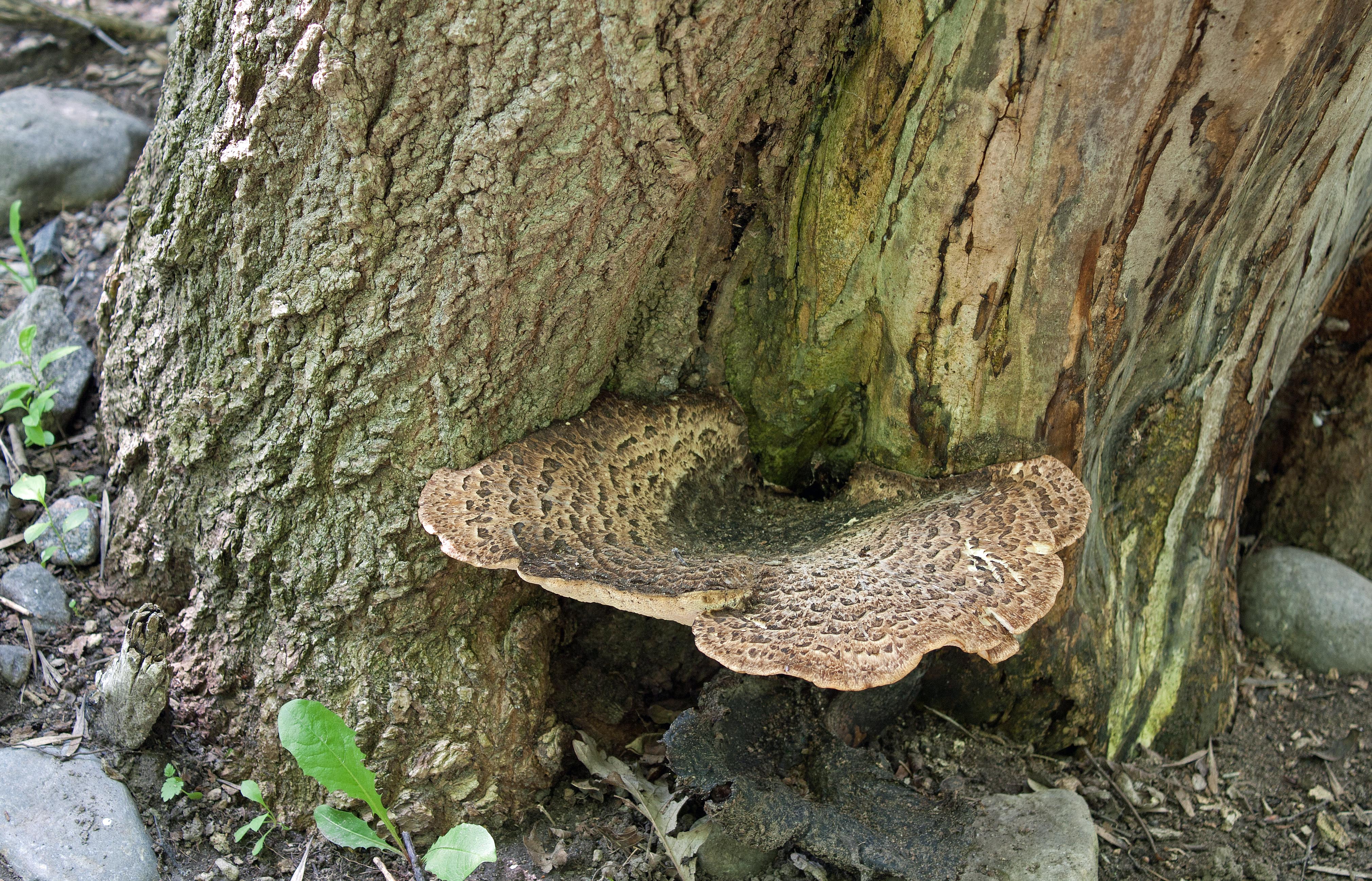
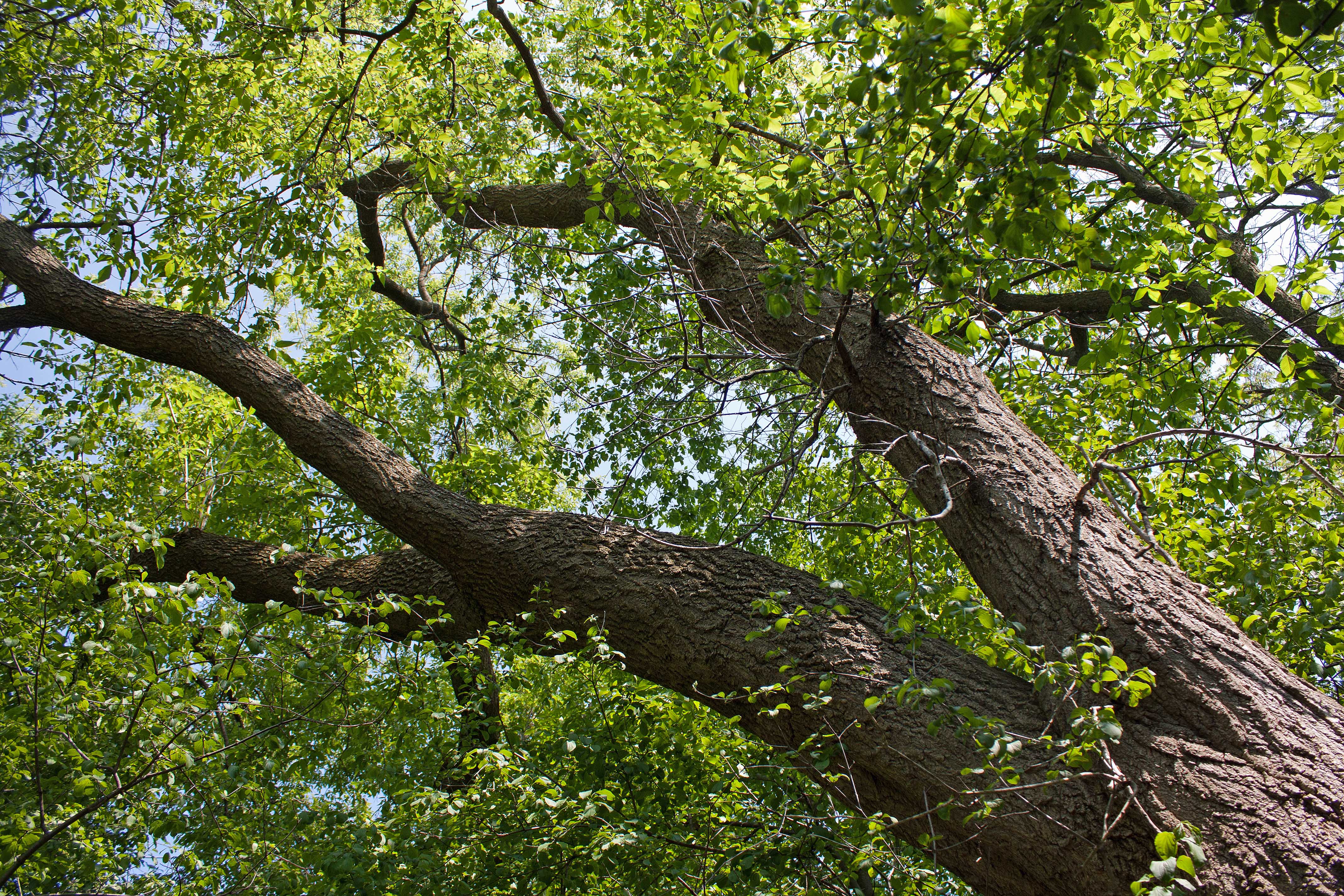
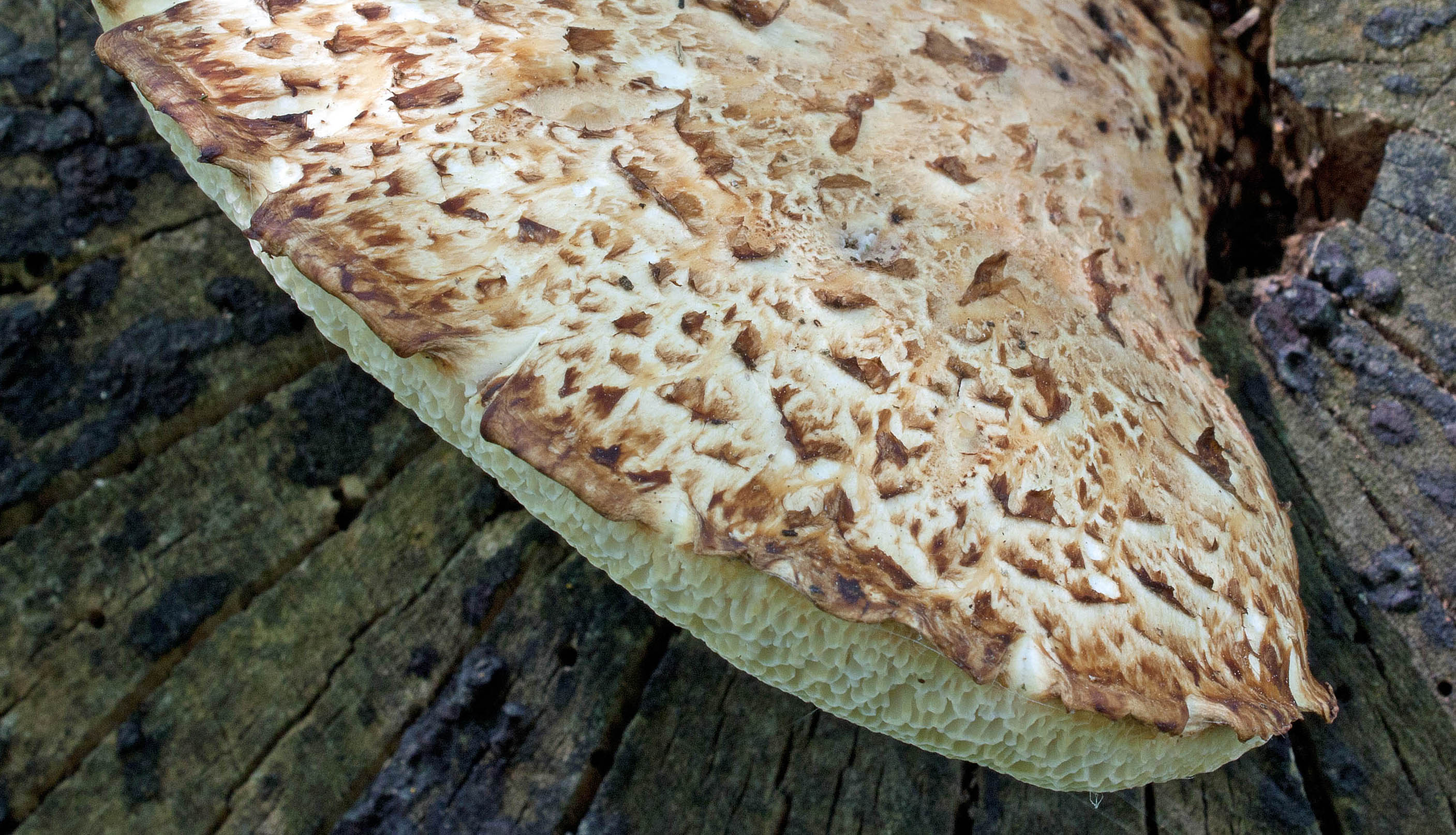
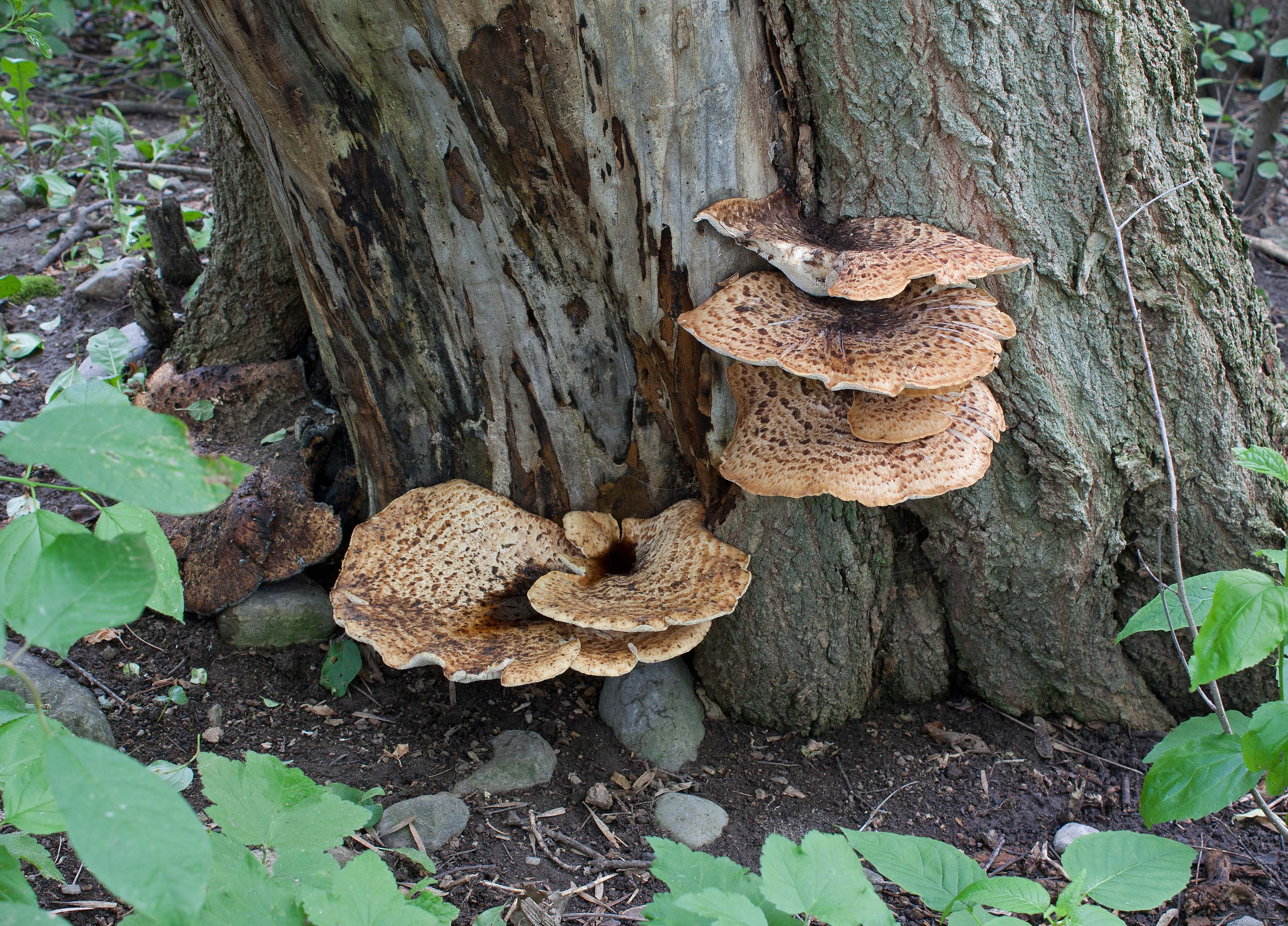
Yesterday, on my walk along a less-used path through the riparian forest of the Otonabee River, I spotted a large bract fungus growing at the base of a large Manitoba Maple or Box Elder (Acer negundo) tree and its dead nearby barkless stump. The fungus at the tree base was growing right above the half decomposed carcass of the previous fungus from the year before whose blackened remains still covering the ground. The white-rot fungus was larger than my spread out hand, spreading out like a fan in a convex semi-circle, with pale tan to dark brown scales above and cream-coloured spongy pores on its underside. The edges of the larger fruiting body were already splitting.
.
.
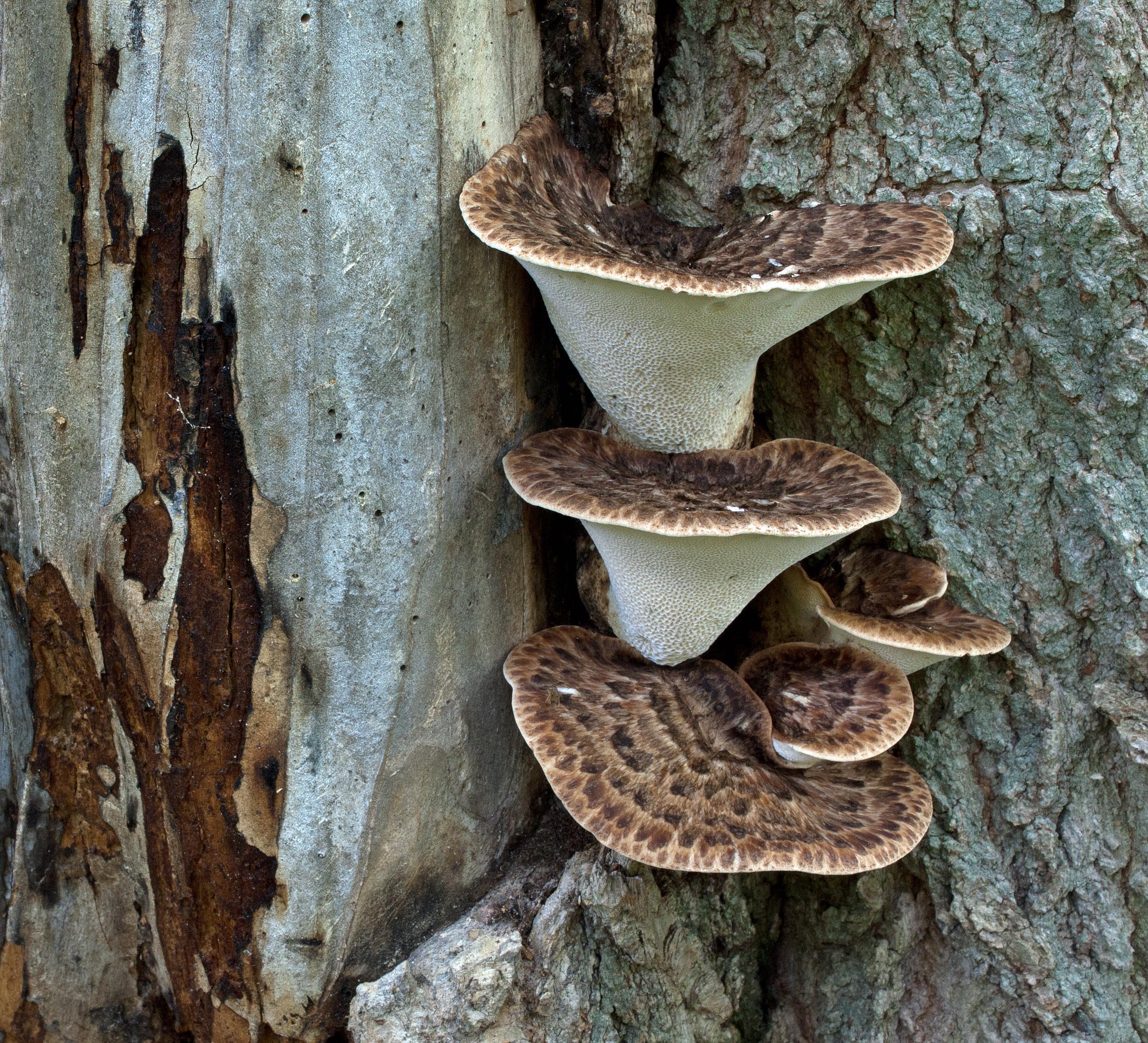
I identified it as Polyporus squamosus or Dryad’s Saddle (also known as “Hawk’s Wing” and “Pheasant Back Mushroom”), known to parasitize living deciduous trees and as a saprophytic decomposer of dead tree stumps and logs. It is typically found in April and May but also in the fall.
Fungiwoman (aka Barbara Batokova) tells us that the back story for the name Dryad’s Saddle refers to the mushroom’s shape and creatures in Greek mythology called dryads: tree nymphs or tree spirits “that could apparently fit and ride on this mushroom!”

.
I could understand the other two names for this shelf fungus, given its feathery pattern of tan and brown resembling the back of a female pheasant or the wing of a hawk. I’d missed the early stage of this mushroom, which resembles bottle stoppers or corks, stubby little knobs that develop into pale beige semicircular caps covered with brown, feathery scales, radially arranged. When I gave it a sniff, the aroma was a delightfully tasty smell that resembled a mixture of cucumber with sweet watermelon. It was fresh and sweet with a lingering pleasant perfume. Indeed, Tim Taranto of Little Village tells us that “The best way to identify a Dryad’s Saddle … is by its scent. They have a distinctly un-mushroom like odour, and smell more like a watermelon rind or a freshly sliced cucumber than mushrooms.”
.

.
No surprise: this mushroom is edible and rather tasty and has some awesome medicinal properties. Cornelia Tjandra with Eat the Planet tells us that Dryad’s Saddle contains viimins B complx and vitamin C and D, as well as essential minerals such as iron, phosphorus, potassium, copper, and selenium. WebMD writes that this mushroom contains valuable bioactive carotenouds and terpenoids and high levels of unsaturated fatty acids such as linoleic, oleic, and palmitic acids. The mushroom contains immunity-boosting and anti-inflammatory properties. A 2018 study in Romania confirmed that this mushroom is also high in antioxidants and antimicrobial properties, which help your body fight off free radicals as well as prevent tumors and cancer. Antioxidants also boost your immunity against common illnesses, such as cold and flu. Tjandra adds that there are no known side effects from eating this mushroom and no poisonous look-a-likes either.
.

.
Tjandra cautions, however, to pick only young mushrooms for eating; older mushrooms become infested and will be tough and leathery … Which is why I didn’t try out the specimen I found; it was far too old to eat. It was also the only specimen I’d seen in this riparian forest and didn’t wish to harvest it away. It is the fruiting body of the fungus, after all, and needs to do its work in the forest!
.

.
Eating Dryad’s Saddle
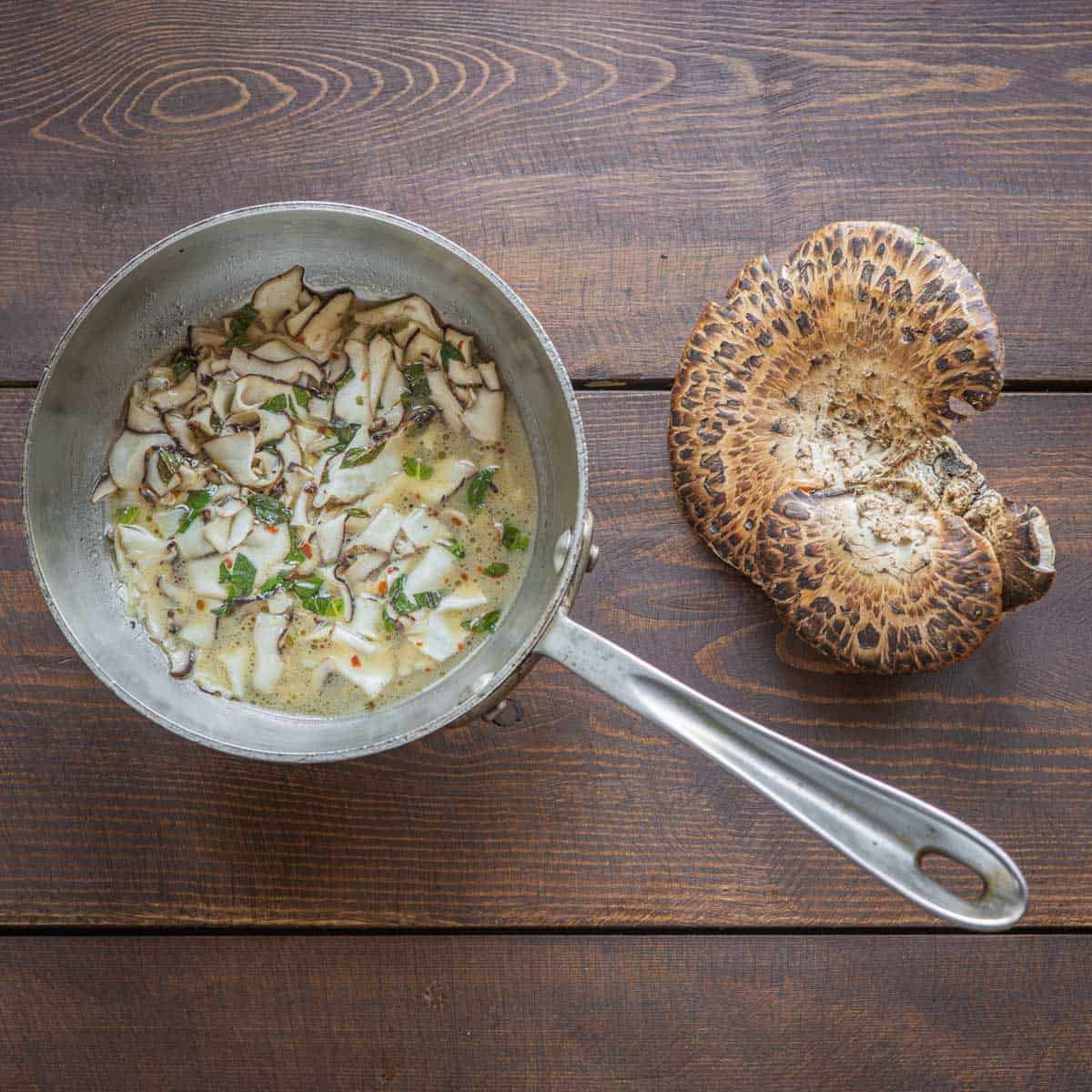
Forager Chef calls Dryad’s Saddle “one of the most underrated mushrooms,” and provides great advice on how to find and identify edible stages of this edible mushroom and to prepare them for best eating.
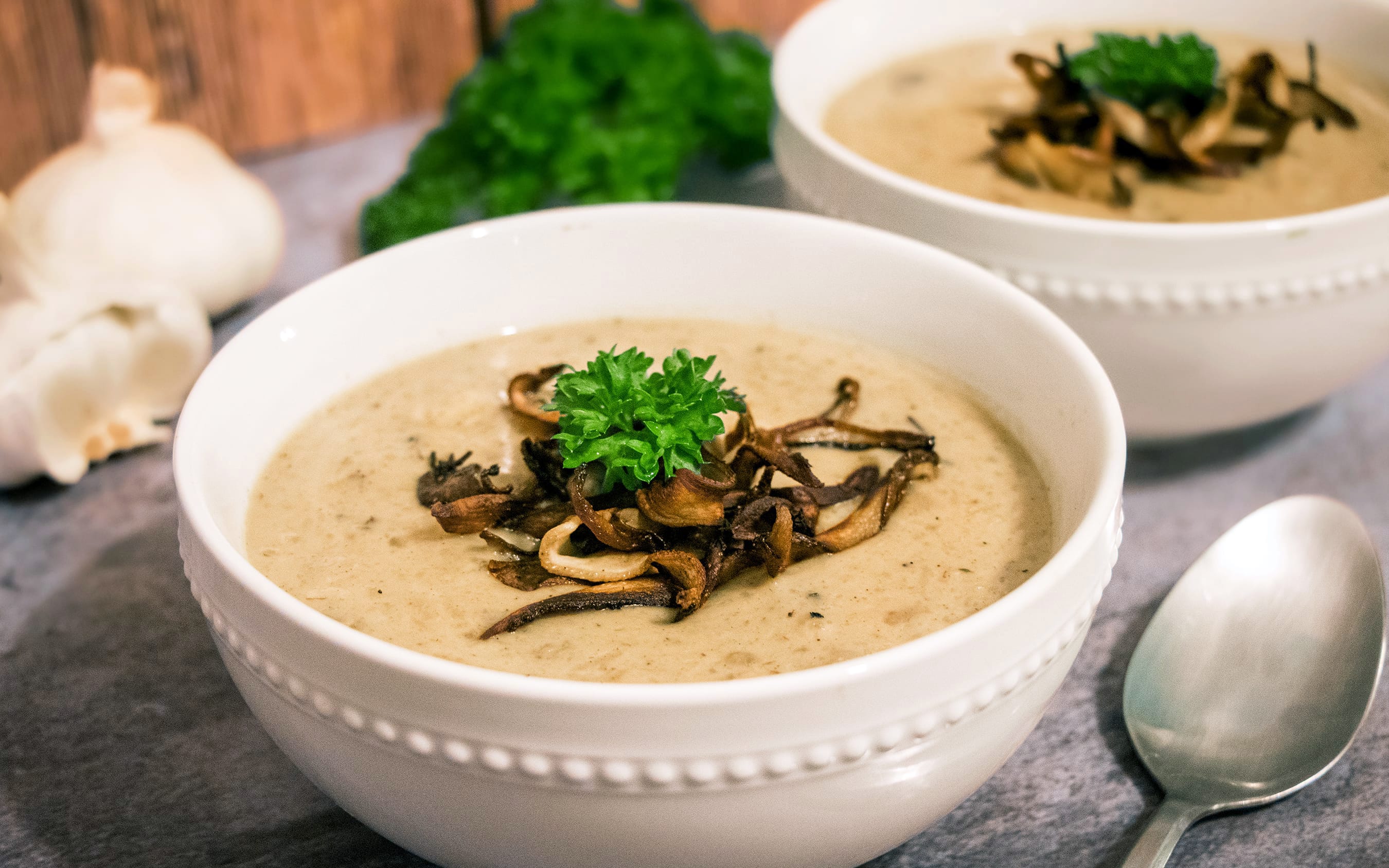
Both Forager Chef and Fungiwomen mention that Dryad’s Saddle make great soups and stews. Even if old they make a great soup broth.
One source suggests cutting off the tender edges, slicing hem into small pieces, cooking them in butter then draining and patting dry, pour a sugar syrup over them and refrigerating. The result tastes like watermelon candy. WOW! I can just imagine it too…
Preparation of Dryad’s Saddles for Eating
Tim Taranto describes how to prep the mushrooms for eating and provides a recipe for dumplings:
“Like chanterelles, Dryad’s Saddles aren’t inhabited by too many unwelcome arthropods, so you don’t have to soak them before cooking (though I would suggest giving them a good rinse and scrubbing their caps gently). Most of the preparation involves removing the spongy pores. This can be done by scraping them off with the edge of a pocketknife or paring knife. Once the pores have been scraped off, the firm, white meat of the mushroom should be visible. Next, cut away any tough flesh near the stem. After that, Dryad’s Saddles can be stored in the fridge, frozen, or pickled.”
.
Dryad’s Saddle Dumplings—Recipe from Little Village
INGREDIENTS
2 cups Dryad’s Saddles, diced
¾ cup tofu
2 medium scallions, chopped
2 tablespoons garlic, minced
1 tablespoon ginger, chopped
1 teaspoon Chinese vinegar
1 teaspoon soy sauce
Peppar, to taste
1 package wonton skins
chill oil or Gyoza sauce for dipping
PREPARATION
Saute mushrooms on medium heat with a little bit of vegetable oil.
Add salt until they brown and release a good amount of water.
Mix mushrooms, tofu, scallions, ginger and garlic in a bowl with a fork.
Add vinegar, soy sauce and pepper to the mixture.
Plop a teaspoon of mixture in your wonton skin and wet two edges of the skin with warm water.
Fold the skin, sealing it gently with your finger.
Dab the left corner of the wonton with a little more warm water and bundle it up.
Drop the wonton in boiling water.
Boil for no more than five minutes.
.



References:
Baroni, Timothy J. 2017. “Mushrooms of the Northeastern United States and Eastern Canada.” Timber Press, Inc. Portland, Oregon. 599pp.
Barron, George. 2014. “Mushrooms of Ontario and Eastern Canada.” Partners Publishing, Edmonton. 336pp.
Mocan, Andrei et al. “Chemical Composition and Bioactive Properties of the Wild Mushroom Polyporus Squamosus (Huds.) Fr: a Study with Samples from Romania.” Food & Function 9.1 (2018): 16–17. Web.
.

.

Nina Munteanu is a Canadian ecologist / limnologist and novelist. She is co-editor of Europa SF and currently teaches writing courses at George Brown College and the University of Toronto. Visit www.ninamunteanu.ca for the latest on her books. Nina’s bilingual “La natura dell’acqua / The Way of Water” was published by Mincione Edizioni in Rome. Her non-fiction book “Water Is…” by Pixl Press(Vancouver) was selected by Margaret Atwood in the New York Times ‘Year in Reading’ and was chosen as the 2017 Summer Read by Water Canada. Her novel “A Diary in the Age of Water” was released by Inanna Publications (Toronto) in June 2020.
.


When you walk through the woods, you need to keep an eye open for special finds like this.
LikeLiked by 1 person
Thanks, Merridy… It’s all about observing, isn’t it? So many things in nature are overlooked and not discovered in our haste to get somewhere… Thanks for your comment. Best, Nina
LikeLike
That recipe sounds absolutely decadent!
Diving into researching the folklore around this mushroom for my book and may just have to make some dumplings to inspire the writing 😉
LikeLike
Sounds great, Kitty! Do let me know how they turn out…
Best,
Nina
LikeLike