
Recently, I returned to a favourite hiking place in the Kawarthas of Ontario: Warsaw Caves Park. The main attraction of this park for most is the cluster of seven limestone karst caves formed thousands of years ago at the end of the last ice age. These cavities in the limestone rock have long passages and small open areas, perfect for spelunking.

But I skipped past the caves and went straight up the Lookout Trail to the lookout of the Indian River. The hike took me through a rare old-growth hardwood forest, with tall pines and cedars, aspens, maples and oaks, all showing brilliant colour.


The beginning of the trail wound its way among large boulders scattered and piled as if thrown carelessly there by a peevish giant. I could hear the Indian River flowing below my feet and, in the odd dark crevice, I felt the cool breeze from the dark waters below.

I stepped carefully over flat limestone slabs, many revealing the odd embedded crystalized fossil. In places, where footfalls were commonly made, the grey cement-looking rock had been polished into a burnished brown.

I passed a small ponded area called Damselfly Pond. This is where the Indian River begins its flow underground for several hundred metres. I had a snack at the pond then continued on, crossing a small wooden bridge, then following the rise up the hog’s back through pine and fir mixed forest.

In places, the trail was littered by a carpet of birch and largetooth aspen leaf corpses, mostly grey and giving way to Nature’s decaying process to bring nutrients back to the forest. Occasionally, I found a brightly coloured leaf among the grey—recently fallen. A few trees stubbornly kept their leaves, blazing like small fires amid the green conifers.


The trail continued steadily up through dense pine, fir and juniper to the lookout point where I had a view of the Indian River below. I pulled out the lunch from my backpack and enjoyed it as a cool breeze played with my hair. The air was fresh with the scent of pine and filled me with energy and serene joy.

The hike normally takes half an hour, if one walks steadily. But it took me twice as long because I was taking photos along the way.

Limestone Formation and the Caves

Limestone is a biological sedimentary rock formation composed mostly of calcite, a calcium carbonate mineral, and often resembles concrete. It forms as shells, corals, algae, fecal matter and other organic debris settle and accumulate on the bottom of a waterbody. Because of the conditions of its formation, limestone may hold fossils from a time long ago. According to Otonabee Conservation the limestone bedrock of the Warsaw area was laid down in the Paleozoic Era when shallow seas covered the region over 350 million years ago. Many organisms, from corals to microscopic foraminifera that grew shells from the carbonates in the water, contributed their carbonate shells when they died, accumulating in the sediments of the shallow seas. This sediment then lithified into limestone.


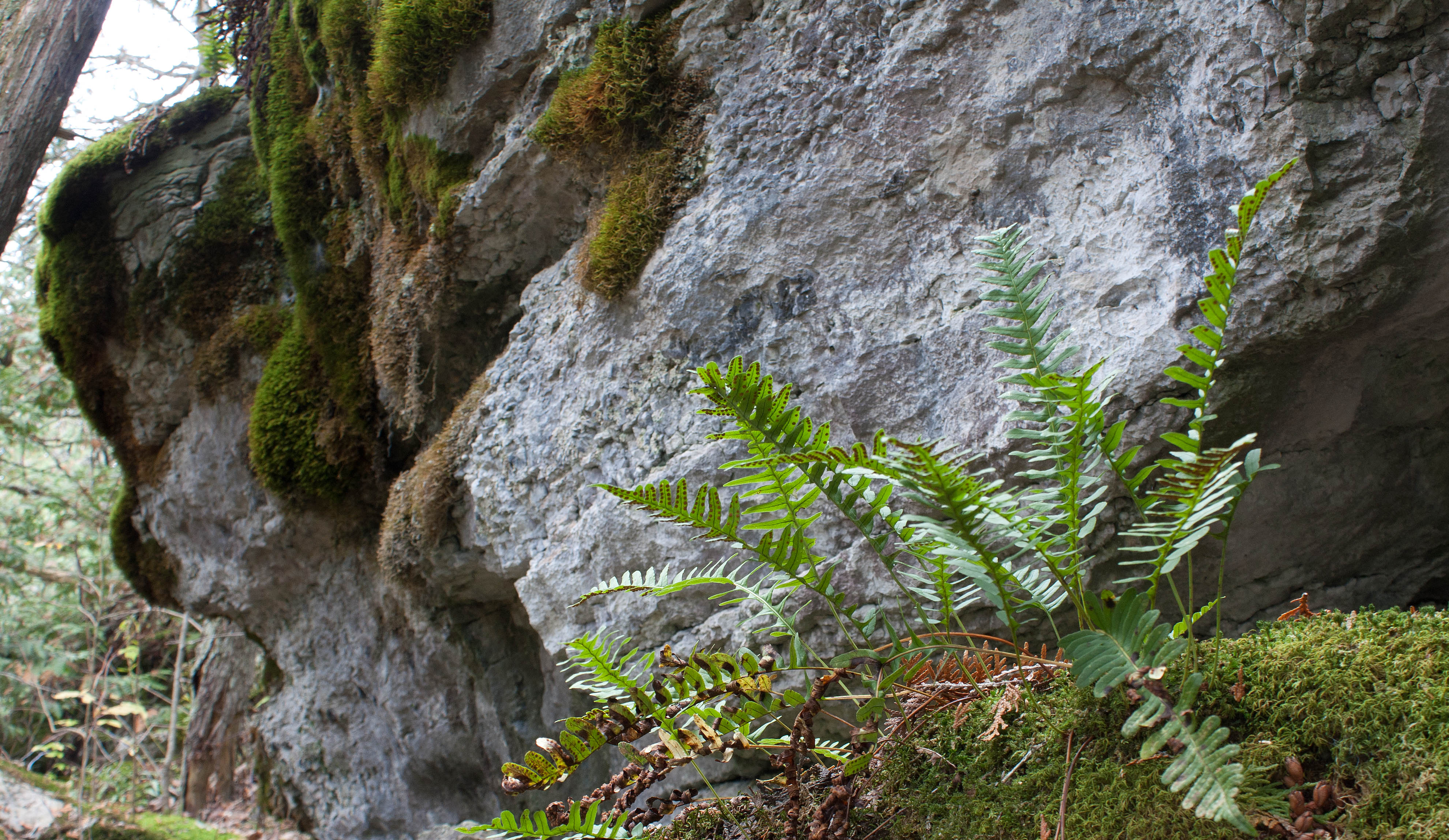
Limestone’s distinctive crystal structure allows it to crack and fracture in a distinct pattern. On limestone cliffs you can easily make out the horizontal cracks called ‘bedding planes’ and the vertical cracks called ‘joints.’ These allow water to easily flow through the limestone rock. The slightly acidic river that flowed over the bedrock made its way into and through these cracks, dissolving the limestone over thousands of years and widening the natural cracks and rock fissures in a process called carbonation. Over time a karst topography formed in the porous limestone at Warsaw Caves as water dissolved the limestone through a process called karstification. This created deep fissures and sinkholes, underground caves and streams. The word ‘karst’ comes from the pre-Indo-European language in which ‘kar’ means ‘rock.’ In Slovenia the word ‘kras,’ later Germanised as ‘karst,’ comes from the name of a barren stony limestone area near Trieste, which is still considered the type area for limestone karst.
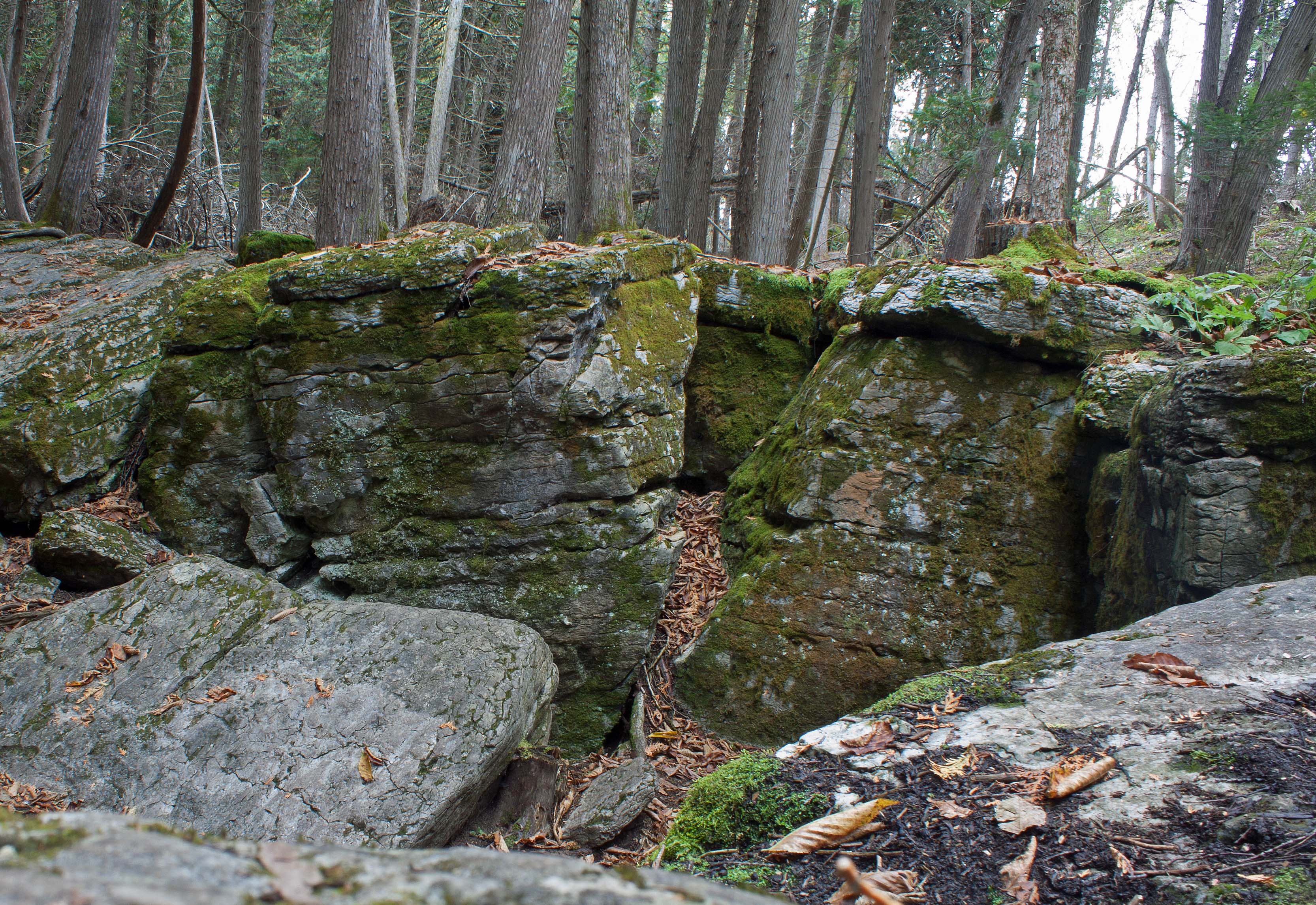
As the glaciers retreated, the bedrock rose in an isostatic rebound. The shifting bedrock and continued erosion collapsed the underground river channels, leaving behind the current series of caves and broken limestone. A walk through this area reveals huge slabs of broken and collapsed limestone, piled in odd formations and all covered in moss and hemlock and cedar trees with adventurous roots that extend over them.


Nina Munteanu is a Canadian ecologist / limnologist and novelist. She is co-editor of Europa SF and currently teaches writing courses at George Brown College and the University of Toronto. Visit www.ninamunteanu.ca for the latest on her books. Nina’s bilingual “La natura dell’acqua / The Way of Water” was published by Mincione Edizioni in Rome. Her non-fiction book “Water Is…” by Pixl Press (Vancouver) was selected by Margaret Atwood in the New York Times ‘Year in Reading’ and was chosen as the 2017 Summer Read by Water Canada. Her novel “A Diary in the Age of Water” was released by Inanna Publications (Toronto) in June 2020.
 The Meaning of Water