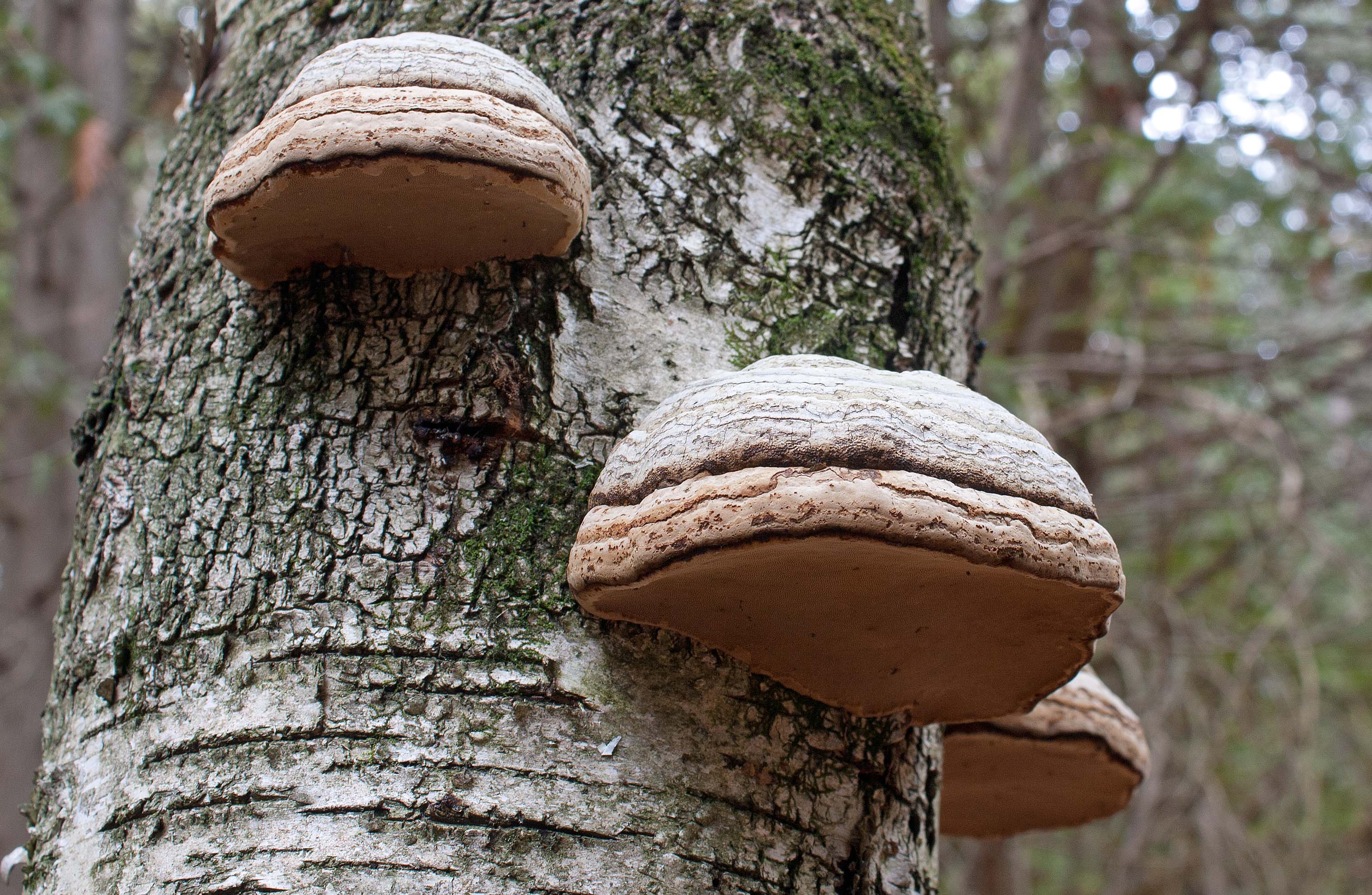
During a recent walk up the Lookout Trail of Warsaw Caves Park in the Kawarthas, I spotted a white birch tree (Betula papyrifera) covered in many attached bracket fungi; they were fist-size, tough and hoof-shaped with brown to tan concentric banding. Like strings of pearls, the fungi formed rings up and down the trunk. The undersides of the bracket fungi were light brown with pores. I’d already seen several standing and fallen birch trees infected with these fungi in the Trent Nature Sanctuary and Jackson Creek park, Ontario.
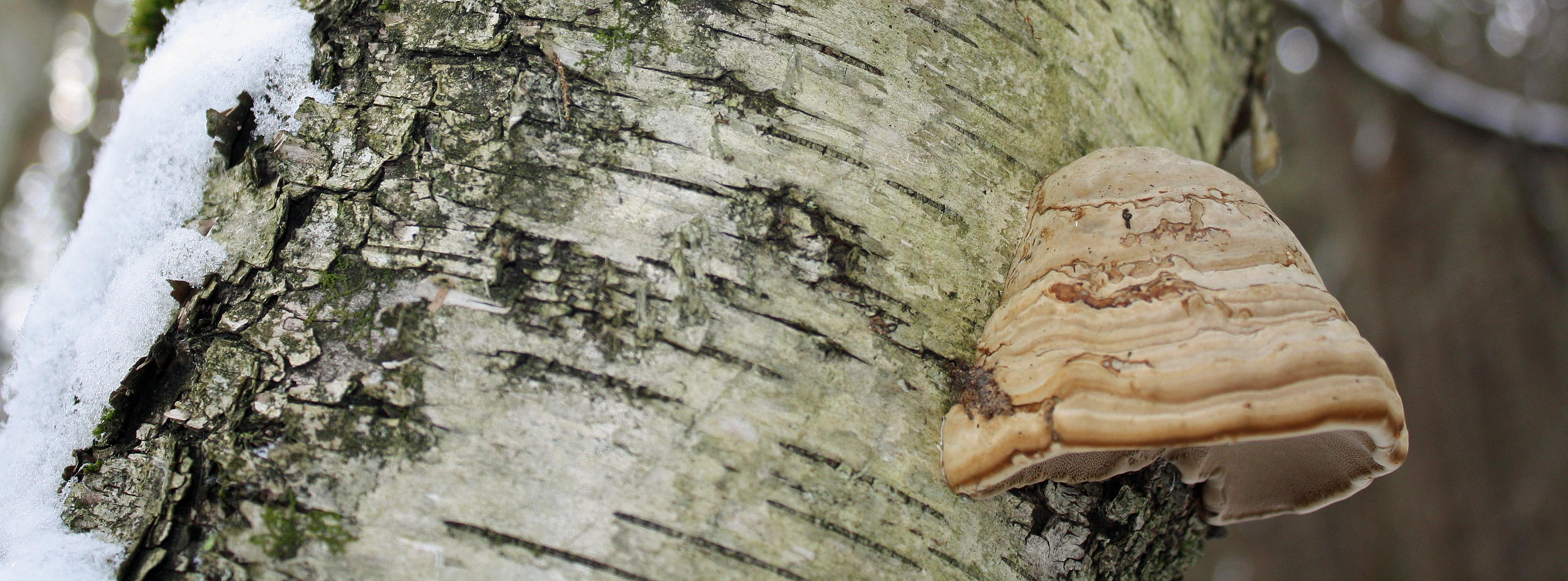
I later confirmed that the fungus was Fomes fomentarius, also known as tinder polypore or hoof fungus, which infects birch trees and other trees. A birch log, also covered in the bracket fungi, lay beside the standing birch tree—foreshadowing what was to come for the still standing living tree…
Treesforlife describe tinder polypore as “a heart rot fungus and parasite of trees that are already weakened, for example by injury or drought.” According to FreshCap and PlantwisePlus tinder polypore infects hardwood trees by infiltrating broken bark and feeds off the wood as it grows and causes white rot, which spreads until the wood becomes soft and spongy and eventually the tree dies. At this point, the fungus becomes saprotrophic and helps breakdown the tough cellulose and lignin in the wood.

Tinder polypore occurs mostly on birch trees (Betula spp.) but other hosts include maples (Acer spp., which I’d documented in Trent Nature Sanctuary), poplars (Populus spp.) and alders (Alnus spp.). I’ve also seen this fungus on several fallen beech trees (Fagus grandifolia) in Jackson Creek Park in Peterborough, where it was dark grey to black (when wet) and partially covered in moss. I can see why it is also called tinder hoof; the dark polypore on the dead beech tree looked just like a horse’s hoof.

Distribution and Development of Tinder Polypore
Fomes fomentarius lives throughout much of the temperate and boreal regions of the northern hemisphere. According to Ediblewildfood, F. fomentarius can live up to thirty years under the right conditions. It grows in a fanlike shape and releases its yellowy spores from pores on the underside of the fruiting body instead of gills. Its colour can range from silver-grey to black with a brownish hue underneath. The older the mushroom gets, the darker it becomes. As the fruiting body’s diameter develops in the first three to four years and the fungus continues to add layers, it creates a “hoof” shape with visible concentric ridges.
The blackish polypores I saw on the dead beech tree in Jackson Creek Park were obviously old. The large decaying beech tree had been there for a long time; a handsome young beech tree had grown up beside it, gathering its mother tree’s nutrients.

Paul Kirtley describes the various layers of the mushroom from the top crust-like very hard layer to the bottom layer of pores at the end of spore tubes that deliver spores to the environment. Between these outer layers lies the trama layer, a dense, firm and fibrous ‘fleshy’ layer the colour of cinnamon. The trama layer also contains growth rings.

Medicinal Properties & Other Uses of Tinder Polypore
Its name—which means “tinder” (Fomes) and “used for tinder” (fomentarius)—reflects its practical uses, hence its other names such as tinder polypore, tinder conk, tinder hoof or hoof fungus (due to its shape and close to black colour when mature), and even ice man fungus (because Ötzi the Iceman from 3000 BC carried some Fomes fomentarius in his pouch when his remains were discovered in the Ötzi Alps in 1991). Recent studies have shown that tinder polypore has strong antiviral and anti-bacterial properties—which, perhaps Ötzi knew about. According to Ediblewildfood, “tinder hoof has been recognized throughout the centuries for medicinal uses. It is [used to] boost immunity, enhance blood circulation, regulate blood sugar and lower blood pressure.” In fifth century BC, Hippocrates documented it as a styptic to help staunch bleeding. The Chinese used it to treat throat, stomach and uterine cancer; Indian medicine used it as a diuretic laxative. In the German speaking Alpines of Europe the mushroom is called Wundschwamm (‘wound sponge’).

Given that F. fomentarius has been used since 11,000 BC by prehistoric cultures to carry fire across frigid landscapes, Ötzi was most likely carried the tinder hoof to use the spongy top inner layer as kindling. StoneAgeMan shows a video on how this corky layer is used to start a fire; when lit, it turns into a smoldering mass, which Ötzi could bring with him when he traveled. Reishi and Rose Botanicals tells us that the smoke generated by burning Fomes fomentarius works as an excellent insect repellent.
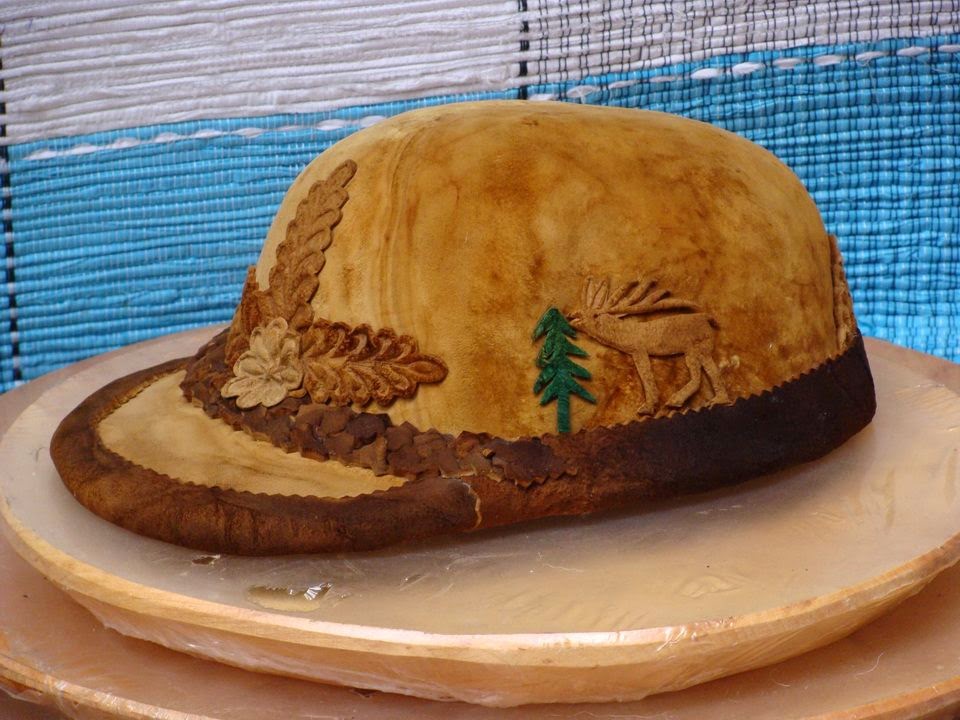
This layer was also used to make Amadou (mushroom felt) hats, leather-looking felt hats showcased by mycologist Paul Stamets and used by shepherds and hunters in Eastern Europe. Hats were typically made by boiling the mushroom and shaping it into a hat, then treating it with oils and waxes to make it waterproof. The craft of Amadou-making was once practiced across the Central and Eastern European mountains, but survives today only in the Transylvanian village of Korund. Romanians call it taplászat, which roughly translates to ‘plastered.’ István Darabán writes more about the village of Korund and its artisans of taplászat.


Ecosystem Services of Tinder Polypore
Tinder fungus forms an important habitat for many invertebrates such as various fungus beetles e.g., Bolitophagus reticulatus), mites (e.g. Boletoglyphus boletophagi), and moths. Treesforlife tell us howtinder polypore contributes to the dynamic and changing nature of forests through its role in the mortality of trees. The death of a tree helps to create gaps in the forest, allowing more light-demanding species of tree and shrub to establish. Standing dead trees (such as the birch snag I saw in Warsaw Cave park) provide nesting sites for various species of birds and contribute an important food source for many species of dead-wood dependent invertebrates that help in the cycle to renew forest nutrients back to the living forest.
As a saprotrophic species, the tinder polypore, according to Treesforlife, plays an important role in breaking down the cellulose and lignin stored in a tree’s wood, rendering the contained nutrients available to the remaining forest ecosystem. This essential recycling includes the tinder polypore itself, which is decomposed by other fungi (e.g. Amblyosporium botrytis) and cobweb mould (Hypomyces rosellus).


Nina Munteanu is a Canadian ecologist / limnologist and novelist. She is co-editor of Europa SF and currently teaches writing courses at George Brown College and the University of Toronto. Visit www.ninamunteanu.ca for the latest on her books. Nina’s bilingual “La natura dell’acqua / The Way of Water” was published by Mincione Edizioni in Rome. Her non-fiction book “Water Is…” by Pixl Press (Vancouver) was selected by Margaret Atwood in the New York Times ‘Year in Reading’ and was chosen as the 2017 Summer Read by Water Canada. Her novel “A Diary in the Age of Water” was released by Inanna Publications (Toronto) in June 2020.


How interesting about the hats. Considering they are from Transylvania, I think I’m going to call these Dracula Hats from now on.
LikeLike
Great name! I think I might too… Thanks! Best, Nina
LikeLike