
Who was on watch and ultimately responsible: DuPont CEO Charles O. Holliday (1998 to 2009); DuPont CEO Ellen Kullman (2009 to 2015); DuPont CEO Ed Breen (2015 to 2019)
In 2000, DuPont releases 31, 250 pounds of C8 into the air (the latest year for which figures are available). In May of that year, 3M phases out its use of C8 and a related chemical. In October of that year, DuPont settles out of court with the Tennants.
In August 2001, attorneys filed a class-action lawsuit on behalf of West Virginia residents exposed to C8. During that year levels of what is considered safe were debated; from the original DuPont “community exposure guideline” for C8 of 1 ppb to 14 ppb to 150 ppb. DuPont influences the West Virginia DEP to release elevated drinking water guidelines at 150 parts per billion–150 times higher than DuPont’s own safety guideline, which had never been made public. One 2001 DuPont email describes a scientist warning that, when airborne, C8 is so hard to deal with that “it might require the public to wear gas masks.” EPA initiates a priority review of C8 (it later determines that 1 ppb of C8 is unsafe for human health). DuPont is caught shredding incriminating documents.

By 2002, C8 was detected 15 miles downriver from the DuPont Washington Works. Under an agreement with the U.S. EPA, DuPont promised to reduce air and water emissions of C8 by at least 50 percent of 1999 levels by the end of 2003. The company also claimed it would install a system to remove up to 95 percent of the C8 in the plant’s wastewater. Using 14 ppb C8 concentration as safe threshold, DuPont was instructed to provide a temporary alternate drinking water supply users of any private drinking water well and Public Water System in West Virginia or Ohio where it exceeded the deemed safe threshold. Other scientists (of unknown allegiance) contested the 14 ppb limit, claiming 150 ppb was safe; this sparked an EPA review to establish a realistic safe exposure level. By December of that year, the Ohio EPA endorsed a ‘safe level for C8’ of 150 ppb in drinking water.
In October 2002, DuPont began manufacturing C8 at a plant in Fayetteville, North Carolina and dumped C8 waste along the Delaware River, claiming that such waste posed no environmental risk.
In 2003, DuPont ignored court orders to make records available and was caught destroying documents relevant to the class action suit against it. Levels of C8 in the blood of people living near the plant could be 1,000 times higher than the general population, according to calculations based on a study DuPont published in 2001. The company claimed that the study was flawed. That same year DuPont tried to block the release of medical records of its employees.
May, 2003, the Environmental Working Group demonstrated that Teflon coated pans emitted toxic particles and chemicals within the normal use on a stovetop. “Our simple test showed DuPont is wrong when they tell customers the pans won’t degrade except under extreme misuse. Actually, the pans started emitting toxic particles and chemicals quite quickly at temperatures within normal use on a typical stovetop,” said Dr. Jennifer Klein, EWG chemist. Later that year, DuPont launched a $20 million ad campaign featuring Teflon products.
In 2003, the effects of bioaccumulation were finally acknowledged by the scientific community and factored into what was considered a safe C8 concentration—knowledge DuPont had known for decades when it originally set its internal level at 1 ppb, which turns out is still too high, given C8’s persistence and bioaccumulation. Long term exposure of only 2 ppb will bioaccumulate over a few years to toxic blood levels of 600 ppb. This is because the body is incapable of removing this forever chemical; C8 simply accumulates over time in the body until it reaches toxic levels.
By this time, DuPont had dispersed almost 2.5 million pounds of harmful C8 from its Washington Works plant into the air and water of the mid-Ohio River Valley area.
In 2004, EPA filed a lawsuit against DuPont, alleging that DuPont concealed evidence that C8 was harmful to human health and had failed to disclose the contamination of public drinking water for more than two decades.
In September 2004, DuPont agreed to settle the class-action suit filed by Bilott. “Under the terms of the settlement, the company wasn’t even obliged to pull C8 from the market… the best the agency could negotiate was a voluntary phase-out by 2015,” the watchdog organization Environmental Working Group says in its May 2015 report “Poisoned Legacy.”
The settlement did trigger an independent health study to help prove that exposure to an unregulated chemical causes health problems. The C8 independent science panel, which took seven years to complete its research, ultimately linked C8 exposure to six diseases: ulcerative colitis; pregnancy-induced hypertension; high cholesterol; thyroid disease; testicular cancer; and kidney cancer. The panel’s findings, published in several peer-reviewed journals, were remarkable because they proved that the chemical pretty much affected the entire body, even at low exposure levels.
The C8 science panel concluded that C8 posed health threats at just 0.05 parts per billion in drinking water for people who drank that water for a single year. They found that the average C8 level in blood samples from the mid-Ohio Valley was 83 parts per billion. The average C8 level for those living closest to the plant – whose drinking water came from Ohio’s Little Hocking water district – was more than 224 parts per billion compared to 4 parts per billion for average Americans (itself over what is considered safe).
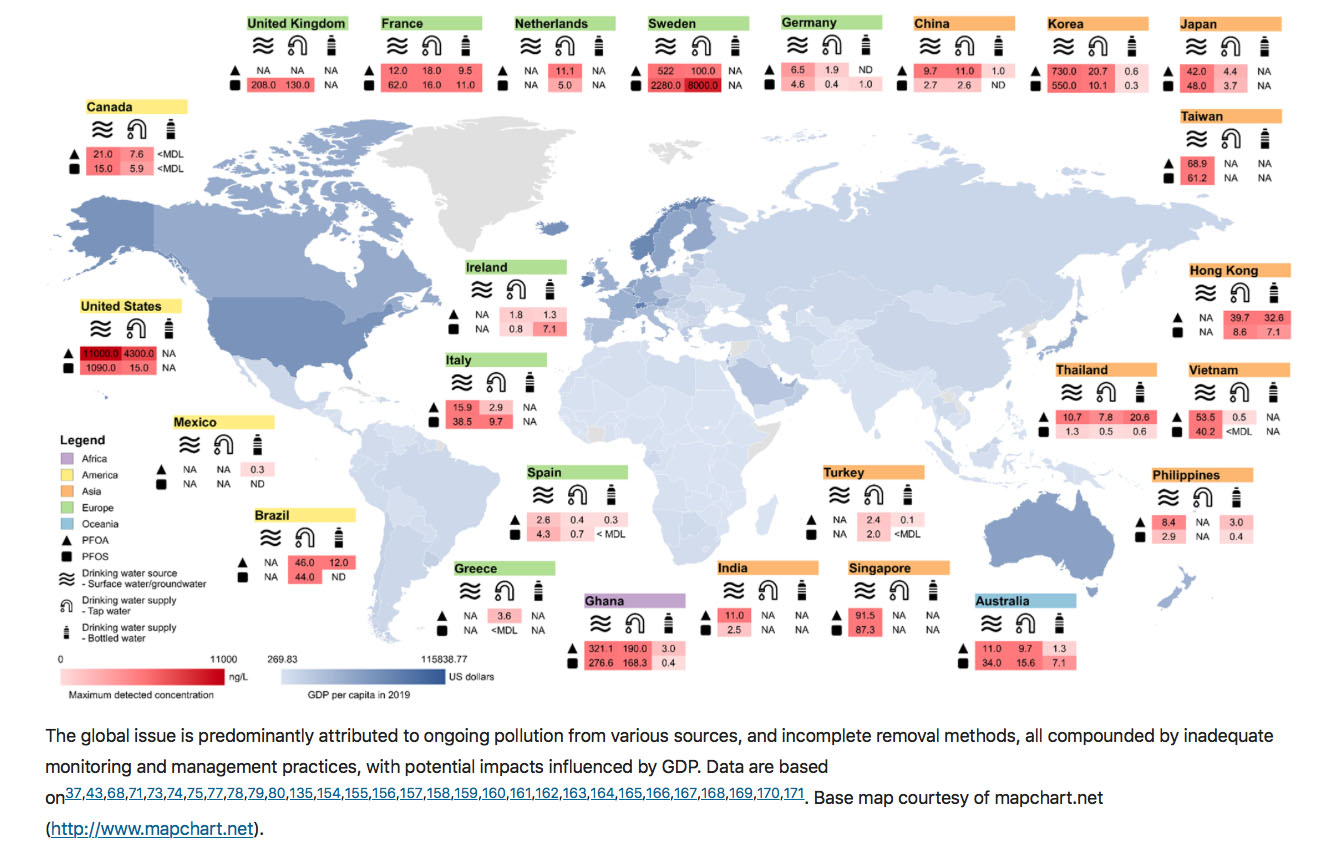
As of March 2022, the EPA’s health advisory for exposure to PFOA and PFOS in drinking water is 70 parts per trillion (recall the previous level of 2 ppb considered safe earlier followed by levels of 0.05 ppb considered by the C8 science panel to pose a health hazard; levels found in people in Parkersburg and area ranged from 80-200 parts per billion; the national average is said to be 4 parts per billion–way over what is deemed safe by scientists). EPA’s health advisories are non-enforceable and non-regulatory; they only provide technical information to states agencies and other public health officials on health effects, analytical methodologies, and treatment technologies associated with drinking water contamination.

These are the faces of the DuPont men and women who sanctioned–encouraged–the willful harm of other life to make a profit. Despite knowing the danger posed by exposure to PFOAs of people, these DuPont CEOs chose to: 1) continue to poison the environment and people, 2) cover up their actions from authorities, and 3) fight the courts and regulators from doing the right thing when they were caught. No one went to jail. No one was fired. They just paid $$$ and shamefully kept going. This is NOT good business. This is NOT being a good person. This is gross disrespect for all life and ultimately heinous criminal behaviour deserving more meaningful prosecution than a simple fine.
References:
Fluoride Action Network Pesticide Project. “Timeline for PFOA and PFOS perfluorinated chemicals compiled by FAN’s Pesticide Project” Draft document.
Blake, Marion, Huff Post “Welcome to Beautiful Parkersburg, West Virginia”
Gaber, Nadia, Lisa Bero, and Tracey J. Woodruff. 2023. “The Devil they Knew: Chemical Documents Analysis of Industry Influence on PFAS Science.” Ann Glob Health 89(1): 37.
Halmeriks, Koen and Irina Surdu. 2020. “Dark Waters: what DuPont scandal can teach companies about doing the right thing.” The Conversation.
Kelly, Sharon. 2016. “DuPont’s deadly deceit: The decades-long cover-up behind he “world’s most slippery material.” Salon.
Lerner, Sharon. 2015. “The Teflon Toxin: DuPont and the Chemistry of Deception.” The Intercept.

Nina Munteanu is a Canadian ecologist / limnologist and novelist. She is co-editor of Europa SF and currently teaches writing courses at George Brown College and the University of Toronto. Visit www.ninamunteanu.ca for the latest on her books. Nina’s bilingual “La natura dell’acqua / The Way of Water” was published by Mincione Edizioni in Rome. Her non-fiction book “Water Is…” by Pixl Press (Vancouver) was selected by Margaret Atwood in the New York Times ‘Year in Reading’ and was chosen as the 2017 Summer Read by Water Canada. Her novel “A Diary in the Age of Water” was released by Inanna Publications (Toronto) in June 2020.
 The Meaning of Water
😱 my word.. the greedy baskets..
LikeLike
Yep … that they are…
LikeLiked by 1 person