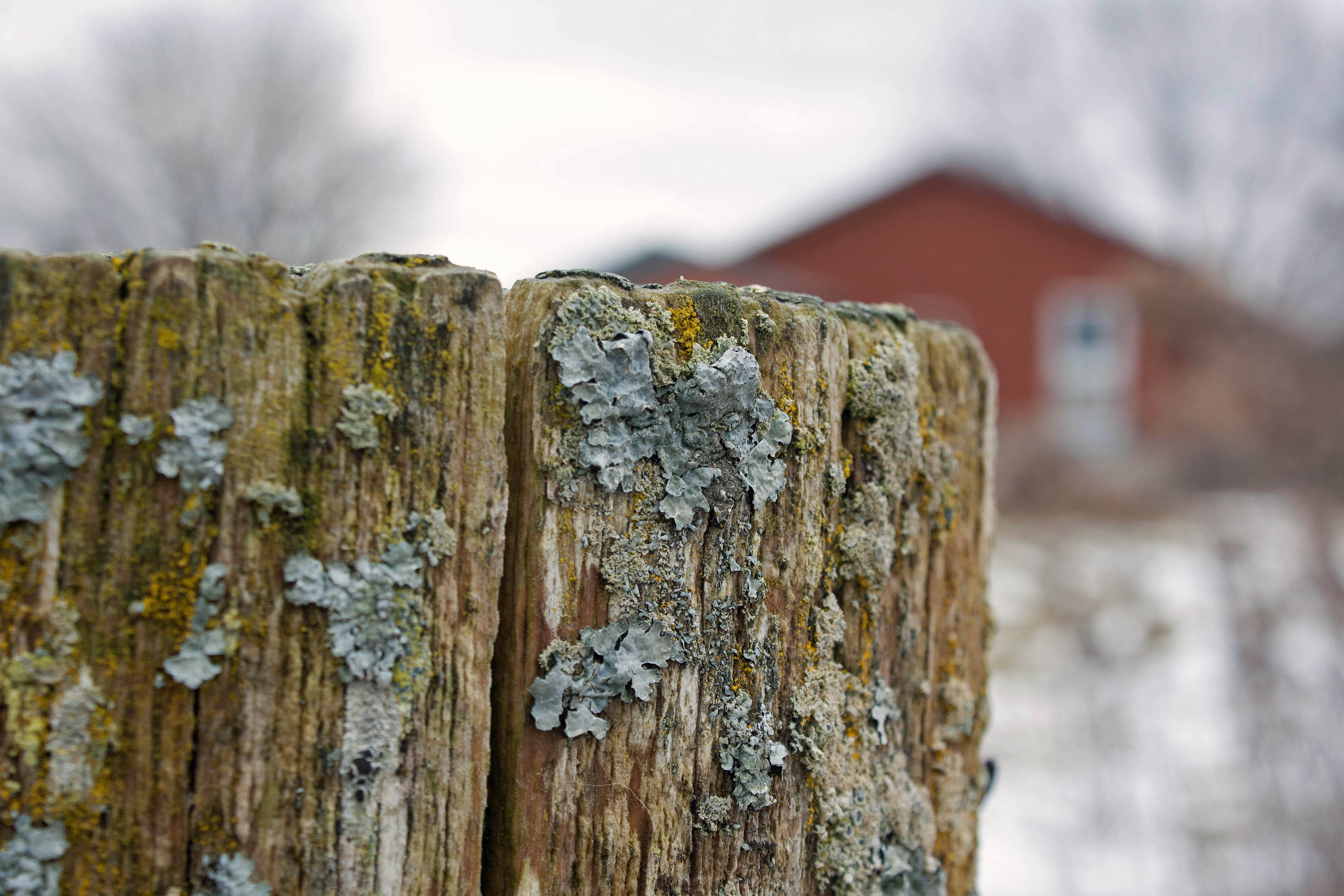
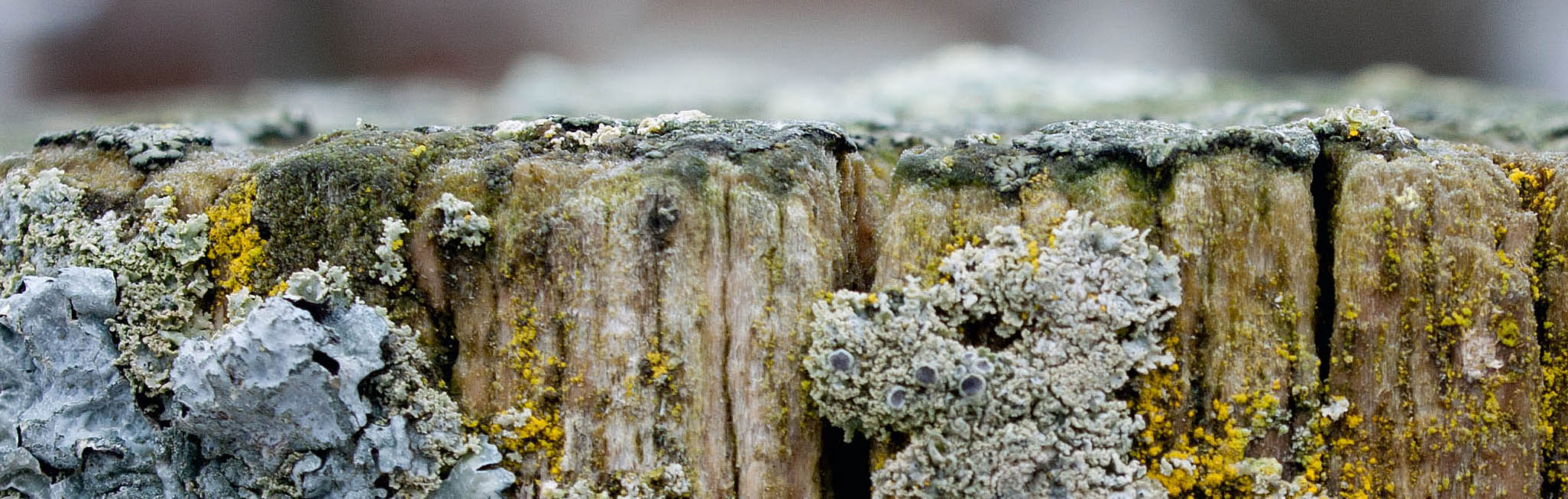
My daily walks in the new neighbourhood I moved to this fall take me through an open meadow—a powerline easement between an old and new suburb—lined with derelict fence posts. I was looking for places where I’d find lichen and, sure enough, one fence post was abundantly dusted with them. This became one of my destinations during my walks. I started photographing the lichen with my new macro lens; I waited for just the right light conditions, then headed out with my camera and tripod. There were days when I visited that fence post several times in a day to catch the right light. The fall and winter are ideal times to look at lichen; during this time of increased moisture from rain and snow they emerge out of dormancy and flourish. This is when they photosynthesize and grow, many of them becoming more vibrant with the greens, olives, and blue-greens of their photosynthetic partners.
My goal was to identify enough lichen on my fence post to figure out what kind of tree was used for the post. This piece of detective work would be based on the lichens’ preferential habitats. Several initial identifications pointed to generalists, versatile and ubiquitous lichens. I knew I needed to find more rare and picky ones.
My many visits over the fall and winter months enabled me to identify ten lichen species on my fence post. They consisted of mostly crustose, foliose, and squamulose lichen (an intermediate between foliose and crustose growth forms). Squamulose lichen have scale-like lobes that attach like tiny shingles and include one or more characteristics of the other two growth forms. I didn’t find any fruticose lichen; however, I did observe a fruticose lichen on a neighbouring fence post—presumably of the same kind of wood (therefore included in my sample): a Common Powderhorn (Cladonia coniocraea) tucked in a small crevice at the top of the post. That brought my sample number to eleven.
Most of the lichens I found are considered early colonizers, and include corticolous lichen (living on bark) and lignicolous lichen (living on bare wood). A few of the more cosmopolitan lichen grow on several habitat surfaces including saxicolous (dwelling on rock).
.
Common Clam Lichen (Hypocenomyce scalaris)

I noticed this attractive gray-blue-green squamulose lichen with tightly clustered lobes forming two large colonies and a few smaller ones on the top of the fence post. Lichenologist R. Troy McMullin notes that apothecia (disk shaped fruiting bodies), which are rare, look bluish due to pruina and have prominent margins. Soredia are also common on the lobe margins and the lower surface is farinose to granular, pale whitish green to yellow-brown.
McMullin writes in his Ontario lichen guidebook “Lichens” that the preferred habitat of the Common Clam Lichen is the charred or non-charred bark and wood of conifers. Lichens of Belgium observe that H. scalaris grows on dry bark of pine, and more rarely on the bark or lignum of birch, spruce, and oak. It also occurs on beech, cherry, pear and very rarely on rock. Consortium of Lichen Herbaria also observe this lichen occurring mainly on the bark and wood, often charred, of conifers. Dorset Nature notes that this lichen prefers acidic bark (typical of conifers), wood, fences and burnt timber. They also note that the photobiont is a chlorococcoid.
.
Mealy Shadow Lichen (Phaeophyscia orbicularis)
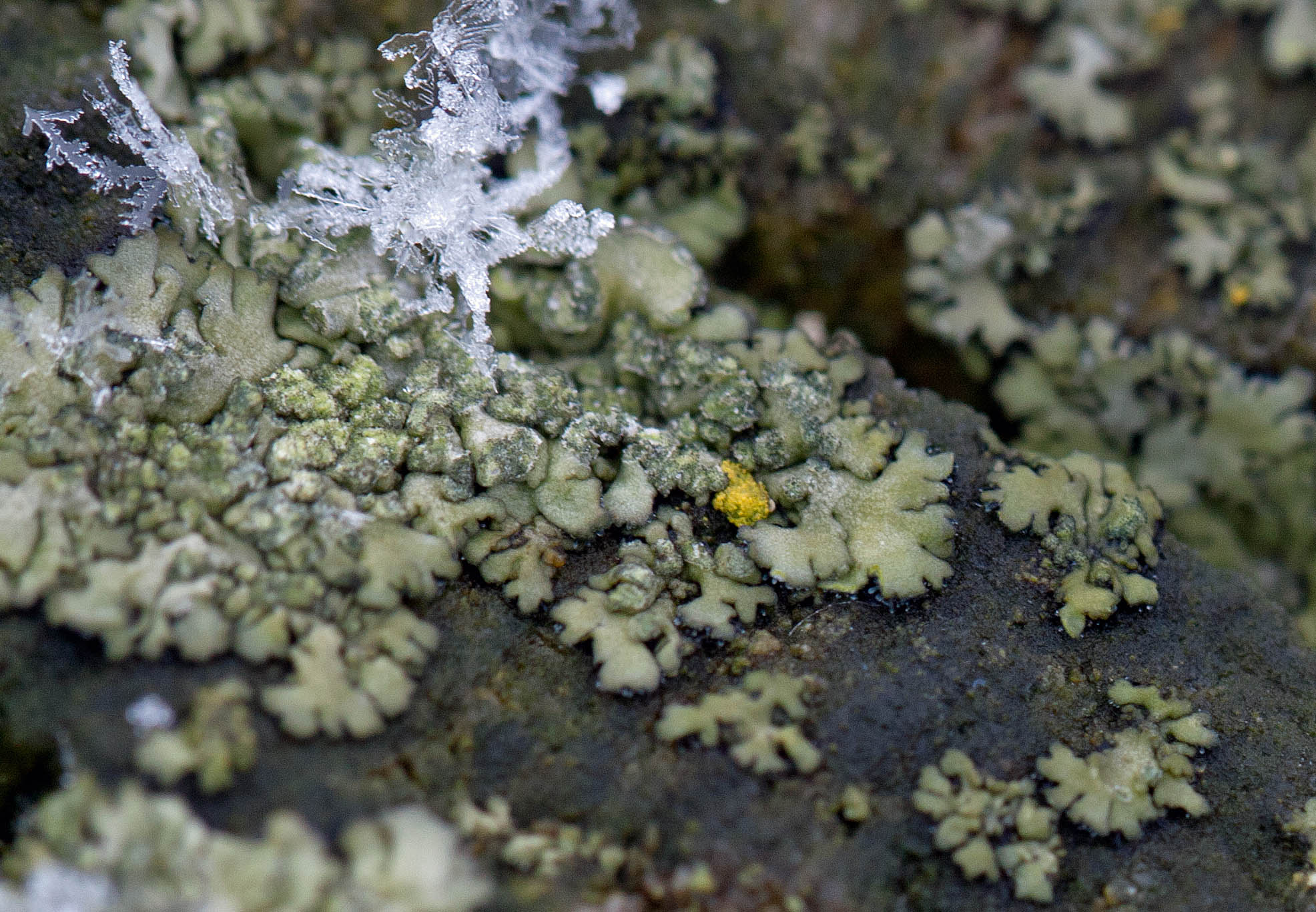
I only later noticed that much of the top of the fence post was dominated by a sprawling squamulose greenish lichen (green to olive-green when wet) that faded to a bluish charcoal grey when dry. This lichen seemed to blend—shadow-like—with the wood. When it was wet, the lichen looked olive green-brown like the wood itself; when it was dry, the crustose part of the lichen was gnarly and charcoal gray, almost black and again blending in with the dry colour of charred wood, with only the leading lobes the colour of dry wood, a non-descript bluish grey—all in great contrast to the lighter blue-grey-green puffy colonies of the clam lichen. The leading edges of the crustose jumble are long divided slightly convex lobes with black undersides and darker edges with dark rhizines, visible at the leading margins (see right lobes in figure below). These extend out from large masses of dense creamy-greenish soralia, often speckled with bright green from the algal partner.
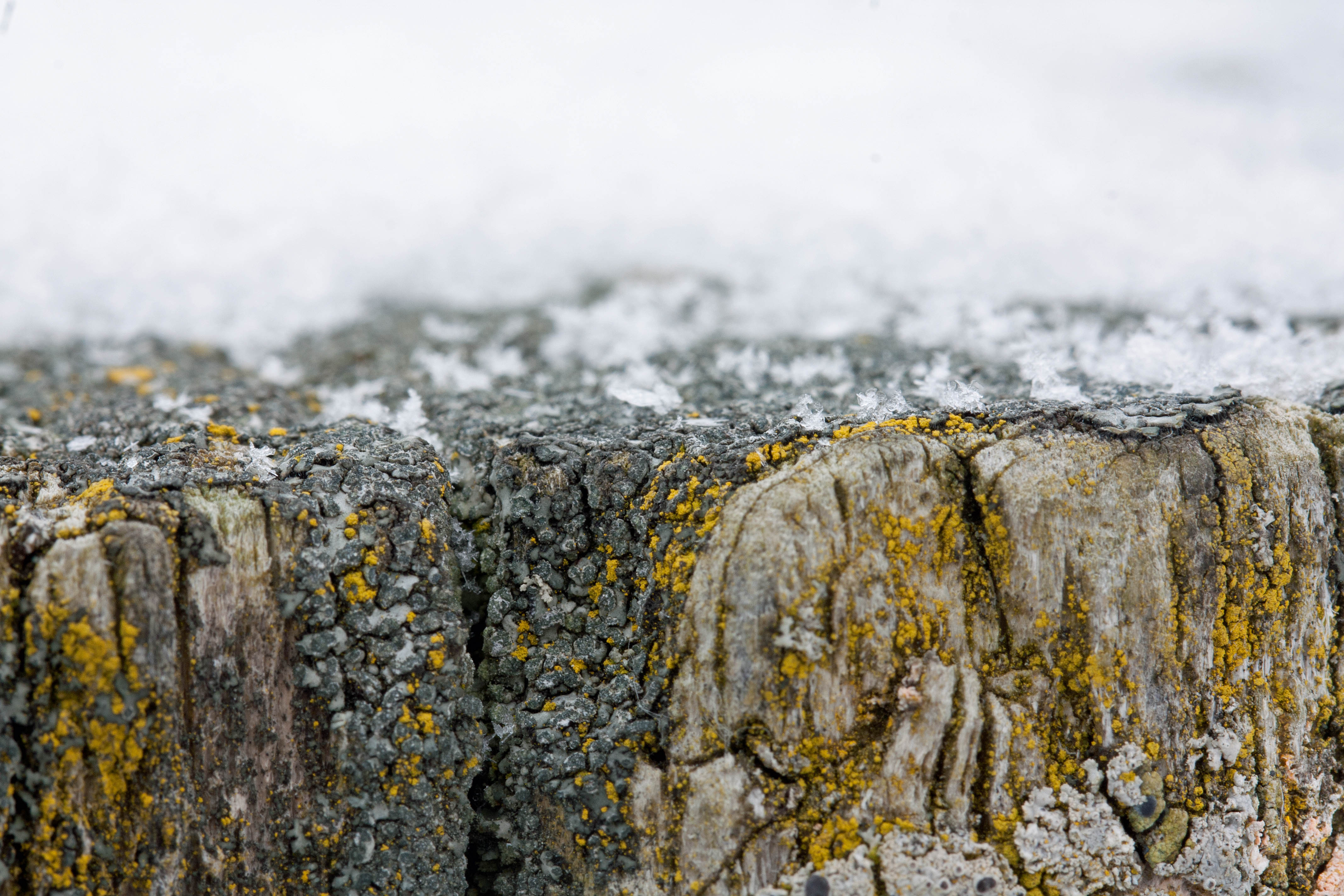
The P. orbicularis mass formed a kind of dark ‘crust’ over the fence top that was discernable from the edges of the post (check out my photos of the edge of the fence post top throughout this article). In one cliff, I observed P. orbicularis cascading down a chasm on the south side of the fence post (photo above). Note the claw-like rhizines on the leading lobes on the ‘cliff’ edge to the right of the image.

Dorset Nature notes that this lichen commonly grows on nutrient-rich bark, twigs, stones and concrete and roads. Lichenologist E. Troy McMullin notes that P. orbicularis grows on a wide variety of trees and is a known suburban and urban dweller.
.
Tiny Button Lichen (Amandinea punctata)

I found this grey crustose lichen with black tiny ‘buttons’ on the west and north sides of the fence post. Its thallus is pale to dark grey with apothecia (fruiting bodies) whose disks become convex, forming tiny dark ‘buttons.’
Consortium of Lichen Herbaria notes that A. punctata grows on bark or wood in dust-rich, often nutrient rich and disturbed habitats. iNaturalist notes that it prefers bark or wood that is acidic and it is known to grow on junipers, pines and oaks. Nature Spot mentions that it is common on fence posts in Britain. This lichen also tolerates air pollution, such as NO2 and SO2.
.
Firedot Lichen (Caloplaca sp.)
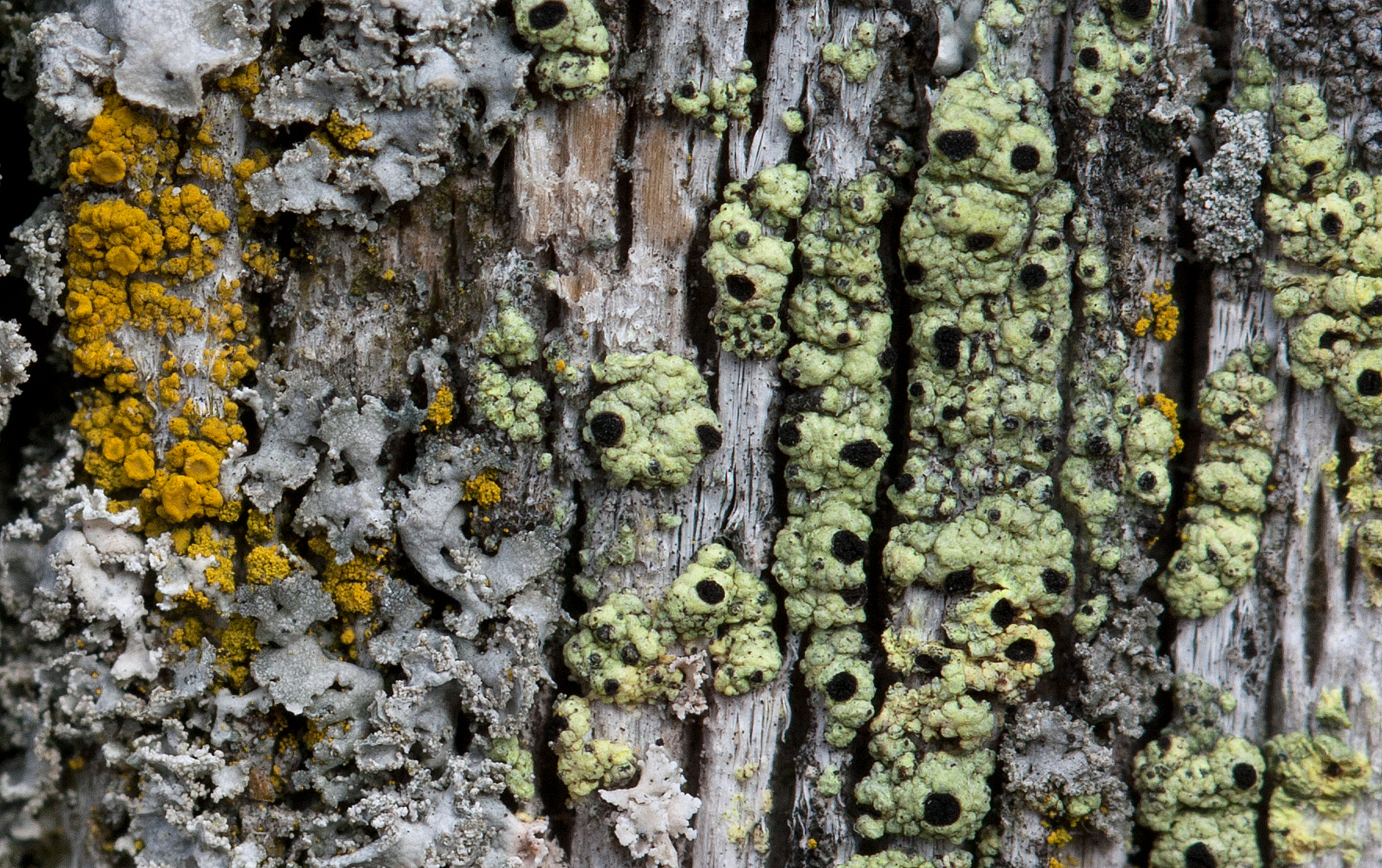
I saw this bright yellow tiny lichen all over the fence post, finding its way between and among the other lichen. Caloplaca is a ubiquitous cosmopolitan genus that grows on a wide range of habitats such as rocks, trees, walls and soils. The orange colour is due to the production of the pigment parietin at the lichen surface, which serves as sun screen among other things.

.
Hooded Sunburst Lichen (Xanthoria fallax)

I found tiny clusters of this rosette-forming yellow-orange foliose lichen on the north side of the fence post. Its lobes are flat to convex and raised where soralia occur. Greenish-yellow soredia are common and occur in crescent-shaped bird’s nest like soralia along the margins between the upper and lower cortices. The lobes of the Xanthoria fallax may also turn green when wet, which I observed on a nearby maple tree; when this happens, the powdered soredia on the edges remain a startling yellow colour, forming lovely contrast with the thallus. Apothecia are occasional and lecanorine with an orange disk darker than the thallus. I didn’t observe any here but did in a nearby maple tree.
Xanthomendoza ulophyllodes is similar to X. fallax in a lot of ways, but instead of soredia it produces blastidia directly from lobe margins, and frequently on the upper surface of the thallus. Sorelia in X. ulophyllodes occur noticeably on the upper surface instead of between the cortices. And the thallus of X. fallax is flatter and more adnate to the substrate.
This sunburst lichen occurs on trees and wood, usually in exposed environments, and is common in parks and urban environments. Ways of Enlichenment reports it colonizing the bark of oak, aspen, pine, and paper birch trees. In Norway, others have reported it growing on various sun-exposed broadleaved trees such as maple, elm, beech, birch, ash, poplar, and basswood.
Nitrogen is a limiting factor for most sunburst lichen that get their needs from the air; next to farmland where fertilizers are applied these orange lichens become more prevalent. Nitrogenous compounds may also drip from tree bark or other lichens during a rain.
.
Mealy Rosette Lichen (Physcia millegrana)

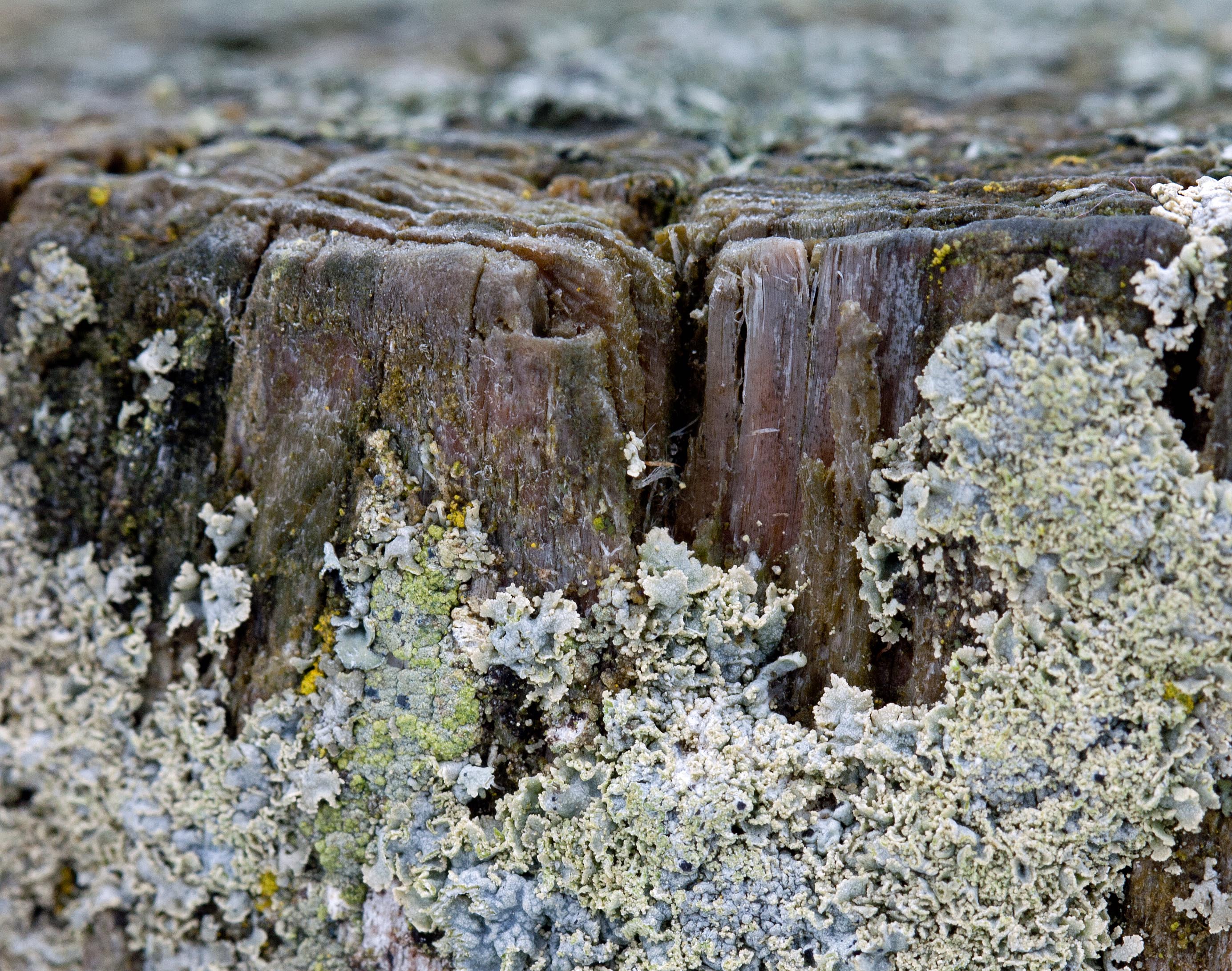
I found patches of this frilly blue-grey lichen often together with Hammered Shield Lichen and Firedot Lichen on all sides of the fence post. Mealy Rosette Lichen is a corticolous foliose lichen with a pale gray thallus, spotted with white maculae. Its lobes are thin, highly dissected with margins thick with granular soredia. Apothecia (sexual reproductive structures) are also frequent, with lecanorine margins and dark brown-bluish pruinose disks. This highly successful lichen uses both sexual (apothecia) and asexual (pycnidia and soredia) reproductive strategies.

P. millegrana is a pioneer species, frequently the first to colonize stems and branches of young woody plants. Its preferred habitat is exposed bark in a forest or human altered habitat. P. millegrana is a very common lichen, often dominating urban settings and described as the most pollution-tolerant macro-lichen in eastern North America. Ways of Enlichenment report finding it on various deciduous trees including the American Sycamore, and even exposed rock.

.
Hammered Shield Lichen (Parmelia sulcata)
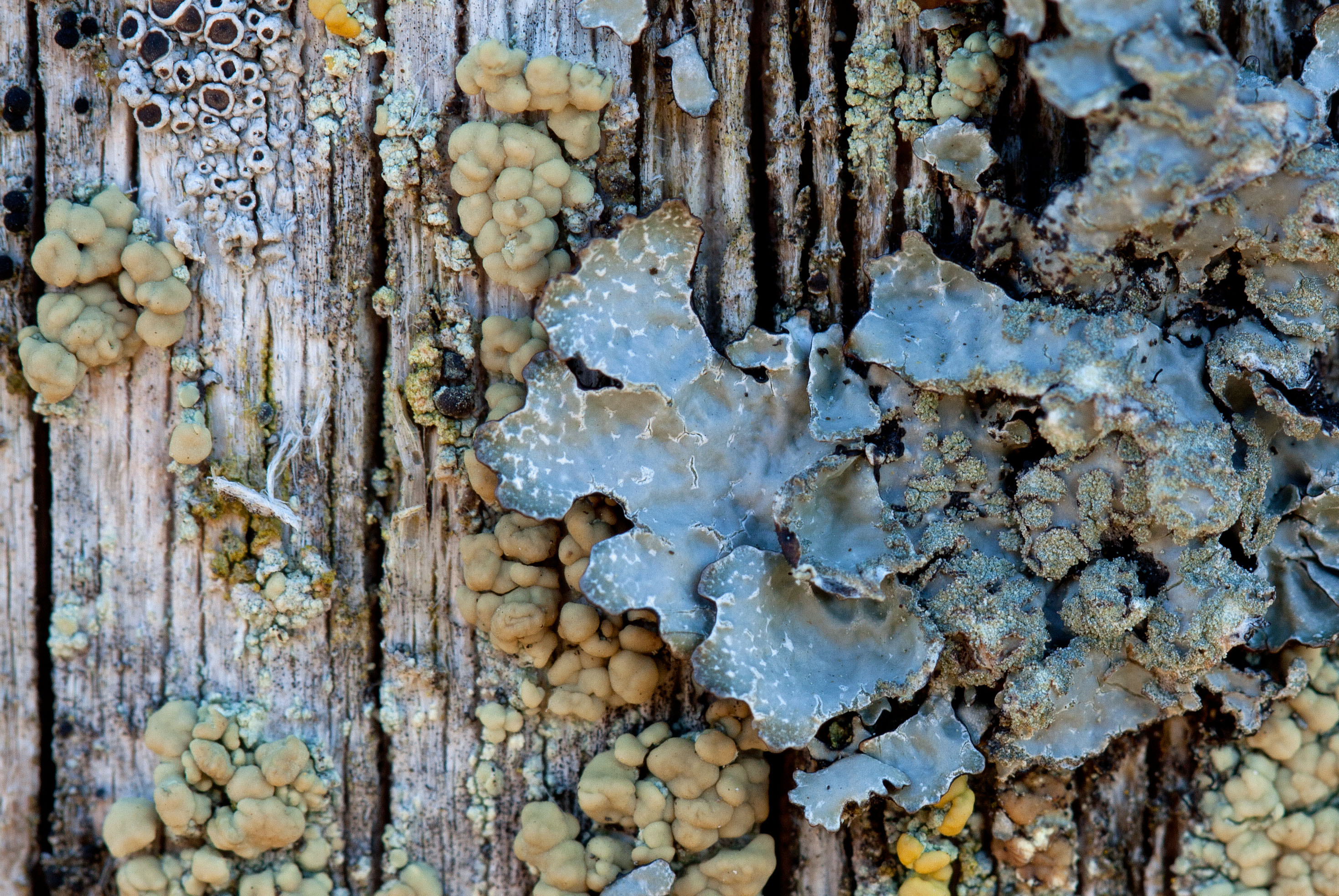
I found this foliose rosette-forming lichen eagerly colonizing all sides of the fence post. Parmelia sulcata is silvery grey-green with dimpled depressions in its lobes that give it a hammered appearance. Soralia (vegetative reproductive structures) occur laminally and marginally. Its photobiont partner is Trebouxia, whose green pigments show through when the lichen is moist.

Hammered Shield Lichen is a widespread and common lichen sensitive to sulphur and nitrous oxides. However, some literature argue that it tolerates acid pollution and fertilizing nitrogen and its ability to accumulate heavy metals and radionuclides, reflecting air quality and contamination levels, has made it a useful bioindicator in pollution studies.
Parmelia sulcata occurs in a wide range of habitats and most commonly on bark and wood of many species of trees and shrubs but occasionally on rocks of open areas. Trees it has been reported on include alder and paper birch in BC, Ponderosa pine in Montana, oak in California, and various fence posts in Ontario.
I had previously seen this foliose pale gray lichen colonizing a white birch in a cedar swamp forest in the Kawarthas. Shield lichen may be the most common lichens in the Kawarthas. They are the first organisms to colonize trees (and even picnic tables!). Ruby-throated hummingbirds are known to camouflage their nests with bits of Parmelia.
.
Soot Lichen (Cyphelium pinicola)
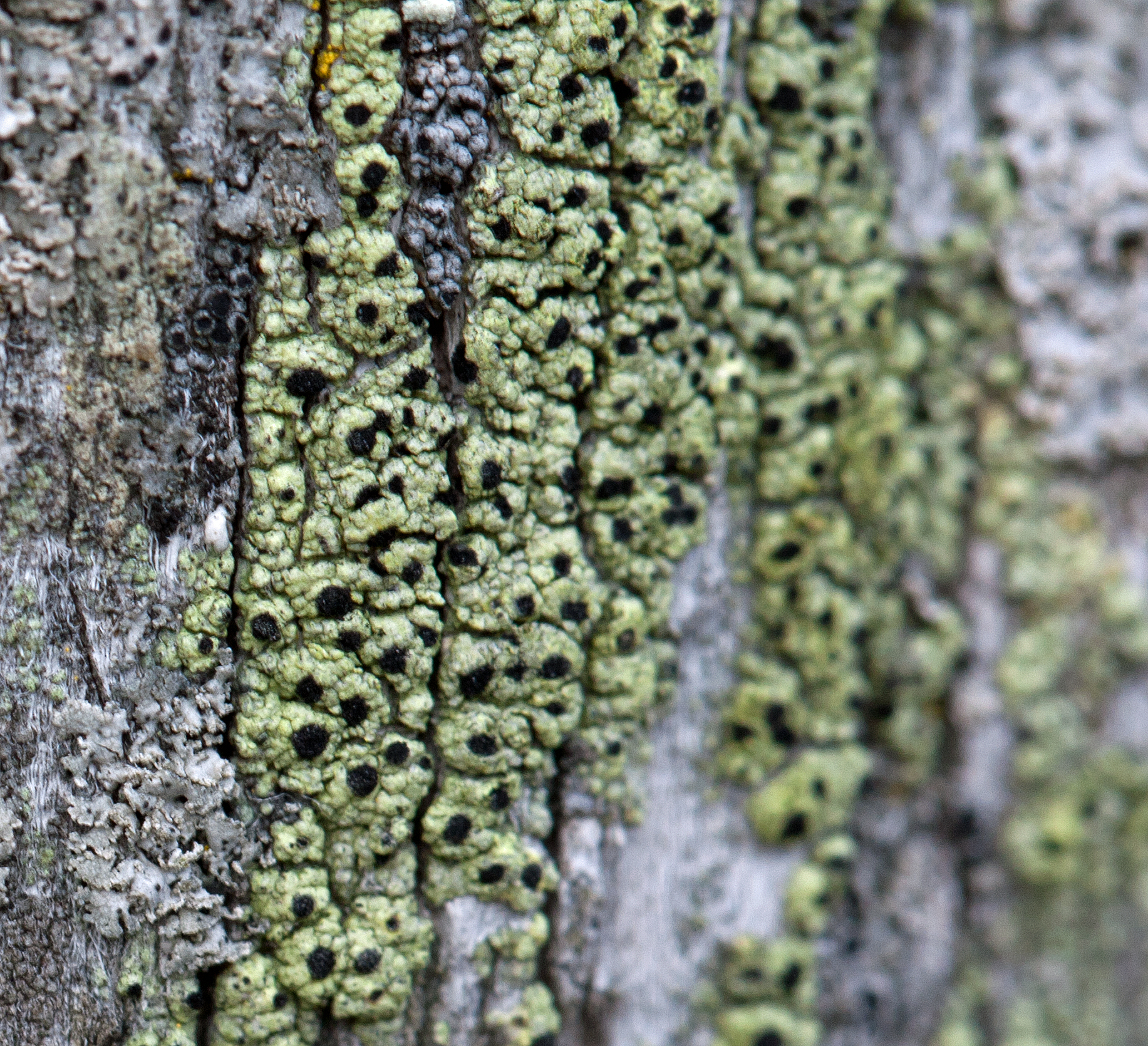
I found this green-yellow warty (verrucose) lichen with startling black spots mostly on the south and east sides of the fence post, forming rough vertical rows. The black ‘soot-like’ spots embedded in the green ‘warts’ are the apothecia (fruiting bodies) of these crustose lichens.
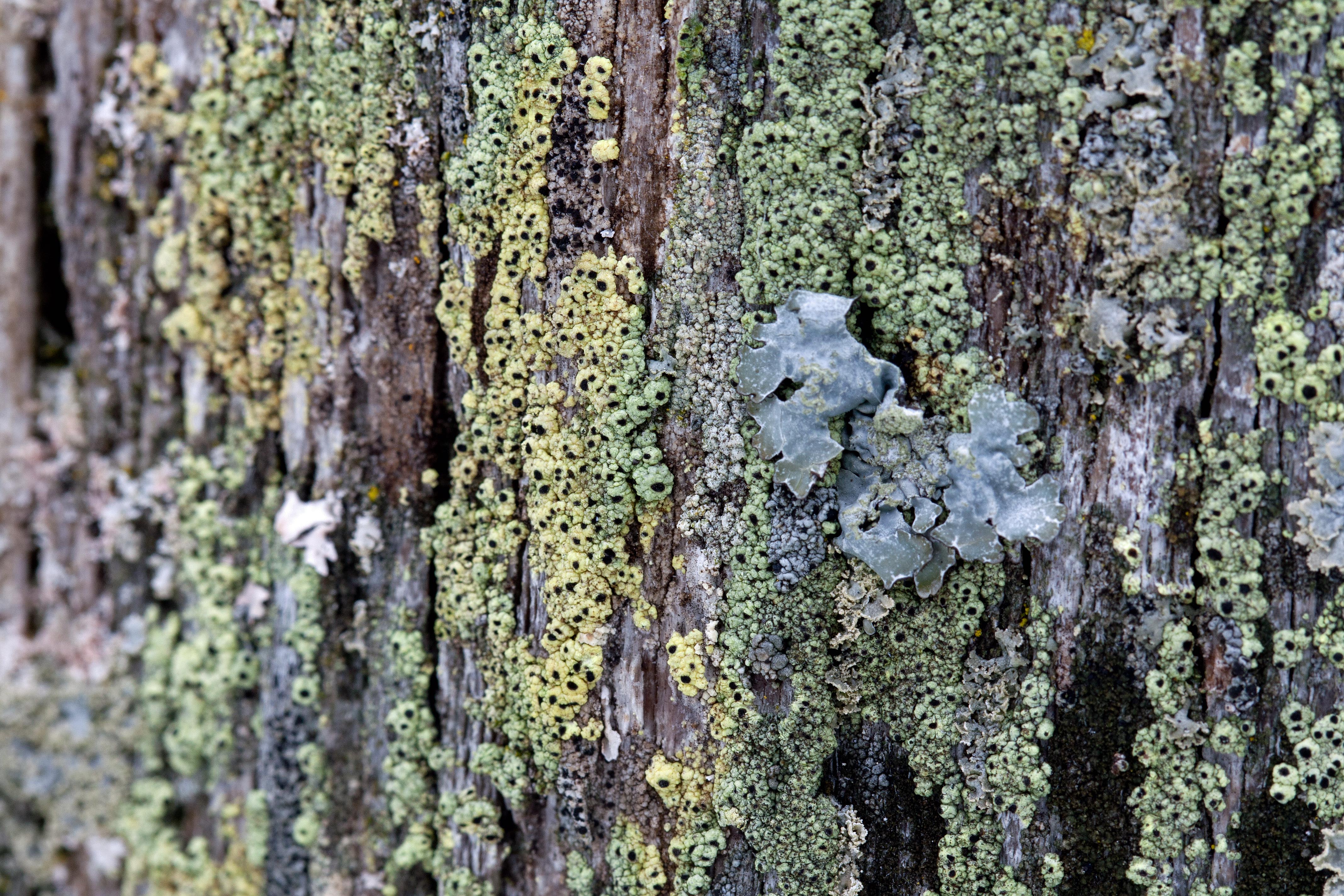
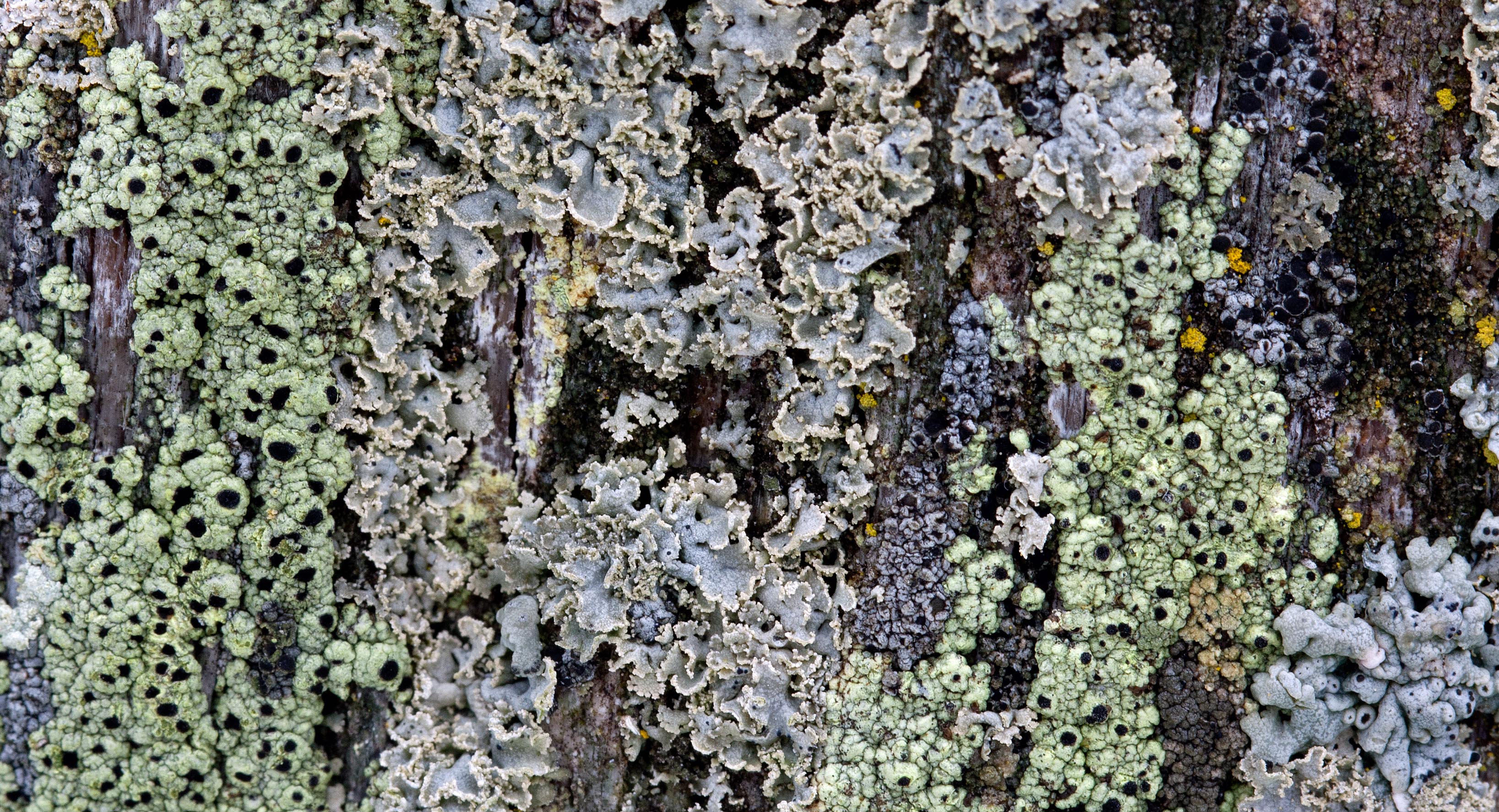
C. pinicola is a lignicolous lichen, widely distributed throughout Canada, and is known to prefer decorticated wood of Scots Pine (Pinus sylvestris), and has been recorded to colonize wood and bark of birch, pine and larch. The Montana Field Guide gives the common name to C. pinicola as Pine Soot Lichen.
.
Brown-Eyed Rim Lichen (Lecanora allophana)

I noticed this crustose lichen only later when I was looking more closely at the lichens inhabiting the top and ‘cliff’ edges of the fence post. Small and sprawling colonies of Brown-Eyed Rim Lichen sprawled alongside the condensed mat of Mealy Shadow Lichen. All I could make out were the large ‘brown eyes’: the apothecia with distinct red-brown disks rimmed by pale grayish epruinose margins. Not surprisingly, this lichen is known to reproduce mainly sexually (through spore dispersal in its apothecia).
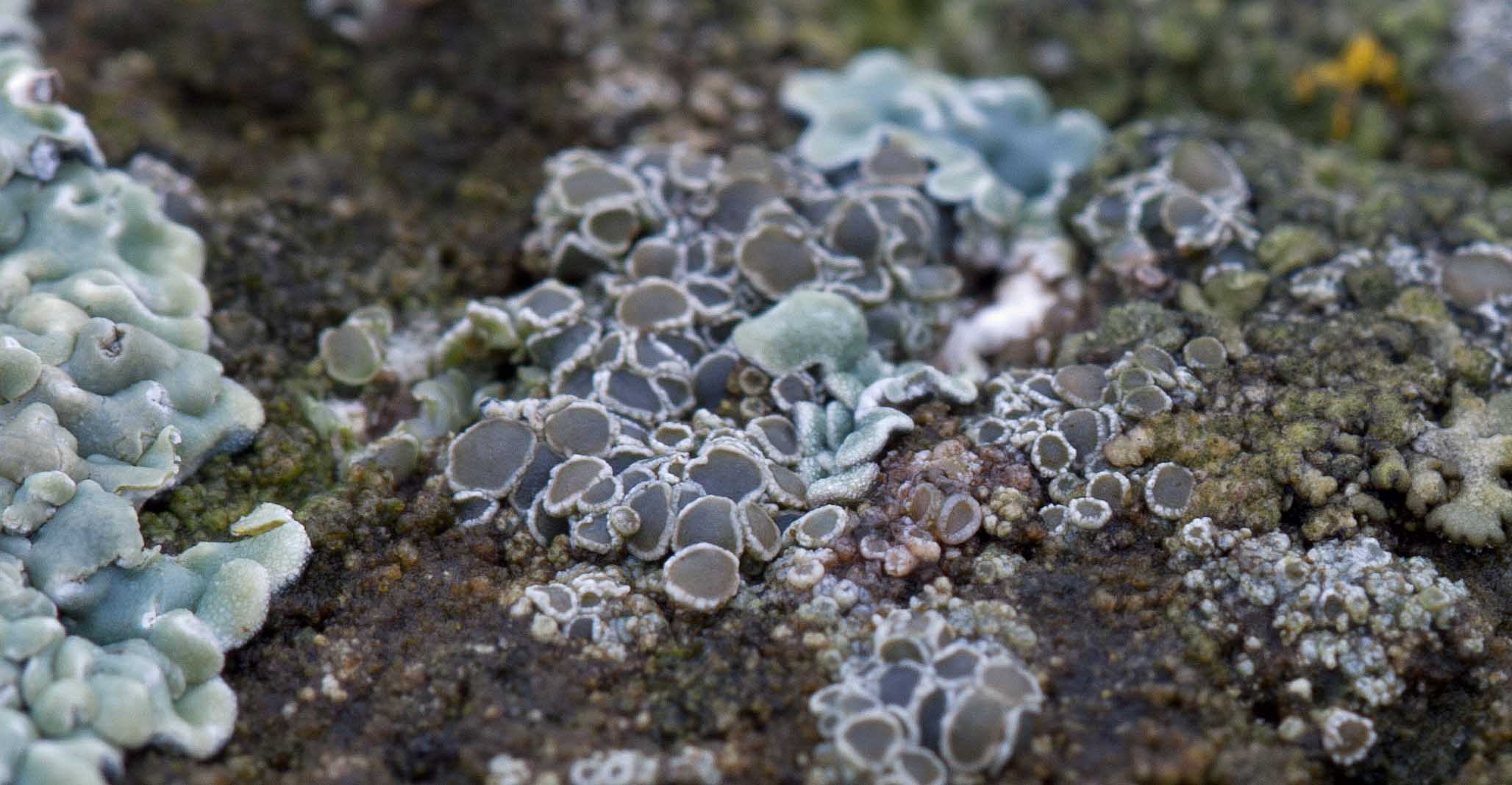
The Consortium of Lichen Herbaria notes that this temperate region lichen colonizes the bark and wood of both deciduous and coniferous trees. Ways of Enlichenment records it colonizing the trunk of alder and willow in BC, and poplar in Alberta. Italic 8.0 noted that this lichen was found on deciduous trees with base-rich bark, particularly walnut, maple, and ash. Sharnoffphotos recorded it on pine bark in California and trembling aspen bark in Ontario and Alaska.
.
Fused Rim Lichen (Lecanora symmicta)

This was the first lichen I noticed on the fence post. My attention was caught by the large tan, orange, and pale green-coloured blobs embedded in a blue-grey-green powdery aggregate that ran vertically along the wood grain. These growths occurred mostly on the north and west-facing sides of the fence post. This lichen—which shouted its bright colours and blobby shapes—seemed to dominate the fence post, though it was not the most abundant on the fence. It was the first lichen I noticed; and turned out to be the most mysterious, which would be the last lichen I securely identified.
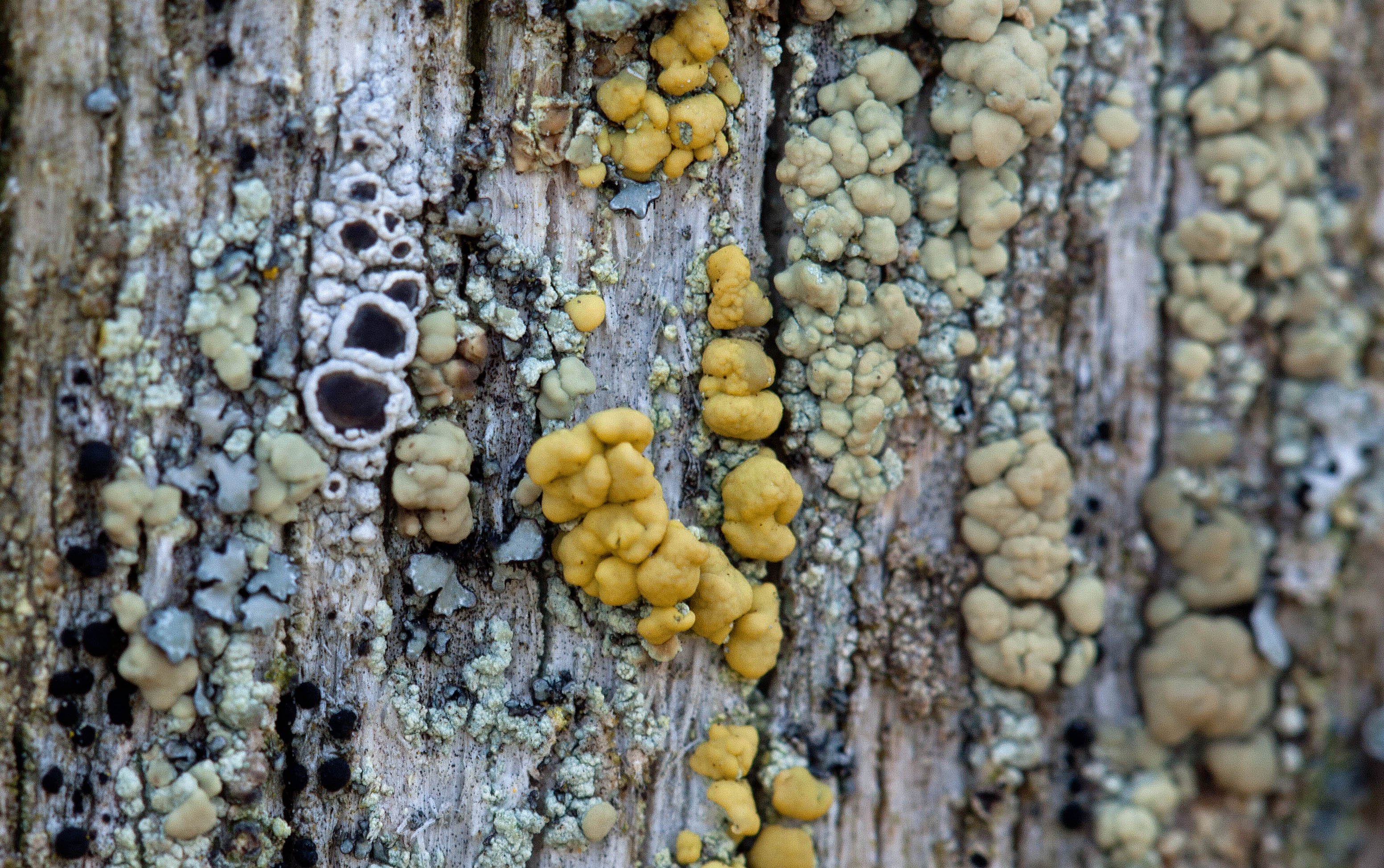
Lecanora symmicta is a corticolous / lignicolous rim lichen (also called Fawn Rim Lichen in NWT). Italic 8.0 describes the thallus of L. symmicta as an undifferentiated simple growth form, a continuous, rimose or wart-areolate leprose lichen with irregular mix of fungal hyphae and scattered photobiont cells. It has roughly circular fruiting disks (apothecia) and rims of photosynthetic tissue similar to the lichen body (thallus). As the clusters of apothecia grow and crowd together, they become distorted and lose their margins entirely. Lecanora symmicta lives throughout Canada and is often found colonizing the smooth acid bark of conifers and shrubs (such as pine and fir), dead trees that have lost their bark, and timber such as fence posts. It has been observed growing on conifer snags (including Douglas fir and pine) and branches. Brickfieldspark observed L. symmicta growing on bark of birch trees. Enlichenment also reported observing it on a fence post in British Columbia.
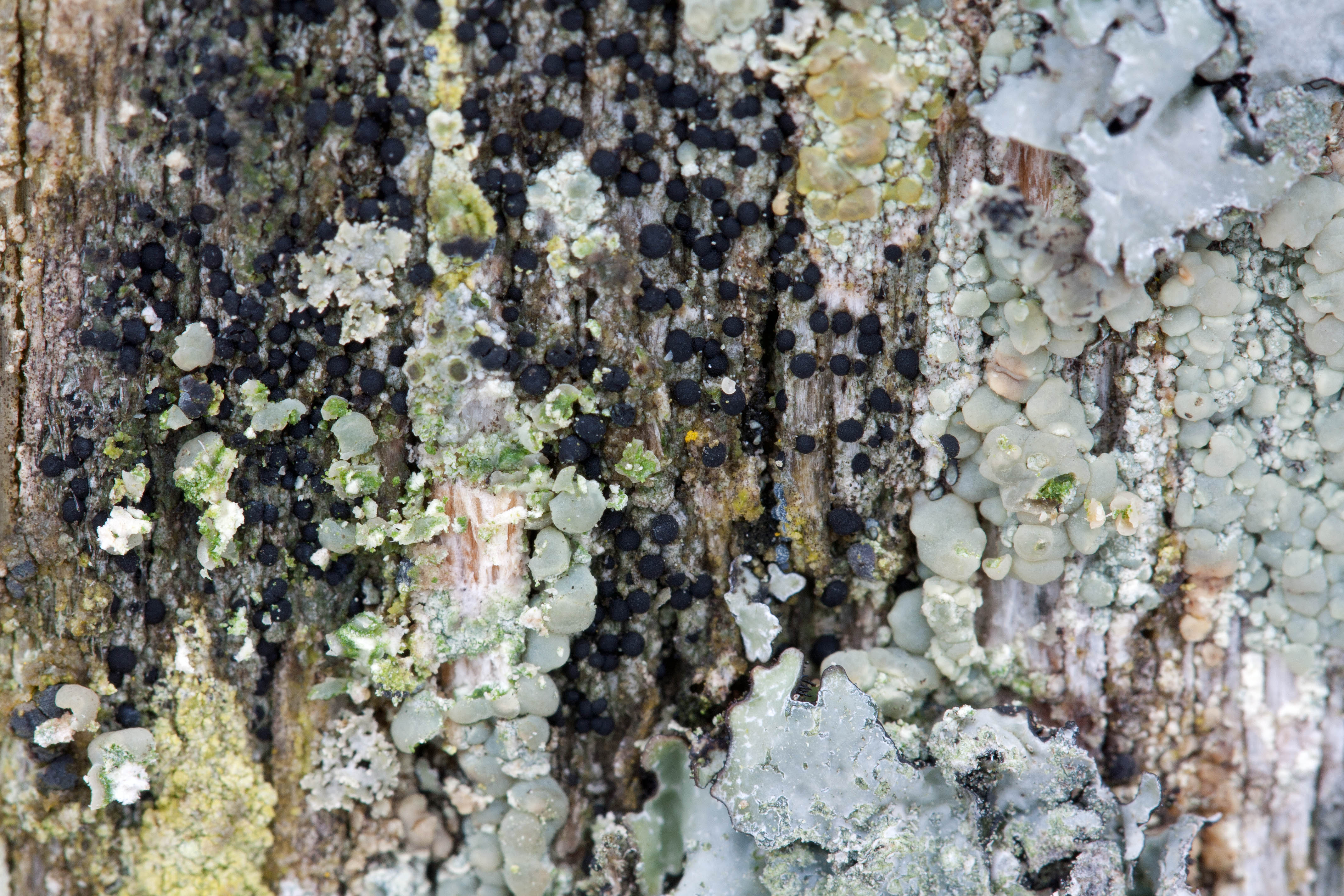
Its algal component is the chlorococcoid green alga Pseudotrebouxia, which shows bright green along with the granular ‘spaghetti-like’ epihymenium and hymenium layers revealed when the epithecium (‘skin’ of the apothecium) broke open to release spores in the moisture of November and December.
In my attempt to identify this strange blobby beast, I went through several other species of Lecanora before settling on L. symmicta. These turned out to be the same ones that according to Lichens Maritimes are confusingly similar to L. symmicta. Lecanora confusa is very similar but the margins of its apothecia usually persist and it is apparently not found in Ontario. I originally thought it was Lecanora polytropa, which is very similar but is rarely found on timber. I then looked at Lecanora varia that shares the same habitat but has different apothecia. L. symmicta also resembles L. strobilina; however, LaGreca and Lumbsch report that the apothecia of the latter are not variable like L. symmicta; apothecia of L. symmicta also tend to crowd and fuse together; while this is never the case for L. strobilina. All to say that I’m pretty confident that the specimen on my fence post is L. symmicta.
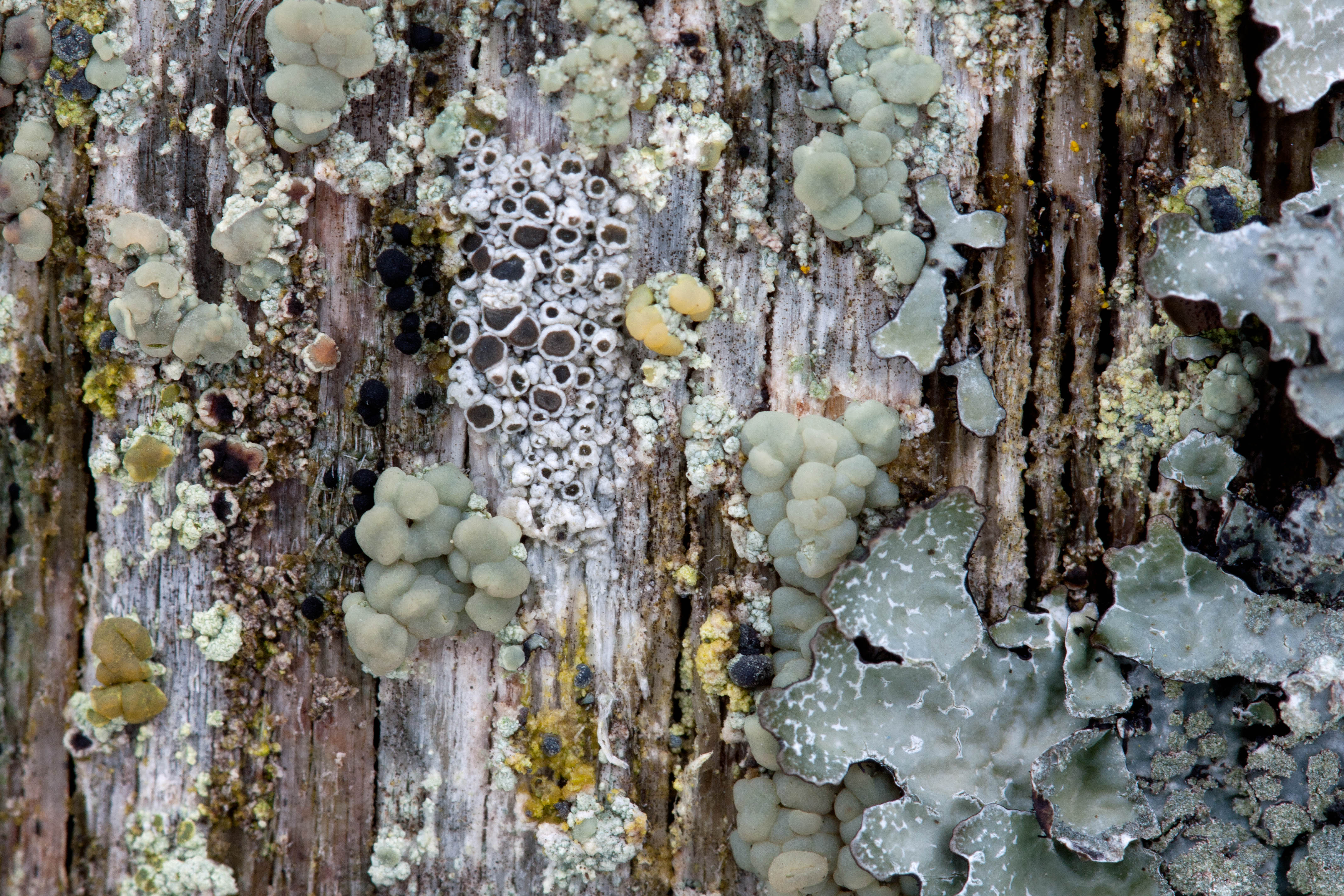
Lichenologist Joe Walewski notes that more than half of all lichen species worldwide are crustose; distinct apothecial disks make this genus Lecanora recognizable. “Identifying Lecanora to species is another task altogether,” he writes. “There are 171 species of Lecanora in North America. Let’s face it they all look alike.”
Common Powderhorn Lichen (Cladonia coniocraea)
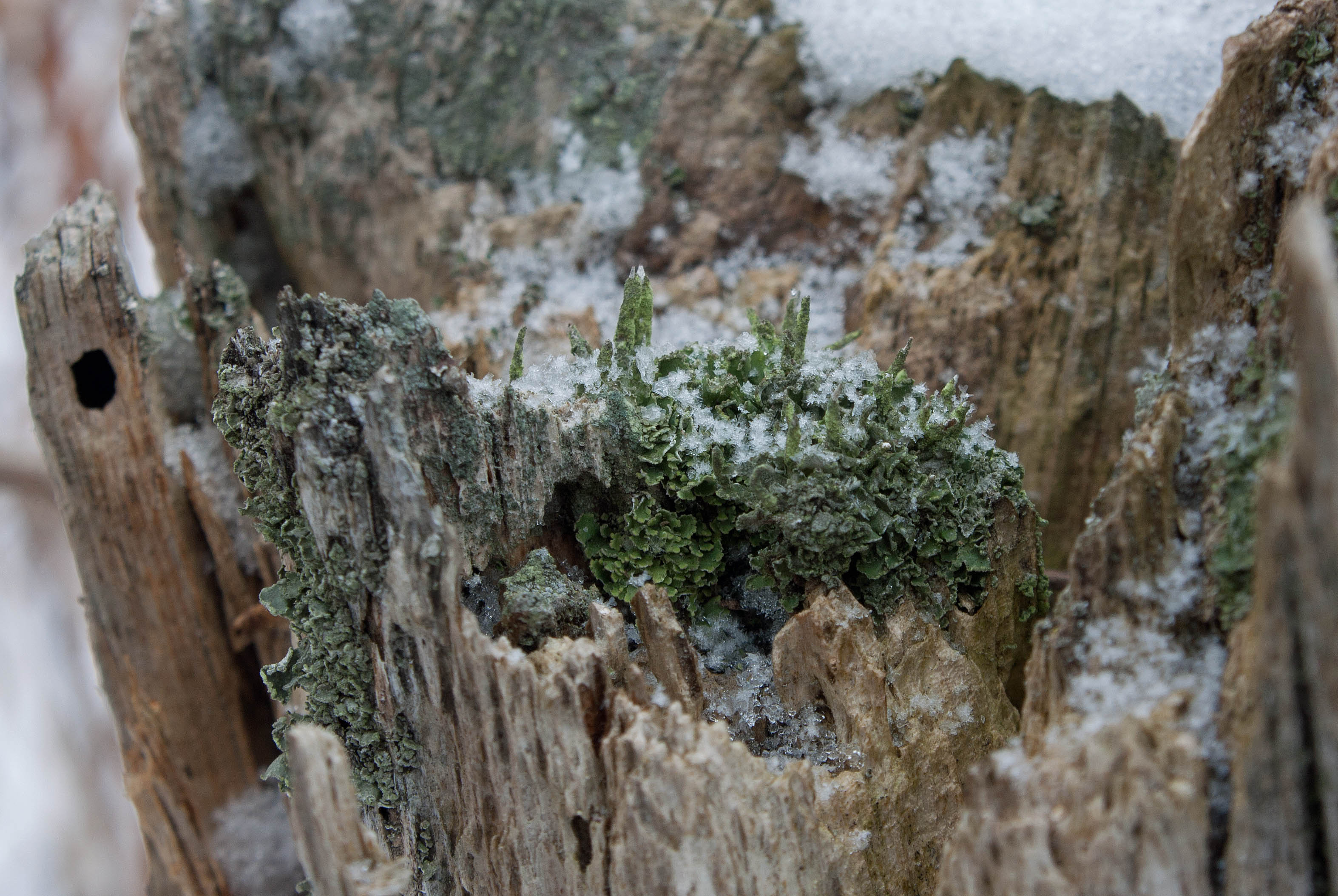
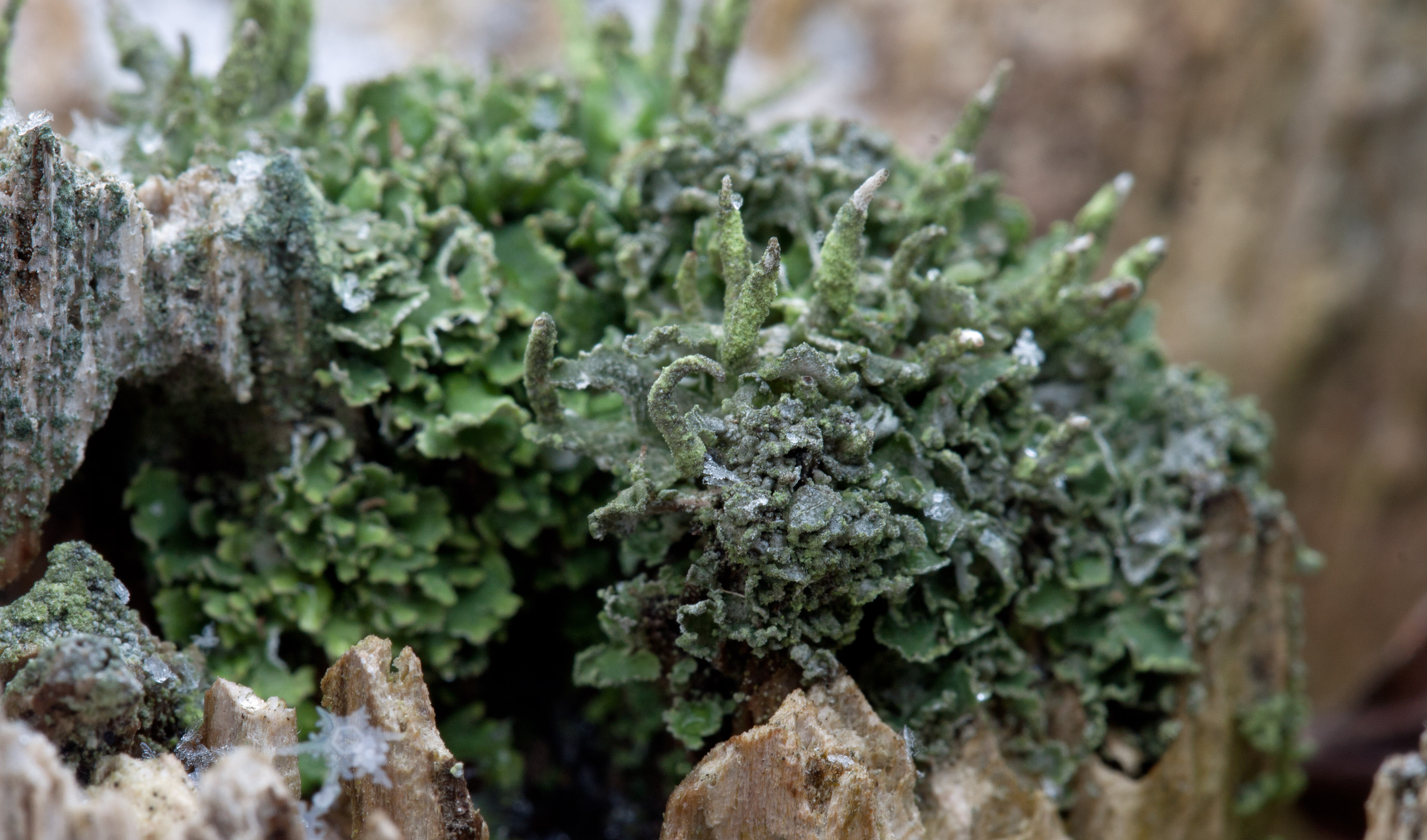
I found a patch of this fruticose lichen nestled in a small crevice at the top of a neighbouring fence post—presumably made of the same wood. The lichen’s tapering, often bent podetia (horn-like stalks that may hold spore-bearing cups or apothecia) rose out of a bed of crinkly green scale-like squamules. Some of the squamules were thick with soredia, particularly on their edges. The podetia were mealy (with soredia) and a wonderful shade of green. I noticed that the top ends of several tapered podetia were whitish or pruinose, likely from a powdery coating of soredia, known to occupy the tips of podetia. The very tops of a few of these tips were brown and these were very likely the rare apothecia noted but not seen by most lichenologists.

.
As its name implies, this lichen is very common, particularly on rotting wood and tree bases. I’ve seen it flourishing on rotting cedar logs as well as other trees and growing on moss on a granite boulder. According to NatureSpot it is pollution resistant and widespread in urban forests that provide some shade. I may have found it on this particular fence, given its location in the shade of a thicket; in contrast, my fence post is totally exposed.
.
Identifying the Wood of My Fence Post
I checked with a Peterborough fence company and they indicated that the preferred wood for fence posts is pressure-treated pine, given its durability, low price and endurance. I thought: bingo! With five of my identified lichens known to colonize or show a preference for conifers, and a few with a particular preference for pine, I’m fairly certain that this fence post has come from a pine tree.
What do you think?


.
References:
Brodo, I. M. 2001. “Lichens of North America”. Yale University Press, New Haven, Conn.
Brodo, I. M. 2016. “Keys to lichens of North America: revised and expanded”. Yale University Press, New Haven, Conn.
Esslinger, T. L. 2021. A cumulative checklist for the lichen-forming, lichenicolous and allied fungi of the continental United States and Canada. Version 24. Opuscula Philolichenum 20: 100-394.
Knudsen, K., and J. Kocourková. 2012. The Annotated Checklist of Lichens, Lichenicolous and Allied Fungi of Channel Islands National Park. Opuscula Philolichenum 11:145-302.
LaGreca, Scott and H. Thorsten Lumbsch. 2013. “Taxanomic investigations of Lecanora strobilina and L. symmicta (Lecanoraceae, Lecanorales) in northeastern North America.” The Bryologist 116(3): 287-295.
McCune, B. (2000). Lichen communities as indicators of forest health. The Bryologist 103(2): 353-356.
McMullin, R. Troy. 2023. “Lichens: The Macrolichens of Ontario and the Great Lakes Region of the United States.” Firefly Books Ltd., Richmond Hill, ON. 607pp.
Perlmutter, G.B. (2010) Bioassessing air pollution effects with epiphytic lichens in Raleigh, North Carolina, U.S.A. The Bryologist 113(1): 39-50.
Walewski, Joe. 2007. “Lichens of the North Woods.” Kollath & Stensaas Publishing, Duluth, MN. 152pp.
.
.

Nina Munteanu is a Canadian ecologist / limnologist and novelist. She is co-editor of Europa SF and currently teaches writing courses at George Brown College and the University of Toronto. Visit www.ninamunteanu.ca for the latest on her books. Nina’s bilingual “La natura dell’acqua / The Way of Water” was published by Mincione Edizioni in Rome. Her non-fiction book “Water Is…” by Pixl Press(Vancouver) was selected by Margaret Atwood in the New York Times ‘Year in Reading’ and was chosen as the 2017 Summer Read by Water Canada. Her novel “A Diary in the Age of Water” was released by Inanna Publications (Toronto) in June 2020.
 The Meaning of Water
A fascinating little study with excellent photos! Gary
LikeLike
Thanks, Gary. It was fun identifying and documenting what grew on the fence post then figuring out what kind of wood it was. 🙂
LikeLike