
.
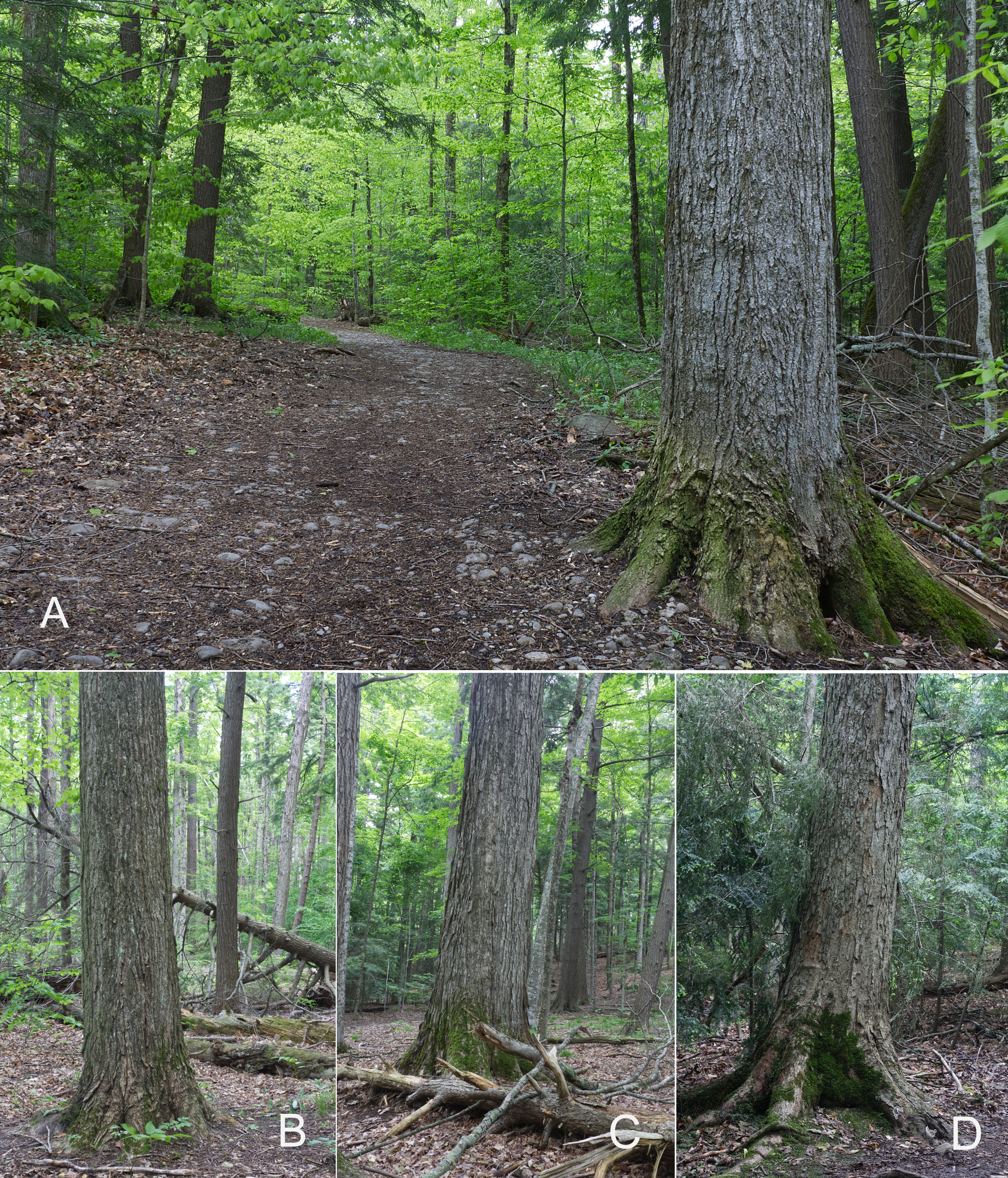
The Mark S. Burnham Provincial Park is one of few remaining and well-preserved mixed old-growth forests in Ontario. The 39-hectare park lies just east of the town of Peterborough off Highway #7 and features 2.5 km of trails on two interconnected loops that meander along and over a drumlin through ancient maple, beech, hemlock and cedar forest. Some of these majestic trees are among the oldest in Ontario, many over 200 years old. For instance, the world’s oldest Sugar Maple (over 330 years) in the province lives here. And it lives in a community of old-growth maples, beeches and hemlocks.
The topography, which features a wetland to the west and a generally north-south running drumlin are the driving ecosystem features of the park.
.

.

I do my usual trail loop by first heading north through lowland forest, on the western side of the park and drumlin; this takes me through a dense forest of tall hemlock, maple, beech and yellow birch. West of the trail, the forest becomes a cedar swamp forest and eventually opens to a wetland. The trail eventually veers east, climbing up through switchbacks and over a drumlin that marks the border of two distinct ecosystems with the eastern portion being a bright mixed deciduous forest of maple-beech and American Hop-hornbeam and ash.
Maple #3, sandwiched between two hemlocks (photo by Nina Munteanu)
.
My focus on this excursion is on the western lowland trail and the switchbacks on the west side of the drumlin which features truly massive super-canopy maples, some over 90 cm dbh wide. It’s as though they’re playing ‘king of the castle’ with the giant hemlocks and cedars—which I suppose they truly are, competing for light.

.
Giant Maples of the Western Lowland and Upland Forest

Like co-conspirators, the trees create their own intrigue. Tall maples, beeches and yellow birches rustle amid the low hush of hemlock in the warm breeze. That same breeze carries with it the musky smell of swamp water and the sweet rot of vegetation. In the distance, a ruffed grouse thumps. Then a hermit thrush offers its tender ode to the forest, a pure song that opens from a singular note into successive waves of pure light.
Sugar maples and hemlocks in Mark S. Burnham Forest, ON (photo by Nina Munteanu)
.
The swamp forest is a remarkably rich and varied ecosystem, supporting a diversity of life: lichen, fungi, slime molds, plants, birds, mammals, reptiles and amphibians. This is old-growth forest*. Many mature maples here have a diameter at breast height (dbh) well over 50 cm, putting them in the large tree category with ages that varies from 72 years to 330 years old**.
.
Life on the Majestic Sugar Maple
The iconic sugar maple represents all the good things about Canada: beautiful (especially in the fall), resilient, tall and quietly assertive, comfortable in its surroundings. It is the tree I used to draw as a child, its generous arms reaching wide to embrace the world.

.
Unlike the stately oak tree that shoots up high and straight, the sugar maple branches early in its growth (especially if out in the open), creating a spreading crown and wide silhouette against the sky. The gnarly opposite branches and furrowed bark give the mature maple lots of character. Young sugar maples have smooth light grey bark like the beech tree. But by three to five years old, the bark darkens and develops a rough texture, divided into long, vertical firm and irregular ridges that may curl outward along one side; the bark is often scaly, often with flaking and peeling ridges.
My walk through the western forest focused on five giant sugar maples, all easily rising over 40 m to scrape the clouds with diameters over 60 dbh and at least 200 years old. These maples were young seedlings in a growing forest well before Peterborough—then a town of less than 2,000—was incorporated, and decades before Darwin wrote his Origin of Species. As the saplings grew about a foot a year, the Industrial Revolution came into full swing, the jingoistic hand of colonialism swept the world and ignited rapacious global trade. Antarctica was sighted for the first time.
Maple #1 stood slightly upslope in a more open area, next to a young stump and surrounded by young beech trees and hemlocks, about 110 m from the fork in the trails. Maple #2, #3, and #4 were located further down in the lowland swamp forest, under the shade of white cedars and eastern hemlocks. Maple #2 was about 76 m down the low trail from Maple #1, well within the denser older hemlock forest. Maple #3 was another 51 m down the trail in a swamp with large hemlocks and yellow birches and #4 another 8 m northeast toward the drumlin trail. Maple #5 stood perched on the steep western slope of the drumlin, among giant hemlocks and surrounded by a few beeches and some American Hop-hornbeam and ash trees.
.
The Sugar Maple Bark Ecosystem

.
The thick trunks of all five maples appeared shaggy with diameters at breast height (dbh) measuring over 50 cm. Their feet were spread-out and snug in green ‘socks’ of various mosses and liverworts. Maple #1 and Maple #5 measured diameters of 56 cm dbh. Maple #2 had a dbh of 64 cm, and Maple #3 had a 76 cm dbh. Maple #4 was the widest tree at 90 cm dbh. Based on cores done by several researchers of sugar maples with similar dbh in this section of the forest, my five maples are easily over 200 years old. Their deeply furrowed greyish-brown bark was covered in splashes of white and frost-green lichen and brilliant green ‘islands’ and ‘skirts’ of moss. The bark on these mature trees often showed the telltale lifting of the bark plates that flaked away, particularly at the bottom.
Maple bark—home for a diversity of corticolous lichens, mosses, liverworts, fungi and slimemolds—has a subneutral pH of 4.9 to 7.5 and contains high amounts of carbohydrates (glucan and xylan), extractives, crude protein, lignin, and ash, as well as vital minerals (e.g. K, Ca, Mg, P, Na, Fe, and Cu) and phenolic glycosides. Sugar maple bark also contains antioxidant extracts; Bhatta and colleagues showed that sugar maple bark extracts have great potential as food additives.
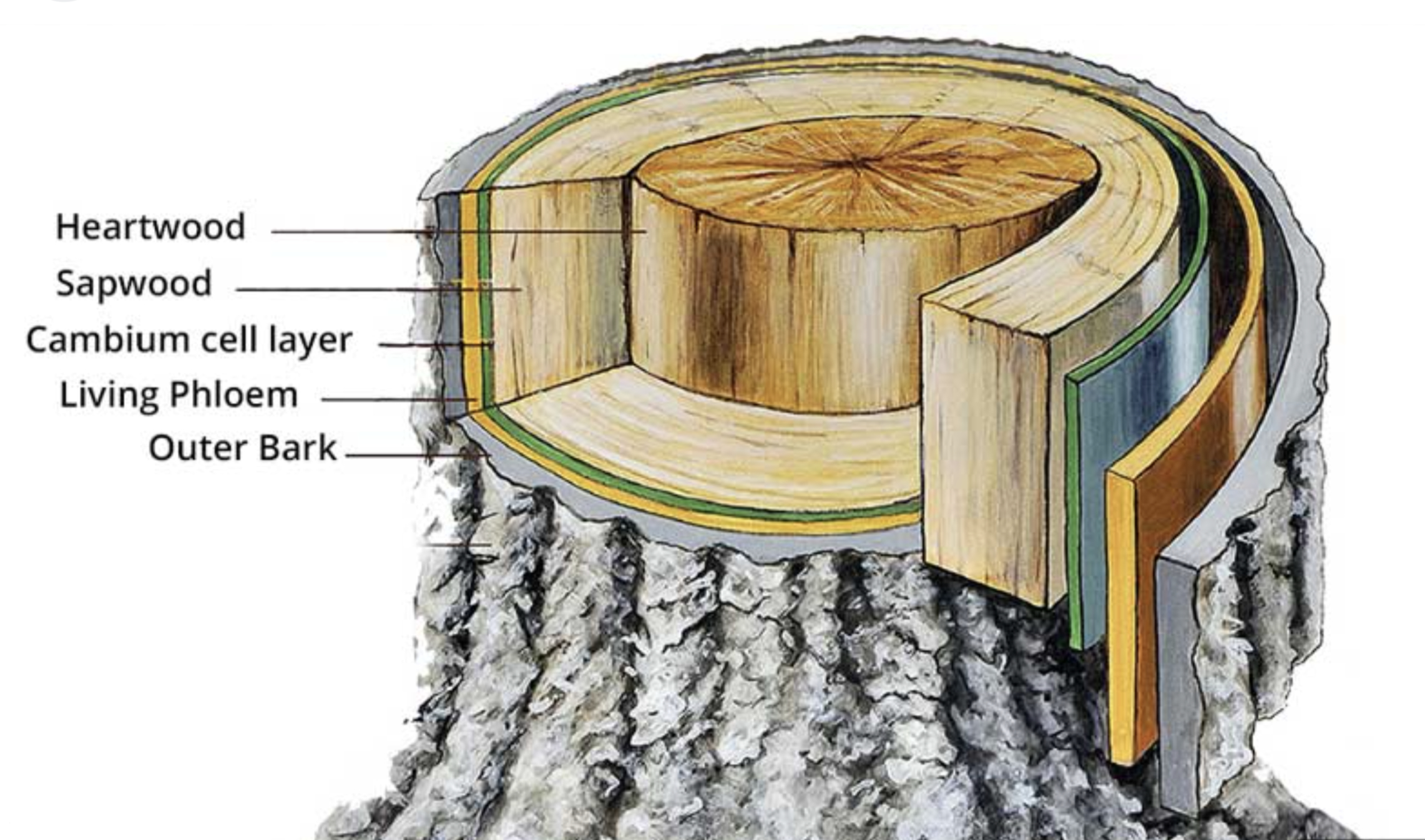
Of course, the sugar maple is known for its delicious maple sap, which flows through the tree’s xylem tissue (sapwood), well beneath the bark. The sapwood is a band of vascular tissue that carries the sap from the roots to the leaves; it exists in a ring just below the vascular cambium layer, the actively growing layer of cells that makes more xylem (sapwood) and more phloem to increase the girth of the tree. Inside the sapwood lies the heartwood, inactive cells that give structure to the tree. The phloem carries sugars manufactured by photosynthesis in the leaves down to the rest of the tree. Outside the phloem lies the periderm, a ring of cork cambium, responsible for making cork that forms the tree’s outer bark for protection.
.
.
Evolving Ecosystems
Think of the tree as a planet: its active molten inner core is surrounded by an outer protective shell. Look how much life has settled on that protective shell! All tree bark evolves as habitat over time and space. Older trees, like these maples, typically support a greater diversity of life than their younger counterparts. Lichenologist Joe Walewski tells us that as a maple tree ages, its bark gets softer and more absorbent with cracks that ooze alkaline, nitrogenous compounds. This is why an older maple tree not only supports a different community than its younger self; the older tree’s community will also be vertically stratified.
The gnarly bark of these five over 200-year old Sugar Maple trees provided a rich and varied habitat for a diversity of inhabitants. See the table at the end of this article for a list of everything that I found living on each of the five maples: mosses, liverworts, lichens, and fungi. And, of course, signs of invertebrates and animals.
.
Mosses & Liverworts
While mosses and liverworts lived all over the bark of my five maples, they were concentrated in a ‘skirt’ that covered each tree’s moist base, looking like brilliant green socks to keep the tree warm and attractive.
.

.

Jerry Jenkins’s excellent moss guide for old trees in northern forests showcases the vertical colonization by the most common mosses and liverworts growing from the base ‘skirt’ up the height of the tree. My observations closely matched his list and graphic portrayal of moss colonization of an older tree.
.
*Porella is a liverwort; all others are mosses
Vertical stratification of common mosses on an old tree (image from Jenkins, 2020)
.
Tree Base:
.
.
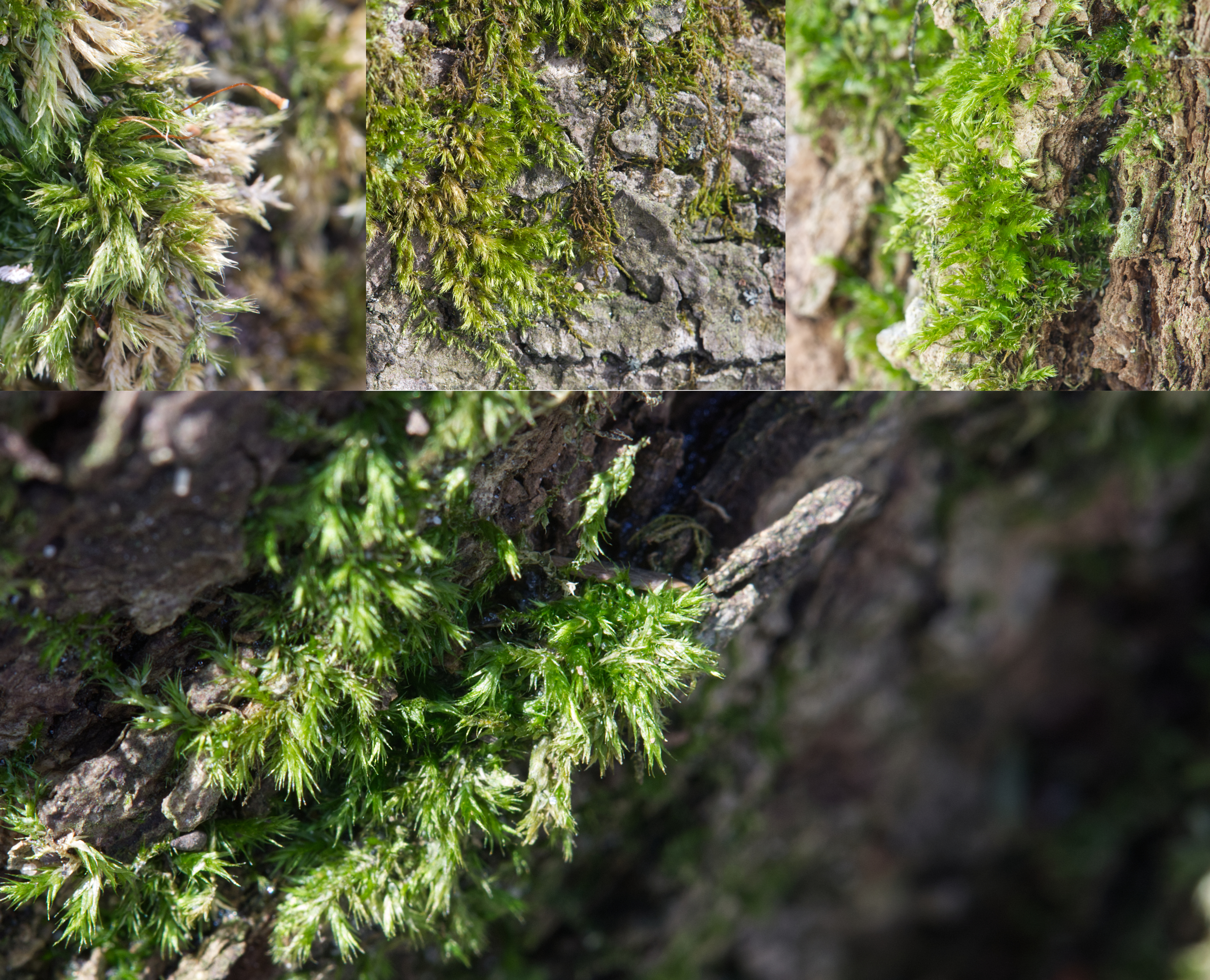
Mosses on the tree bases of my five old maples were dominated by Feather Mosses (Brachythycium spp.), likely Pleated Foxtail Moss (B. laetum) along with B.rotaeanum and Sand Feather Moss (B. mildeanum).
.

.
Co-dominant mosses included Tree-skirt Moss (Anomodon attenuatus), Shingle Moss (Neckera pennata) and Dented Silk Moss (Plagiothecium denticulatum).
.


.
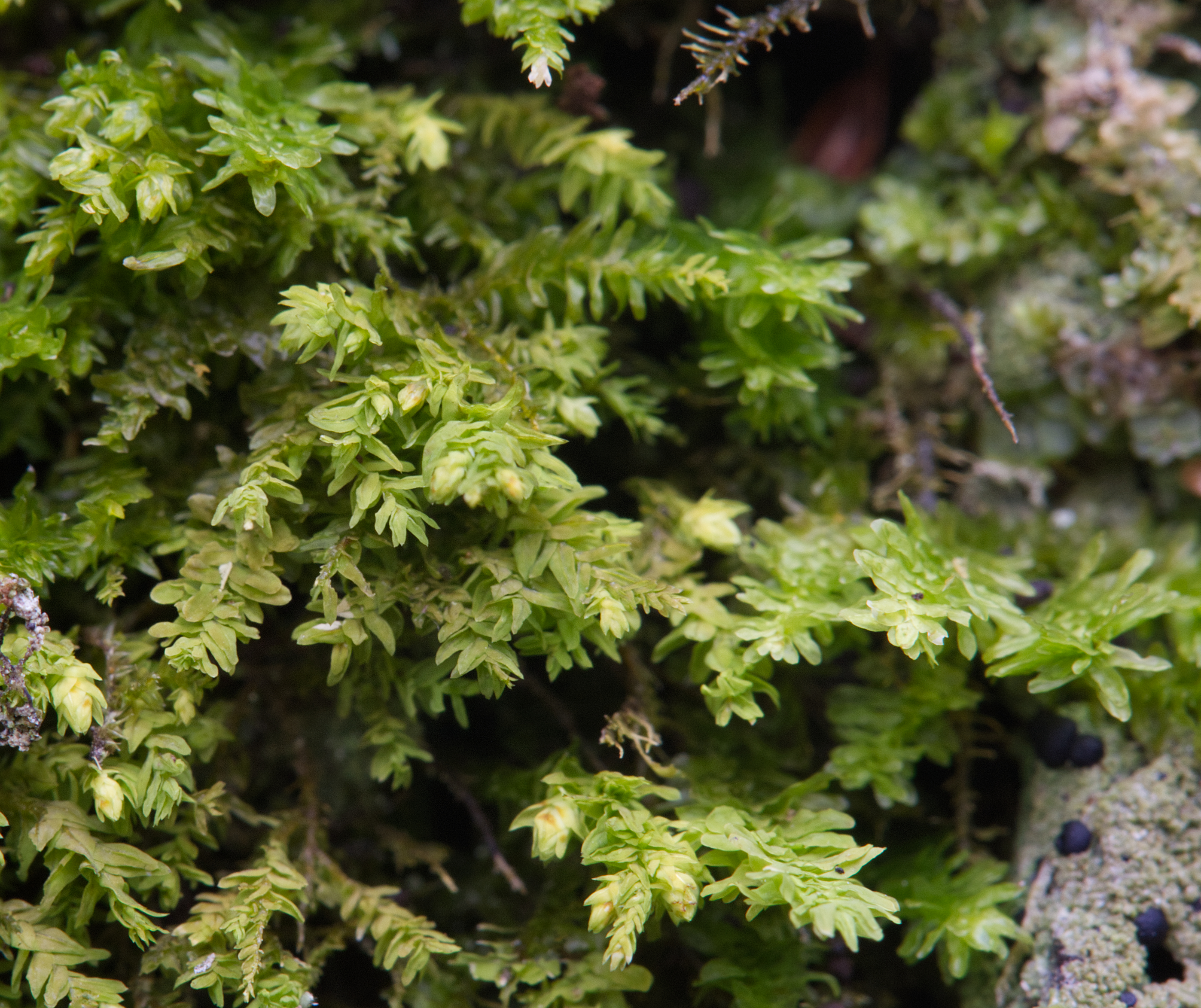
Tree-skirt Moss (Anomodon attenuatus, which also goes by Pseudanomodon attenuatus), forms sprawling mats or low cushions, primarily on tree bases which retain moisture and where it creates a lush green apron or skirt that clings to the bark through an adapted holdfast system. This beautiful and delicate-looking moss thrives in moist, shaded forests and prefers trunks and bases of trees. Moss and Stone Gardens tells us that it can best be found in deciduous forests, but also inhabits the bases of conifers–though, I did not see it on any of the nearby hemlocks.
.

.
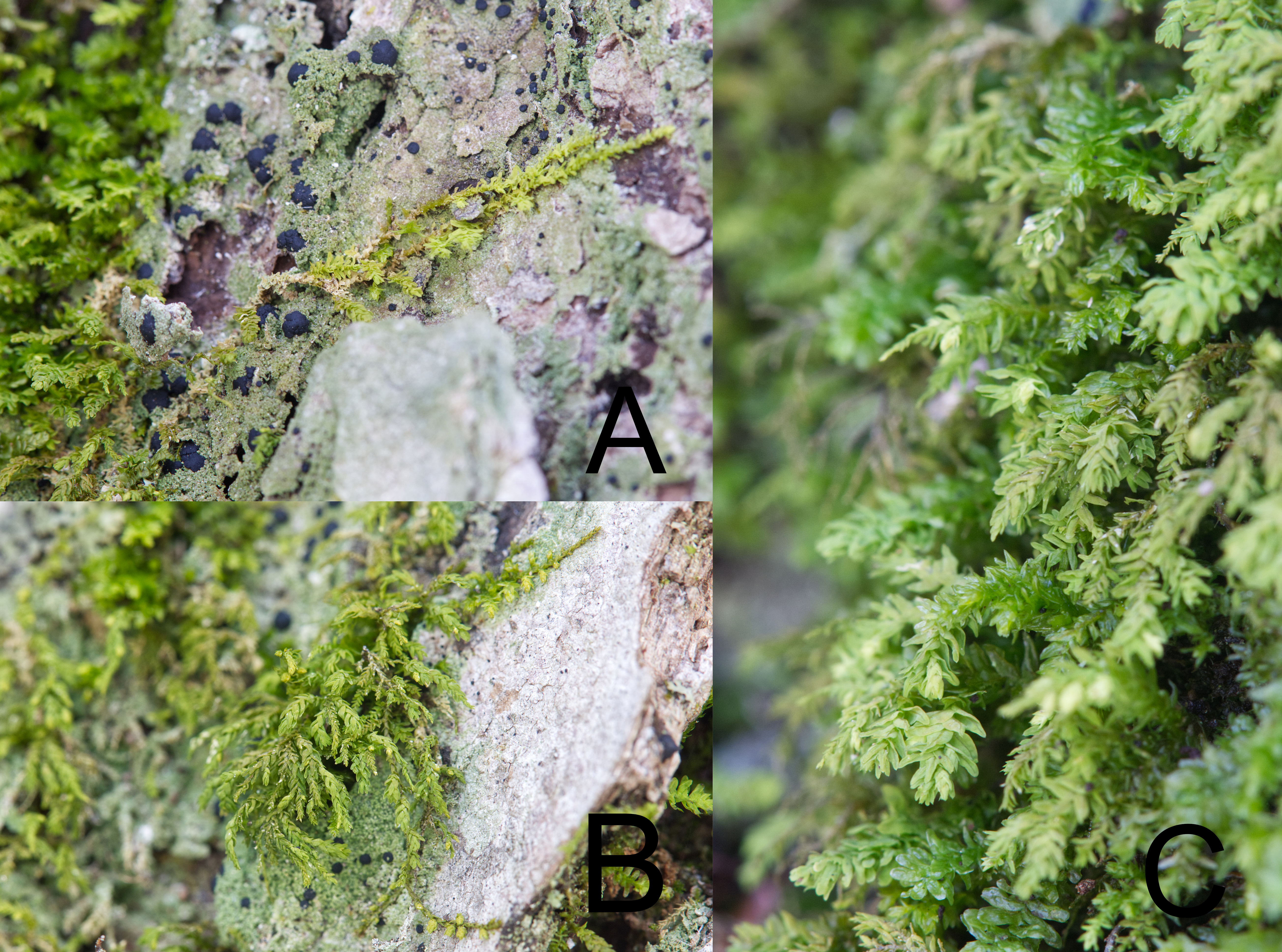
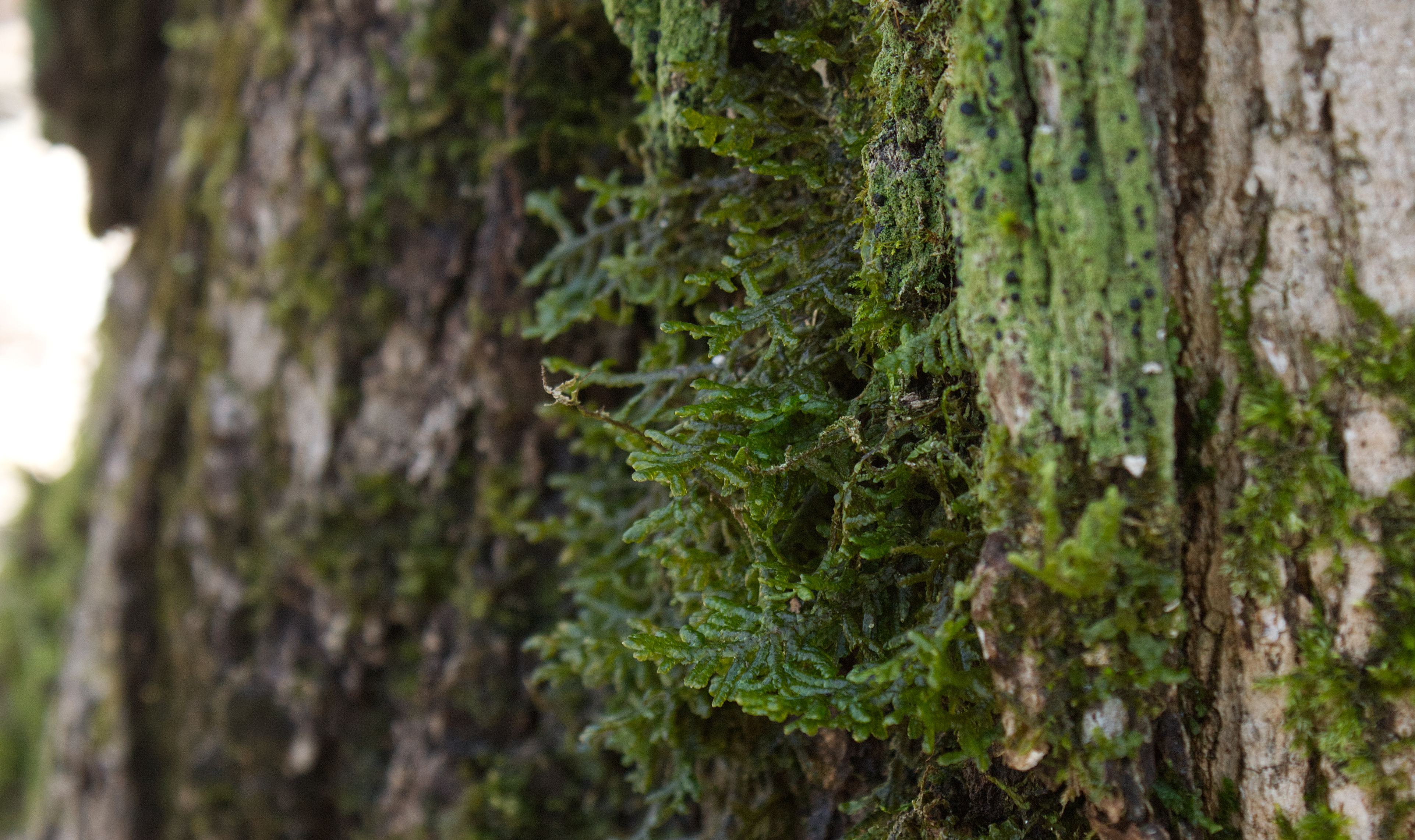
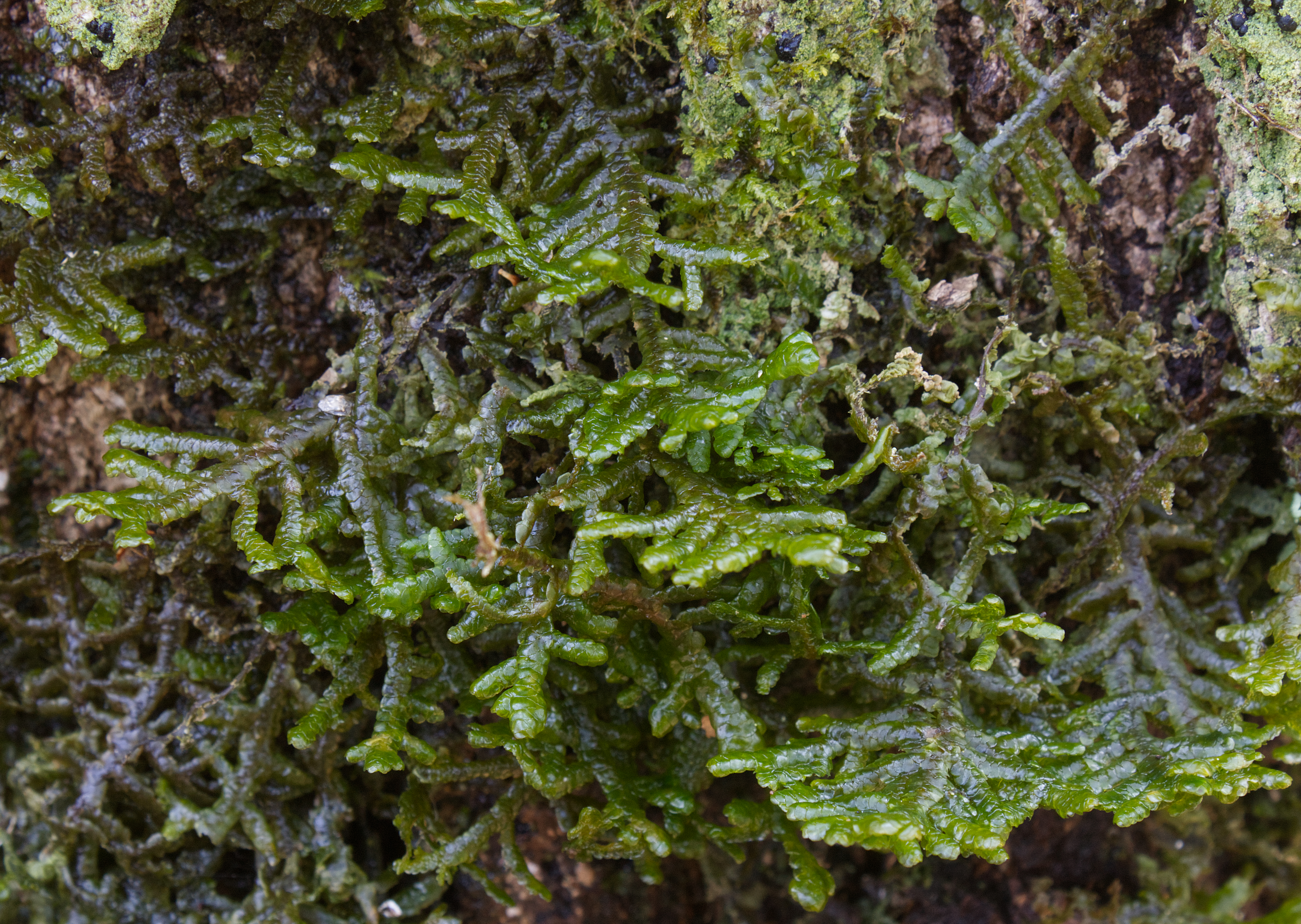
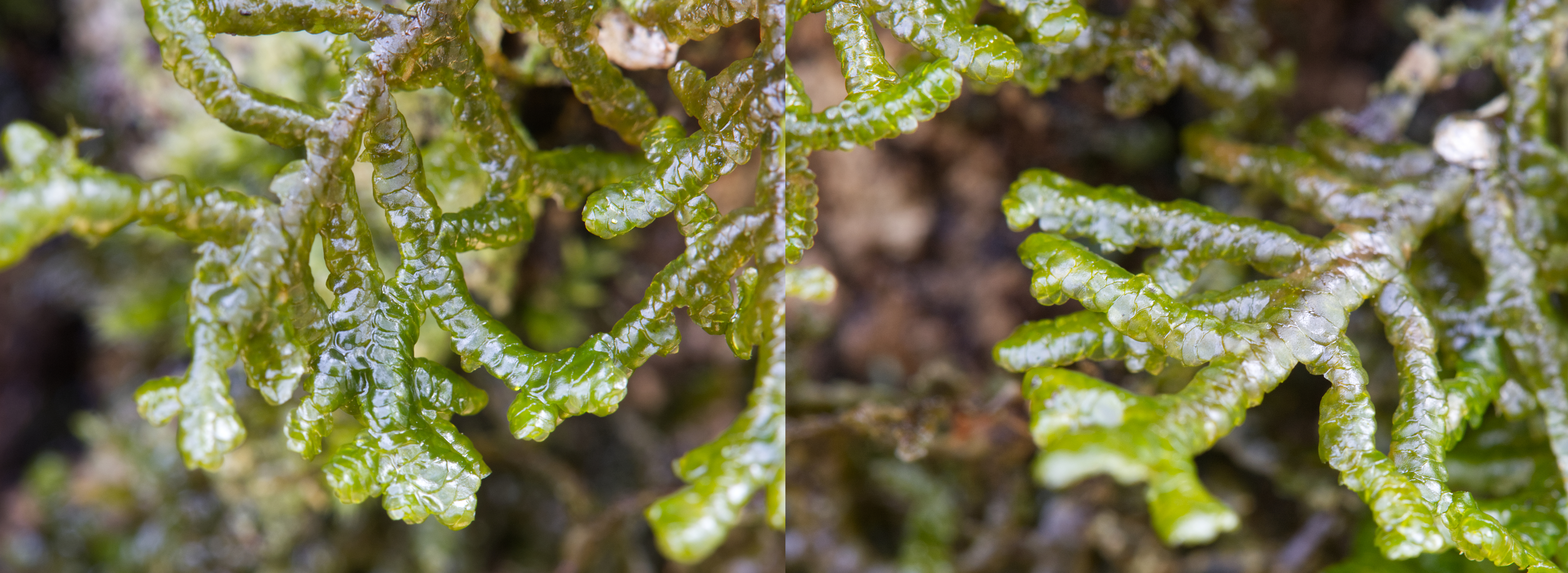
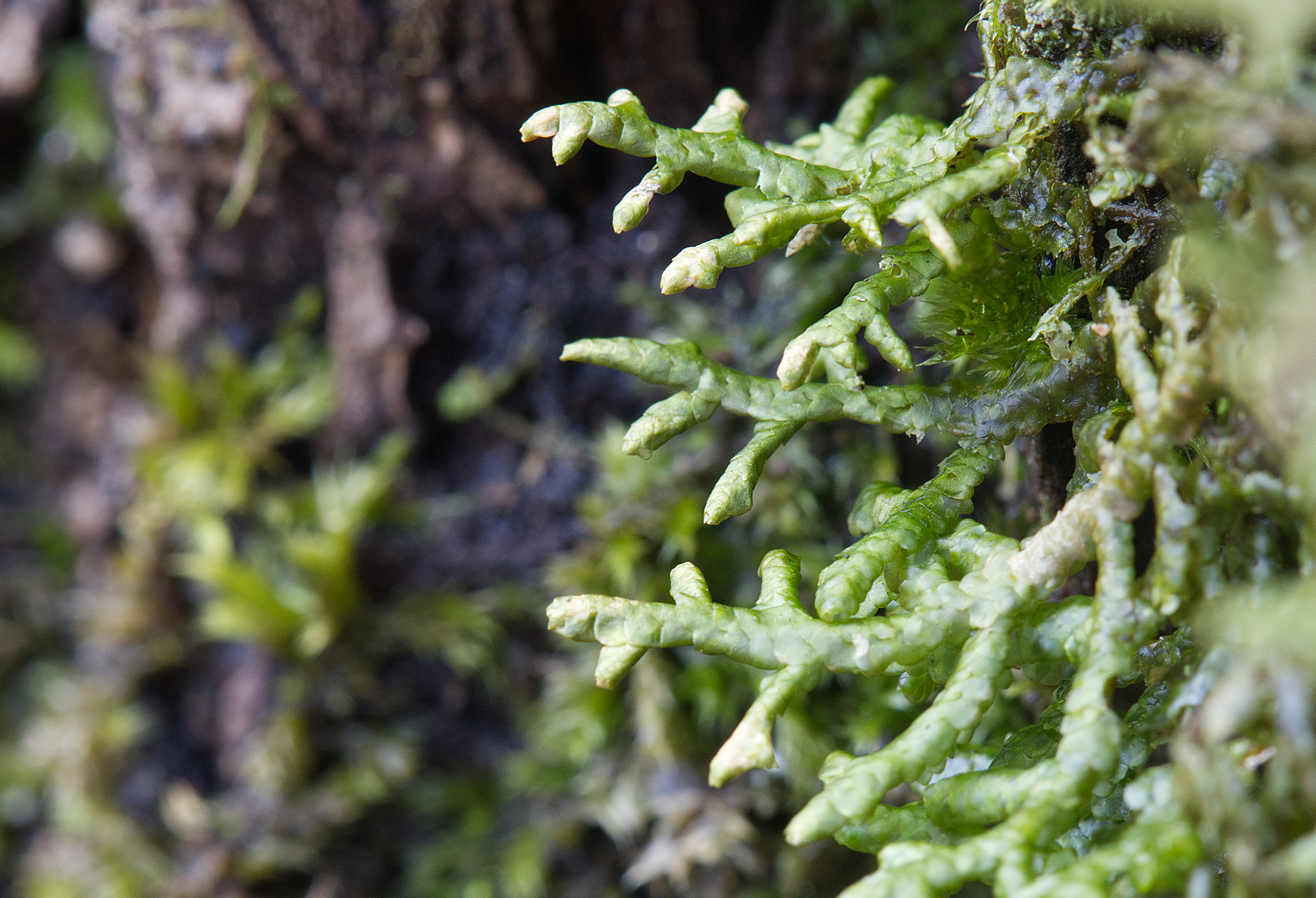
Two liverworts also dominated the tree bases. The first, Tree Ruffle Liverwort (Porella navicularis), I found particularly on the base of Maples #1, #3, and #4. This beautiful liverort formed dense compressed mats of pinnately branching shoots that varied in colour and glossiness, and created ‘ruffles’ that reached out from the tree base.
.

.
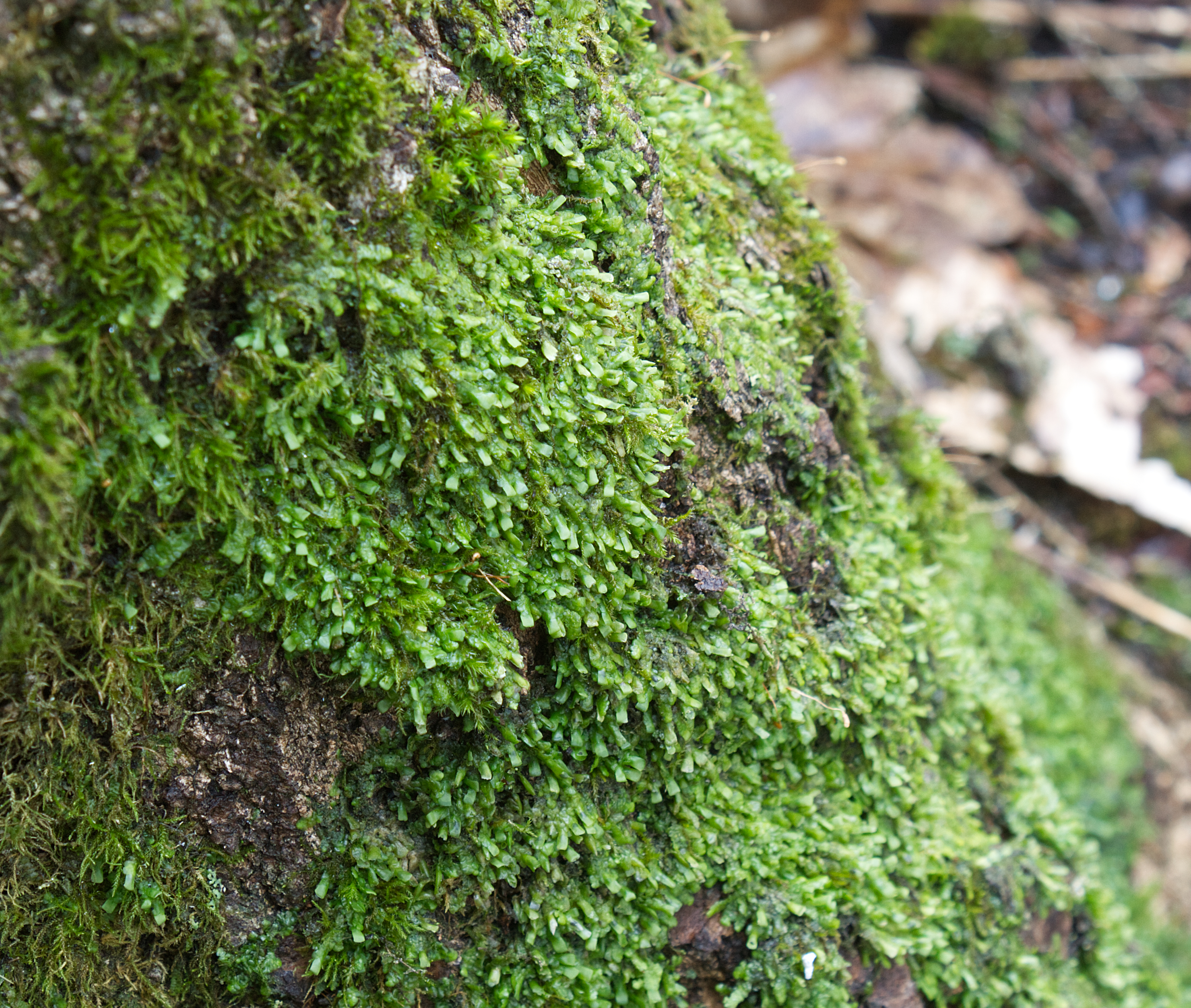
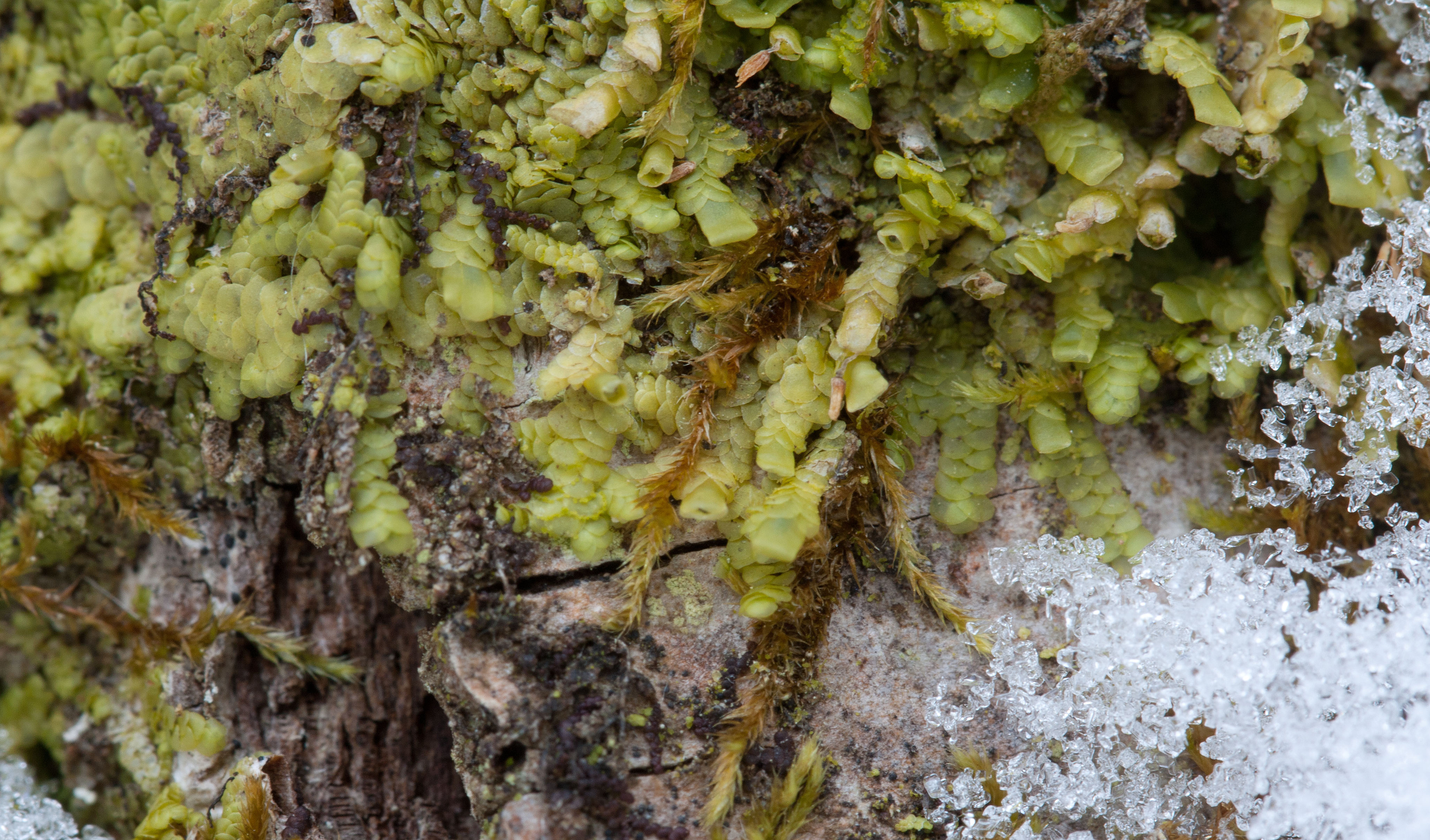
The second liverwort, the Flat-leaved Scalewort (Radula complanata), I found mostly at the tree base but also saw it growing higher up the tree, forming ‘crawling fingers’ along the bark. The Flat leaved Scalewort is bright green with incubous leaves and flat square perianths at the end of the branches. This liverwort usually grows flattened against its substrate (hence the name), either forming patches or with scattered stems that creep among mosses.
.


.
Rest of the Tree:
.
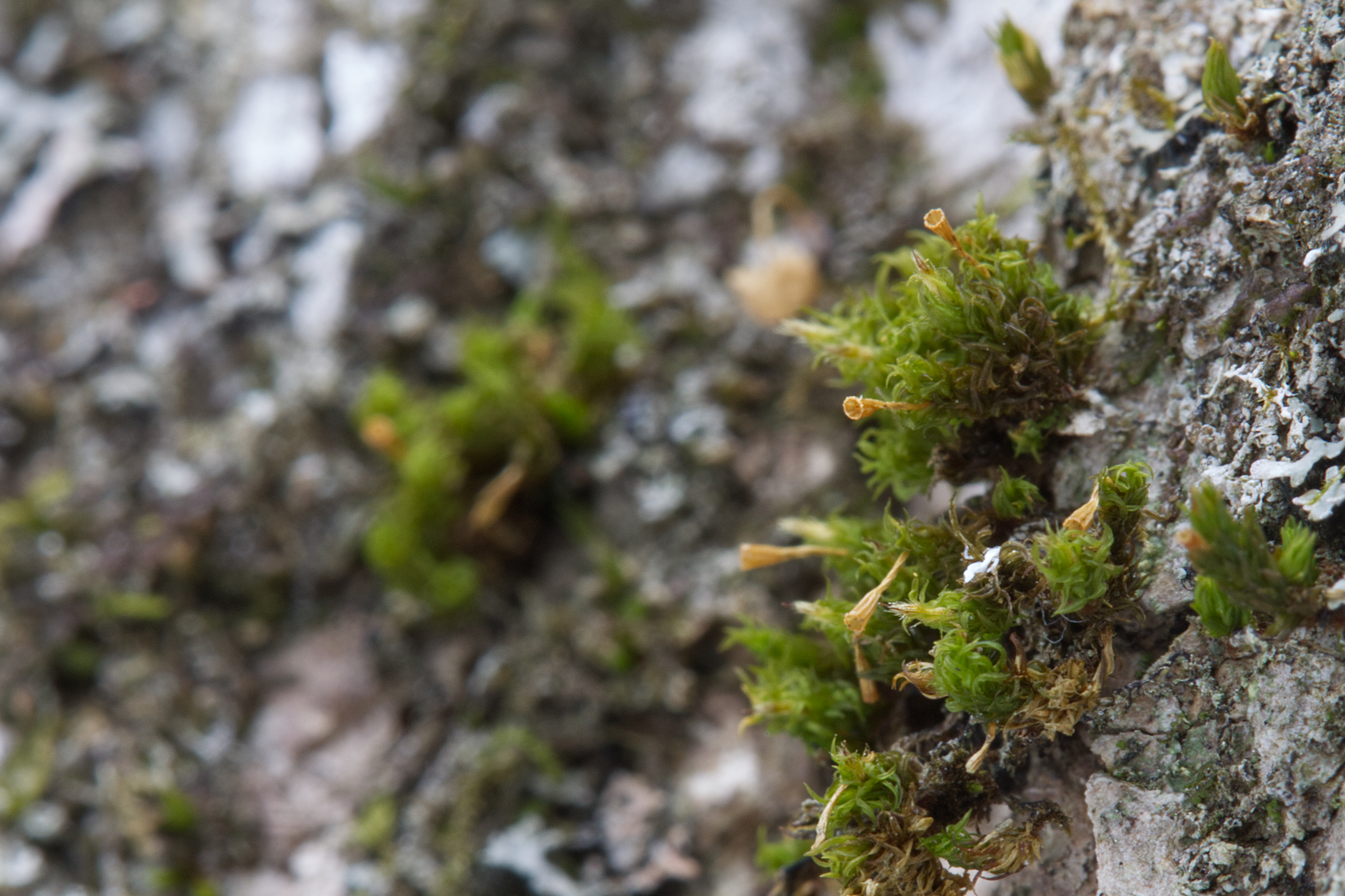
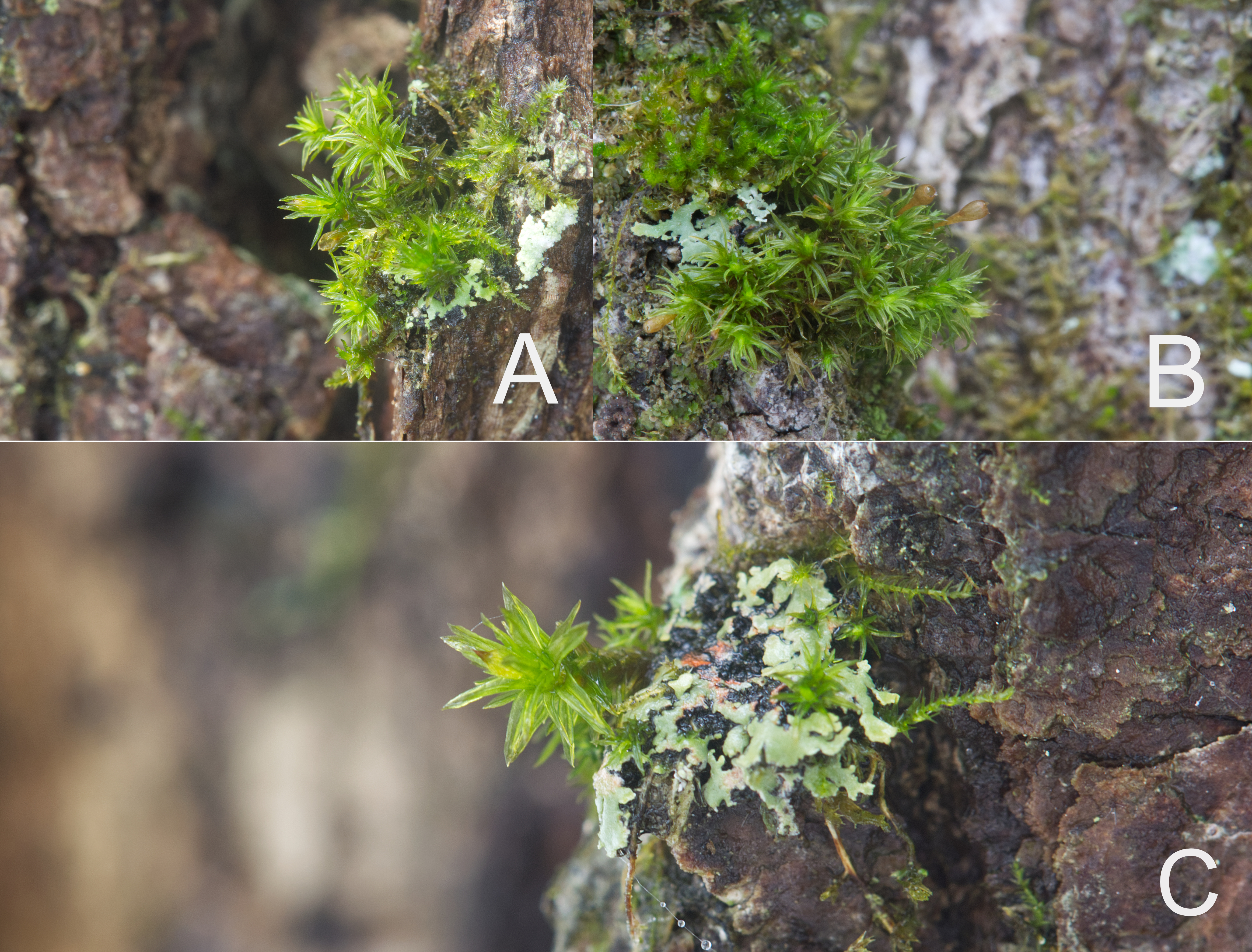
Other mosses that lived on the rest of the trunks of my maple trees included Crisped Pincushion Moss (Ulota crispa), Wood Bristle Moss (Orthotrichum affinis), and Star Bristle Moss (Orthotrichum stellatum), all formed bright green tufts that were mostly visible on Maples #1 and #2 (though I saw tufts of these mosses at heights greater than me on the other maples). The Bristle Mosses grow on tree trunks and branches, especially deciduous trees such as maple, alder and oak, but also some conifers such as hemlock and spruce. They are particularly common on older trees. Bristle mosses are also pollution-sensitive.
.
.
Liverworts on the rest of the tree included mostly the New York Scalewort (Frullania eboracensis), and Flat leaved Scalewort (Radula complanata); these spread throughout the height of the trees but were more abundant near the bottom. Frullania eboracensis is known to colonize deciduous trees such as maple, oak, ash, elm, birch, ironwood, and beech. I’ve also seen it on poplar.
.

.
Lichens
Lichenologist Joe Walewski writes that “a single Sugar Maple may be a home to as many as twenty lichen species tree-wide.” I counted seventeen shared among my five maples and dominated by crustose lichen. By far, the most common lichens were the crustose Script Lichen (literally covering Maple #1) along with several dust, disk, button and comma lichens, the foliose Pom Pom Shadow Lichen, and its cousin the Orange-cored Shadow Lichen (mostly on Maple #1).
Walewski tells us that succession of bark-colonizing (corticolous) lichen communities is the reverse of rock-dwelling (saxicolous) communities. On rocks and concrete, the first lichens are usually the crustose lichen, followed by foliose then fruticose lichen. Lichen that colonize trees follow the reverse order with fruticose and foliose lichens first invading the tree bark and stems. Older climax communities, though complex, are often dominated by crustose lichen.
.
CRUSTOSE: Script Lichens (Graphis scripta and Alyxoria varia) & Lichenicolous Arthonia graphidicola

.
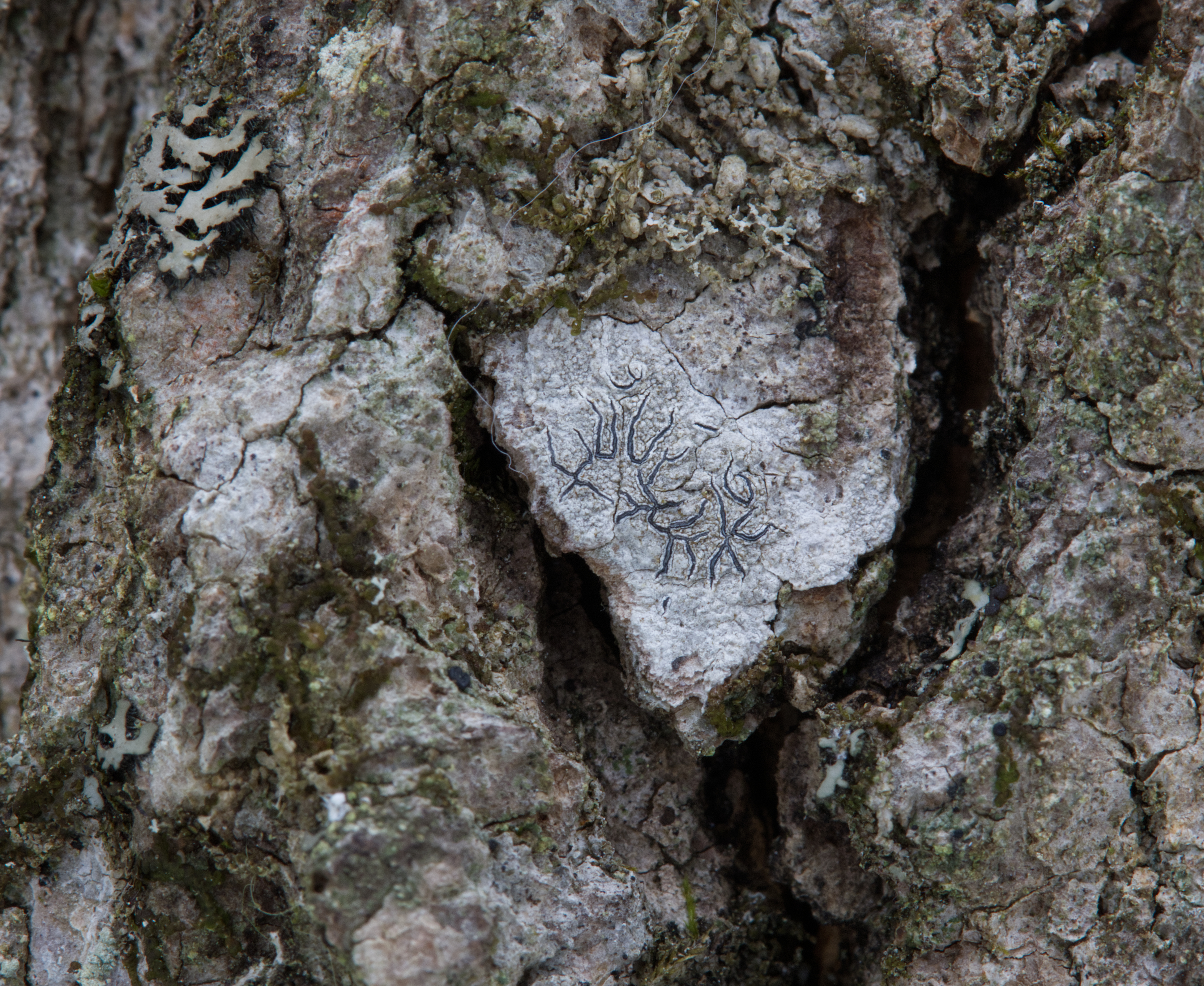
All my studied maples, but particularly Maple #1, were colonized by small white splashes of the Common Script Lichen (Graphis scripta), a crustose lichen with white-grey thallus and blue-black squiggles. Practically every plate of flat bark on Maple #1 displayed a mini parchment with squiggled ‘writing.’ This genus has been writing its memoirs for over 250 million years. Its ‘parchment’ is the grey-green-whitish thallus of the lichen and the scribbled blueish ‘script’ (actually black but pruinose) are the fruiting bodies (aphothecia) of the lichen, whose elongate “lirellae” branch and get pointy at their edges. Several beech trees nearby also hosted this writing lichen. The deep furrows and gnarly plates of these old maples didn’t stop this lichen from writing its poetry though; patches were often restricted to the 1-2 cm surface of the bark’s flat surface.
.

.
On nearby beech trees, whose bark the script lichen liked to write on, the thallus spread out unbroken and unlimited in a 3 to 10-cm circle, room for a novellete. Consider that crustose lichens grow very slowly and may add from 0.006 to 1 mm per year of radial growth (RGR) to their expanding thallus (with a lag phase in the beginning and a slower growth rate later in life). That would make a 10 cm wide thallus (radius of 5 cm) at least a 100 years old. Considering the age of the maples in this forest, I’m guessing these crustose lichens are more close to 200 years old; this would suggest a decent radial growth rate of 0.25 mm/yr. The lichens would have established on the smooth bark of the young tree 10 or so years after it grew from a seedling; such a maple would already by close to 20 feet high (growing 1-2 feet annually).
.
.
I also observed script lichen on several yellow birches; here, the linear apothecia were less branched and followed the birch grain, which is often the case according to the Muskoka Watershed Council.
.

.
I found no script lichen on the nearby hemlocks. Not one. My initial thought was that this lichen prefers the subneutral pH of maples and beeches (pH of 4.9 to 7.5) over the more acidic bark of the hemlock (pH 3.4 to 4.0). Lichen can be fairly picky about the pH of the substrates they colonize. However, I then learned that birch trees, which also harbor script lichen, tend to have more acidic pH. This is why birches, while being deciduous trees, often support lichen communities more often seen on conifers (which usually have more acidic bark). Lichenologist Joe Walewski gives the example of Camouflage Lichens (Melanelia), typically found on conifers but also found on birch trees. All to say that acidity is not the restriction for the script lichen. It’s possible that hemlocks have some other chemistry in their bark that deters the script lichen from establishing. Walewski tells us that conifer bark is rich in organic resins and gums. Hemlock bark is also very high in tannins and terpenoids, secondary metabolites produced to defend against herbivores. These include α-pinene, camphene, sesquiterpenes, diterpines, and isobornyl acetate and diterpene resin. It could be any of these unpronounceable substances that deter this literary lichen from establishing on hemlock bark.
.

.
Some of the script lichens I saw on Maple #1 through #5 might be either 1) the Bark Scribble Lichen (Arthonia varia) or 2) the lichenicolous Comma Lichen (Arthonia graphidicola), or both.
Alyxoria varia is a widely distributed species of corticolous crustose lichen; its ascomata (fruiting bodies) are similar to the apothecia of G. scripta, but simpler (short, often wrinkled oblong, infrequently with simple branches or star-shaped) with a thin evanescent thallus, mostly within the bark itself. Previously called Opegrapha varia, Alyxoria varia prefers the neutral rough bark of old trees in humid but open forests, particularly old maples and other deciduous trees such as elm and oak. I saw many examples of this script lichen hiding in crevices of Maples #1 through #5, with thin to no discernable white thallus.
.


.
Arthonia graphidicola is associated with G. scripta, using it as a host to parasitize; so wherever you see G. scripta, you will likely also see A. graphidicola. This comma lichen without a thallus has apothecia that resemble G. scripta though simpler—shorter and more simply branched—and colonizes the G. scripta as host thallus only to erupt through it like some parasite from Ridley Scott’s movie Alien. See my article on this interesting lichen then check the images above. What do you think?
.
CRUSTOSE: Dot and Button Lichens
.
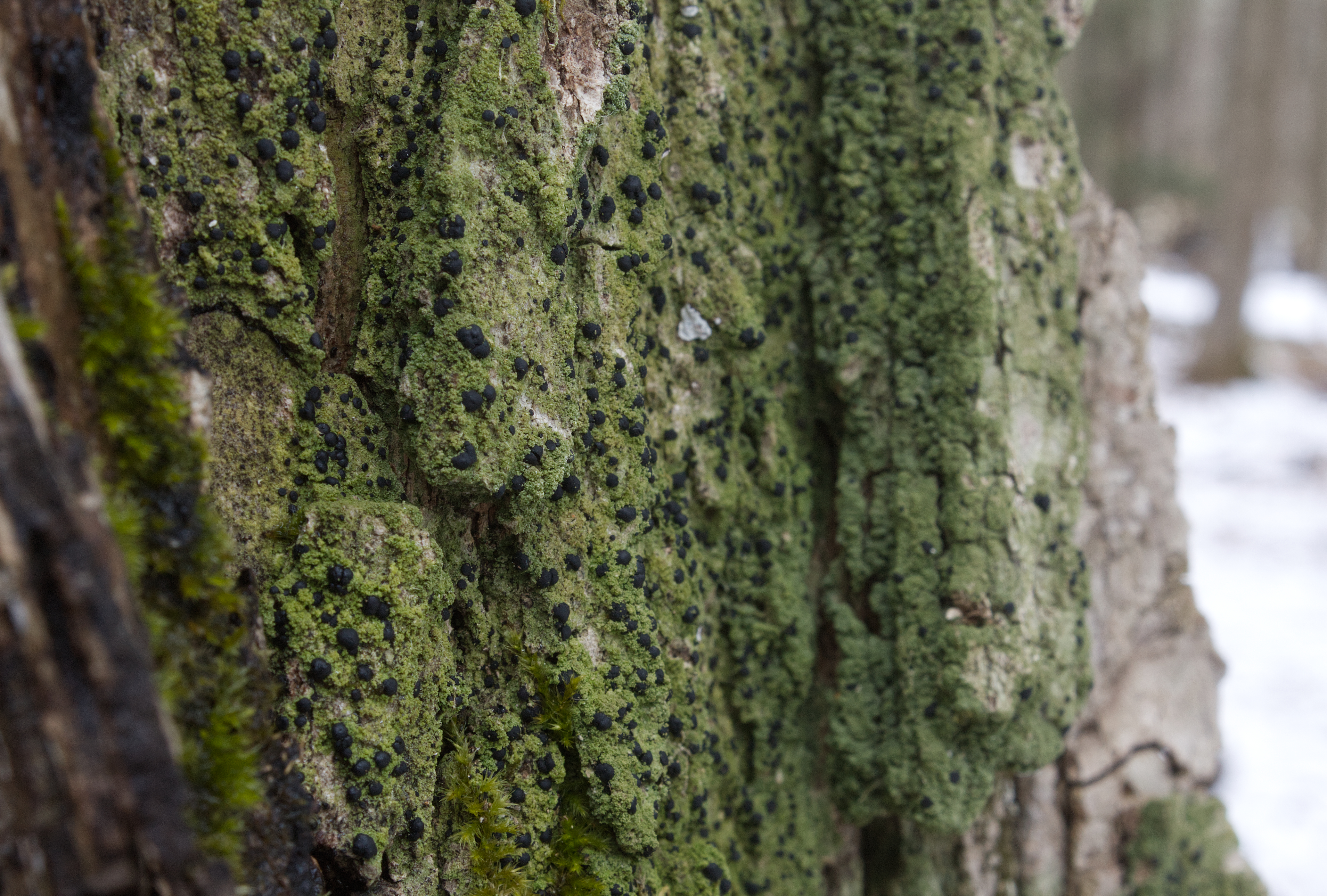
I noticed large patches of a green highly granulated crustose lichen with noticeable blue-black half-spheres at the base of Maple #3 and #4. I then observed small scattered patches on the other Maples. The blue-black fruiting bodies (apothecia) embedded in the granular green thallus start out as flat ‘disks’ then grow into round convex ‘half-spheres.’
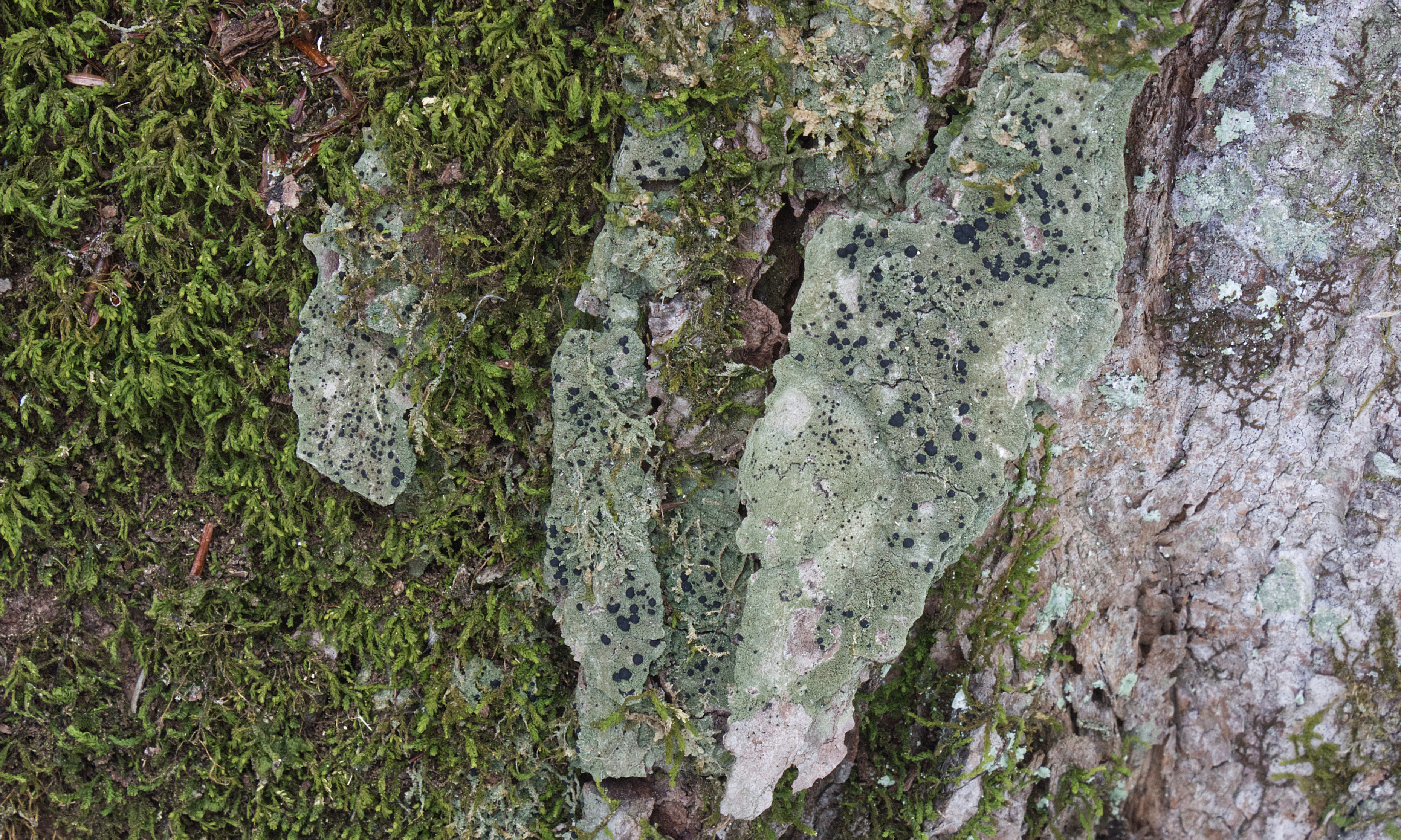
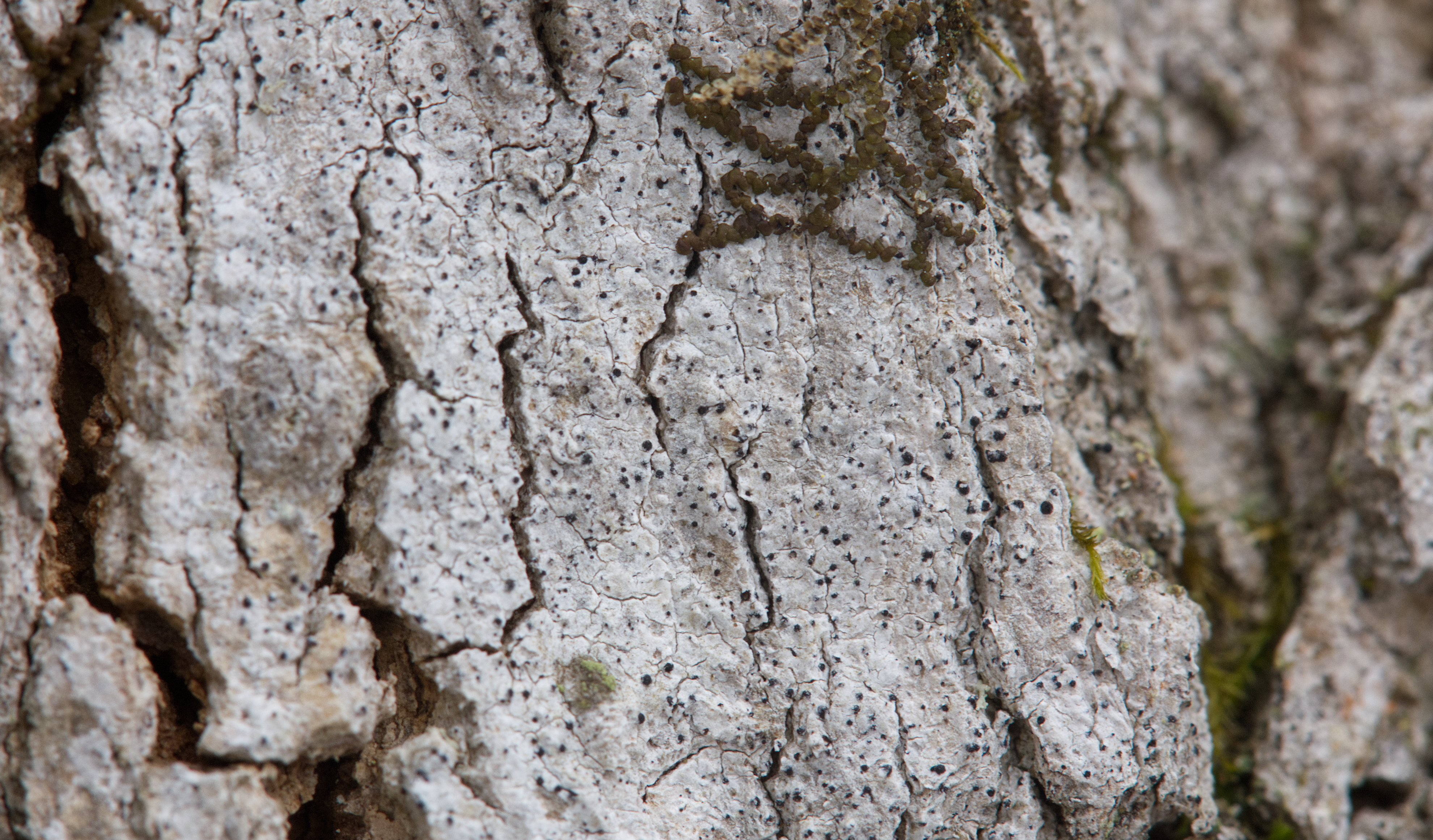
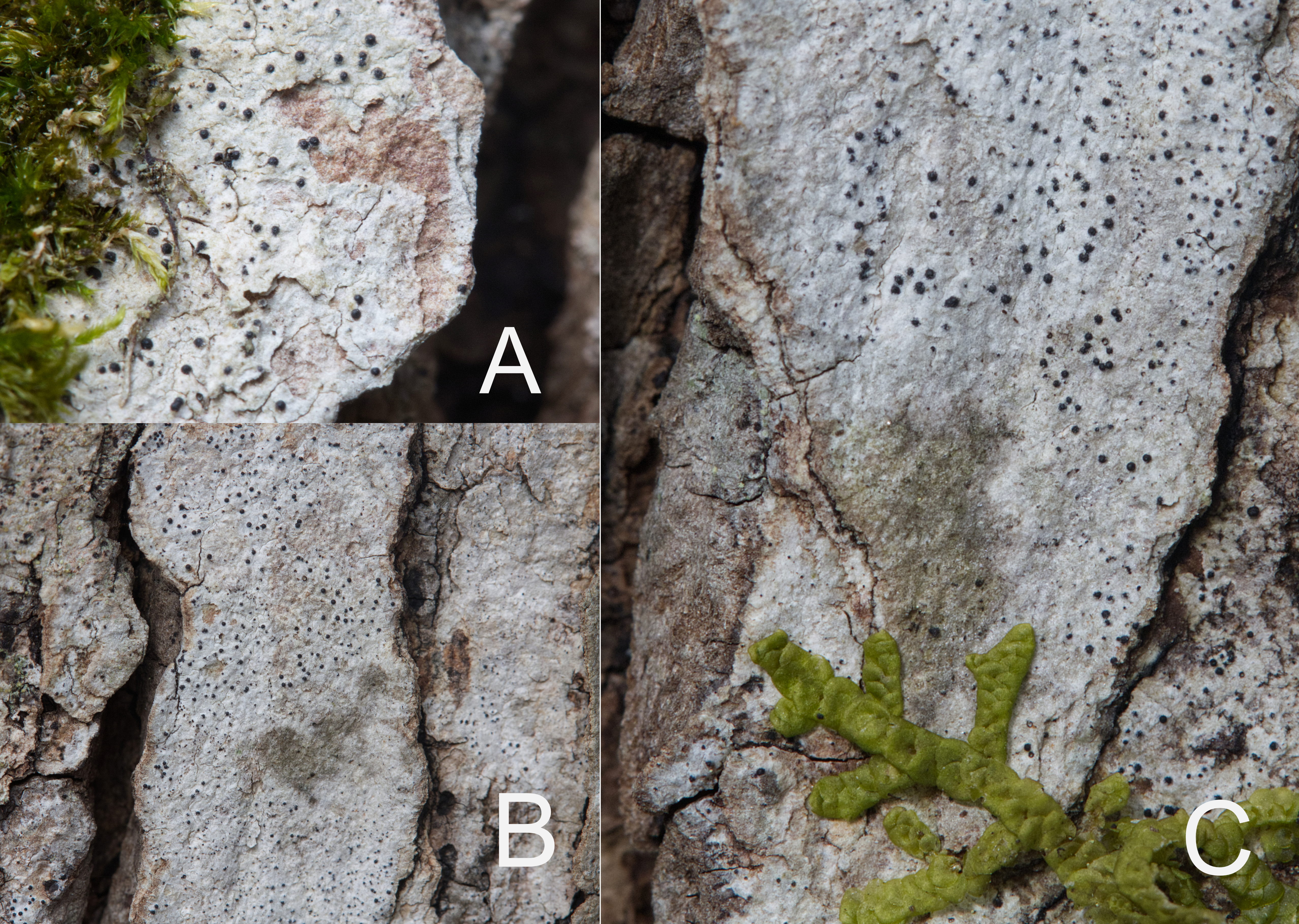
I first identified this beautiful lichen as Bark Disk Lichen (Lecidella euphorea) or Lecidella elaeochroma. But further research and observation indicated a better fit for City Dot Lichen (Scoliciosporum chlorococcum), based on its characteristic dark green irregularly granular thallus and large blue-brown convex apothecia. These two similar-looking crustose lichens otherwise share the same type of habitat, colonizing damp, shaded, nutrient-rich bark, often wood and even rock.
.
.
Italic 8.0 notes that the City Dot Lichen is ecologically wide-ranging and normally found on bark (corticolous) (especially Beech), sometimes on wood (lignicolous) and more rarely on siliceous rocks (saxicolous). Consortium of Lichen Herbaria and Tanunchai et al. note that Scoliciosporum also grows on leaves (foliicolous) of broadleaved trees including maples and on other lichen (lichenicolous), making it highly versatile and cosmopolitan. NatureServe Explorer tells us that this lichen occurs in southeastern Canada and throughout most of the eastern U.S. It has been observed throughout Ontario, often on the bark of red maples.
Italic 8.0 tells us that City Dot Lichen tends to colonize substrates from very acidic to subneutral pH (from Oak to Elderberry), preferring nutrient-rich bark (weakly eutrophied). NYBG notes that Scoliciosporum chlorococcum grows in mixed hardwoods including maple, birch, oak, and pine. Dymytrova (2011) notes that S. chlorococcum often grows on twigs of deciduous trees, which often is an overlooked habitat for lichens. On a separate outing, I saw this lichen on several downed branches of maples after an ice storm.
.

.
City Dot Lichen lives in shaded areas and areas with plenty of diffuse light. Italic 8.0 adds that S. chlorococcum tolerates a high degree of human disturbance, often occurring in moderately disturbed areas (e.g. agricultural areas, small settlements) to heavily disturbed areas (such as large towns). Its apothecia are biatorine (e.g. lack a thaline margin derived from the lichen thallus itself) and are glossy reddish-brown, turning brownish-blue-black when wet or damp.
.

.
The Common Button Lichen (Buellia erubescens) was common on all the maples, but particularly widespread on the bark of Maples #3, and #4. This crustose lichen with thin grey surface (thallus) and tiny flat black disks, is known to colonize the bark of both deciduous and conifer trees. It has been reported on oaks and red maples particularly. I found it on several young maples and poplars in a nearby forest.
.
.
.
CRUSTOSE: Dust Lichens
Several dust lichens occurred through the trunks of the four maples with some preference for the tree base. These included the Fluffy Dust Lichen (Lepraria lobificans), found on all the maples, and Mapledust Lichen (Lecanora thysanophora). Whitewash Lichen (Phlyctis argena) and its recently discovered cousin Eggshell Rock Blaze Lichen (P. petraea) were found on Maples #4 and #5.
Fluffy Dust Lichen is known to commonly grow on the bases of trees in shaded areas. The thallus is pale mint green and granular with a ‘dusty’ surface.
.

.
Mapledust Lichen, of course, grows on Sugar Maple; but I’ve also seen it on beech, oak and basswood. Its distinguishing feature is the white to bluish webby outwardly-growing fungus margin. The green granular surface is the algal photosynthesizing partner. I’ve seen palm-sized colonies on younger maples with smooth bark.

.
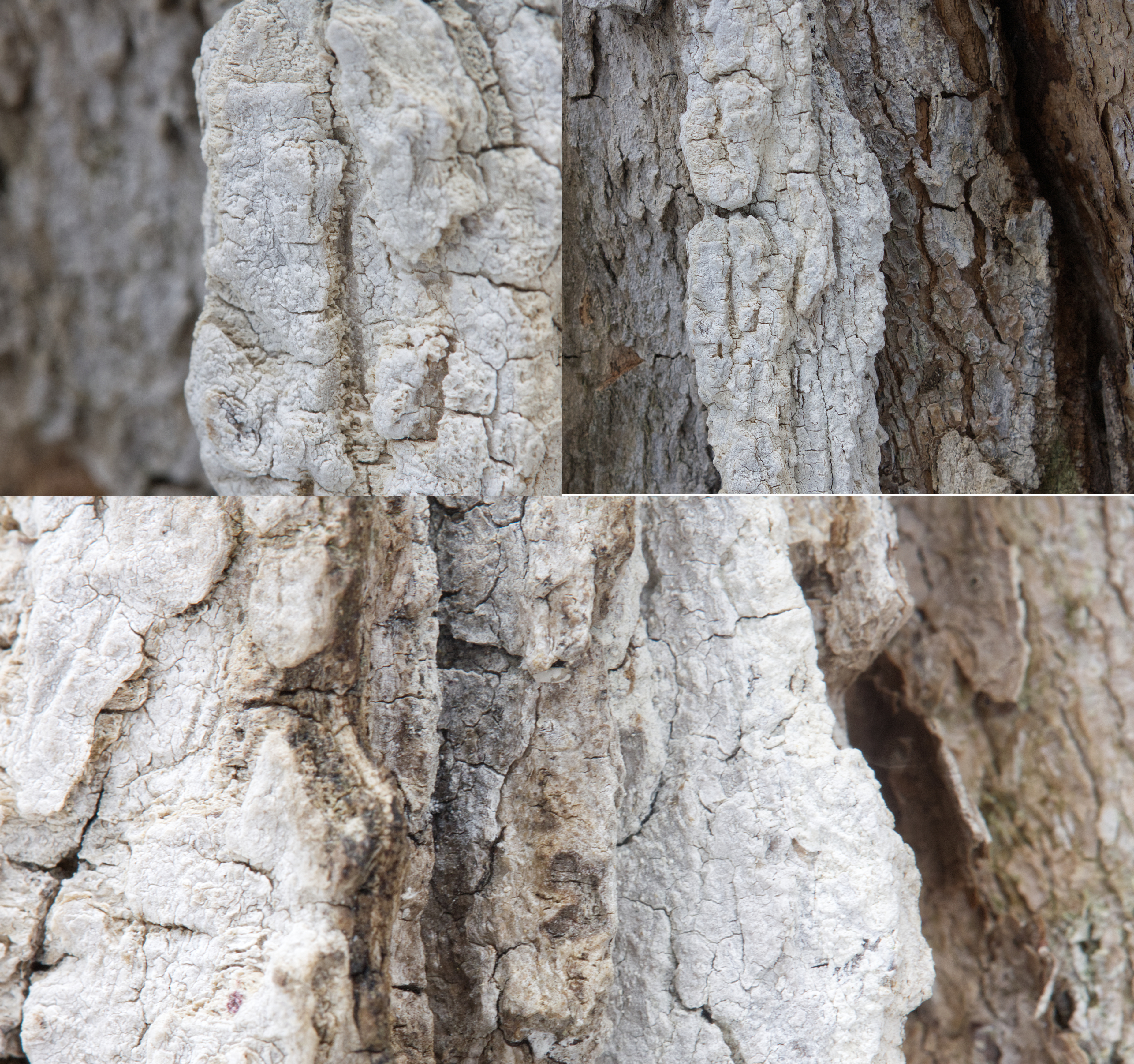
Whitewash Lichen (Phlyctis argena) is a generalist epiphyte, growing on many deciduous trees, particularly on Red Maple, where I’ve seen it colonize large bark surfaces of trunk and branches. The north-facing bark of Maple #4 contained large areas of Phlyctis argena.
.
.
Smaller 1-3 cm patches of its thicker, smoother cousin P. petraea were found on both Maple #4 and Maple #5. These resembled flat lacquer paint that was cracking in places. Muscavitch, Lendemer and Harris, who discovered and first described this newly widespread lichen in 2017, tell us that while this mostly saxicolous lichen appears to prefer rock surfaces, P. petraea also colonizes bark. P. petraea is known only in eastern North America, and in Canada only in Ontario.
.

.
I also saw bright yellow specks of Candelflame Lichen (Candelaria concolor) and tiny Powdery Goldspeck Lichen (Candelariella efflorescens)—both common residents of nutrient-rich rain tracks of Sugar Maple bark—on Maple #1. And, after a storm brought down several large branches, I saw Common Greenshield Lichens on many of the downed maple branches.
.
.
CRUSTOSE: Comma Lichens

.
The giant Sugar Maple #4 on the shady upland showed very gnarly bark, which closeup, resembled a dramatic topography of huge cliffs and overhangs over deep chasms that led into dark caverns. All were ‘infested’ with little bean-shaped black-brown things that resembled lips; they turned out to be the naked apothecia of a comma lichen whose thallus was embedded in the bark. I determined that this lichen belonged to the comma lichen of the genus Arthonia. After much searching I landed on Arthonia excipienda, found on deciduous trees in humid forests. A. excipienda also colonized Maple #5, up the hill. I later also found in on Maple #1.
.

.
Italic 8.0 describes this corticolous crustose lichen as having an endosubstratic thallus (e.g. invisible because it lies inside the bark) with arthonioid (without a true margin) and mostly lirelliform apothecia (fruiting bodies that are “lip-shaped”—elongated, straight or curved, rarely branched, with a furrow or ridge running down their middles). Italic 8.0 adds that Arthonia excipienda prefers a subneutral substrate (e.g., my old maples) in a closed to open canopied condition.
.
FOLIOSE: Shadow Lichens & Shield Lichen

.
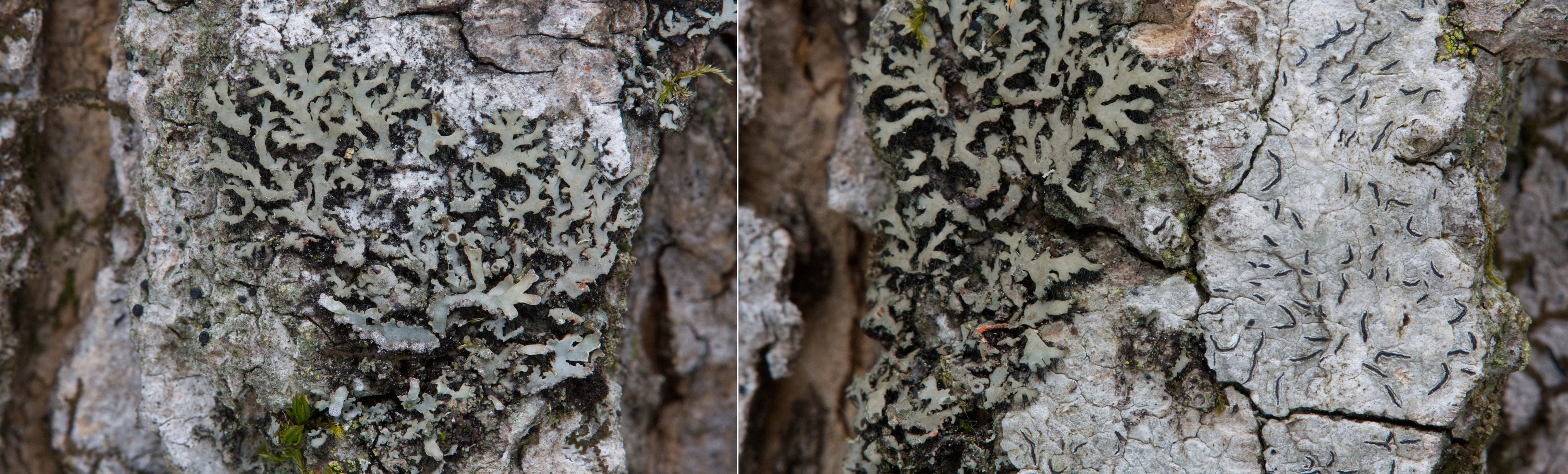
All five maples supported Shadow Lichens throughout the height of bark visible to me. The Pom Pom Shadow Lichen (Phaeophyscia pusilloides) occurred on all five maples. This small foliose greenish-grey lichen is distinguished by its slender lobes and black rhizines that extend visibly out of the thallus on all sides like someone with a bad hair day. It is a common lichen on deciduous trees with nutrient-rich bark, like these old maples; I’ve observed it growing on ash, poplars, maples, beeches, oaks, ironwoods, and birches.
.
.
I noticed its cousin the Orange-cored Shadow Lichen (Phaeophyscia rubropulchra) on Maples #1, #2, #3, and #4, often ‘invading’ several crustose lichens (e.g. Common Button Lichen, and Bark Disk Lichen). The Orange-cored Shadow Lichen prefers shaded habitats. It is easily distinguished from its look-a-like cousin by its red-orange inner core or medulla, often revealed through the actions of grazing slugs that eat the upper cortex and expose the orange medulla.
.

.
I found one shield lichen, the Bottlebrush Shield Lichen (Parmelia squarosa) on all the maples. This foliose lichen typically grows on deciduous tree bark of both young and old trees and is typically seen with Physcia, Candelariella, and Xanthoria. Parmelia squarrosa enjoys dry and more open sites, which may be why I first noticed it on Maple #1 and Maple #2, both in more open areas. I saw small patches of the foliose Mealy Rosette Lichen (Physcia millegrana) on the bark of all the maples. Known to inhabit the subneutral pH bark of several deciduous trees, the Mealy Rosette Lichen is common on bark exposed to sunlight but is often found in shaded moist areas of mature mixed hardwood forests as well as urban areas. I found large patches of this lichen on a pine fence post on the edge of the city.
.
Fungi

.
I even found a TLBM (Tiny Little Brown Mushroom) on Maple #2, perched on a bark ledge amid lichen and scaleworts. Called Bark Bonnets (Mycena corticola), these tiny pink-tan saprotrophic fungi are no larger than 5 mm and normally grow on the bark—not the wood—of fallen and standing hardwoods and conifers. The Bark Bonnet belongs to a group of mushrooms, the Mycenoid mushrooms, appropriately called Fairy Helmets.
.

.
I found another fungus growing on Maple #3: a tiny white ‘donut’ shape with brown interior no larger than two millimetres in diameter. I’d found this same fungus growing amid the liverwort Frullania on an old poplar tree in the nearby Trent Forest and identified it as Poplar Bells (Schizophyllum amplum). Given that I found many organisms that occurred on both poplar and maple, perhaps this fungus is one and not so fussy as its name implies. Further research presented the possibility that this tiny fungus may actually be the diminutive White Barrel Bird’s Nest (Nidula niveotomentosa), though its preferred habitat is sticks, moss, wood chips and other woody debris. It’s often seen growing among mosses.
.
Fallen Maple Tree Branches
.
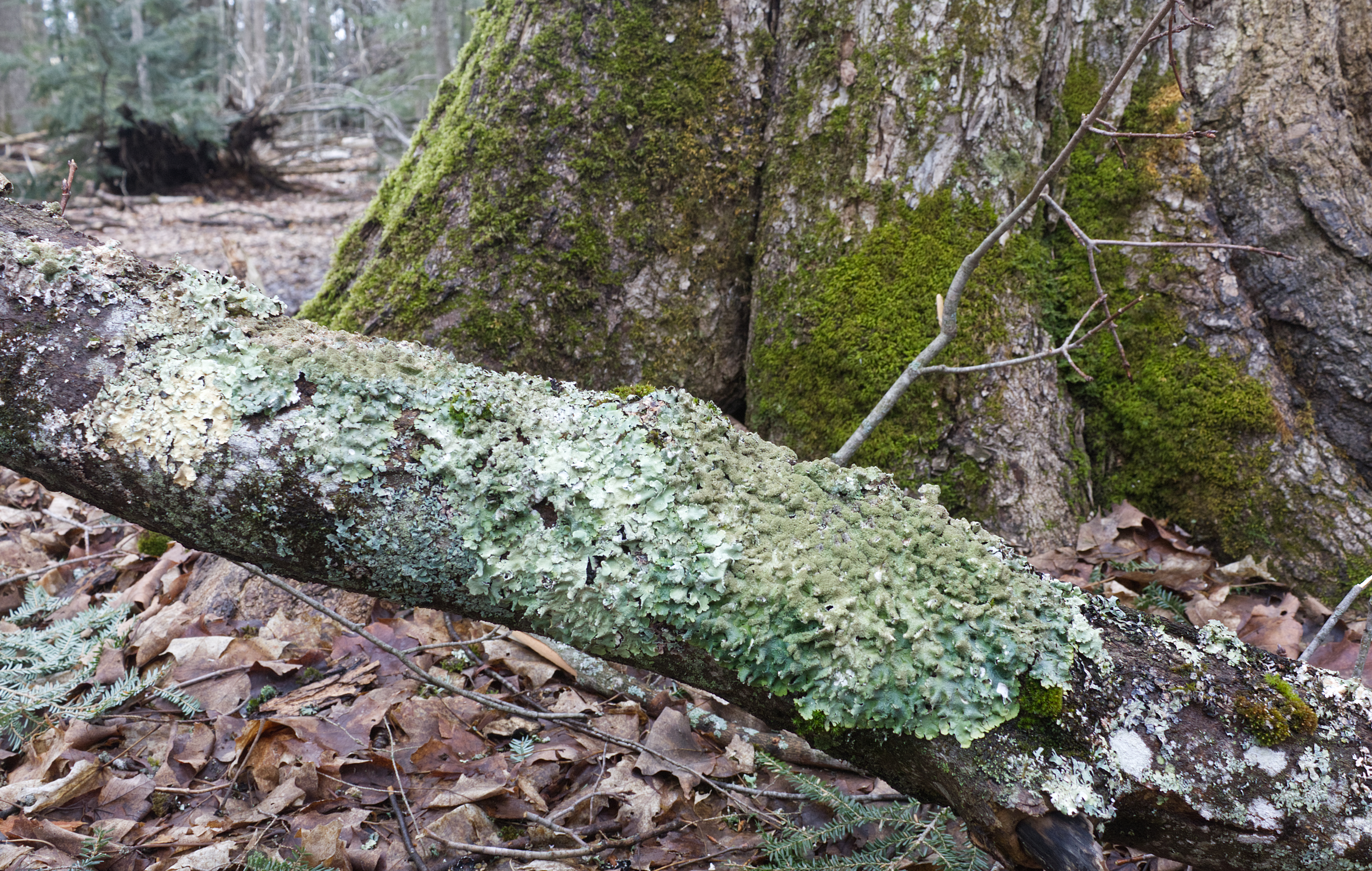
After a severe ice storm tore many upper tree limbs and large maple branches littered the ground, I was able to see what grew higher up these giant maples and confirm vertical stratification of life on the bark of these tall trees.
.
.
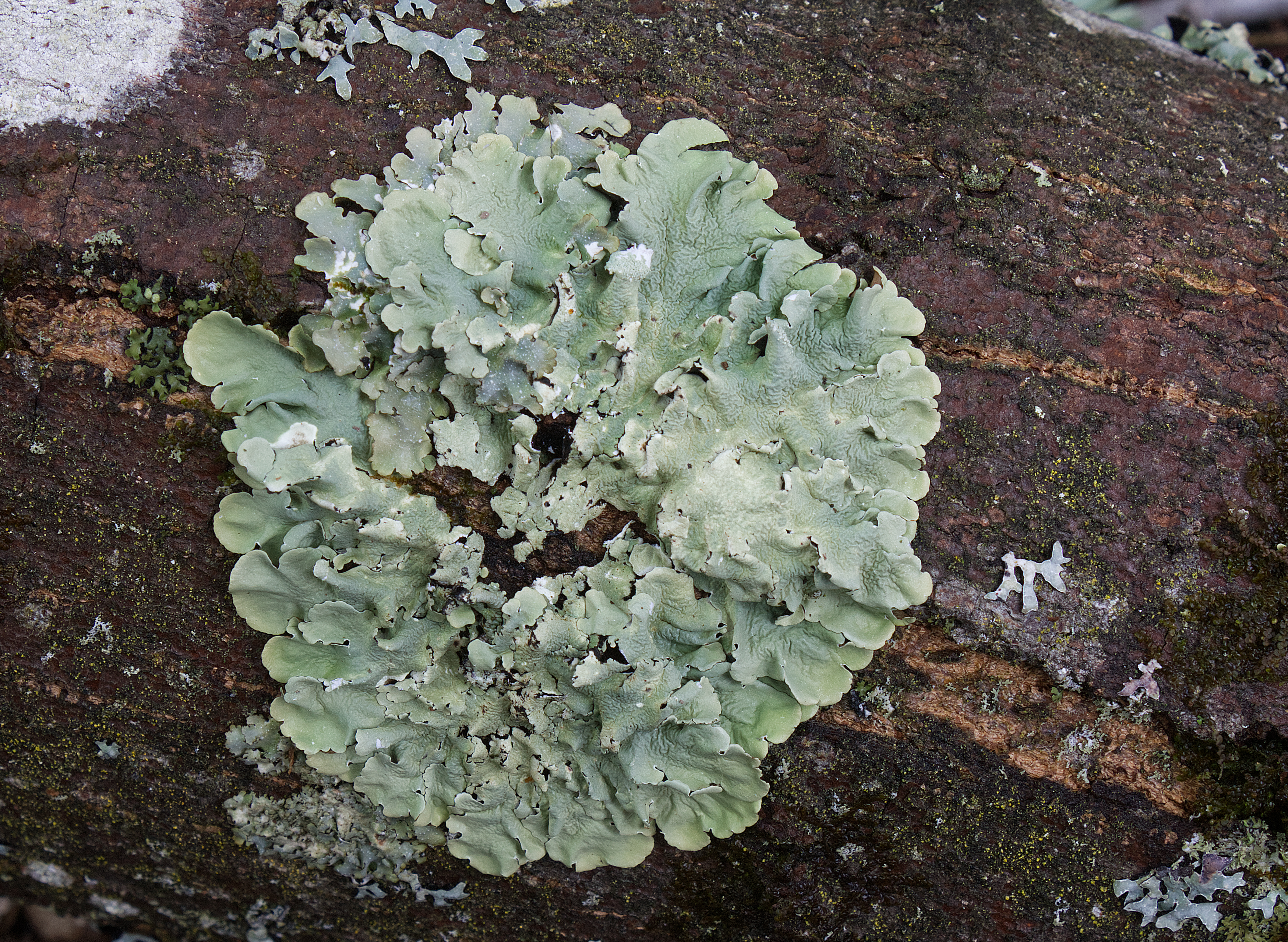
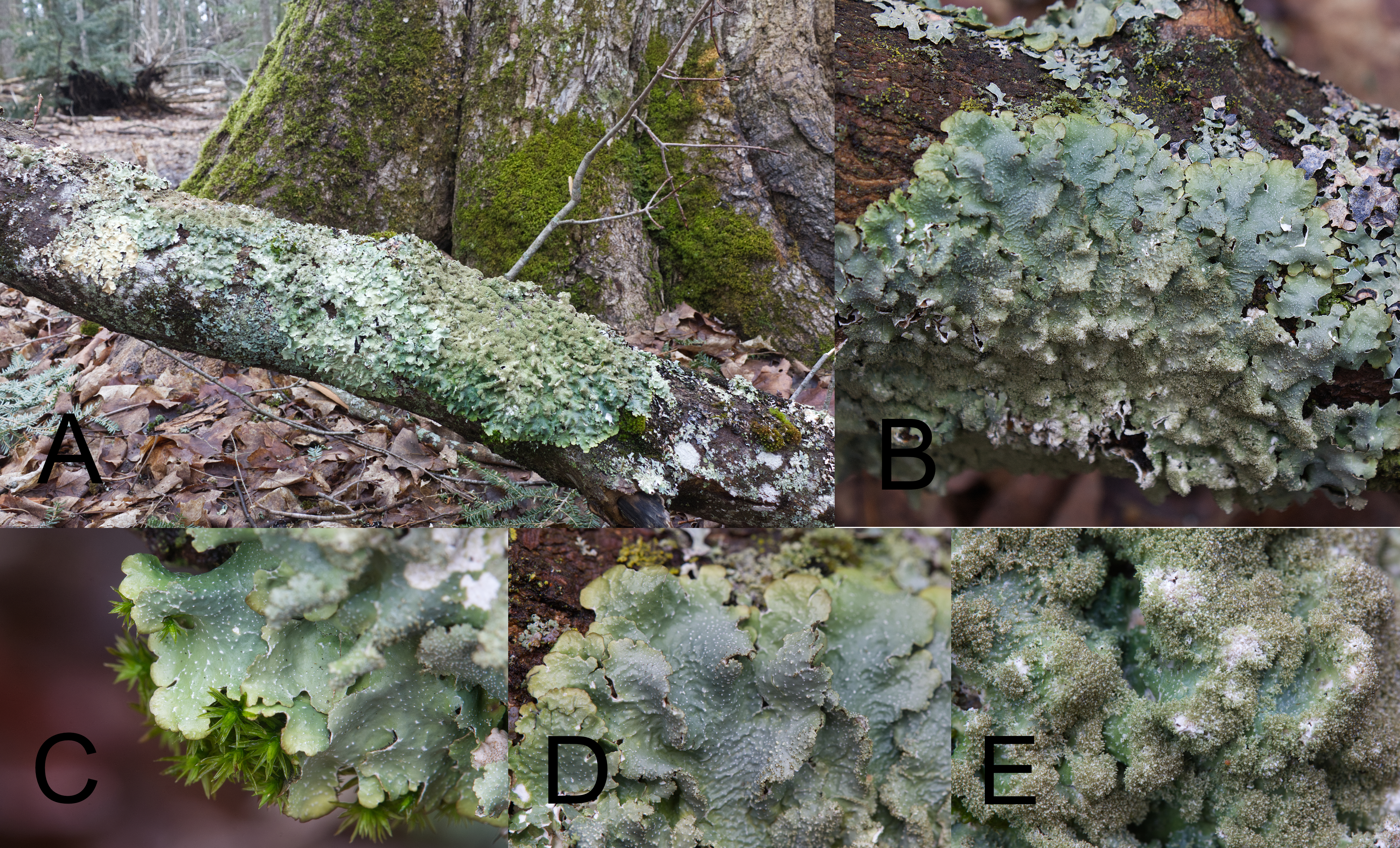
Two large foliose lichens dominated the branches that had fallen from at least twenty metres above the ground. The pale yellow-green corticolous Common Greenshield Lichen (Flavoparmelia caperata) formed fist-sized circular patches that wrapped right around the branch. Known to grow on bark of all kinds in sun or partial shade, this very common lichen is often the first to return following complete loss of lichens.The lobes of most specimens I saw were wrinkled, showing their age. The corticolous Rough Speckled Shield Lichen (Punctelia rudecta) sprawled over and under and alongside the Common Greenshield Lichen, large lobes spreading out from the thallus edges. This bluish-green lichen is distinguished by the tiny white pores (pseudocyphellae) on its upper thallus and central dense mass of white brown-tipped isidia (asexual fruiting bodies). Its annual growth rate (5 mm/year) tends to be faster than Common Greenshield Lichen (1-5 mm/yr).
.
.
Both lichens prefer hardwood nutrient-rich bark with base-poor substrate (pH 5.5 to 7.0) in moist shaded environments, and both are considered pollution tolerant. The branches also supported Hammered Shield Lichen (Parmelia sulcata), the City Dot Lichen (Scoliciosporum chlorococcum), and two mosses, Bristle Moss (Orthotrichum spp.) and Crisped Pincushion Moss (Ulota crispa).
*****
*This forest meets all criteria for old-growth: super-canopy trees in a many-layered forest with dead wood and cavity trees, logs and snags; diverse and abundant fungi, lichen, moss and herbaceous layer, food for mammals and birds; an organic-rich spongy soil layer of pits and mounds; and—aside from the trails themselves—no human disturbance.
**A 2012 core survey of eight large Sugar Maples (52.5 to 78.8 dbh) in the Burnham Forest by the Ontario Ministry of Natural Resources revealed ages from 72 to 330 years old, with an average of 190 years old. A 2020 survey of large Sugar Maples by Quinby and Collings confirmed that most large Sugar Maples (over 60 dbh) were over 200 years old. I wonder at the exact age of my #4 maple with dbh of 90 cm.
.
.

.
References:
Armstrong, Richard A. and Tom Bradwell. 2010. “Growth of crustose lichens: a review.” Geografiska Annuler Series A Physical Geography 92(1): 3-17.
Bhatta, Sagar, Cristina Ratti, Pataice E. Poubelle, and Tatjana Stevanovic. 2018. “Nutrients, Antioxidant Capacity and Safety of Hot Water Extract from Sugar Maple (Acer saccharum M.) and RTed Maple (Acer rubrum L.) Bark.” Plant Foods Hum Nutr. 73(1): 25-33.
Dymytrova, Lyudmyla. 2011. “Notes of the genus Scoliciosporum (Lecanorales, Ascomycota) in Ukraine.” Polish Botanical Journal 56(1): 61-75.
Farrar, John Laird. 1995. “Trees in Canada.” Natural Resources Canada, Canadian Forest Service, Ottawa. 502pp.
Jenkins, Jerry. 2020. “Mosses of the Northern Forest.” Cornell University Press, Ithaca. 169pp.
McKenzie, E. Alexa et al. 2014. “Terpene chemistry of eastern hemlocks resistant to hemlock woolly adelgid.” J Chem Ecol. 14(9): 1003-12.
Muscavitch, Zachary, James Lendemer, and Richard C. Harris. 2017. “A review of the lichen genus Phlyctis in North America (Phlyctidaceae) including the description of a new widespread saxicolous species from eastern North America.” The Bryologist 120(4): 388-417.
Nature Conservancy of Canada (NCC) and TD Bank Group. 2017. “Putting a Value on the Ecosystem Services Provided by Forests in Canada: Case Studies on Natural Capital and Conservation.” Nature Conservancy of Canada, Toronto, Ontario.
Shelley E. Schoonover, Shelley E. 1951. “American Woods.” Watling & Co., Santa Monica, CA
Tanunchai, Benjawan, et al. 2022. “More than you can see: Unraveling the ecology and biodiversity of lichenized fungi associated with leaves and needles of 12 temperate tree species using high-throughput sequencing.” Front. Microbiol. 15.
Quinby, P. 2019. “Rare, Threatened and Endangered Forest Ecosystems in Ontario’s Temperate Forest Region.” Forest Landscape Baselines No. 34, Ancient Forest Exploration & Research, Powassan & Peterborough, Ontario.
Quinby, Peter and Laura Collings. 2020. “Ages of Large Trees in Mark Burnham Provincial Park, Ontario.” Preliminary Results Bulletin #8, March 2020. Ontario Ministry of Environment, Conservation and Parks. 3pp.
Walewski, Joe. 2007. “Lichens of the North Woods.” Kollath & Stensaas Publishing, Duluth, MN. 152pp.
.

.

Nina Munteanu is a Canadian ecologist / limnologist and novelist. She is co-editor of Europa SF and currently teaches writing courses at George Brown College and the University of Toronto. Visit www.ninamunteanu.ca for the latest on her books. Nina’s bilingual “La natura dell’acqua / The Way of Water” was published by Mincione Edizioni in Rome. Her non-fiction book “Water Is…” by Pixl Press(Vancouver) was selected by Margaret Atwood in the New York Times ‘Year in Reading’ and was chosen as the 2017 Summer Read by Water Canada. Her novel “A Diary in the Age of Water” was released by Inanna Publications (Toronto) in June 2020.
.
 The Meaning of Water
One thought on “A Diversity of Life on Five Ancient Maple Trees—A Tree Study”