It’s 1.5°C. That’s the line we cannot cross. Or we’re f**ked and we’ve f**ked the entire world too.
Crossing into 2.0°C of global warming seems small, but it isn’t. Remember that this is a global average over space and time. That means that in some places the rise will be much greater and more intense while in others not so great. We will experience this rise very differently region to region through local weather. This seemingly small rise will also have cumulative effects on other systems affected by incremental changes and these, in turn, will escalate into more observable disruptions of water circulation and availability, ecosystem function and biodiversity. According to most climate scientists, a 1.5°C increase marks the boundary between escalating disruption and irreversible calamitous damage.
.
.
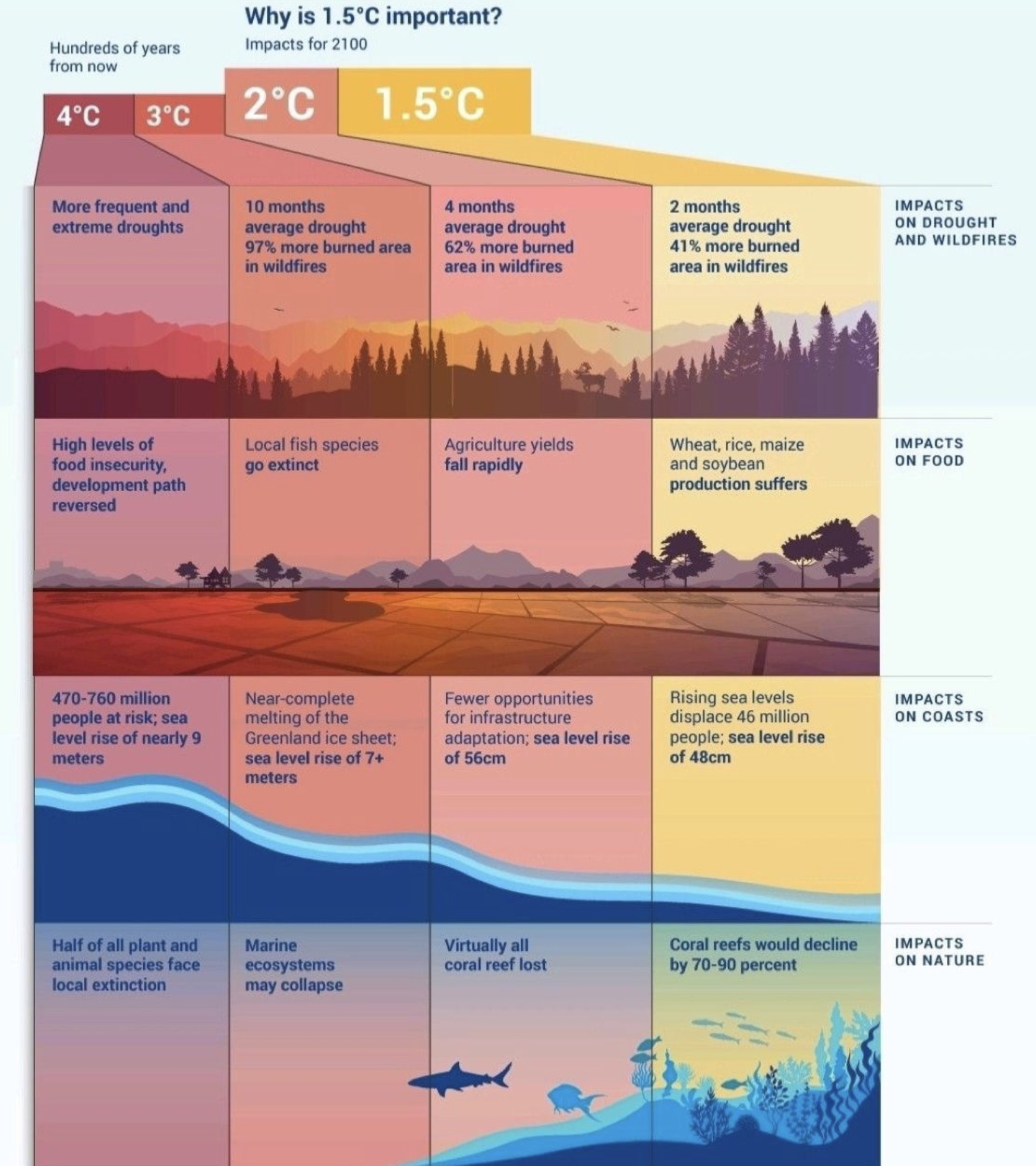
In a clear graphic, Behavior X Climate maps out the difference that a warming of 1.5°C, 2.0°C, 3.0°C and 4.0°C will make over the century.
“At 1.5°C,” climate scientists tell us, “we already face intensifying drought, longer wildfire seasons, rising seas, and severe stress on food systems. Coral reefs decline dramatically. Crop yields weaken. Millions are exposed to coastal flooding.”
At a warming of 2.0°C and beyond, the risks multiply catastrophically: doubling wildfires, sharp agricultural decline and increase in food insecurity; ice sheets destabilize, causing meters-high sea level rise; coral reefs will disappear, accelerating biodiversity collapse.
Every fraction of a degree amplifies risk. Climate systems are not linear, they explain. They respond in tipping points. Sometimes with nothing until a sudden leap; like a building titration to a threshold or tipping point. Once crossed, some changes cannot be reversed within human timescales.
“This is why 1.5°C is not just a policy ambition,” says Behavior x Climate. “It reflects physical limits identified by climate science. It defines whether impacts remain challenging or catastrophic.”
This is why we must act now.
.

Nina Munteanu is a Canadian ecologist / limnologist and novelist. She is co-editor of Europa SF and currently teaches writing courses at George Brown College and the University of Toronto. For the latest on her books, visit www.ninamunteanu.ca. Nina’s bilingual “La natura dell’acqua / The Way of Water” was published by Mincione Edizioni in Rome. Her non-fiction book “Water Is…” by Pixl Press (Vancouver) was selected by Margaret Atwood in the New York Times ‘Year in Reading’ and was chosen as the 2017 Summer Read by Water Canada. Her novel “A Diary in the Age of Water” was released by Inanna Publications (Toronto) in June 2020. Her latest eco-fiction novel Gaia’s Revolution was released by Dragon Moon Press in March 2026.
.

