Sustainability means a lot of things to a lot of people. Put simply, sustainability is the ability to continue at a certain level or rate over a long period of time: to sustain. But taken beyond the simple verb, what does sustainability encompass? In the context of planetary sustainability, most definitions are human-centric. In 1987, the UN Brundtland Commission defined sustainability as “meeting today’s needs [of humans] without compromising future generations’ ability to meet theirs.”
Discussions on sustainability recognize environmental, economic and social considerations, often debating on issues of welfare / prosperity and conservation /preservation: resource use, economic models, industry & waste treatment, productivity, consumerism, geopolitics and trade, transportation, communication, technology use, etc. Environment, in too many cases, is viewed through the lens of “resource-use” (anthropocentric), not ecosystem integrity toward planetary health to support all life (ecocentric).
Key aspects of environmental sustainability—which some argue is the cornerstone to all other aspects of sustainability—include climate change, habitat destruction and biodiversity loss. I would draw attention to specific global issues of sustainability such as planet-wide polluted rainwater (with forever chemicals), AMOC slowdown, ocean acidification, and globally reduced air, water, and soil quality.
Some consider the concept of sustainability vague, normative and jargon. Others argue that it is impossible to achieve. Of course, it’s a matter of scale and interpretation. Environmental sustainability—like climate change—is difficult to define and respond to. It remains a much-debated concept: what does it encompass? Who and what is responsible? What can be done and by who?
Environmental sustainability—like climate change—is a hyperobject.
.
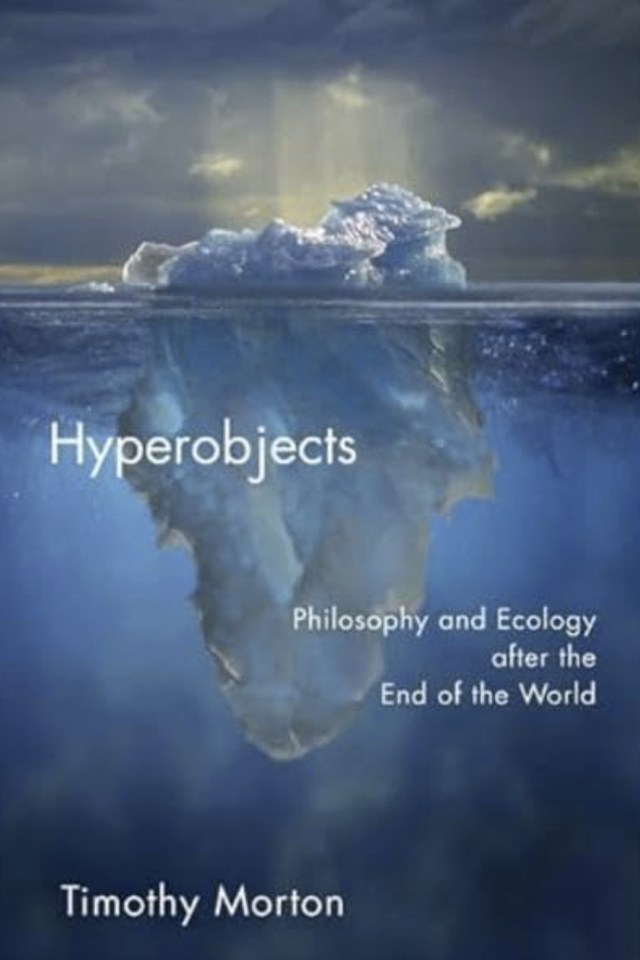
In his 2013 book Hyperobjects, Timothy Morton explains that hyperobjects are immense non-local entities that challenge our traditional understanding of objects; things so massively distributed in time and space that they defy human perception. They exist beyond our immediate sensory grasp yet they affect us profoundly. Hyperobjects are comprised of multiple other object relations; a hyperobject ‘takes over’ other objects, forcing its relations on other objects, engulfing them and changing them like a feeding amoeba.
.
How should we proceed toward a sustainable existence on the planet? Certainly at the government level. Certainly at the corporation / organizational level. Certainly at the individual and community level. These are all interlinked. They are fractal. How else can we deal with a hyperobject?
On the corporate front, some economic leaders have come up with what they call a solution without abandoning capitalism: stakeholder capitalism.
.
.
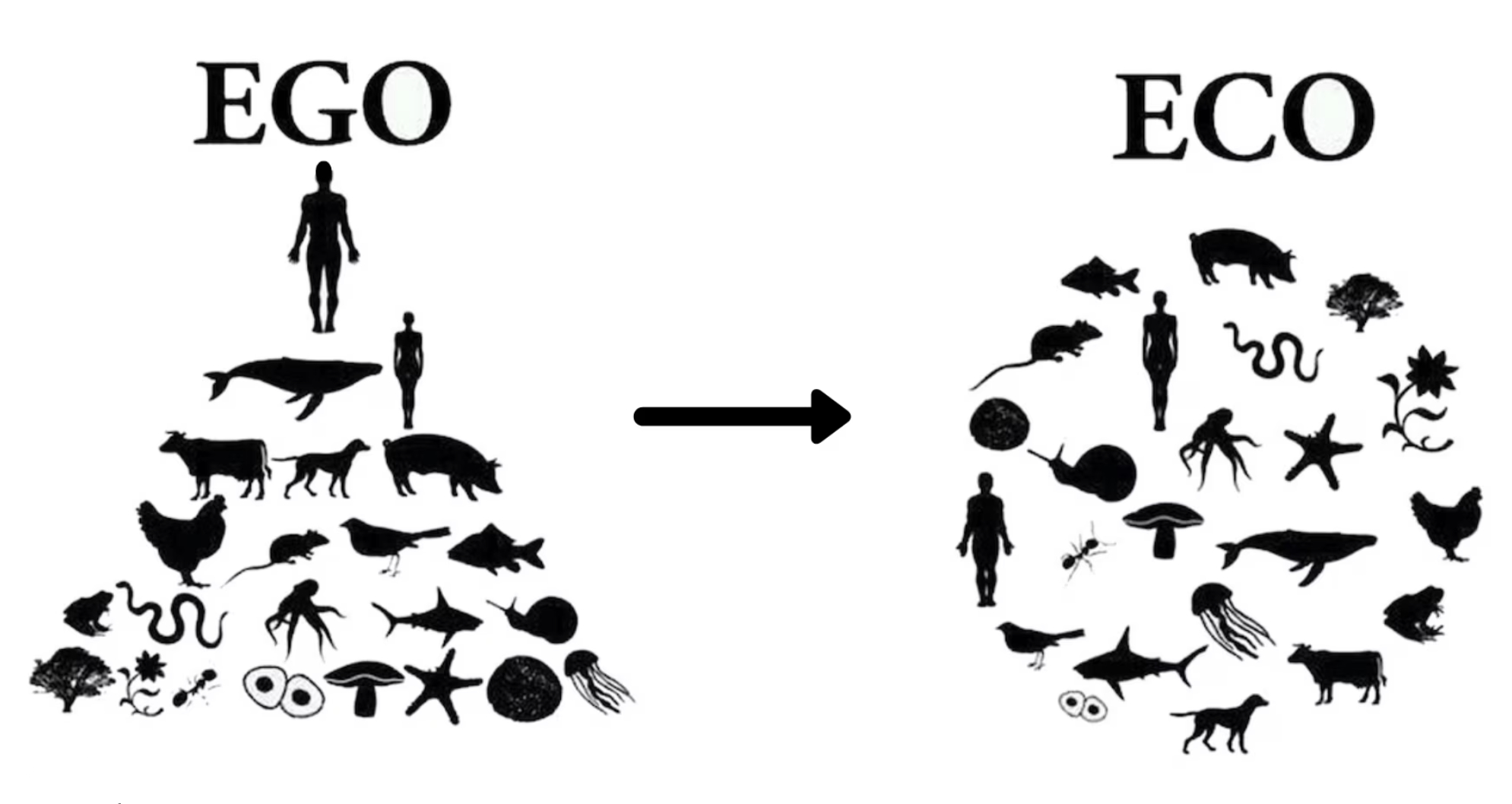
In Jan 17, 2020, The World Economic Forum presented a case for “Why we must move from egocentric to ecocentric leadership to safeguard out planet.” Promoting a revisionist strategy to capitalism, the forum discussed the notion of stakeholder capitalism (vs. shareholder or state capitalism) as a viable alternative toward sustainability. It was the theme of the Davos Manifesto 2020 announced by Klaus Schwab, Founder and Executive Chairman in preparation for the World Economic Forum, where the world’s top business executives met in Davos, Switzerland. It became the popular concept to consider for business; a kind of cheat to remain capitalist and make a profit but do it sustainably. Well, so the rhetoric goes…
Stakeholder capitalism is a corporate governance model where businesses create long-term value by serving the interests of all stakeholders, which include employees, customers, suppliers, communities—oh, and the environment—rather than solely maximizing shareholder profits. Successful stakeholder capitalism, the authors contend, would rely on building a regenerative economy. They did not define how interests and needs of the various stakeholders—environment, particularly—would be represented and how conflicting needs would be addressed. This is precisely what happened when stakeholder capitalism was first introduced in the 1930s in the United States. Organizations that adopted this model were challenged to balance conflicting claims among stakeholders, which led to mass confusion. The lack of clear prioritization among different stakeholders led to management theorists calling them “garbage can organizations.” The pushback led to Maximizing Shareholder Value (MSV).
Unfortunately, in this model, as with all capitalist models, accepting less profitability for increased sustainability appears anathema. In an article in Fortune, corporate governance lawyer Robert Profusek criticised stakeholder capitalism: “While sustainability remains a vital consideration, climate change is not an immediate existential risk that justifies spending trillions of public and private funds on unproven ventures that, at their Paris Accord extreme, would require radical change in peoples’ everyday lives…the billions poured into ESG-focused investment vehicles and start-ups failed to produce acceptable financial returns and have been largely shuttered or repurposed.” (my italics)
.
.
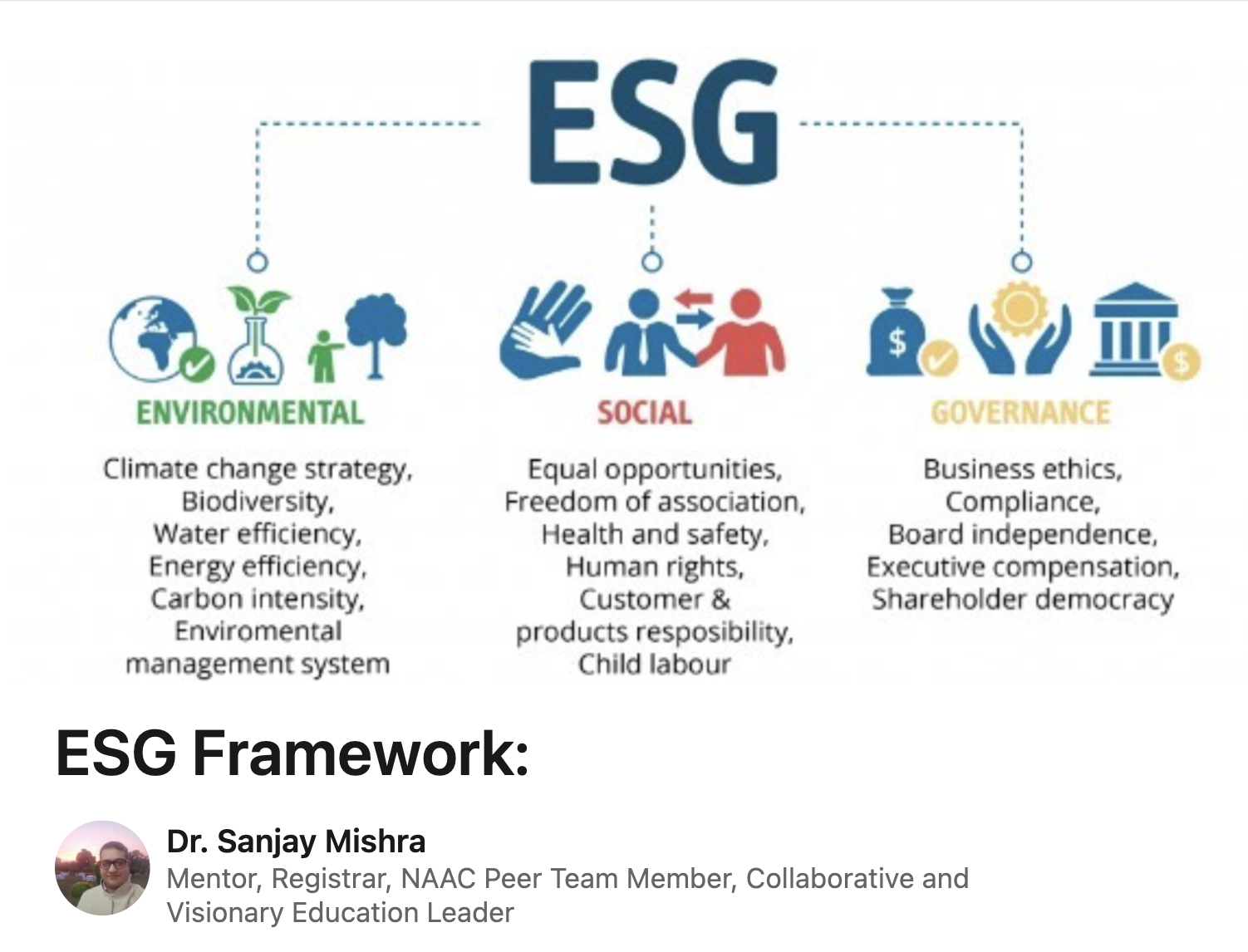
An Environmental, Social, and Governance (ESG) framework is a standardized set of guidelines used by some organizations to measure, manage, and report on their sustainability and ethical impacts. This allows a company to track its non-financial performance, mitigate risks, attract investment and build trust with stakeholders. The framework helps ensure regulatory compliance by focusing on environmental impact (e.g., carbon emissions, waste management and resource depletion), social responsibility, and corporate governance.
Profusek claimed that companies generally support key ESG objectives (though evidence was not presented) and pithily added, “but this is so only if connected to the real purpose of the enterprise—to operate for the long-term benefit of its shareholders, rather than the accomplishment of abstract societal or political objectives.” Profusek concluded his article with this proselytization: “that is to say, ESG considerations are important means to an end, not an end of themselves no matter what the loudest voices on electronic and social media might say.”
That is to say, the bottom line remains profitability. We seem stuck with the infantile notion that we can improve our home without spending anything. It seems that you can take the economist out of the ecology but you can’t take the ecologist out of the economy.
OK. Corporations have a way to go when it comes to sustainability and recognizing environment as a vital and existential stakeholder. Let’s move on to the individual…
How do you—as an individual—respond to a global phenomenon?
When I was a teenager, I became an environmental activist; I wrote articles in the school newspaper and put up posters on the school walls about how we were globally polluting and changing the planet. My finger pointed far and wide. Then a well-meaning teacher counselled me to focus on local—not global—concerns. Things in my community like recycling and the local waste stream. Littering. Use of plastics. While his condescending advice rankled, I must now accept some wisdom in that advice.
How can we, as individual citizens, expect industry and governments to respect the environment—stop raping the land and water, come up with innovative respectful solutions and accept less profit for more sustainability—if we continue to act as blind consumers, always wanting more without thinking of the consequence, relentlessly adding so much to the waste stream, littering our streets, roadways, paths and parks?
Environmental sustainability starts with you and me, acting as environmental citizens and ecocentric communities. This is one case where my Mennonite relatives’ adage of “less is more” truly applies. Sustainability is a fractal phenomenon; it flows from the microcosm to the macrocosm, and back. I am reminded of the SF series The Expanse, and the Belters’ maxim: the more you share, the more your bowl is plentiful. Time to live with less, so there is more…
.
(A version of this article appeared in the Sustainability Thread of Reality Skimming Blog in March 2026)
.
References:

.
Capital Institute. “8 Principles of A Regenerative Economy.”
Morton, Timothy. 2013. “Hyperobjects: Philosophy and Ecology after the End of the World.” University of Minnesota Press. 240pp.
Profusek, Robert. 2026. “It isn’t partisan politics to admit that stakeholder capitalism went too far, too fast.” Fortune, February 11, 2026.
United Nations. “Sustainability”
World Economic Forum. 2019. “Davos Manifesto 2020: The Universal Purpose of a Company in the Fourth Industrial Revolution.” December 2, 2019.
World Economic Forum. 2020. “Why we must move from egocentric to ecocentric leadership to safeguard out planet.” January 17, 2020.
.
.

Nina Munteanu is a Canadian ecologist / limnologist and novelist. She is co-editor of Europa SF and currently teaches writing courses at George Brown College and the University of Toronto. For the latest on her books, visit www.ninamunteanu.ca. Nina’s bilingual “La natura dell’acqua / The Way of Water” was published by Mincione Edizioni in Rome. Her non-fiction book “Water Is…” by Pixl Press (Vancouver) was selected by Margaret Atwood in the New York Times ‘Year in Reading’ and was chosen as the 2017 Summer Read by Water Canada. Her novel “A Diary in the Age of Water” was released by Inanna Publications (Toronto) in June 2020. Her latest eco-fiction novel Gaia’s Revolution was released by Dragon Moon Press in March 2026.
.

