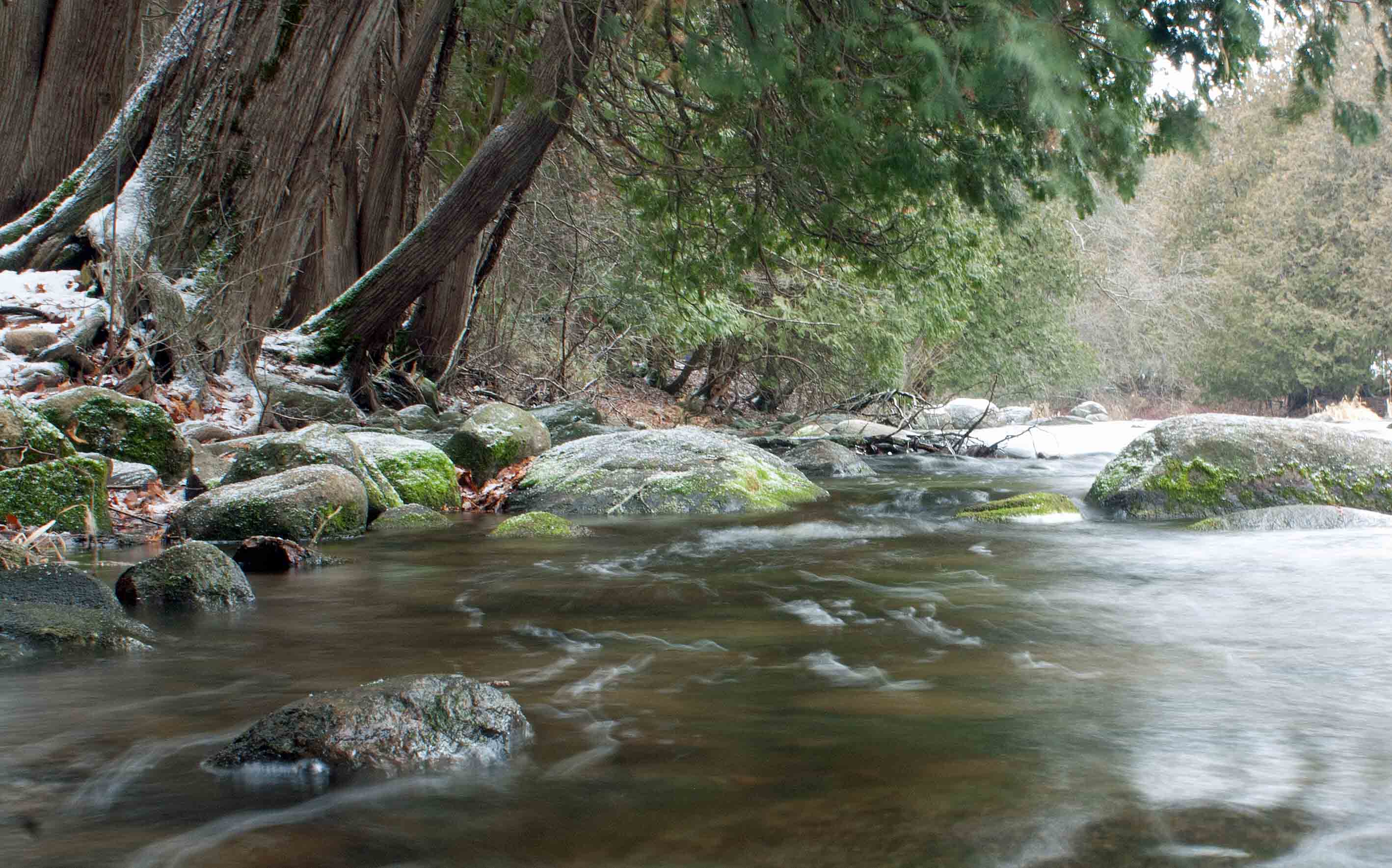
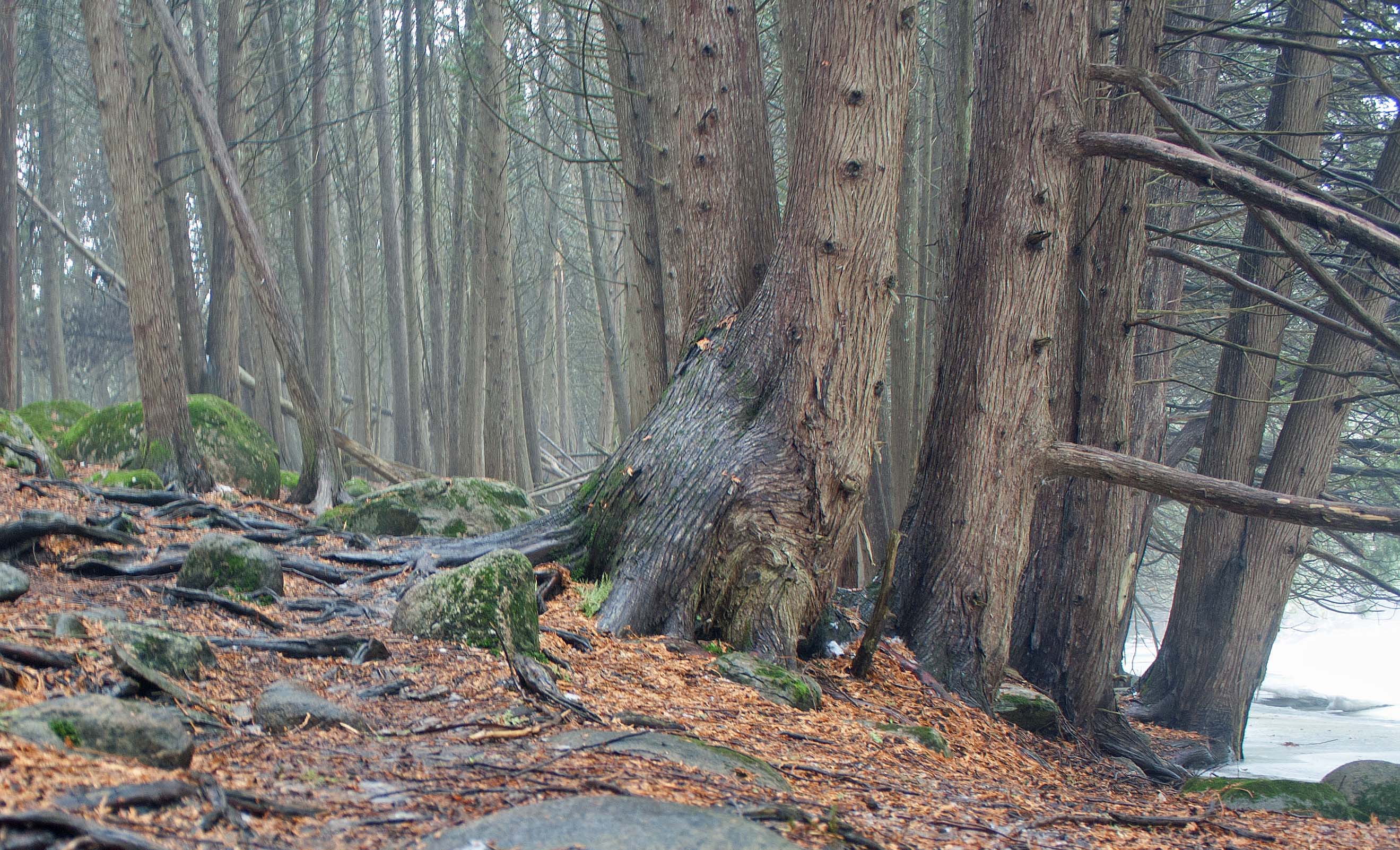
One of the gems of the town of Peterborough is Jackson Creek Park, a 4.5-hectare old-growth forest of over 150-year old trees with super-canopy trees, typical pit and mound topography, lots of coarse woody debris and nursing logs and snags for significant wildlife from the Pileated woodpecker to the red fox. Some trees are 250 years or older, pre-dating the original settlement of the town of Scott’s Plains, now Peterborough, Ontario.
I’m told that Peterborough is one of only eight cities in Ontario with an identified remnant old-growth forest within its urban core. The Jackson Creek old-growth forest is the fourth oldest of Ontario’s identified old-growth forests.
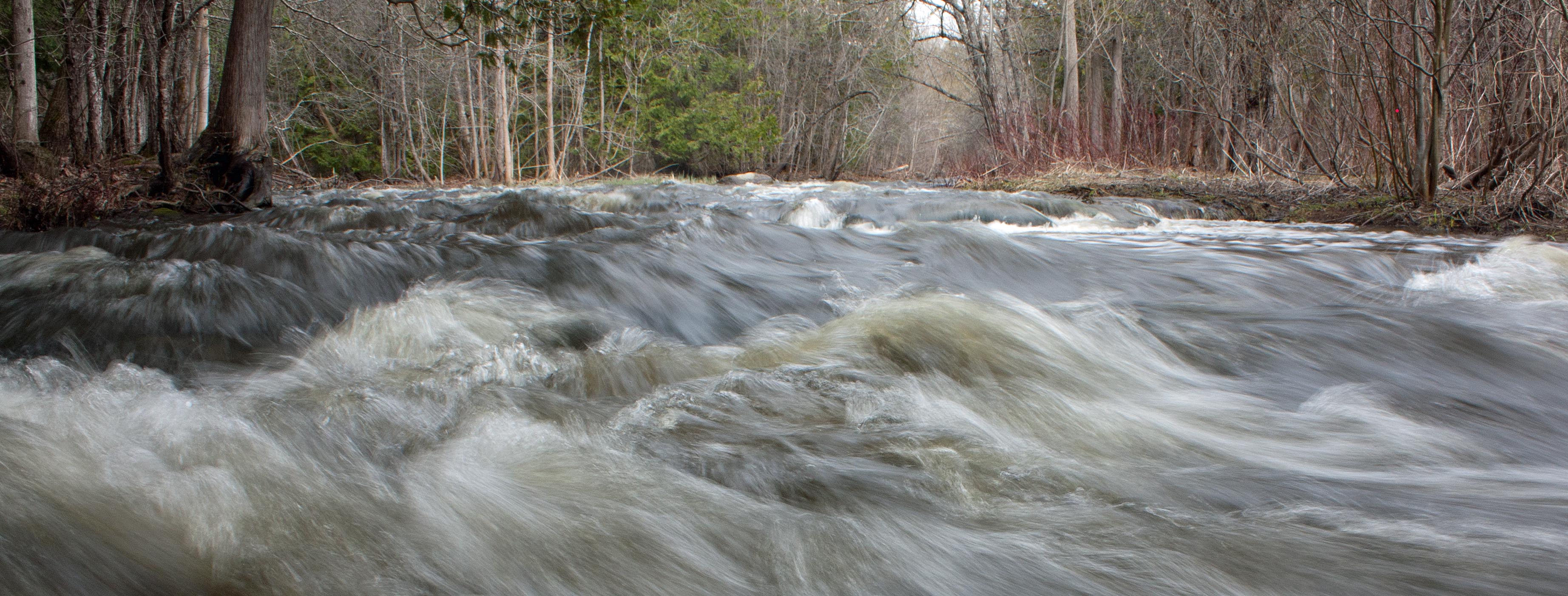
I walk this park as often as I can to enjoy its rich sensual treasures that both calm me and thrill me. I normally take a small trail down a steep incline to Jackson Creek, where a succession of rapids and glades has cut an active channel of rushing water over glacial boulders and cobbles.
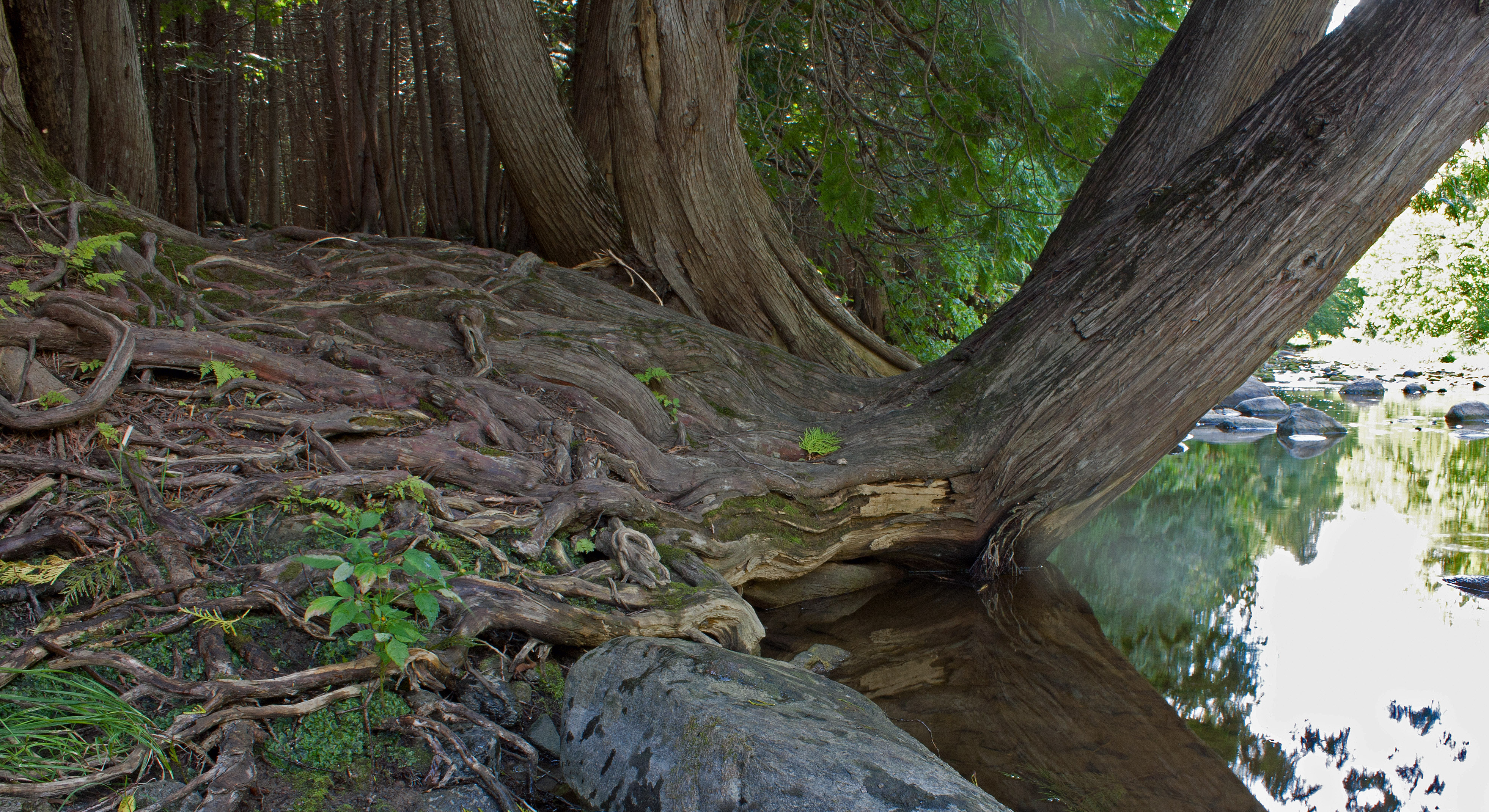
From there, I walk upstream along the creek’s right bank via a small, root-riddled rocky muddy path in a White Cedar (Thuja occidentalis) riparian forest, beneath a supercanopy of White Pines (Pinus strobus). I’m often accompanied by the shrill cry of bluejays, the ponderous echoing knock of the pileated woodpecker and the quarrelsome chatter of the red squirrel. Eastern Hemlock (Tsuga Canadanesis) and deciduous trees add to the mixed diverse lowland forest: sugar maple, American beech (Fagus grandifolia), yellow birch (Betula alleghaniensis) red oak (Quercus rubra), American hophornbeam (Ostrya virginiana).
Two other riparian trees, both nut trees, keep the copious black and red squirrels happy: the black walnut (Juglands nigra)and the bitternut hickory (Carya cordiformis), also in the walnut family (Juglandaceae). The bitternuts that I observed and identified by their nuts on the ground stood among black walnuts and cedar trees just metres from Jackson Creek.

Description of the Bitternut Hickory
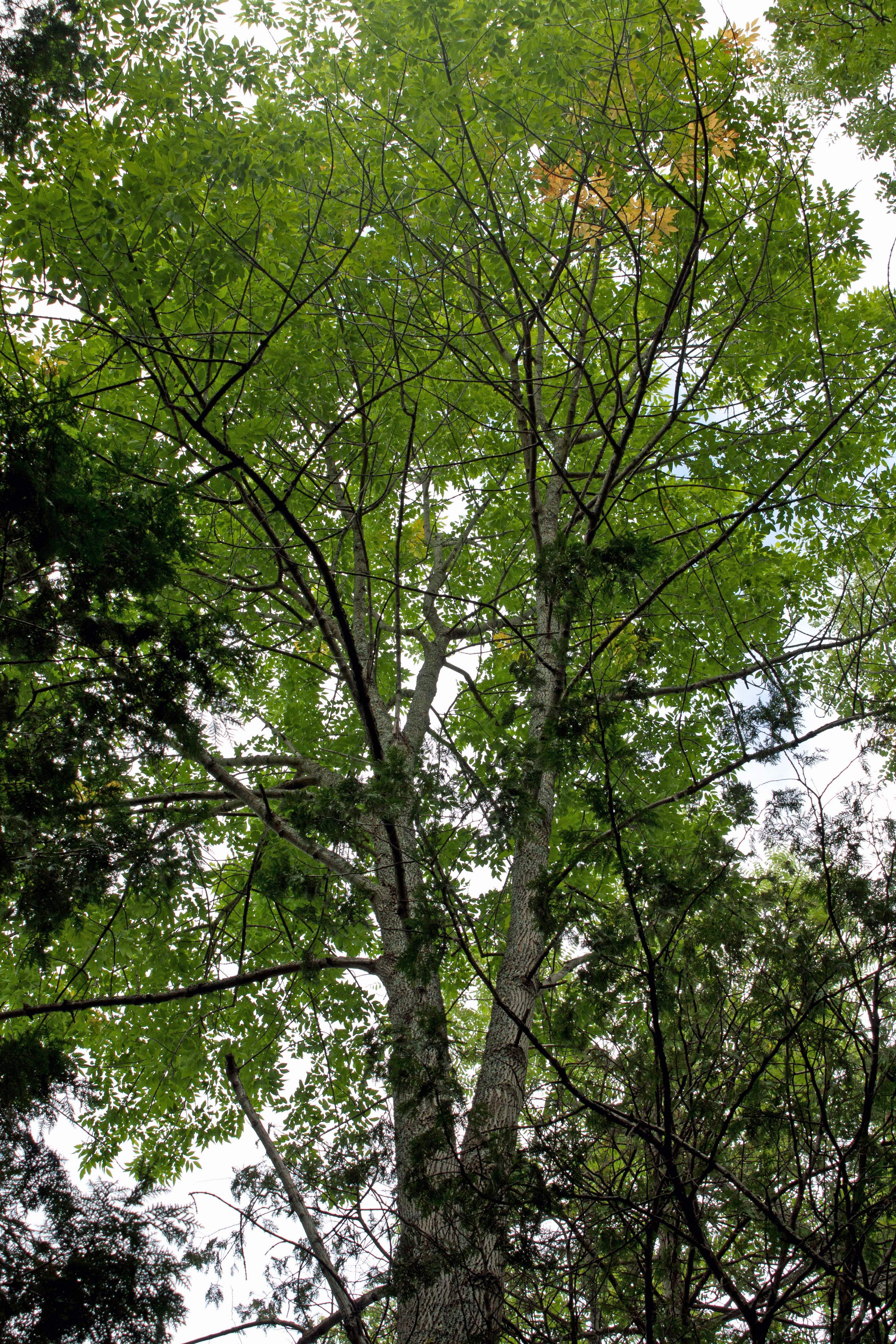
The bitternut hickory tree—also known as swamp hickory—is considered a large tree, growing to 30 metres (100 feet) and a trunk reaching about 60-90 cm in diameter. The trunks of the bitternut in the Jackson Creek densely forested riparian area were long and straight with a relatively short crown.
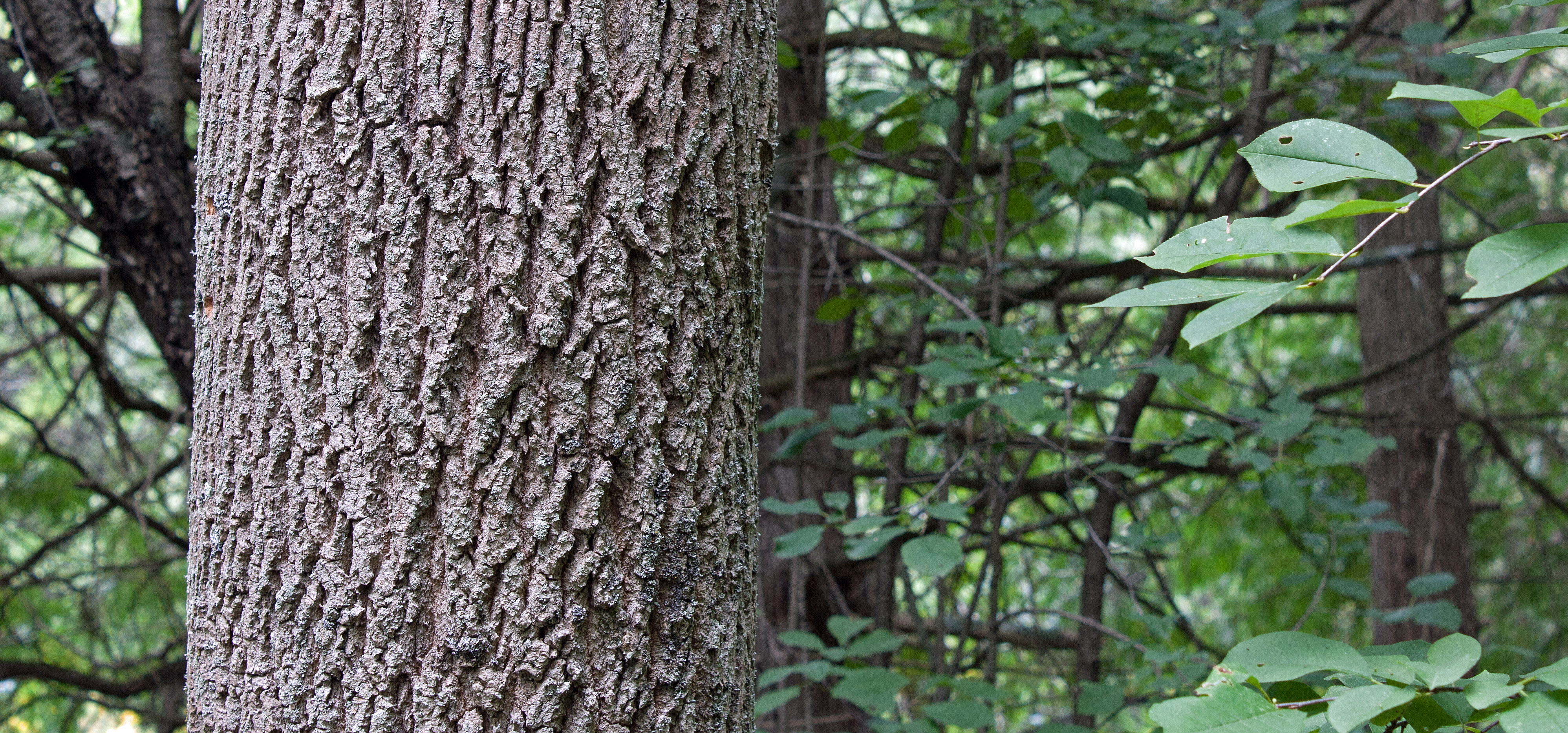
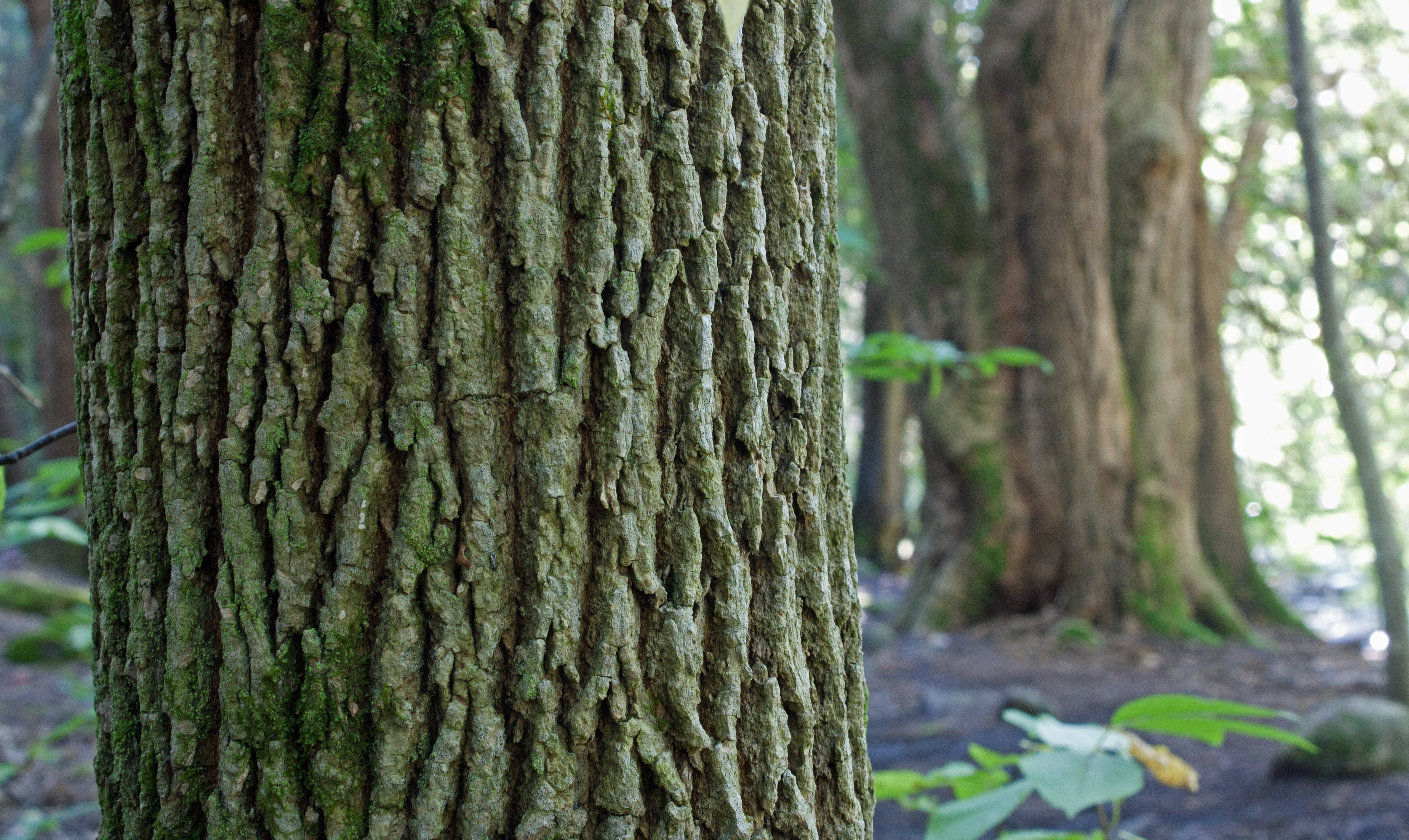
Trunk bark can be highly variable, depending on the age of the tree: young trees have light gray to gray trunk bark with shallow fissures that are dull white or yellowish red; trees of intermediate age have trunk bark that is gray, rough, irregular, and shallowly furrowed; older trees have trunk bark that is gray with interlaced furrows and flat-topped ridges.
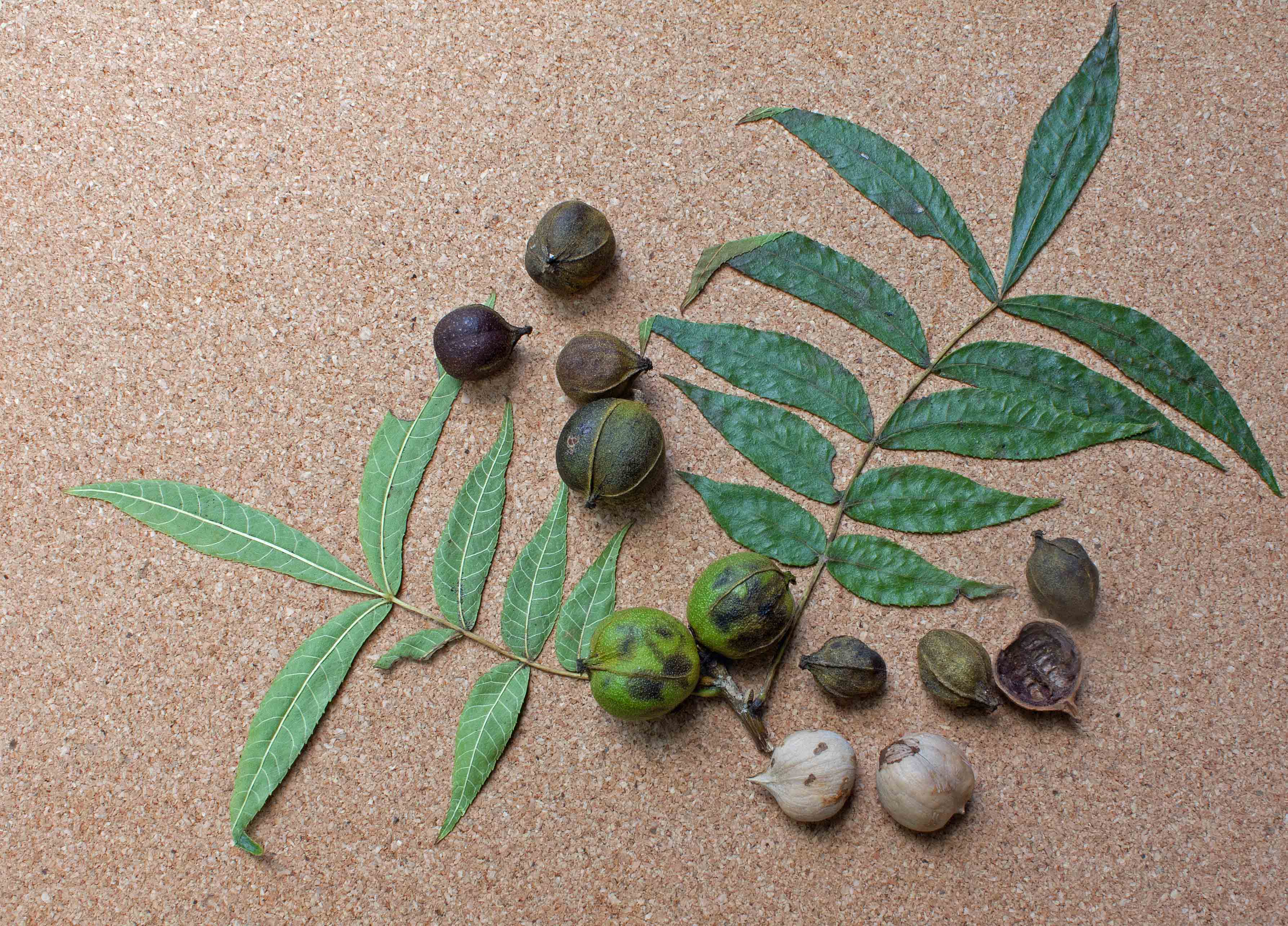
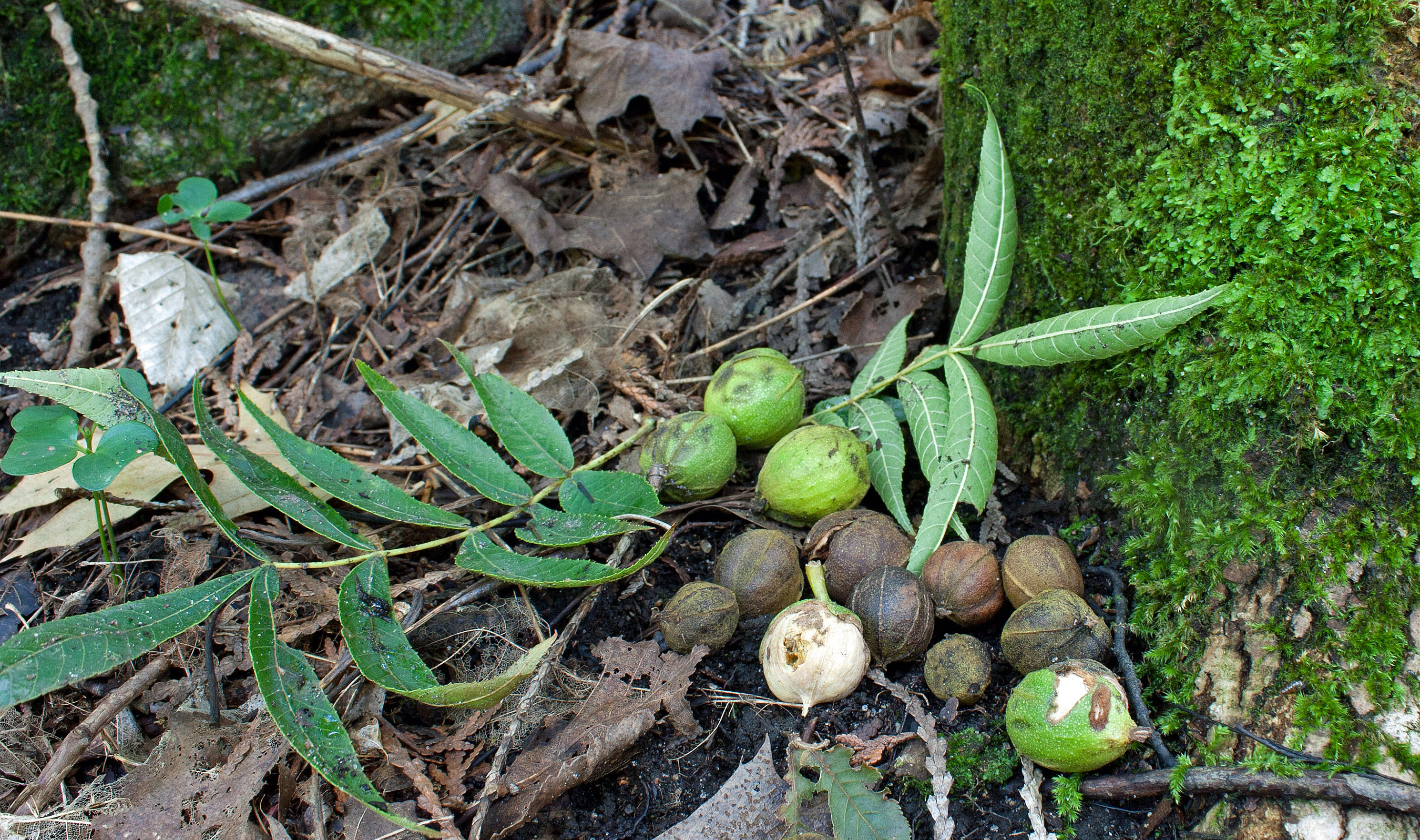
The alternate leaves are compound, odd-pinnae with 7-11 long and pointed leaflets, normally about 7-13 cm (up to 5 inches) long, with serrated margins. Distal leaflets are larger than leaflets closer to the petiole. The luna moth, regal moth and underwing moths use bitternut hickory leaves as food.
A key identifying feature of the tree is its lateral buds of young twigs that are bright sulfur-yellow or yellow-orange from a powdery coating.

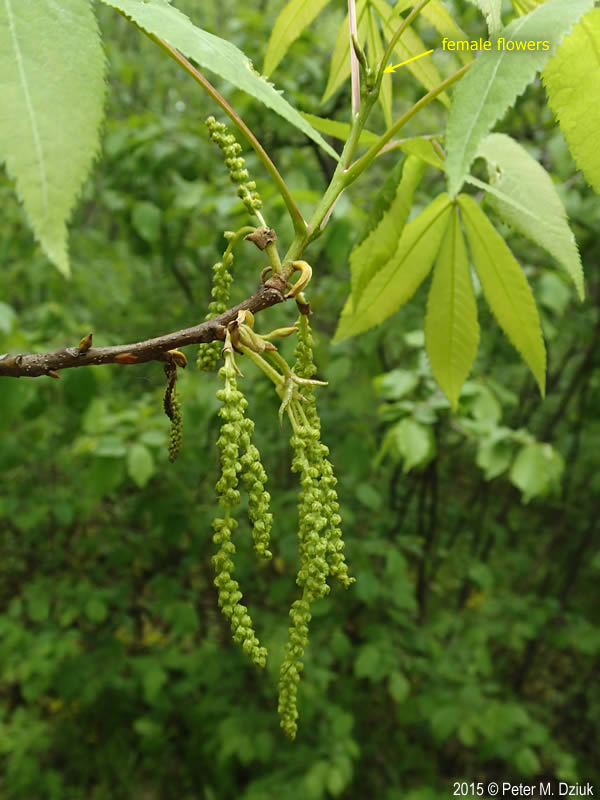
The bitternut hickory tree is monoecious, with both male and female flowers produced on the same tree. It’s male catkins droop downward and he female flowers are arranged in small short spikes at the tips of the current year’s twigs. The tree blooms from mid- to late spring for bout 1-2 weeks, cross-pollinating flowers through wind action.
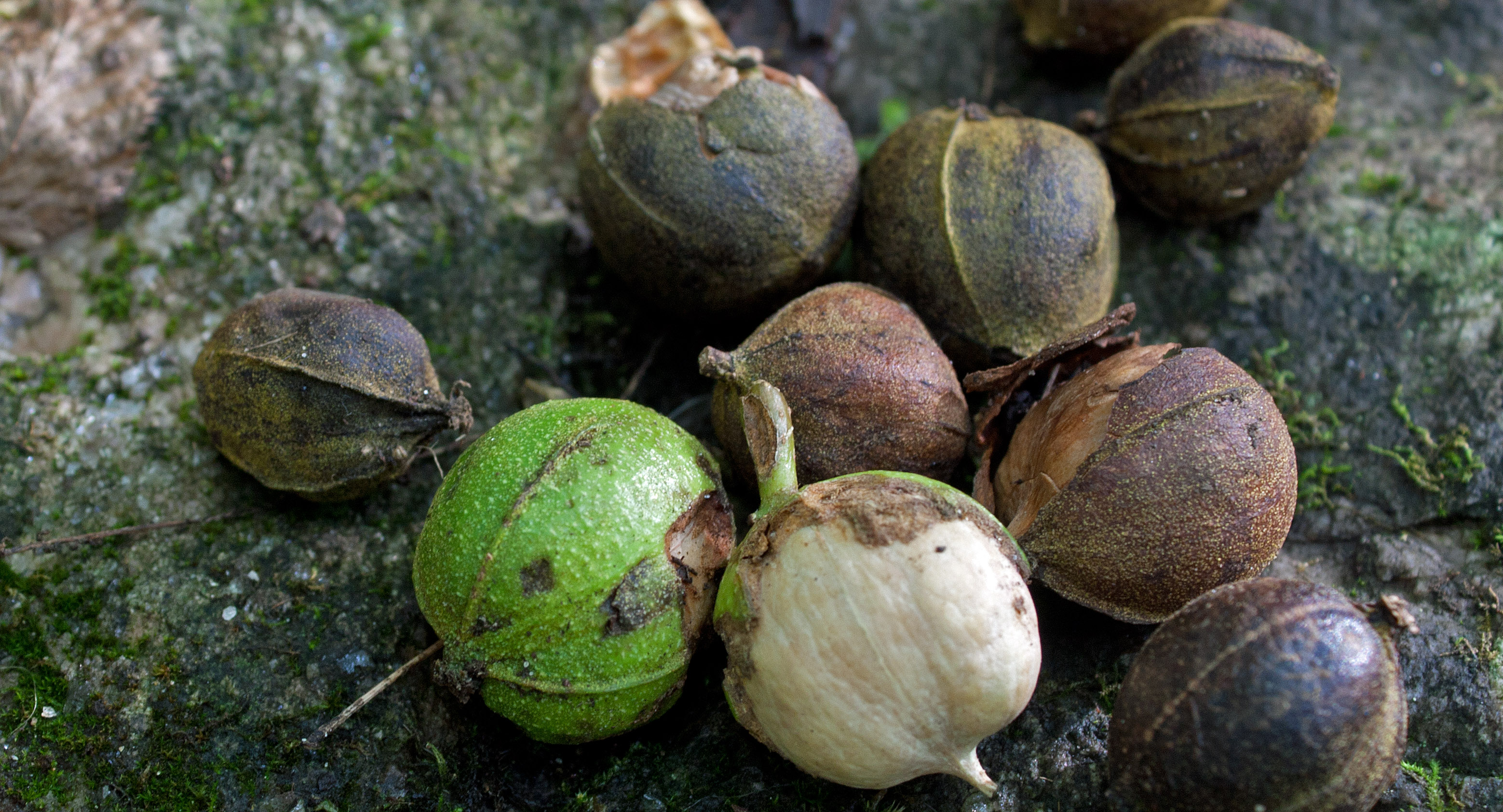

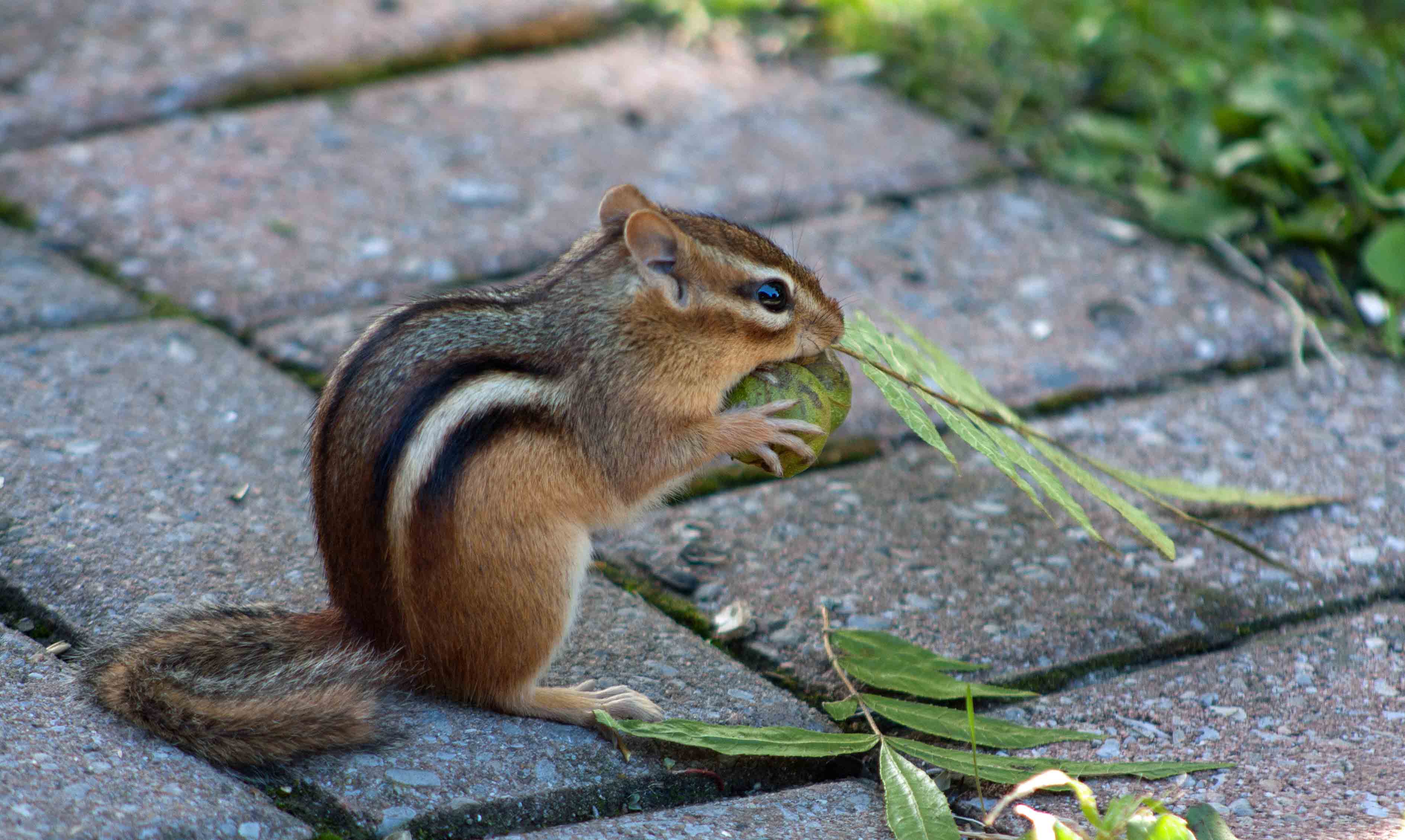
When it is over thirty years old the tree begins to develop fruit from September to October. Solitary or paired nuts form greenish globe-shaped husks about 2 to 3.5 cm long in autumn, each with a smooth surface and four narrow ridges along the fruit’s length. The husk eventually splits open along these ridges to release the nut. Each nut has a round shape with a prominent beak; its shell is light brown, thin and smooth. The meat of the nut is very bitter—hence the name of the tree. Despite its bitterness, the nuts are eaten by squirrels, mice and deer. Squirrels also nibble on the buds.
Where The Bitternut Hickory Grows
The bitternut hickory is the most widespread hickory in Canada. It grows across Southern Ontario and south throughout the eastern United States. This tree is usually found in bottomland woodlands and protected river valleys along streams and rivers, at the base of moist slopes and cliffs. It also occurs in upland woodlands, along the edges of rocky glades, woodland borders along roads, and edges of powerline clearances in wooded areas where there is sufficient moisture and rich soil. It is somewhat vulnerable to fire and can be found in both degraded and higher quality woodlands. The Bitternut tree prefers full or partial sun, moist to dry-mesic conditions, and a fertile loamy soil. Small bitternut hickories will grow in dense shade under the tops of sugar maple, white oak, white ash, and black walnut. The bitternut hickory is a moderately fast growing tree; individuals can live up to 200 years. It takes 30 years for a tree to produce nuts.
The Human Connection
The bitternut is used for lumber and pulpwood. Given the hard and durable wood, uses include furniture, paneling, dowels and ladders. The Missouri Department of Conservation shares that bitternut hickory wood is shock resistant and has been used to make handles for striking tools. It has also been used to make wheel spokes and sports equipment such as lacrosse sticks. Bitternut wood is highly prized as fuel for making hickory-smoked meats and is also used for making barbecue charcoal. The wood is excellent as fuel for cook stoves, furnaces, or fireplaces.
Bitternut Hickory Lore & Wisdom
The Bitternut Hickory is a symbol of strength and endurance; it symbolizes rebirth and survival, echoing an indigenous heritage that promotes environmental stewardship. The bitternut hickory is a biodiversity and environmental ally, providing habitat, purifying air, and combatting erosion. It holds a storied place in Native American mythology, casting the hickory as a resurrector in Seneca myth; the dead rise at the base of this magnificent tree–echoing a reverence for the cycle of life and death.


Nina Munteanu is a Canadian ecologist / limnologist and novelist. She is co-editor of Europa SF and currently teaches writing courses at George Brown College and the University of Toronto. Visit www.ninamunteanu.ca for the latest on her books. Nina’s bilingual “La natura dell’acqua / The Way of Water” was published by Mincione Edizioni in Rome. Her non-fiction book “Water Is…” by Pixl Press (Vancouver) was selected by Margaret Atwood in the New York Times ‘Year in Reading’ and was chosen as the 2017 Summer Read by Water Canada. Her novel “A Diary in the Age of Water” was released by Inanna Publications (Toronto) in June 2020.


A lovely place. Hope to see it in person sometime.
LikeLiked by 1 person
I hope you do too, David. It is a lovely urban forest …
LikeLike