In 1973 Dallas, Texas, Mrs. Marie Harris called firefighters about an ominous yellow blob that was attacking a telephone pole by her place. According to news reports, the firefighters “tried to subdue it with hoses, but the creature grew bigger and climbed up the pole.” Locals feared an alien invasion. Yellow blobs were appearing on peoples’ lawns. Now a giant yellow blob was ‘eating’ the telephone pole!
.

Shades of “The Blob,” in which a young Steve McQueen battles … well … an alien blob.
This 1958 cult classic of gooey greatness follows the havoc wreaked on a small town by an outer-space monster with neither soul nor vertebrae. Steve McQueen plays the rebel teen who tries to warn the residents about the jellylike invader.
.
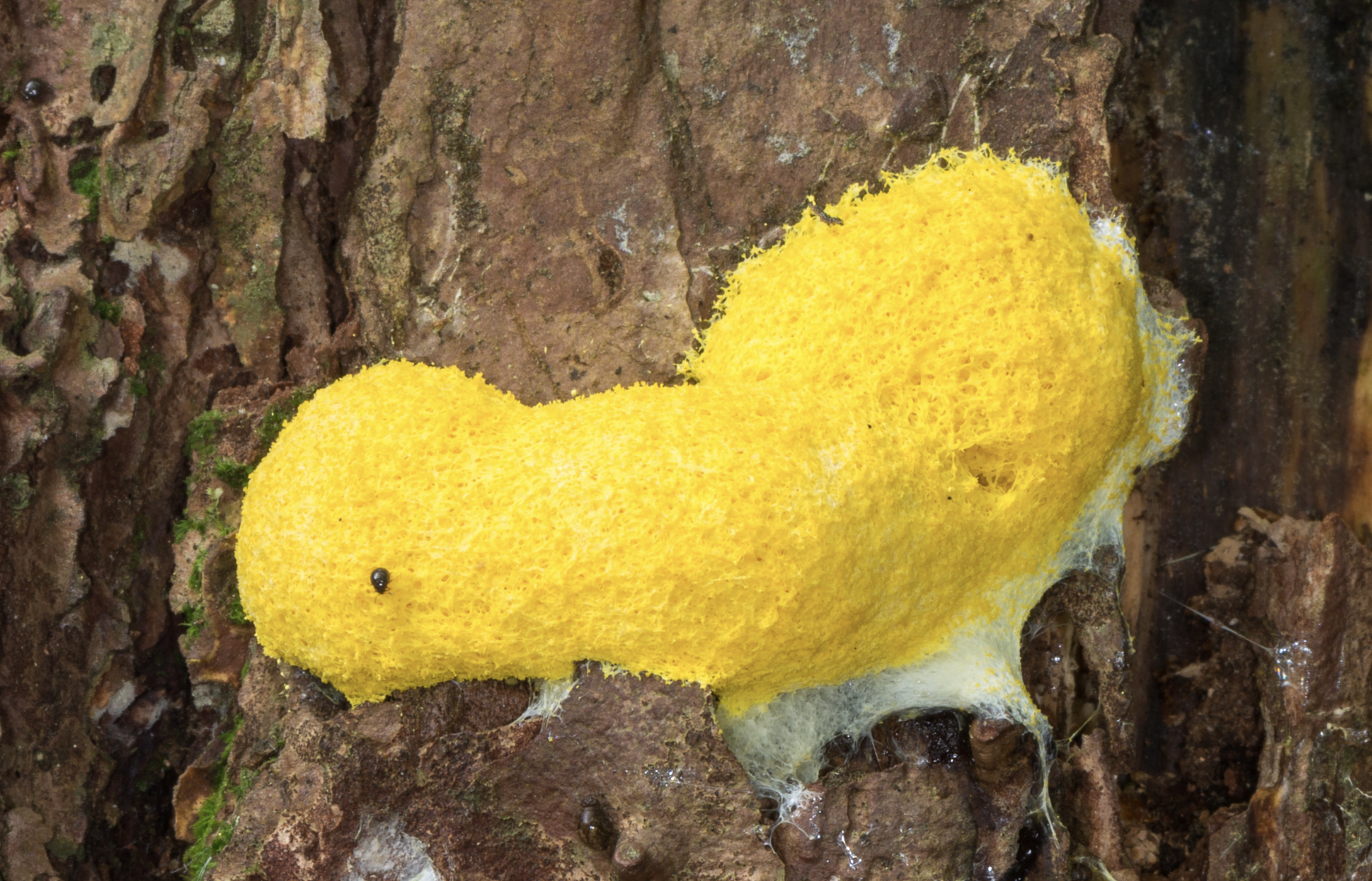
Luckily, before things got out of hand and the Dallas community went into full panic mode, Dr. Fannie Hurst, botanist at Baylor University, and Jerry Flook, herbarium botanist at Southern Methodist University, identified the interloper as the common slime mold Fuligo septica (affectionately known by some as Dog vomit slime mold and Scrambled Egg slime mold by others).
.
.
Slime molds are bizarre life forms, once classified as fungus—because they sort of looked like fungi. Unlike a fungus that is not capable of absorbing and digesting their food internally, a slime mold can; they conduct phagocytosis—just like the amoeba I studied in school. slime molds are made up of amoeboid organisms currently classified under the polyphyletic grouping Mycetozoa belonging to the Kingdom Protista, which includes algae (e.g. diatoms) and protozoans (e.g., Paramecium). Fungi also don’t move, but slime molds do.
Fuligo septica is a bright yellow or white, cushion-shaped, great big single-celled organism with multiple nuclei (a plsmodial slime mold) that feeds on bacteria and fungi in decaying organic matter. It belongs to the Myxomycetes, the true slime molds, and is commonly found on rotten wood, plant debris, and bark mulch during warm, wet weather. The jelly-like plasmodium crawls, moving like an amoeba, as it feeds until it matures into a rigid, spore-producing structure.
The fruiting bodies of F. septica are large, yellowish sponge-like called an aethalium, which produce spores. The aethalium is a specialized, sessile, cushion-shaped structure without a stalk. The spores are violet-black.
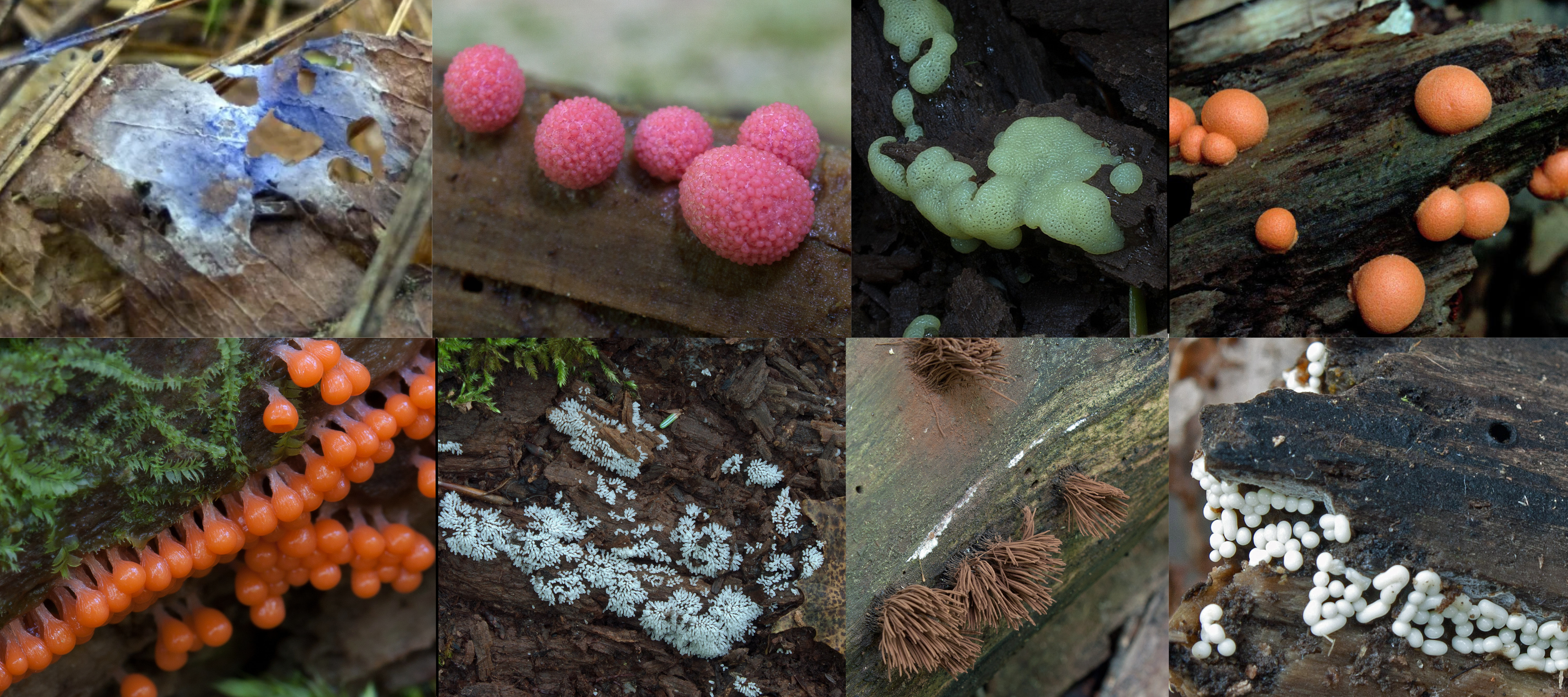
Slime molds come in many different shapes and colours—some being bright neon—varying from yellow, pink, green, brown, black and white. Their names are as flamboyant and distinctive as their colours. Names like: Moon Poo Slime, Wolf’s Milk Slime, Tree Hair Slime, Bubble Gum Slime, Tapioca Slime, and Chocolate Tube Slime.
.
.
All to say that these ‘blobs’ are indeed harmless and won’t be taking over the planet any time soon. However, do keep in mind that ‘taking over the planet’ can be interpreted in many different ways:
“The slime mold doesn’t need to stomp or punch; it just spreads and consumes and fruits, expanding the microcosmos in its own body as it stakes a claim in our world.”—James Weiss and Deboki Chakravarti, Journey to the Micro Cosmos
.
References:
Smith, H.R. 2023. “A Slime of One’s Own.” Bay Nature magazine, January 3, 2023.
.

Nina Munteanu is a Canadian ecologist / limnologist and novelist. She is co-editor of Europa SF and currently teaches writing courses at George Brown College and the University of Toronto. For the latest on her books, visit www.ninamunteanu.ca. Nina’s bilingual “La natura dell’acqua / The Way of Water” was published by Mincione Edizioni in Rome. Her non-fiction book “Water Is…” by Pixl Press (Vancouver) was selected by Margaret Atwood in the New York Times ‘Year in Reading’ and was chosen as the 2017 Summer Read by Water Canada. Her novel “A Diary in the Age of Water” was released by Inanna Publications (Toronto) in June 2020. Her latest eco-fiction novel Gaia’s Revolution was released March 2026 by Dragon Moon Press.
.

