May 2071
I rock on the cedar swing on my veranda and hear the wind rustling through the gaunt forest. An abandoned nest, the forest sighs in low ponderous notes. It sighs of a gentler time. A time when birds filled it with song. A time when large and small creatures—unconcerned with the distant thrum and roar of diggers and logging trucks—roamed the thick second-growth forest. The discord was still too far away to bother the wildlife. But their killer lurked far closer in deadly silence. And it caught the birds in the bliss of ignorance. The human-made scourge came like a thief in the night and quietly strangled all the birds in the name of progress.—Robin’s Last Song
.
.
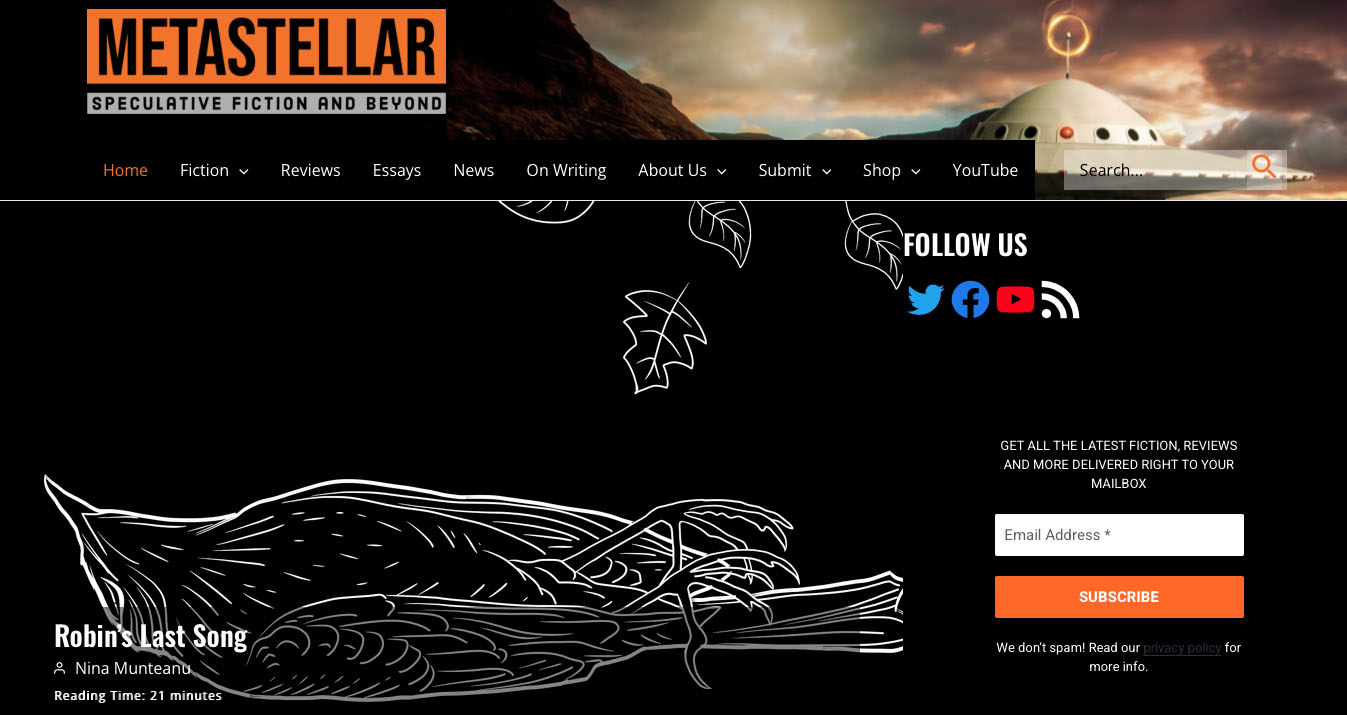
My story Robin’s Last Song is an eco-fiction short story that follows Robin, a blind elder who uses sight-enhancing technology, as she navigates the aftermath of a sudden global extinction of birds that her digital app failed to predict. The story explores the conflict between nature and technology, as well as Robin’s journey to find hope in soundscape ecology. You can read the full story on MetaStellar Magazine or find it in the classic Apex Magazine Issue #128.
.

.
In a recent interview I was asked how I came to write this particular story about birds and soundscape ecology; here’s my response:
Since I was a child, the burgeoning SF writer in me had dared to imagine a world without the sound of birds—I thought it utterly bleak and, recognizing an ever-polluting world, I feared for my feathered relatives. I didn’t follow through with a story until September 2019, when I was approached by Oliver Hockenhull, the guest editor of subTerrain Magazine, to write a piece on technology and the environment. The timing was interesting; I’d just read two impactful things that resonated with me.
The first was the October issue of Science Magazine that reported a staggering decline in North American birds. Kenneth V. Rosenberg and his team of researchers had estimated that three billion birds of various species had disappeared in Canada and the US since 1970. That’s a third of the entire bird population lost in five decades. To make it clear, we aren’t talking about rare birds going extinct; these declines are of common birds throughout the world. The wrens, sparrows, starlings, and, of course, the robins. I was devastated; I could not imagine a world without the comforting sound of birds. What would it be like if the birds all disappeared? This brought me back to my childhood fears.
The second article I ran across talked about an emerging bioacoustics tool, soundscape ecology, that measures biodiversity and the health of an ecosystem, mostly through bird sound which well represents ecosystem health. Bernie Krause, a soundscape ecologist who had been conducting long-term recordings for decades noted how the dawn chorus in many areas had greatly diminished if not vanished altogether.
I now had my premise and my connection with technology. The title of my original story for subTerrain was “Out of the Silence.” This story focused on the technical aspects of the premise and solution. When I was approached for a story in February 2021 by Francesco Verso, the guest editor of Apex Magazine Issue #128, I rewrote the story with a stronger focus on the protagonist’s personal journey and connection with the bird catastrophe, how she coped with Asperger’s syndrome and the failure of her tool to predict the disaster. Hence the change in the title to Robin’s Last Song.
I was already primed with research into genetic engineering for the sequel to my 2020 eco-novel A Diary in the Age of Water. I wanted to make the bird disappearance in Robin’s Last Song a dramatic catastrophe linked to our own dangerous ecological tampering. I had the notion of using a gene hacking disaster to create ecological calamity and how this might affect birds. I wanted to make Robin’s Last Song a realizable work of fiction in which science and technology play both instigator of disaster and purveyor of salvation. Our biogenetic technology comes to us as a double-edged sword in the form of gene-editing, proteomics, DNA origami, and CRISPR—just to name a few. These biotechnological innovations promise a cornucopia of enhancements: from increased longevity and health in humans to giant disease-resistant crops. But, for every ‘magic’ in technology, there is often unintended consequence. Unforeseen—or even ignored—casualties and risks. I suppose my ultimate question with this story is: will synthetic biology redesign Nature to suit hubris or serve evolution? Science doesn’t make those decisions. We do.
.
Rachel Carson & Silent Spring
.
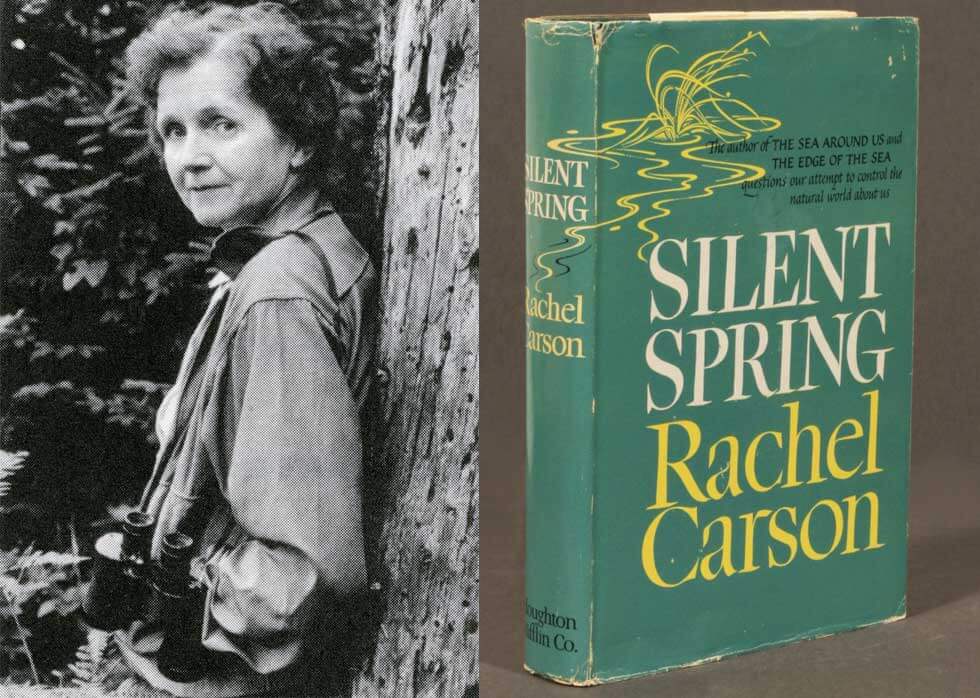
Rachel Carson was nothing short of prophetic when she published Silent Spring in 1962 (in reference to the dawn chorus most noticeable in spring during breeding). Silent Spring cautioned burgeoning ag-biotech companies (like Monsanto—now Bayer—Sygenta, Dow, and DuPont) who were carelessly and flagrantly spraying fields with pesticides and herbicides—at the time DDT was the main culprit. This would soon become a GMO world where gene-hacked plants of monocultures can withstand the onslaught of killer pesticides like neonicotinoids (currently killing bees everywhere) and Roundup. Roundup is a carcinogenic glyphosate-based weed killer that has recently been shown to kill beneficial insects like bees) and has been linked to Alzheimer’s disease, ADHD, birth defects, autism, and several kinds of cancer in humans.
Despite Carson’s warnings in 1962 and despite some action eventually taken (e.g. the ban on use of DDT in 1972—the precursor to Roundup and other neonicotinoids currently in use), the use of chemicals in big ag-industry has increased over five-fold since the 1960s. And this is destroying our bee populations, other beneficial insects, beneficial weeds, small animal populations and—of course—our bird life. And it’s making us sick too. Alarming signals suggest that Rachel Carson’s 1962 warning is currently underway.
.
Soundscape Ecology
“Soundscape ecology is a quick and easy way to assess the health of a habitat. We know that the richness of the soundscape is linked to the diversity and abundance of life in an ecosystem—from the smallest insect to a roaming bear and rustling tree…”
Jack Gopnik in Robin’s Last Song
The new science of soundscape ecology can analyze the health of an ecosystem. Jack Gopnik in Robin’s Last Song explains:
“All sounds, from trickling streams to singing birds, combine in a unique soundscape that represents a ‘fingerprint’ of the ecosystem. Ecologists divide these acoustics into three categories. Geophony describes natural processes like crashing waterfalls, tides, lightning, and earthquakes. Biophony describes the sounds produced by all living things from plants to insects to larger wildlife. And then there’s anthropophony, the sounds produced by human activities such as planes, traffic, and construction …
“Acoustic communication is crucial for birds to reproduce, feed, defend territories, and avoid predators. Birds use sonic territories or channel bandwidths to ensure their voices can be heard unimpeded by others. But soundtracks are changing. Bernie Krause—the originator of Soundscape Ecology—documented how a forest can flatline. He called it dysphonia…”
.
.
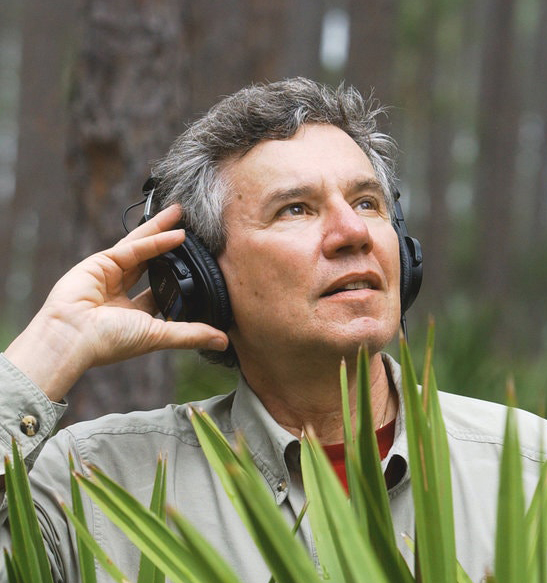
Bernie Krause, a soundscape ecologist who has been conducting long-term recordings recently noted that in Sugarloaf Ridge State Park, not far from his home in Northern California, “the effect of global warming and resulting drought has created the first completely silent spring I’ve ever experienced.” Stuart Winter at Express reports that “many of the iconic birds whose mating calls ring out across woodlands and open fields during early May are vanishing at an alarming rate.”
.
Structures of Feeling & Climate Change
.
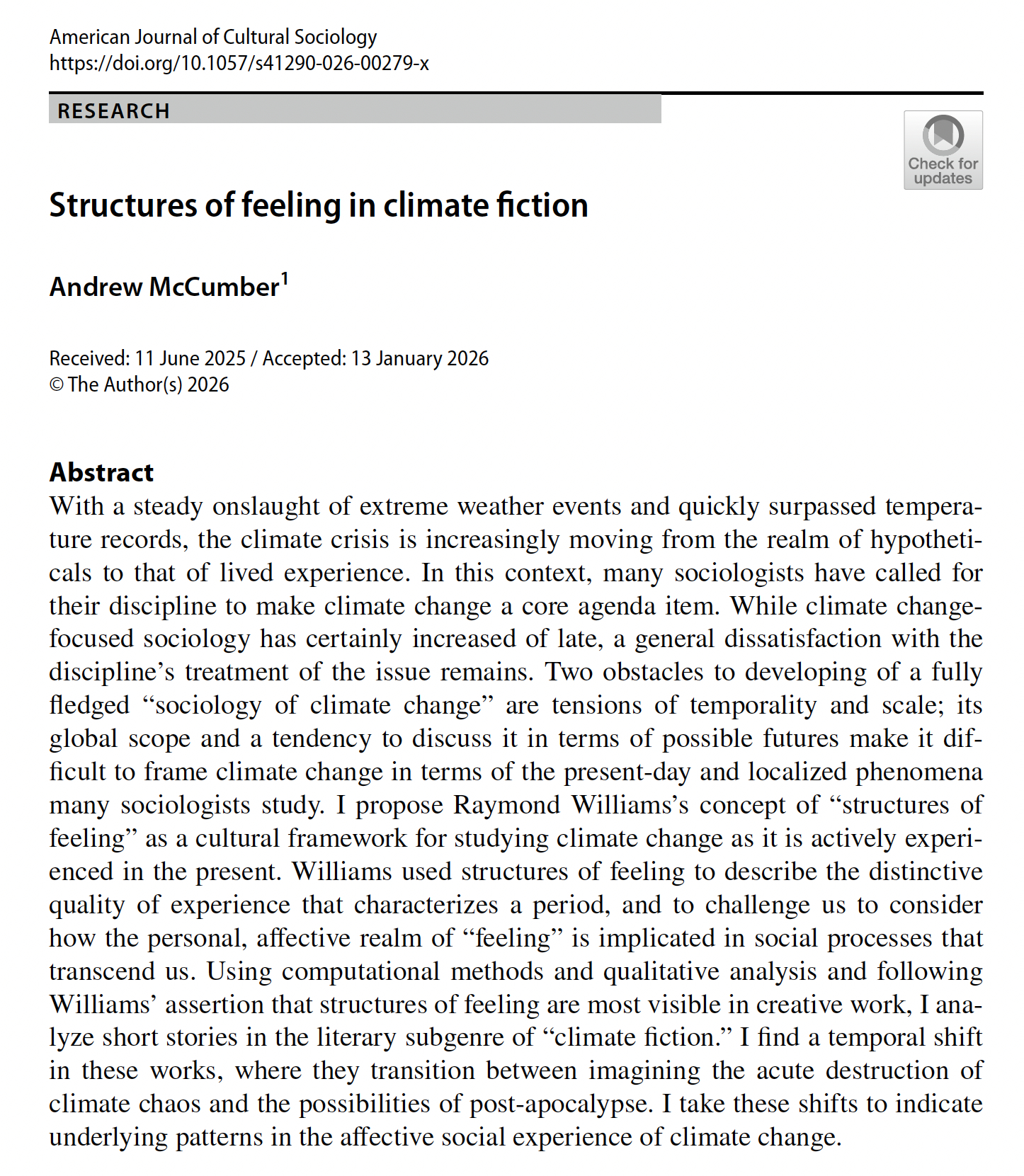
In his paper “Structures of feeling in climate fiction” published in The American Journal of Cultural Sociology, Andrew McCumber used Raymond William’s concept of “structures of feeling’ as a cultural framework to study climate change as it is actively experienced in the present.
“Williams used structures of feeling to describe the distinctive quality of experience that characterizes a period, and to challenge us to consider how the personal, affective realm of “feeling” is implicated in social processes that transcend us.” McCumber used computational methods and qualitative analysis and followed Williams’ assertion that structures of feeling are most visible in creative work, to analyze short stories in the literary subgenre of “climate fiction. McCumber found a temporal shift in the works he looked at; he observed that they transitioned “between imagining the acute destruction of climate chaos and the possibilities of post-apocalypse.” He took these shifts to indicate underlying patterns in the affective social experience of climate change.
McCumber argued that the development of a fully-fledged sociology of climate change is challenged by the ambiguous temporality of the climate crisis. “Discussions of climate change are almost always implicitly discussions of possible futures, which can make it difficult to frame the contemporary phenomena we study in terms of it.”
Another difficulty is one of scale, said McCumber. “Climate change is at once ubiquitous and abstract.” A hyperobject. It requires, he argues, a combination of effective science communication and informed critical thinking to connect the localized destruction with larger global effects.
McCumber brings the theoretical and analytical perspectives of cultural sociology to both expand and advance the sociology of climate change. With its focus on processes of shared meaning making, cultural sociology “promises a window into how climate change constitutes a ‘social drama’ and functions as a frame through which our everyday lived experience is filtered.”
He makes use of Raymond Williams’s concept of “structures of feeling” to explore “the ever-changing and increasingly palpable lived reality of climate change.” Given how climate change “announces its presence unevenly in fits and starts, it is both important and uniquely difficult to understand how it is experience along with how that experience shifts over time.”
McCumber looked at several short stories from five prominent science fiction magazines (Apex, Clarkesworld, Lightspeed, Reactor, and Uncanny) and identified a notable shift in the evolution of climate-focused science fiction over the period from 2011 to 2024 as well as a general increase in climate fiction over this period.
McCumber identified three periods over that time: Period I, in which the human experience of climate change cedes the spotlight to a more expansive imagination of life and its potential future; Period II, emphasizing the acute, lived reality of humanity during climate change; and Period III, which emphasizes themes of symbiosis and ecological resilience that transcend human experience.
My short story Robin’s Last Song fit into Period II: “In the stories that characterize the period that bookends the May 2021 low-point in climate sentiment, the devastation of climate chaos (or in some cases an imagined corollary to this destruction on a fictional world) is front and center. While these stories vary in how optimistic or pessimistic their final dispositions vis-a-vis climate change are, acute ecological crisis or climate destruction tends to be central to the worlds they imagine and the action that unfolds. Thus, the structure of feeling of this period is shaped by the sense of loss that climate change entails…These stories explore the affective experience of this loss and pain.”
“The structure of feeling [of Robin’s Last Song] is characterized by a preoccupation with the acute pain of climate shocks and the dread of their imminent intensification… The title character, a soundscape ecologist, loses her sense of purpose and becomes a recluse after spiraling ecological destruction causes a sudden mass extinction of birds. Munteanu’s story dramatizes a form [of] loss engendered by climate change (extinction and biodiversity loss) mostly experienced as a gradual process by depicting it as sudden and traumatic:
I stood by the kitchen window, concentrating on reading the recipe for Diana’s birthday cake when a loud thwap made me jump. A bird must have flown into the window. As I looked out, another bird sailed into the window with a violent thud, leaving behind a red smear.
I rushed out the kitchen door and saw two starlings lying on the patio. Both had obviously broken their necks. Something made me look up. What I saw made my heart cave in: a dark cloud of starlings was raining birds. They fell from the sky, thudding and pelting into cars, and plopping on the ground. Some flew like drunks into buildings, trees, windows, and even people. It was a deluge.
Diana ran outside and I seized her in a tight embrace, sheltering her eyes from it all. The neighborhood rang with shouts, cries, and wails. It felt like the end of the world.
Heartbroken, I stood still like granite, pressing my daughter against me in a crushing embrace. In that moment made eternity, I knew. Then I burst into tears of despair.
“There are certainly glimmers of optimism to be found in these stories,” says McCumber; “Robin’s Last Song, for instance, ends on a hopeful note when a surviving population of birds is discovered and the protagonist has renewed purpose. But the substantive trend that seems to best explain the dip in climate sentiment during this period observed in the computational analysis is the way the narrative timelines of climate change and the short stories themselves overlap. The stories’ plots take place largely within the period of the immediate, felt effects of ecological crisis. As such, the emotional register that typifies these stories emphasizes loss and dread.”
.
.
References:
McCumber, Andrew. “Structures of feeling in climate fiction.” American Journal of Cultural Sociology, February 2026.
Munteanu, Nina. 2021. “Robin’s Last Song.” Apex Magazine, Issue 128.
.
.
Nina Munteanu is a Canadian ecologist / limnologist and novelist. She is co-editor of Europa SF and currently teaches writing courses at George Brown College and the University of Toronto. For the latest on her books, visit www.ninamunteanu.ca. Nina’s bilingual “La natura dell’acqua / The Way of Water” was published by Mincione Edizioni in Rome. Her non-fiction book “Water Is…” by Pixl Press (Vancouver) was selected by Margaret Atwood in the New York Times ‘Year in Reading’ and was chosen as the 2017 Summer Read by Water Canada. Her novel “A Diary in the Age of Water” was released by Inanna Publications (Toronto) in June 2020. You can read her just released eco-fiction thriller Gaia’s Revolution by Dragon Moon Press.
.

